
UNITED STATES
SECURITIES AND EXCHANGE COMMISSION
Washington, D.C. 20549
________________________________________
FORM 10-K
________________________________________
(Mark One)
| ANNUAL REPORT PURSUANT TO SECTION 13 OR 15(d) OF THE SECURITIES EXCHANGE ACT OF 1934 | |||||
For the fiscal year ended December 31 , 2025
OR
| TRANSITION REPORT PURSUANT TO SECTION 13 OR 15(d) OF THE SECURITIES EXCHANGE ACT OF 1934 | |||||
For the transition period from to
Commission file number 000-56342
________________________________________
________________________________________
(Exact name of registrant as specified in its charter)
(State or other jurisdiction of incorporation or organization) | (I.R.S. Employer Identification No.) | ||||
(Address of Principal Executive Offices) | (Zip Code) | ||||
( | ||
(Registrant's telephone number, including area code) | ||
Securities registered pursuant to Section 12(b) of the Act:
| Title of each class | Trading Symbol(s) | Name of each exchange on which registered | ||||||||||||
| N/A | N/A | N/A | ||||||||||||
Securities registered pursuant to section 12(g) of the Act:
| (Title of class) | ||
Indicate by check mark if the registrant is a well-known seasoned issuer, as defined in Rule 405 of the Securities Act.
Yes o No x
Indicate by check mark if the registrant is not required to file reports pursuant to Section 13 or Section 15(d) of the Act. Yes o No x
Indicate by check mark whether the registrant (1) has filed all reports required to be filed by Section 13 or 15(d) of the Securities Exchange Act of 1934 during the preceding 12 months (or for such shorter period that the registrant was required to file such reports), and (2) has been subject to such filing requirements for the past 90 days. Yes x No o
Indicate by check mark whether the registrant has submitted electronically every Interactive Data File required to be submitted pursuant to Rule 405 of Regulation S-T (§232.405 of this chapter) during the preceding 12 months (or for such shorter period that the registrant was required to submit and post such files). Yes x No o
Indicate by check mark whether the registrant is a large accelerated filer, an accelerated filer, a non-accelerated filer, a smaller reporting company, or an emerging growth company. See the definitions of “large accelerated filer,” “accelerated filer,” “smaller reporting company” and “emerging growth company” in Rule 12b-2 of the Exchange Act.
| Large accelerated filer | o | x | ||||||||||||
Non-accelerated filer | o | Smaller reporting company | ||||||||||||
Emerging growth company | ||||||||||||||
If an emerging growth company, indicate by check mark if the registrant has elected not to use the extended transition period for complying with any new or revised financial accounting standards provided pursuant to Section 13(a) of the Exchange Act. o
Indicate by check mark whether the registrant has filed a report on and attestation to its management’s assessment of the effectiveness of its internal control over financial reporting under Section 404(b) of the Sarbanes-Oxley Act (15 U.S.C. 7262(b)) by the registered public accounting firm that prepared or issued its audit report. x
If securities are registered pursuant to Section 12(b) of the Act, indicate by check mark whether the financial statements of the registrant included in the filing reflect the correction of an error to previously issued financial statements. o
Indicate by check mark whether any of those error corrections are restatements that required a recovery analysis of incentive-based compensation received by any of the registrant’s executive officers during the relevant recovery period pursuant to §240.10D-1(b). o
Indicate by check mark whether the registrant is a shell company (as defined in Rule 12b-2 of the Act). Yes o No x
The aggregate market value of the registrant’s previously authorized Class A subordinate voting shares, and Class B proportionate voting shares (on an as converted to Class A subordinate voting shares basis), based on the closing price of the Class A subordinate voting shares listed on Cboe Canada as of June 30, 2025, the last business day of the registrant’s most recently completed second fiscal quarter, held by non-affiliates was $164,049,793 . For this purpose, directors, executive officers and greater than 10% record stockholders are considered affiliates of the registrant. On November 3, 2025, all Class A subordinate voting shares were deemed to be exchanged for authorized, issued and outstanding shares of common stock, par value $0.001 per share, of the registrant on a one-for-one basis, and the Class B proportionate voting shares, of which there were none outstanding as of such time or as of June 30, 2025, were no longer authorized shares of the registrant.
The registrant had outstanding 363,245,512 shares of common stock as of March 10, 2026.
DOCUMENTS INCORPORATED BY REFERENCE
Portions of the definitive Proxy Statement to be delivered to stockholders in connection with the Annual Meeting of Stockholders to be held during 2026 are incorporated by reference into Part III of this Annual Report on Form 10-K.
TABLE OF CONTENTS
| Page | |||||
SIGNATURES | |||||
i
Cautionary Note Regarding Forward-Looking Statements
This Annual Report on Form 10-K (this “Form 10-K”) contains “forward-looking information” and “forward-looking statements” within the meaning of United States and Canadian securities laws (together, “forward-looking statements”). All statements, other than statements of historical fact, made by the Company or its affiliates that address activities, events or developments that the Company or its affiliates expect or anticipate will or may occur in the future are forward-looking statements, including, but not limited to, statements preceded by, followed by or that include words such as “may,” “will,” “would,” “could,” “should,” “believes,” “assumes,” “estimates,” “projects,” “potential,” “expects,” “plans,” “intends,” “anticipates,” “targeted,” “continues,” “forecasts,” “designed,” “goal,” “progress,” or the negative of those words or other similar or comparable words.
The forward-looking statements contained herein are based on certain key expectations and assumptions, including, but not limited to, expectations and assumptions concerning:
•our ability to obtain, maintain and renew licenses and other regulatory approvals in all states and localities of our operations and planned operations on a timely basis;
•government regulations, including future U.S. state and federal legislative and regulatory developments involving medical and adult use cannabis and the timing thereof;
•our outlook on our expansion and growth of business and operations;
•our ability to achieve our goals, business plans and strategy;
•our ability to access capital and obtain necessary financing to pursue our growth and business plans;
•our operational results and other financial and business conditions and prospects;
•the timing and completion of acquisitions and other commercial transactions;
•the integration and operation of acquired businesses;
•the timing and amount of capital expenditures;
•the availability of facilities, equipment, skilled labor and services needed for cannabis operations;
•demand, developments and trends in the medical and adult use cannabis industry;
•competition in the cannabis industry in the markets in which we operate or plan to operate;
•the medical benefits, viability, safety, efficacy, and dosing of cannabis;
•the size of the medical cannabis market and the adult use cannabis market in each state; and
•conditions in general economic and financial markets.
Forward-looking statements may relate to future financial conditions, results of operations, plans, strategies, objectives, performance or business developments. These statements speak only as at the date they are made and are based on information currently available and on the then-current expectations of the party making the statement and assumptions concerning future events, which are subject to a number of known and unknown risks, uncertainties and other factors that may cause actual results, performance or achievements to be materially different from that which was expressed or implied by such forward-looking statements, including, but not limited to, risks and uncertainties related to:
•the current illegality of cannabis under federal law, the U.S. federal regulatory landscape and enforcement related to medical or adult use cannabis, including political risks, civil asset forfeiture and regulation by additional regulatory authorities;
•regulatory and political changes to U.S. federal, state and local laws related to medical or adult use cannabis, including political risks and regulation by additional regulatory authorities;
•rescheduling may lower the barriers to entry for well-capitalized institutional competitors;
•the federal rescheduling process is subject to significant procedural delays and legal challenges;
•the impacts of economic uncertainty stemming from disruptions in U.S. and global markets, inflation, rising interest rates, and changes in consumer and business confidence;
•our outstanding indebtedness and potential future indebtedness, including our ability to repay such indebtedness;
•reliance on key management;
•market acceptance of existing and new products and potential returns or recalls of our products;
•potential cultivation biosecurity failures;
•consumer acceptance of our brand portfolio;
•the accuracy of our forecasted demand for our products;
•our ability to accurately forecast, manage, and monetize inventory;
•the potential for fraudulent activity by employees, contractors and consultants;
•our exposure to growth-related operational and execution risks;
•potential negative findings in our clinical research with respect to our products;
•potential product liability claims;
1
•our exposure to natural phenomena and resulting potential uninsured or under insured losses;
•the risk that our property will be subject to civil asset forfeiture;
•our corporate structure and our resulting reliance on the performance of our subsidiaries and affiliates;
•our expansion-by-acquisition strategy;
•our ability to acquire businesses and cannabis licenses in desired markets and the integration and operation of acquired businesses;
•the typically limited operations of businesses we acquire;
•the unconventional due diligence process in the cannabis industry;
•our ability to acquire and lease properties suitable for the cultivation, production and sale of cannabis;
•potential limited representations and warranties of businesses we may acquire;
•our acquisition of businesses in developing cannabis markets;
•our lack of portfolio diversification by industry and geographic concentration;
•our use of joint ventures, strategic partnerships and alliances;
•our contractual relationships with our consolidated variable interest entities;
•existing competition and new market entrants;
•the introduction of synthetic alternatives to cannabis products by pharmaceutical and other companies;
•the immaturity of the cannabis industry and limited comparable, competitive and established industry best practices;
•the availability of and our reliance on third-party suppliers, service providers, contractors and manufacturers, and any significant interruption of these relationships, including negative changes to quality, availability, pricing, trade policy and other economics;
•changes in U.S. trade policy, including the imposition of tariffs and the resulting consequences;
•wholesale and retail price fluctuations;
•public opinion and perception of the cannabis industry;
•the availability of raw or other materials;
•rising or volatile energy costs;
•agricultural and environmental risks and the impacts of environmental regulations on the cannabis industry and environmental protections;
•physical security risks, such as theft;
•disparate state-by-state regulatory landscapes and licensing regimes for medical and adult use cannabis;
•the difficulties cannabis businesses face accessing and maintaining banking or financial services due to federal regulations;
•the cost and difficulty of complying with various regulatory schemes;
•the impact of state social equity legislation as it relates to the cannabis industry;
•the risk of high bonding and insurance costs;
•environmental regulations;
•effects of changes in laws and policies governing employees and by union organizing activity;
•increased unionization efforts and labor shortages;
•potential scrutiny from Canadian authorities due to our status as an SEC Foreign Issuer (defined below);
•potential divestment of licenses if required by regulatory authorities;
•our dependency on the banking industry;
•required public disclosure and governmental filings containing personal information of our officers, investors and other stakeholders;
•potential findings by regulatory authorities that one of our stockholders is unsuitable;
•the risk that our directors, officers, employees or investors are barred from entering the U.S.;
•the ability to, and constraints on, promoting and marketing cannabis products;
•potential U.S. Food and Drug Administration governance of the cannabis industry;
•the potential limitations on our ability to enforce our contracts or any liens granted to us;
•the potential lack of access to federal bankruptcy protections in the U.S.;
•reliance on information technology systems, the potential disclosure of personal information of patients and customers and cybersecurity risks;
•our increasing use of, or failure to effectively implement, artificial intelligence (AI) and automated systems;
•our reliance on third-party software providers;
•costs related to preserving our brand identity;
•our ability to protect our intellectual property due to limited intellectual property protection available for cannabis products and the potential infringement by third parties;
•potential infringement or misappropriation claims;
•the risk of financial crimes;
2
•the inability to realize the anticipated benefits of the Continuance (as defined below), or to do so within the anticipated timeframe;
•the risk of receiving no return on our securities;
•our elimination of individual liability and indemnification rights against our directors, officers and employees under Nevada law;
•our organizational documents contain provisions that may prevent transactions that could be beneficial to our stockholders and may insulate our management from removal;
•the time and resources necessary to comply with corporate governance practices and securities rules and regulations;
•our management’s ability to maintain effective internal controls;
•potential dilution if we issue additional shares of Common Stock (as defined below);
•market perception of sales of a substantial amount of Common Stock;
•transfer restrictions on our Common Stock;
•price volatility of our Common Stock;
•our stockholders’ limited participation in our affairs;
•our expectation to not declare or pay out dividends;
•certain of our stockholders holding Common Stock representing greater than 5% of our voting power;
•the taxation of cannabis companies in the U.S., including the impact of Section 280E of the Internal Revenue Code of 1986, as amended (“Section 280E”); and
•other risks described in this Form 10-K, as more particularly described under the heading “Item 1A. Risk Factors” therein.
Although we believe that the expectations and assumptions on which forward-looking statements are based are reasonable at the time made, undue reliance should not be placed on the forward-looking statements, because no assurance can be given that they will prove to be correct. Forward-looking statements address future events and conditions, and thus involve inherent risks and uncertainties. Readers are cautioned that the above list of cautionary statements is not exhaustive.
The cannabis industry involves risks and uncertainties that are subject to change based on various factors. Certain forward-looking statements contained herein concerning the cannabis industry and our general expectations concerning the cannabis industry are based on estimates prepared by us using data from publicly available governmental sources as well as from market research and industry analysis and on assumptions based on data and knowledge of the cannabis industry. Such data is inherently imprecise.
Consequently, all forward-looking statements made in this Form 10-K and our other documents are qualified by such cautionary statements and there can be no assurance that the anticipated results or developments will actually be realized or, even if realized, that they will have the expected consequences to or effects on us. We do not undertake any obligation to update or revise any forward-looking statements, whether as a result of new information, future events or otherwise, other than as required under applicable securities legislation.
3
PART I
ITEM 1. BUSINESS
Overview
Verano Holdings Corp., a Nevada corporation (“Verano,” the “Company,” “we,” “us,” or “our”), one of the U.S. cannabis industry’s leading companies based on historical revenue, geographical scope and brand performance, is a vertically integrated, multi-state operator embracing a mission of saying Yes to plant progress and the bold exploration of cannabis. As an operator of licensed cannabis cultivation, processing, wholesale distribution and retail facilities, our goal is to support communal wellness by providing responsible access to regulated medical and adult use cannabis products. As of March 10, 2026, through our subsidiaries and affiliates we operate businesses in 13 states, including 160 retail dispensaries and 14 cultivation and processing facilities with over 1.1 million square feet of cultivation capacity. We produce a wide variety of cannabis products sold under our portfolio of consumer brands, including Encore™, Avexia™, MÜV™, Savvy™, (the) Essence™, BITS™, HYPHEN™, Swift Lifts™ and Verano™. We also design, build and operate branded dispensaries operating under the Zen Leaf™ and MÜV™ retail banners, among others, that deliver a cannabis shopping experience in both medical and adult use markets.
Notwithstanding the permissive regulatory environment of medical, and in some cases, also adult use (i.e., recreational) cannabis, at the state level, it remains illegal under U.S. federal law to cultivate, manufacture, distribute, sell or possess cannabis in the U.S. Because federal law prohibits transporting any federally restricted substance across state lines, cannabis cannot be transported across state lines. As a result of current federal law prohibitions, the U.S. cannabis industry is conducted on a state-by-state basis. To date, in the U.S. 40 states plus the District of Columbia and the U.S. territories of Puerto Rico, Guam, the Commonwealth of Northern Marina Islands, and the U.S. Virgin Islands have authorized comprehensive medical cannabis programs, 24 states plus the District of Columbia and the U.S. territories of Guam, the Commonwealth of Northern Mariana Islands, and the U.S. Virgin Islands have authorized comprehensive programs for medical and adult use (i.e. recreational) cannabis, and eight states allow the use of low tetrahydrocannabinol (“THC”) and high cannabidiol (“CBD”) products for specified medical uses. Verano operates within states where cannabis use, medical or both medical and adult use, has been approved by state and local regulatory bodies. Strict compliance with state and local laws with respect to cannabis may neither absolve the Company of liability under U.S. federal law, nor may it provide a defense to any federal proceeding which may be brought against the Company or any of its subsidiaries. On December 18, 2025, President Trump issued an executive order titled “Increasing Medical Marijuana and Cannabidiol Research,” (the “Executive Order”) which directs federal agencies to expedite the process of rescheduling cannabis from a Schedule I to a Schedule III controlled substance under the Controlled Substances Act (21 U.S.C. § 811) (the “Controlled Substances Act” or the “CSA”). The effect of the Executive Order may be that the cultivation, manufacturing, distribution, sale or possession of cannabis in the U.S. is no longer federally illegal and would lessen criminal penalties at the federal level and remove Section 280E tax considerations, however, the final effects of the Executive Order are dependent on other government actions. Despite such actions and the ongoing rule making process, there can be no guarantees that the rescheduling rule making process will continue on a certain timeline or at all under this administration or that any rules will come out of the rule making process that will benefit the Company. The Executive Order, and agency implementation of the Executive Order does not federally legalize adult use and would not federally authorize or approve state sanctioned medical programs. Cannabis would still be subject to the same FDA drug approval process as all other substances, and sales outside of FDA approval, would still be criminal at the federal level.
For the fiscal year ended December 31, 2025, medical-use sales and adult use sales comprised approximately 53% and 47% of our consolidated revenues, respectively. For each of the fiscal years ended December 31, 2024 and 2023, medical-use sales and adult use sales comprised approximately 51% and 49% of our consolidated revenues and approximately 55% and 45% of our consolidated revenues, respectively.
Substantially all of the Company’s business, operating results and financial condition relate to U.S. cannabis-related activities. Our strategy is to vertically integrate as a single cohesive company in multiple states through the consolidation of seed-to-sale cultivating, manufacturing, distributing, and dispensing cannabis brands and products at scale. Our cultivation, processing and distribution of cannabis consumer packaged goods are designed to support our retail dispensaries, as well as to develop and foster long term wholesale supply relationships with third-party retail operators. Our model includes establishing a diverse geographic footprint that allows us to adapt to changes in both industry and market conditions.
4
Verano is a reporting issuer under both federal securities legislation in the U.S. and applicable securities legislation in all of the provinces and territories of Canada, being classified thereunder as an “SEC Foreign Issuer” for purposes of Canadian securities laws. The Company’s common stock, par value $0.001 per share (“Common Stock”) is listed on Cboe Canada (“Cboe”) under the stock symbol, “VRNO,” and is also quoted for trading in the U.S. on the OTCQX under the stock symbol “VRNO”.
The corporate headquarters of Verano is located at 224 W. Hill Street, Suite 400, Chicago, Illinois 60610. Verano’s telephone number is (312) 265-0730. Verano’s internet address is www.verano.com. The information provided on the Company’s website is not part of this Form 10-K, unless otherwise noted.
The U.S. Securities and Exchange Commission (the “SEC”) maintains an internet site that contains reports, proxy and information statements, and other information regarding issuers that file electronically with the SEC at http://www.sec.gov. As an SEC Foreign Issuer in Canada, currently the Company also files reports, and other information regarding the Company with the securities regulatory authorities of Canada via the System for Electronic Document Analysis and Retrieval at www.sedarplus.ca.
History of the Company
Verano Holdings, LLC, a subsidiary of the Company (“Verano LLC”), was the start of Verano’s business operations. Verano LLC is a Delaware limited liability company that was co-founded by George Archos, our current Chairman, Chief Executive Officer and President, in September 2017. Verano LLC was formed as a Chicago, Illinois based holding company to consolidate cannabis operations initially in Illinois, including cultivation and production facilities and retail dispensaries. Verano LLC, either directly or through subsidiaries or affiliates, acquired control, management, ownership, and other rights to medical and adult use cannabis businesses across multiple U.S. states, including cultivation, production, wholesale distribution and retail dispensaries.
On December 14, 2020, Verano LLC, Majesta Minerals, Inc., an Alberta corporation, and certain British Columbia corporations named therein, entered into an arrangement agreement, pursuant to which the Company would result from a reverse takeover transaction as a British Columbia public reporting company (the “RTO”). The RTO and related transactions (the “Go Public Transactions”), closed on February 11, 2021, resulting in the creation of the Company as a Canadian publicly-traded company and the parent holding company of Verano LLC and its subsidiaries and ownership and control interests.
The RTO authorized the Company’s former dual class structure of an unlimited number of Class A subordinate voting shares (the “Subordinate Voting Shares”) and an unlimited number of Class B proportionate voting shares (the “Proportionate Voting Shares”). Each Proportionate Voting Share was convertible into 100 Subordinate Voting Shares, and each Subordinate Voting Shares was convertible into 1/100 of a Proportionate Voting Share. The rights, preferences and protections of the Subordinate Voting Shares and the Proportionate Voting Shares were the same based upon the deemed conversion ratio of 100 Subordinate Voting Shares for one Proportionate Voting Share.
On November 3, 2025 (the “Continuance Effective Date”), the Company filed articles of domestication and articles of incorporation with the Secretary of State of the State of Nevada to continue out from the jurisdiction of the Province of British Columbia, Canada, to the jurisdiction of the U.S. State of Nevada (the “Continuance”). The Continuance was consummated pursuant to a Plan of Arrangement, which was approved by the Company’s stockholders at a special meeting of the stockholders held on October 27, 2025, and a Final Order issued by the Supreme Court of British Columbia, Canada on October 30, 2025. As part of the Continuance, the previously authorized, issued and outstanding Subordinate Voting Shares of the Company were deemed to be exchanged on the Continuance Effective Date for authorized, issued and outstanding shares of Common Stock of the Company on a one-for-one basis (the “Share Exchange”). The Proportionate Voting Shares were no longer authorized, and all special rights and restrictions of the Proportionate Voting Shares were removed from the Company’s governing documents. The issuance of the shares of Common Stock in connection with the Share Exchange was made in reliance upon the exemption from registration provided by Section 3(a)(10) of the U.S. Securities Act of 1933, as amended. The Subordinate Voting Shares and Proportionate Voting Shares are no longer part of the authorized capital structure of the Company.
5
After the consummation of the RTO, the Subordinate Voting Shares were listed on the Canadian Securities Exchange (“CSE”) and began trading on February 17, 2021 under the stock symbol “VRNO”. On October 18, 2023, the Subordinate Voting Shares began trading on Cboe under the stock symbol “VRNO.” In connection therewith, the Subordinate Voting Shares ceased trading on the CSE as of the close of market on October 17, 2023. The Subordinate Voting Shares were also quoted for trading in the U.S. on the OTCQX under the stock symbol “VRNOF”. On the Continuance Effective Date, the Subordinate Voting Shares ceased trading on Cboe and the Common Stock began trading on Cboe under the same stock symbol “VRNO”, and began to be quoted on the OTCQX under the symbol “VRNO”.
2022 Credit Agreement
On October 27, 2022, Verano and certain of its subsidiaries and affiliates from time-to-time party thereto (collectively, the “Borrowers”), entered into a Credit Agreement (the “2022 Credit Agreement”) with Chicago Atlantic Admin, LLC (“Chicago Atlantic”), as administrative agent for the lenders, and the lenders from time-to-time party thereto (the “Lenders”), pursuant to which the Lenders advanced the Borrowers a $350,000,000 senior secured term loan, all of which was used to repay the amounts owing under the Company's previous senior secured term loan credit facility. In connection with such repayment, such previous credit facility was terminated and is no longer in force or effect. Beginning in October 2023, Verano made scheduled amortization payments of $350,000 per month and the remaining principal balance was due in full on October 30, 2026.
The obligations under the 2022 Credit Agreement were secured by substantially all of the assets of the Borrowers, excluding vehicles, specified parcels of real estate and other customary exclusions. The 2022 Credit Agreement provided for a floating annual interest rate equal to the prime rate then in effect plus 6.50%, which could have been increased by 3.00% upon an event of default that was not a material event of default or 6.00% upon a material event of default. The 2022 Credit Agreement included customary representations and warranties, covenants and customary events of default, including, without limitation, payment defaults, breaches of representations and warranties, covenant defaults, cross-defaults to material indebtedness, and events of bankruptcy and insolvency. Additionally, the 2022 Credit Agreement required the Borrowers to meet certain financial tests regarding minimum cash balances, minimum levels of Adjusted EBITDA (as defined in the 2022 Credit Agreement) and a minimum fixed charge coverage ratio. As of December 31, 2025, the Company was in compliance with the terms and conditions of the 2022 Credit Agreement.
George Archos, the Chairman, Chief Executive Officer and President of the Company, participated in the 2022 Credit Agreement as a Lender funding $1,000,000 of the $350,000,000 principal amount. Mr. Archos was excluded from certain approval rights of the lenders and any penalties and fees due to Mr. Archos under the 2022 Credit Agreement were immaterial to the Company.
On April 30, 2024, Verano made a Permitted Partial Optional Prepayment (as defined in the 2022 Credit Agreement) in the amount of $50,000,000 pursuant to the 2022 Credit Agreement and paid a $1,000,000 prepayment premium in connection therewith. On September 30, 2025, the Company made an additional Permitted Partial Optional Prepayment in the amount of $50,000,000 pursuant to the 2022 Credit Agreement, without any penalty or premium.
6
Revolver
On September 30, 2025, the Company entered into a credit agreement (as amended, the “Revolver”), by and among the Company, as a guarantor, certain subsidiaries of the Company from time-to-time party thereto as borrowers (the “Real Estate Subsidiaries”), the lenders from time-to-time party thereto (the “Revolver Lenders”), and Chicago Atlantic, as administrative agent for the Revolver Lenders.
The Revolver initially provided for a $75,000,000 revolving loan facility, $50,000,000 of which was drawn on September 30, 2025 and was used to prepay, without any penalty or premium, $50,000,000 of outstanding obligations due under the 2022 Credit Agreement. The Revolver provides for a floating annual interest rate on amounts drawn equal to one-month Term SOFR (subject to a minimum 4% SOFR floor) plus 6%, which rate may be increased by 3% upon an event of default or by 6% upon a material event of default as provided in the Revolver. The Company incurred debt issuance costs of $2,209,700 in connection with the establishment of the Revolver.
The Revolver may be drawn in $2,500,000 increments upon ten business days prior notice and any outstanding amount under the Revolver may be voluntarily prepaid in $2,500,000 increments upon five business days prior notice without any penalty or premium, unless such prepayment occurs within six months of the applicable advance, in which case, such prepayment will be subject to a six-month interest make whole. Any amounts prepaid may be redrawn subject to funding requirements set forth therein. The Revolver was initially subject to a borrowing base which required the outstanding principal balance under the Revolver to be equal to or less than 60% of the appraised value, net of certain indebtedness, of the owned real estate serving as collateral for the Revolver from time to time.
The obligations under the Revolver are secured by substantially all of the assets of the Real Estate Subsidiaries, which primarily consistent of owned real estate, and are guaranteed by the Company on an unsecured basis. Additionally, the Revolver allows for the proportionate release of certain Real Estate Subsidiaries upon request of the Company so long as the outstanding principal balance under the Revolver does not exceed 80% of the appraised value, net of certain indebtedness, of the owned real estate serving as collateral after giving effect to such release.
The Revolver includes customary representations, warranties, covenants and customary events of default, including, without limitation, payment defaults, breaches of representations and warranties, covenant defaults, cross-defaults to material indebtedness, and events of bankruptcy and insolvency. The Revolver also includes customary covenants, including, without limitation, limiting the Real Estate Subsidiaries’ ability to incur additional indebtedness, make guarantees and grant liens that are otherwise not permitted and enter into or consummate acquisitions or dispositions that are not otherwise permitted, among others. As of December 31, 2025, the Company was in compliance with such covenants.
7
Certain 2026 Developments
On January 12, 2026, the Company, the Real Estate Subsidiaries, the Revolver Lenders and Chicago Atlantic entered into a First Amendment (the “Revolver First Amendment”) to Credit Agreement and Omnibus First Amendment to Credit Documents, to amend the Revolver and related credit documents initially entered into on September 30, 2025. The Revolver First Amendment increased the lending commitment of the Revolver from $75,000,000 to $100,000,000 and amended the date on which all outstanding amounts are due in full from September 29, 2028 to February 28, 2029. Additionally, the Revolver First Amendment amended the borrowing base for the Revolver to an advance rate of up to 80%, rather than 60%, of the appraised value, net of certain indebtedness, of the owned real estate serving as collateral for the Revolver. The Revolver First Amendment also includes certain other immaterial updates to the Revolver. No additional collateral was pledged to secure the Revolver and certain real estate may be released as collateral upon specified conditions, as originally provided. Amounts drawn under the Revolver do not require amortization payments with all outstanding amounts being due in full on the maturity date of February 28, 2029. On March 11, 2026, the Company drew $50,000,000 under the Revolver, bringing the total amount drawn under the Revolver to $100,000,000, which was used to repay the amounts owing under the 2022 Credit Agreement, as further discussed below.
On March 11, 2026, Verano and certain of its subsidiaries and affiliates from time-to-time party thereto (collectively, the “2026 Borrowers”), entered into a Credit Agreement (the “2026 Credit Agreement”) with Needham Bank (“Needham”), as collateral agent and administrative agent for the lenders, Chicago Atlantic Financial Services, LLC, as co-administrative agent for the lenders, and the lenders from time-to-time party thereto (the “2026 Lenders”), pursuant to which the 2026 Lenders advanced the 2026 Borrowers a $195,000,000 senior secured term loan, all of which was used to repay the amounts owing under the 2022 Credit Agreement. In connection with such repayment, the Company paid a prepayment premium of approximately $4,345,000 and the 2022 Credit Agreement was terminated and is no longer in force or effect. Beginning in April 2026, Verano will be required to make scheduled amortization payments of $875,000 per month and the remaining principal balance is due in full on March 11, 2029; provided that the maturity date may be extended to March 11, 2030 upon the election of the Company, the payment of 1.5% of the then outstanding principal balance by the Company, and the consent of the 2026 Lenders. The 2026 Credit Agreement may be prepaid in part (in increments of $5,000,000 and in an amount not less than $10,000,000) or in full at any time, subject to a 1.5% prepayment premium during the first two years of the 2026 Credit Agreement and 0% thereafter; provided, that if the maturity date is extended to March 11, 2030, the prepayment premium will be 1.5% in all cases.
The obligations under the 2026 Credit Agreement are secured by substantially all of the assets of the 2026 Borrowers, excluding vehicles, specified parcels of real estate, other customary exclusions and subject to compliance with the terms of the 2026 Credit Agreement, entities, assets and parcels of real estate acquired after the closing of the 2026 Credit Agreement. The 2026 Credit Agreement provides for a floating annual interest rate equal to one-month Term SOFR (subject to a minimum 4% SOFR floor) plus 5.5%, which rate may be increased by 5% upon an event of default as provided in the 2026 Credit Agreement. The 2026 Credit Agreement included customary representations and warranties, covenants and customary events of default, including, without limitation, payment defaults, breaches of representations and warranties, covenant defaults, cross-defaults to material indebtedness, and events of bankruptcy and insolvency.
Additionally, the 2026 Credit Agreement requires the Borrowers to meet certain financial tests regarding minimum cash balances and a minimum fixed charge coverage ratio.
George Archos, the Chairman, Chief Executive Officer and President of the Company, funded, through an affiliated entity, $10,000,000 of the amount provided by a 2026 Lender. As a result of this participation, Mr. Archos will receive his pro rata share of all interest and principal payments made by the Company to such 2026 Lender under the 2026 Credit Agreement.
8
Organizational Structure
Verano is a holding company and conducts its business operations through direct and indirect subsidiaries and affiliates. The following chart sets forth the corporate structure of the Company and its primary subsidiary, Verano LLC. As part of the implementation of the Go Public Transactions and tax considerations, the Company formed two levels of subsidiaries above Verano LLC that included Verano Holdings USA Corp., a Delaware corporation (“BlockerCo”), and five subsidiaries of BlockerCo, those being ZNN Holdings, LLC, a Delaware limited liability company, Nuuvn Holdings, LLC, a Delaware limited liability company, ZenNorth LLC, a Delaware limited liability company, A&T SPV II LLC, a Texas limited liability company, and SGI 1 LLC, a Delaware limited liability company (collectively, the “Blocker Subsidiaries”). Each of the Blocker Subsidiaries were dissolved in February 2025 and as a result, Verano LLC became a direct wholly-owned subsidiary of BlockerCo. BlockerCo has no, and prior to the dissolutions, the Blocker Subsidiaries had no, business or operations and exist, or existed, as applicable, solely to effect the Go Public Transactions and the taxation of Verano as a U.S. corporation for U.S. federal income tax purposes. The below structure chart shows the structure of the Company as of March 10, 2026.
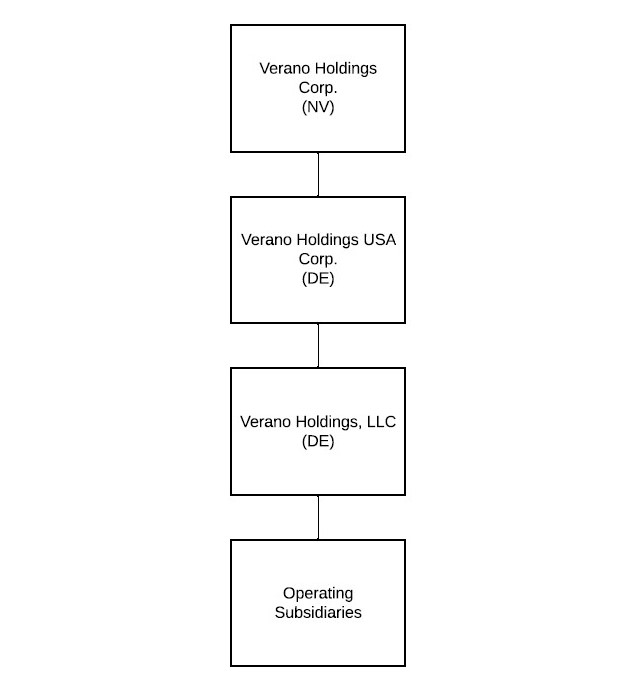
From time to time, we may reorganize our operating subsidiaries through consolidations, mergers, contributions, distributions and similar corporate restructurings in order to integrate acquired companies, enhance efficiencies, streamline operations, group borrowers under our credit facilities and align financial reporting. After giving effect to any corporate reorganization, all operating entities have remained as indirect subsidiaries or affiliates of the Company. See Exhibit 21.1 to this Form 10-K for a list of subsidiaries of the Company as of December 31, 2025.
Because of this holding company structure, Verano has no business operations and to the extent it cannot raise funds through the issuance of debt or equity securities, it is dependent on the financial health and operating performance of its subsidiaries and affiliates to meet its financial obligations. The ability of Verano’s subsidiaries and affiliates to pay dividends and other distributions to it or any of its other subsidiaries will depend on their operating results and will be subject to applicable laws and regulations which require that solvency and capital standards be maintained, as well as contractual restrictions on dividends and distributions that may be contained in credit facilities, mortgages and other similar agreements. In the event of a liquidation or reorganization of any of Verano’s subsidiaries or affiliates, lenders and trade creditors may be entitled to payment of their claims from the assets of such subsidiary or affiliates before Verano.
9
In certain jurisdictions the Company has agreements in place with third parties that provide us contractual rights with respect to ownership, management services, consulting or licensing, or a combination thereof, with respect to the applicable licenses and related cannabis businesses being conducted pursuant thereto (each such agreement, a “Management Services Agreement”).
Our Strategy
As an operator of licensed cannabis cultivation, processing, wholesale distribution and retail facilities, Verano’s goal is to support communal wellness by providing responsible access to regulated medical and adult use cannabis products.
Our strategy is to vertically integrate as a single cohesive company in multiple states through the consolidation of seed-to-sale cultivating, manufacturing, distributing and dispensing cannabis brands and products at scale. Our cultivation, processing and distribution of cannabis consumer packaged goods are designed to support our retail dispensaries, as well as, to develop and foster long term wholesale supply relationships with third-party retail operators. We also design, build and operate branded dispensaries operating under the Zen Leaf™ and MÜV™ retail banners, among others, that deliver a cannabis shopping experience in both medical and adult use markets. As of March 10, 2026, we also have several dispensaries operating under the Cannabist or SWC brand name following our acquisitions of Salubrious Wellness Clinic, Inc. (“SWC”), 203 Organix, LLC (together with SWC, “Cannabist AZ”) and Columbia Care Eastern Virginia LLC (“CC East Virginia”).
Our model includes establishing a diverse geographic footprint that allows us to adapt to changes in both industry and market conditions. We have pursued this strategy of geographic diversity through acquisitions and organic growth funded by internally generated cashflow, the issuance of equity, deferred purchase price payments and the incurrence of indebtedness.
We believe that the following business objectives have positioned Verano for continued growth.
•The Company’s business plan centers around four foundational pillars: cultivation, production, brand development and retail.
•Diversity in geographic revenue streams helps position the Company to respond proactively to changes in economics, regulations and healthcare, as well as to navigate ever-evolving consumer habits.
•The Company strives to operate and manage the entire vertical cannabis operation and supply chain from seed-to- sale.
•The Company focuses on a current potential market size of approximately 89 million adult Americans based on BDSA.com, which includes the total adult population in the 13 states in which we currently have active operations, those states being Arizona, Connecticut, Florida, Illinois, Maryland, Massachusetts, Michigan, Nevada, New Jersey, Ohio, Pennsylvania, Virginia and West Virginia.
•The Company aims for a “first-mover” competitive advantage in emerging markets by seeking early entry into states with approved medical cannabis programs and then establishing a footprint and vertical operations.
•The Company emphasizes developing high-quality products at various price points to elevate its products’ market desirability and value.
•The Company aims to adhere to standard operating procedures across all of its cultivation and processing facilities, producing state-permitted products and implementing compliance programs to meet product testing, inventory controls and other state regulatory requirements.
•The Company espouses a customer and patient driven business philosophy aiming to deliver value to its downstream patients and consumers.
10
Regulatory Framework in the United States
The U.S. regulatory scheme varies in its terminology and definitions, using “cannabis”, “marijuana” and “hemp” as distinct terms. For purposes of this Form 10-K, the term “cannabis” means “marijuana” as set forth in the Controlled Substances Act and is used interchangeably with the term “marijuana.”
To date, in the U.S. 40 states plus the District of Columbia and the U.S. territories of Puerto Rico, Guam, the Commonwealth of Northern Marina Islands, and the U.S. Virgin Islands have authorized comprehensive medical cannabis programs, 24 states plus the District of Columbia and the U.S. territories of Guam, the Commonwealth of Northern Mariana Islands, and the U.S. Virgin Islands have authorized comprehensive programs for medical and adult use (i.e. recreational) cannabis, and eight states allow the use of low THC and high CBD products for specified medical uses. Notwithstanding the permissive regulatory environment of medical, and in some cases, adult use cannabis, at the state level, it remains illegal under U.S. federal law to cultivate, manufacture, distribute, sell or possess cannabis in the United States. Because U.S. federal law prohibits transporting any federally restricted substance across state lines, cannabis cannot be transported across state lines. As a result of federal law prohibitions, the U.S. cannabis industry is conducted on a state-by-state basis, and we rely on established and developing laws and regulations in the states and local jurisdictions in which we operate. In addition, financial transactions involving proceeds generated by, or intended to promote, cannabis-related business activities in the U.S. may form the basis for prosecution under applicable U.S. federal money laundering legislation. On December 18, 2025, President Trump issued the Executive Order, which directs federal agencies to expedite the process of rescheduling cannabis from a Schedule I to a Schedule III controlled substance under the CSA. The effect of the Executive Order may be that the cultivation, manufacturing, distribution, sale or possession of cannabis in the U.S. is no longer federally illegal and would lessen criminal penalties at the federal level and remove Section 280E tax considerations, however, the final effects are dependent on other government actions. Despite such actions and the ongoing rule making process, there can be no guarantees that the rescheduling rule making process will continue on a certain timeline or at all under this administration or that any rules will come out of the rule making process that will benefit the Company.
Regulation of Cannabis at the U.S. Federal Level
The U.S. federal government’s approach to enforcement of cannabis laws has trended toward deference to state laws where a robust state regulatory framework exists. In August 2013, the U.S. Department of Justice (the “DOJ”) issued a memorandum known as the “Cole Memorandum” to all U.S. Attorneys’ offices. The Cole Memorandum generally directed U.S. Attorneys not to prioritize the enforcement of federal cannabis laws against individuals and businesses that comply with state cannabis programs. The Cole Memorandum, while not legally binding and only a policy statement, assisted in managing the tension between state and federal laws concerning all medical and adult use state-regulated cannabis businesses.
In January 2018, the Cole Memorandum was rescinded by former Attorney General Jeff Sessions. While this did not create a change in federal law, the revocation added to the uncertainty of U.S. federal enforcement of the Controlled Substances Act in states where cannabis use is regulated. Former Attorney General Jeff Sessions also issued a one-page memorandum known as the “Sessions Memorandum” which confirmed the rescission of the Cole Memorandum and explained that the Cole Memorandum was “unnecessary” due to existing general enforcement guidance as set forth in the U.S. Attorney’s Manual. While the Sessions Memorandum does emphasize that marijuana is a Schedule I controlled substance, it does not otherwise indicate that the prosecution of marijuana-related offenses is a heightened DOJ priority. The Sessions Memorandum explicitly describes itself as a guide to prosecutorial discretion, which remains in the hands of U.S. Attorneys when deciding whether to prosecute marijuana-related offenses. No direction was given to federal prosecutors in the Sessions Memorandum as to the priority they should ascribe to such cannabis activities, and the Sessions Memorandum did not address the treatment of medical cannabis by federal prosecutors.
Former President Joe Biden, who assumed office in January 2021, stated a policy goal of federal cannabis decriminalization. In March 2021, Merrick Garland was appointed U.S. Attorney General by Former President Biden. Mr. Garland indicated he would generally act in accordance with the Cole Memorandum. In December 2022, President Biden signed The Medical Marijuana and Cannabidiol Research Expansion Act. This Act, the first standalone cannabis bill to be passed by Congress, reduces federal barriers to cannabis research, creates a mechanism for the Food and Drug Administration (the “FDA”) to approve products derived from cannabis, protects state-licensed physicians who certify patients for medical cannabis use, requires the U.S. Department of Health and Human Services to report on the potential therapeutic benefits of cannabis, and requires the Attorney General to annually review whether a sufficient amount of cannabis is being produced to meet the needs of medical cannabis research.
11
On August 29, 2023, the Department of Health and Human Services (“HHS”) recommended that cannabis be placed in Schedule III of the Controlled Substances Act. This recommendation is based on FDA analysis which recommends control in Schedule III as well as the National Institute on Drug Abuse’s review and concurrence. HHS conducted a review of the FDA’s consideration of the following eight factors: (1) actual or relative potential for abuse; (2) scientific evidence of its pharmacological effect, if known; (3) the state of current scientific knowledge regarding the drug or other substance; (4) historical and current patterns of abuse; (5) the scope, duration, and significance of abuse; (6) risks to public health; (7) its psychic or physiological dependence liability; and (8) whether the substance is an immediate precursor of a substance already controlled. After such review, HHS found that (i) cannabis’s potential for abuse is less than the drugs or other substances in Schedules I and III of the CSA, (ii) cannabis has a currently accepted medical use in treatment in the United States, and (iii) cannabis poses a moderate to low risk of physical dependence or high psychological dependence.
On May 21, 2024, the U.S. Justice Department announced that Attorney General Merrick Garland submitted to the Federal Register a notice of proposed rule making initiating a formal rule making process to consider moving cannabis from a Schedule I to Schedule III drug under the CSA. On December 2, 2024, the DEA held a preliminary formal hearing regarding the rescheduling of cannabis, and additional hearings were scheduled from January 21, 2025 to March 6, 2025. On January 13, 2025, the Chief Administrative Law Judge presiding over the rescheduling of cannabis ordered that the hearing scheduled for January 21, 2025, be cancelled, and that the proceedings in the matter were stayed, pending a resolution of an interlocutory appeal to the DEA administrator.
In November 2024, Donald Trump was elected President of the United States, and later that month announced that Pam Bondi would be his nominee for Attorney General. On the campaign trail, Donald Trump expressed his support for moving cannabis to a Schedule III substance under the CSA and expressed his commitment to work with Congress to pass common sense cannabis laws, including safe banking laws, for state authorized companies.
On December 18, 2025, President Trump issued the Executive Order, which directs federal agencies to expedite the process of rescheduling cannabis from a Schedule I to a Schedule III controlled substance under the CSA. The effect of the Executive Order may be that the cultivation, manufacturing, distribution, sale or possession of cannabis in the U.S. is no longer federally illegal and would lessen criminal penalties at the federal level and remove Section 280E tax considerations, however, the final effects are dependent on other government actions. Despite such actions and the ongoing rule making process, there can be no guarantees that the rescheduling rule making process will continue on a certain timeline or at all under this administration or that any rules will come out of the rule making process that will benefit the Company. The order, and agency implementation of the order does not federally legalize adult use and would not federally authorize or approve state sanctioned medical programs. Cannabis would still be subject to the same FDA drug approval process as all other substances, and sales outside of FDA approval, would still be criminal at the federal level.
The Company is also subject to a variety of federal laws and regulations that relate to money laundering, financial recordkeeping and proceeds of crime, including in the U.S., the Currency and Foreign Transactions Reporting Act of 1970 (commonly known as the “Bank Secrecy Act”), as amended by Title III of the Uniting and Strengthening America by Providing Appropriate Tools Required to Intercept and Obstruct Terrorism Act of 2001 (USA PATRIOT Act), in each case as amended and any related or similar rules, regulations or guidelines of governmental authorities in the U.S.. As an SEC Foreign Issuer, we may be subject to similar applicable laws in Canada. Further, under U.S. federal law, banks or other financial institutions that provide a cannabis business with a checking account, debit or credit card, small business loan, or any other service could be found guilty of money laundering, aiding and abetting, or conspiracy. It is unclear what effect, if any, the Executive Order will have on these U.S. federal laws and regulations.
Additionally, under U.S. federal law it may be a violation of federal money laundering statutes for financial institutions to take any proceeds from the sale of cannabis or any other CSA Schedule I controlled substance. Banks and other financial institutions, particularly those that are federally chartered in the U.S., could be prosecuted and possibly convicted of money laundering for providing services to cannabis businesses. The Company may also be considered in violation of federal money laundering statutes for “federal health care law violations,” which include violations of the Federal Food, Drug, and Cosmetic Act of 1938 (“FDCA”).
12
In February 2014, the Financial Crimes Enforcement Network of the U.S. Treasury Department issued a memorandum (the “FinCEN Memorandum”) providing instructions to banks seeking to provide services to cannabis-related businesses. The FinCEN Memorandum clarifies how financial institutions can provide services to cannabis-related businesses consistent with their Bank Secrecy Act obligations. It refers to supplementary guidance previously issued to federal prosecutors relating to the prosecution of money laundering offenses predicated on cannabis-related violations of the Controlled Substances Act and independently listed the U.S. federal government’s enforcement priorities as related to cannabis. Although the original FinCEN Memorandum is still in place, this supplementary DOJ guidance that accompanied the FinCEN Memorandum was rescinded when former Attorney General Sessions rescinded the Cole Memorandum. Despite the attempt to legitimize cannabis banking, in practice the FinCEN Memorandum guidance has not made banks much more willing to provide services to cannabis businesses. The current law does not guarantee banks immunity from prosecution, and it also requires banks and other financial institutions to undertake time-consuming and costly due diligence on each cannabis business they accept as a customer.
Due to financial institutions concerns of being implicated in or prosecuted for money laundering, cannabis businesses are often forced into becoming “cash-only” businesses. As banks and other financial institutions in the U.S. are generally unwilling to risk a potential violation of federal law without guaranteed immunity from prosecution, most refuse to provide any kind of services to cannabis businesses. The credit unions and banks who have agreed to work with cannabis businesses are limiting those accounts in relation to their total deposits. Since the federal government could change the banking laws as it relates to cannabis businesses at any time and without notice, these financial institutions must keep sufficient cash on hand to be able to return the full value of all deposits from cannabis businesses in a single day, while also servicing the need of other customers.
In the absence of comprehensive reform of federal cannabis legislation that would decriminalize the cannabis industry, a growing number of members of the U.S. Congress (“Congress”) have expressed support for federal legislation that would eliminate the financing activity of businesses operating under state-sanctioned cannabis programs from the scope of federal money laundering statutes. In September 2019, the U.S. House of Representatives (the “House”) first passed the Secured and Fair Enforcement Banking Act of 2019 (commonly known as the “SAFE Banking Act”), which aims to provide safe harbors and guidance to financial institutions that work with legal U.S. cannabis businesses, as a standalone bill but it failed to be taken up by the U.S. Senate (“Senate”). The language of the SAFE Banking Act has been attached to various proposed legislation, but the language has not been included in any final legislation. To date, the SAFE Banking Act has passed the House a total of six times either as a standalone bill or attached to other legislation, most recently in February 2022 as an amendment to the America Competes Act (the “COMPETES Act”). However, the amendment was removed from the Senate version of the bill and was not included in the final version of the COMPETES Act amendment.
In June 2022, a variation on the SAFE Banking Act’s federal banking and financing protections was introduced. The bipartisan Capital Lending and Investment for Marijuana Businesses Act (the “CLIMB Act”) would amend any applicable federal law to allow cannabis operators access to traditional financial institutions (e.g., national U.S. securities exchanges and commercial banks). The CLIMB Act further proposes the express federal protection of third-party providers that work with legitimate cannabis and cannabis-related businesses. Such third-party business assistance includes, but is not limited to, sale of insurance or surety products; sale, leasing, or renting of real estate; provision of legal, accounting, marketing, information technology and accounting services; and the provision of equipment, parts, substances or testing services to cannabis business operators. Cannabis companies must currently pay a premium for many of these standard business services as a result of the cannabis plant’s present status under federal law, which can result in increased operating expenses.
13
In September 2023, the Senate Banking Committee passed the Secure and Fair Enforcement Regulation Banking Act (the “SAFER Banking Act”) and while the bill was placed on the Senate legislative calendar, Congress concluded without passage of the bill. Other legislation that has previously been introduced in past Congresses that would make cannabis transactions easier and more predictable include the Marijuana Opportunity Reinvestment and Expungement Act (the “MORE Act”), the Cannabis Administration and Opportunities Act (the “CAO Act”), the Preparing Regulators Effectively for a Post-Prohibition Adult-Use Regulated Environment Act (the “PREPARE Act”), the Strengthening the Tenth Amendment Through Entrusting States Act (the “STATES 2.0” Act) and the States Reform Act (the “SRA”). Despite the rescission of the Cole Memorandum, one legislative safeguard for the medical cannabis industry remains in place. Since 2015 Congress has used a rider known as the Rohrabacher-Blumenauer Amendment (also known as the Rohrabacher–Farr amendment) (the “RBA”) to prevent the federal government from using congressionally appropriated funds to enforce federal cannabis laws against regulated medical cannabis actors operating in compliance with state and local law. However, this measure does not protect adult-use cannabis businesses. Congress has repeatedly renewed the RBA and it remains in effect today. There can be no assurance that the SAFE Banking Act, the SAFER Banking Act, the CLIMB Act, the CAO Act, the MORE Act, the PREPARE Act, the STATES 2.0 Act, the States Reform Act or similar comprehensive legislation that would de-schedule and de-criminalize cannabis will be passed in the near future or at all, and there can be no assurance that the RBA will be renewed in the future. If any such legislation is passed, there is no guarantee that it will include provisions that preserve the current state-based cannabis programs under which the Company’s subsidiaries and affiliates operate or that such legislation will otherwise be favorable to the Company and its business.
The Agricultural Improvement Act of 2018 (the “2018 Farm Bill”) removed hemp from the Controlled Substances Act and legalized the growth and sale of hemp and hemp products. At the time the 2018 Farm Bill passed, there was general consensus among the scientific community that THC, CBD, and hundreds of other cannabinoids were present in such a limited capacity that their potential for psychoactive response in users was not studied or considered. Under the protections of the 2018 Farm Bill, some manufacturers began synthesizing the abundant non-psychoactive CBD into intoxicating delta-8 THC, a molecule that only differs from its delta-9 relative by a location of a double bond between carbons. This expanded to include previously unstudied cannabinoids, such as delta-O THC, delta-10 THC, and THC-P (believed to be almost 33% more potent than delta-9 THC found in ‘traditional’ cannabis products), all of which is known as “Hemp-Synthesized Intoxicants”, or HSIs.
In January of 2023, the FDA, via an internal working group, concluded that the existing regulatory framework for food and supplements is not appropriate for hemp products and CBD. The Subcommittee on Health Care and Financial Services released a request for information to subject matter experts and stakeholders regarding the FDA’s regulation of hemp products and CBD. Responses to the request for information indicated FDA inaction has left both the cannabis and hemp industries in limbo.
An additional federal law challenge to cannabis businesses is that the provisions of Section 280E of the Internal Revenue Code of 1986 as amended (the “Code”), are being applied by the Internal Revenue Service (the “IRS”) to businesses operating in the medical and adult use cannabis industry. Section 280E of the Code prohibits cannabis businesses from deducting their ordinary and necessary business expenses, forcing them to pay higher effective U.S. federal tax rates than similar companies in other industries. The effective tax rate on a cannabis business depends on how large its ratio of non-deductible expenses is to its total revenues. Therefore, businesses participating in the state legalized cannabis industry may be less profitable than they would otherwise be if Section 280E were not applied to their businesses. If cannabis were rescheduled to Schedule III under the CSA, as recommended by HHS and pursuant to the Executive Order, Section 280E prohibitions would no longer apply to businesses such as the Company operating in the state-legalized medical and adult use cannabis industry. At this time, the Company cannot predict the effect any potential rescheduling would have on its taxes, and there is no assurance that cannabis will become a Schedule III substance under the CSA on a given timeframe, or at all. We do not know what effect the Executive Order will have, if any, on the COMPETES Act, the CLIMB Act, the SAFER Banking Act, the 2018 Farm Bill, Section 280E, or other legislative acts and bills mentioned in this section.
Violations of any U.S. federal laws and regulations could result in significant fines, penalties, administrative sanctions, convictions or settlements arising from civil proceedings conducted by either the federal government or private citizens, or criminal charges, including, but not limited to, disgorgement of profits, cessation of business activities, civil forfeiture or divestiture. This could have a material adverse effect on the Company, including our reputation and ability to conduct business, our cannabis licenses, the listing and trading of our securities on stock exchanges and platforms, our financial position, operating results, profitability, liquidity and the market price of our publicly traded Common Stock. In addition, it is difficult for the Company to estimate the time or resources that would be needed for the investigation of any such matters or its final resolution because, in part, the time and resources that may be needed are dependent on the nature and extent of any information requested by the applicable authorities involved, and such time and resources could be substantial.
14
Regulation of Cannabis at the U.S. State and Local Levels
Because U.S. federal law prohibits transporting any federally restricted substance across state lines, cannabis cannot be transported across state lines. This prohibition applies to, among other things, transporting cannabis between states that have legalized cannabis use and transporting cannabis that has been legally acquired in a state. Because of current federal law, the U.S. cannabis industry is regulated on a state-by-state basis, and we rely on established and developing laws and regulations in the states and local jurisdictions in which we operate. The cannabis industry is subject to state and local laws, regulations and guidelines relating to, among other matters, the cultivation, processing, distribution, sale, storage and disposal of medical and adult use cannabis, with each state enacting laws and regulations for that particular state upon approval of medical or adult use cannabis in such state. States and localities currently require licenses and permits to engage in the cannabis industry with the laws and regulations varying from state to state and locally. In many states, there are specific license caps that create high barriers to entry. In addition to stringent application requirements, licenses may be limited in scope of business. States also may enact social equity programs to foster an inclusive and equitable cannabis industry by increasing diversity in the number of license holders, which may further limit available licenses. Generally, any change in ownership of a license holder or other deemed sale, assignment or transfer of a license requires prior approval by the applicable state regulators, which approval process may be lengthy and rigorous.
For each of our licenses, the states impose strict license renewal requirements that vary state by state. We generally must complete the renewal application process within a prescribed period prior to the expiration date and pay an application fee. The state licensing body can deny or revoke licenses and renewals for a variety of reasons, including, among others, (i) submission of materially inaccurate, incomplete or fraudulent information, (ii) failure of the Company or any of its directors or officers to comply, or have a history of non-compliance, with any applicable law or regulation, including laws relating to minimum age of customers, safety and non-diversion of cannabis or cannabis products, taxes, child support, workers compensation and insurance coverage, or failure to otherwise remain in good standing (iii) failure to submit or implement a plan of correction for any identified violation, (iv) attempting to assign registration to another entity without state approval, (v) insufficient financial resources, (vi) committing, permitting, aiding or abetting of any illegal practices in the operation of a facility, (vii) failure to cooperate or give information to relevant law enforcement related to any matter arising out of conduct at a licensed facility and (viii) lack of responsible operations, as evidenced by negligence, disorderly or unsanitary facilities or permitting a person to use a registration card belonging to another person. Some jurisdictions also require licensees to attend a public hearing or forum in connection with their initial license application and license renewal application. Any unexpected delays or costs associated with the licensing renewal process could impede our ongoing or planned operations and could have a material adverse effect on the Company’s business, financial condition, results of operations or prospects.
Below is a general summary overview of the current licensing and regulatory framework in the states where we operate under cultivation, processing, transportation or retail licenses or have rights to operate under such licenses pursuant to Management Service Agreements as of March 10, 2026. In addition to the states listed below, in the ordinary course of business we may also conduct pre-licensing activities in other markets. In these markets, we may have either received conditional licenses, applied for licenses, or plan on applying for licenses, but we do not currently own or manage businesses with operational cultivation, processing, transportation or retail licenses. See Appendix A to this Form 10-K for a list of the licenses and permits, by state, held by the Company for the cultivation, processing, wholesale distribution and retail sale of cannabis products as of March 10, 2026.
15
Arizona
Cannabis licenses in Arizona may be vertically integrated and, subject to state regulations, Arizona currently allows access to cannabis for both medical and adult use. Cannabis establishment licensees may operate all of the following: (i) a single retail location at which the licensee may sell cannabis and cannabis products to consumers, cultivate cannabis and manufacture cannabis products; (ii) a single off-site cultivation location at which the licensee may cultivate cannabis, process cannabis and manufacture cannabis products, but from which cannabis and cannabis products may not be transferred or sold to consumers; and (iii) a single off-site location at which the licensee may manufacture cannabis products and package and store cannabis and cannabis products, but from which cannabis and cannabis products may not be transferred or sold to consumer.
Arizona state licenses are renewed biennially. Every other year, licensees are required to submit a renewal application. While renewals are biennial, there is no ultimate expiry after which no renewals are permitted. Additionally, in respect of the renewal process, provided that the requisite renewal fees are paid, the renewal application is submitted at least thirty days prior to the expiration date, and there are no material violations noted against the applicable licenses, a licensee would expect to receive the applicable renewed license in the ordinary course of business.
See Appendix A to this Form 10-K for a list of the licenses issued to us with respect to our operations in Arizona.
Connecticut
Subject to state regulations, Connecticut allowed access to cannabis for medical use beginning in 2012. In July 2021, legislation went into effect allowing for the purchase and use of cannabis by any adult over the age of 21. Adult retail sales began in January 2023. Connecticut regulations apply to all aspects of cannabis seed-to-sale including record keeping, reporting, inventory quality, inventory tracking, storage, security and transportation.
Connecticut state licenses are renewed annually. Each year, licensees are required to submit a renewal application. While renewals are annual, there is no ultimate expiry after which no renewals are permitted. Additionally, in respect of the renewal process, provided that the requisite renewal fees are paid, the renewal application is submitted at least forty-five days prior to license expiration, and there are no material violations noted against the applicable licenses, a licensee would expect to receive the applicable renewed license in the ordinary course of business.
See Appendix A to this Form 10-K for a list of the licenses issued to us with respect to our operations in Connecticut.
Florida
Subject to state regulations, Florida currently allows access to cannabis for medical use. The Florida operation includes a call center for all state operations.
Florida state licenses are renewed biennially. Every other year, licensees are required to submit a renewal application. While renewals are biennial, there is no ultimate expiry after which no renewals are permitted. Additionally, in respect of the renewal process, provided that the requisite renewal fees are paid, the renewal application is submitted at least ninety days prior to the expiration date, and there are no material violations noted against the applicable licenses, a licensee would expect to receive the applicable renewed license in the ordinary course of business.
The Florida Marijuana Legalization Initiative (“Initiative #22-05”) appeared on the ballot in Florida as an initiated constitutional amendment on November 5, 2024. If adopted, Initiative #22-05 would have authorized the legalization of cannabis for adults twenty-one years old and older and allowed individuals to possess up to three ounces of cannabis, with up to five grams in the form of concentrate. Existing medical cannabis treatment centers would have been authorized under the initiative to acquire, cultivate, process, manufacture, sell, and distribute cannabis products and accessories. The amendment achieved majority, 56%, support among voters in Florida but failed to reach the supermajority 60% required for adoption. A revised constitutional amendment, drafted to address a number of concerns raised by opponents of Initiative #22-05, has been submitted to the Florida Secretary of State for consideration during the 2026 election. This ballot initiative remains subject to possible legal challenges. There is no assurance that this initiative will appear on the ballot in Florida or that Florida voters will support this initiative.
See Appendix A to this Form 10-K for a list of the licenses issued to us with respect to our operations in Florida.
16
Illinois
Subject to state regulations, Illinois currently allows access to cannabis for both medical and adult use. Illinois has issued a limited amount of dispensary, cultivation, and processing licenses. Applicants for cannabis business licenses must meet, among others, the following requirements: (i) the location for a dispensary must be suitable for public access; (ii) the location must not pose a detrimental impact to the surrounding community; (iii) demonstrate compliance with safety procedures for dispensary employees, patients, and caregivers, and safe delivery and storage of cannabis and currency; (iv) provide an adequate plan for recordkeeping, tracking and monitoring inventory, quality control, destruction and disposal of cannabis, and procedures to discourage unlawful activity; (v) develop a business plan specifying products to be sold; and (vi) demonstrate knowledge of, experience, and proven record of ensuring optimal safety and accuracy in the dispensing and sale of cannabis.
Once a license is granted, licensees have a continuing obligation to ensure no cannabis is sold, delivered, transported, or distributed to a location outside of Illinois. Licenses are valid for one year, and after the initial term, licensees are required to submit renewal applications. Illinois requires on-going compliance by license holders to regulations regarding the requirements of the application, which include suitable locations, safety procedures, procedures for compliance with laws, record keeping, reporting, storage, inventory quality, inventory tracking, security and transportation. In respect of the renewal process, provided that the requisite renewal fees are paid, the renewal application is timely submitted prior to the expiration date, and there are no material violations noted against the applicable licenses, a licensee would expect to receive the applicable renewed license in the ordinary course of business.
Following an approximate three-year delay in Illinois’s 2020 licensing application process, new adult use dispensary, infuser, craft grower, and transporter licenses have began to operationalize. The Company established strong relationships with Illinois customers and the communities in which it operates, and will work with new licensees to build profitable new business relationships. While the operationalization of new cannabis business licenses does increase the level of retail competition within this state market, it also presents additional wholesale opportunities for the Company’s cultivation and manufacturing operation in this state market.
See Appendix A to this Form 10-K for a list of the licenses issued to us with respect to our operations in Illinois.
Maryland
Subject to state regulations, Maryland currently allows access to cannabis for both medical and adult use. The principal license categories in Maryland are: (i) standard grower; (ii) standard processor; (iii) standard dispensary; (iv) micro grower; (v) micro processor; (vi) micro dispensary; (vii) incubator space; and (viii) on-site consumption establishment. Maryland has limited the number of each license, and allows a dispensary licensee to have a direct interest in up to four dispensaries at one time. The standard dispensary license permits the licensee to purchase cannabis from cultivation facilities, cannabis and cannabis products from product manufacturing facilities and cannabis from other retail stores and allows the sale of cannabis and cannabis products to registered patients. The standard grower license permits the licensee to acquire, possess, cultivate, deliver, transfer, have tested, transport, supply or sell cannabis and related supplies to cannabis dispensaries, and cannabis cultivation facilities. The standard processing license permits the licensee to purchase cannabis from cultivation facilities, manufacture cannabis products, and sell those products to licensed cannabis dispensaries. Maryland licenses are valid for a period of five years and are subject to renewals after required fees are paid and provided that the business remains in good standing.
Maryland requires on going compliance with laws and regulations regarding record keeping, reporting, storage, inventory quality, inventory tracking, security and transportation. The license holder must ensure that no cannabis may be sold, delivered, transported or distributed by a producer from or to a location outside of the State. Registration renewal applications may be denied if the licensee has a history of non-compliance and penalties.
See Appendix A to this Form 10-K for a list of the licenses issued to us with respect to our operations in Maryland.
17
Massachusetts
Subject to state regulations, Massachusetts currently allows access to cannabis for both medical and adult use. On the medical side, there is one principal state license category in Massachusetts: a vertically-integrated license. On the adult use side, there are many state license categories, but the two principal ones are cultivator and establishment (i.e., dispensary). Municipalities may individually determine what local permits or licenses are required if a licensee wishes to establish an operation within its boundaries. Medical use licensees are “vertically-integrated” meaning they grow, process, and dispense their own cannabis. As such, each medical use licensee is required to have a retail facility as well as cultivation and processing operations. Under certain conditions, medical use licensees can acquire up to 45% of their annual inventory of product from other medical use licensees. Medical use licensees that elect to conduct cultivation, processing and retail operations in one location, are commonly referred to as a “co-located” operation.
Massachusetts mandates a comprehensive application process for licensees. Each applicant must submit charter documents, comprehensive financial statements, a character competency assessment, and employment and education histories of the senior partners and individuals responsible for the day-to-day security and operations. Each Massachusetts dispensary, grower, and processor license is valid for one year.
Licensees are heavily regulated with on-going requirements related to operations, security, storage, transportation, inventorying, personnel, and more. As in other states where cannabis is legal, Massachusetts regulators can deny or revoke licenses and renewals for multiple reasons. Additionally, license holders must ensure that no cannabis is sold, delivered, or distributed by a producer from or to a location outside of Massachusetts. Provided that the requisite renewal fees are paid, the renewal application is submitted at least ninety days prior to the expiration date, and there are no material violations noted against the applicable licenses, a licensee would expect to receive the applicable renewed license in the ordinary course of business.
See Appendix A to this Form 10-K for a list of the licenses issued to us with respect to our operations in Massachusetts.
Michigan
Subject to state regulations, Michigan currently allows access to cannabis for both medical and adult use. Michigan administers five types of licenses: (i) grower licenses; (ii) processor licenses; (iii) secure transporter licenses; (iv) provisioning center licenses; and (v) safety compliance facility licenses. There are no stated limits on the number of licenses that can be made available on a state level; however, regulatory authorities have discretion over the approval of applications and municipalities can pass additional restrictions.
Licensees are heavily regulated with on going requirements related to operations, security, storage, transportation, inventorying, personnel, and more. As in other states where cannabis is legal, Michigan regulators can deny or revoke licenses and renewals for multiple reasons. Additionally, license holders must ensure that no cannabis is sold, delivered, or distributed by a producer from or to a location outside of Michigan.
Michigan state licenses are renewed annually. Every year, licensees are required to submit a renewal application with requisite renewal fees, including maintaining and providing proof of commercial general liability insurance and coverage for bodily injury resulting from sale of cannabis products. Provided that the requisite renewal fees are paid, the renewal application is timely submitted prior to the expiration date, and there are no material violations noted against the applicable licenses, a licensee would expect to receive the applicable renewed license in the ordinary course of business.
See Appendix A to this Form 10-K for a list of the licenses issued to us with respect to our operations in Michigan.
18
Nevada
Subject to state regulations, Nevada currently allows access to cannabis for both medical and adult use. Nevada is not a vertically integrated system, and there are three principal license categories in Nevada: (i) cultivation; (ii) processing; and (iii) dispensary. The cultivation licenses permit the licensee to acquire, cultivate, deliver, supply and/or sell cannabis and related supplies to cannabis dispensaries and facilities for the production of edible cannabis products and cannabis -infused products. The processing license permits the licensee to acquire, manufacture, deliver, supply and/or sell edible cannabis products or cannabis-infused products to other cannabis production facilities or cannabis dispensaries. The dispensary licenses permit the licensee to purchase cannabis from cultivation facilities, cannabis and cannabis products from product manufacturing facilities, and cannabis from other retail stores, as well as allow the sale of cannabis and cannabis products to lawful consumers.
Nevada licenses are valid for one year and are subject to annual renewals after required fees are paid and provided that the business remains in good standing. Nevada requires on going compliance with laws and regulations regarding record keeping, reporting, storage, inventory quality, inventory tracking, security and transportation. Provided that the requisite renewal fees are paid, the renewal application is timely submitted prior to the expiration date, and there are no material violations noted against the applicable licenses, a licensee would expect to receive the applicable renewed license in the ordinary course of business.
See Appendix A to this Form 10-K for a list of the licenses issued to us with respect to our operations in Nevada.
New Jersey
Subject to state regulations, New Jersey currently allows access to cannabis for medical use and adult use. New Jersey permits the operation of vertically integrated cannabis licenses, named Alternate Treatment Centers (“ATCs”) which allow the licensee to cultivate, process, and sell medical cannabis products to registered qualified patients and caregivers. There are also non-vertically integrated licenses, which principally include: (i) cultivators and manufacturers, which may cultivate cannabis and manufacture medical cannabis products; and (ii) dispensaries which may sell medical cannabis and products to registered qualified patients and caregivers. For adult use cannabis, New Jersey administers six license classes, the principal of which are: (i) cultivator, which may grow recreational use cannabis; (ii) manufacturers, which may produce recreational use cannabis in additional approved forms; and (iii) retailer, which may sell recreational cannabis to consumers over the age of 21. ATCs may expand into adult use sales if approved by New Jersey’s Cannabis Regulatory Commission.
Licensees are heavily regulated with on going requirements related to operations, security, storage, transportation, inventory, personnel, and more. New Jersey licenses are valid for one year and are subject to annual renewals. As in other states where cannabis is legal, New Jersey regulators can deny or revoke licenses and renewals for multiple reasons. Additionally, license holders must ensure that no cannabis is sold, delivered, or distributed by a producer from or to a location outside of New Jersey. Provided that the requisite renewal fees are paid, the renewal application is submitted at least ninety days prior to the expiration date, and there are no material violations noted against the applicable licenses, a licensee would expect to receive the applicable renewed license in the ordinary course of business.
See Appendix A to this Form 10-K for a list of the licenses issued to us with respect to our operations in New Jersey.
19
Ohio
Subject to state regulations, Ohio currently allows access to cannabis for medical and adult use. There are three principal license categories in Ohio: (i) dual use cultivator; (ii) dual use processor; and (iii) dual use dispensary. On at least a biennial basis, state regulators consider whether enough medical cannabis dispensaries exist, considering the state population, the number of patients seeking to use medical cannabis and the geographic distribution of dispensary sites. More licenses may be issued based on those findings. The dual use cultivation licenses permit the licensee to acquire, possess, cultivate, manufacture, and process medical and adult use cannabis products, deliver, transfer, have tested, transport, supply and/or sell cannabis and related supplies to dispensaries. The dual use processor license permits the licensee to manufacture and produce medical and adult use cannabis products. The dual use dispensary license permits the licensee to purchase cannabis and cannabis products from cultivation and processing facilities, as well as allow the sale of cannabis and cannabis products to registered patients and lawful consumers.
Ohio requires on going compliance with laws and regulations regarding record keeping, reporting, storage, inventory, product quality, inventory tracking, security, and transportation. The license holder must ensure that no cannabis may be sold, delivered, transported, or distributed by a producer from or to a location outside of the State. Registration renewal applications may be denied if the licensee has a history of non-compliance and penalties. Ohio cultivation, processing, and dispensary licenses are valid for one year and subject to annual renewal. Provided that the requisite renewal fees are paid, the renewal application is submitted at least 30 days for cultivation and/or manufacturing (or forty-five days for dispensaries), prior to the expiration date, and there are no material violations noted against the applicable licenses, a licensee would expect to receive the applicable renewed license in the ordinary course of business.
On November 7, 2023, ballot initiative Ohio Issue 2, the Marijuana Legislative Initiative, was approved by 57% of Ohio voters as an indirect initiated state statute. In addition to authorizing adult use in Ohio, the ballot initiative authorizes adult-use consumers to possess up to 2.5 ounces of cannabis (up to fifteen grams of cannabis concentrates) and to purchase plant material, seeds, live plants, and clones. The initiative further established the Division of Cannabis Control within the Ohio Department of Commerce. Under the initiative, additional adult-use licenses may be allocated beginning two years from the issuance of initial adult-use licenses based on certain market factors.
See Appendix A to this Form 10-K for a list of the licenses issued to us with respect to our operations in Ohio.
Pennsylvania
Subject to state regulations, Pennsylvania currently allows access to cannabis for medical use. The principal permit categories in Pennsylvania are: (i) cultivation; (ii) processing; and (iii) dispensary. The cultivation and processing permits allow the holder to acquire, possess, cultivate, manufacture and/or process medical cannabis products and medical cannabis-infused products, and deliver, transfer, have tested, transport, supply or sell cannabis and related supplies to medical cannabis dispensaries. The retail dispensary permits allow the holder to purchase cannabis and cannabis products from cultivation and processing facilities, as well as allow the sale of cannabis and cannabis products to registered patients and caretakers.
Pennsylvania state licenses are renewed annually, and licensees are required to submit a renewal application every year. There is no ultimate expiry after which no renewals are permitted. In respect of the renewal process, the renewal application must be submitted within six months, but no later than four months of the license’s expiration and requires detailed information regarding the licensee’s operations.
Permit holders are heavily regulated with on-going requirements related to operations, security, storage, transportation, inventorying, personnel, and more. As in other states where cannabis is legal, Pennsylvania regulators can deny or revoke permits and renewals for multiple reasons. Additionally, permit holders must ensure that no cannabis is sold, delivered, or distributed by a producer from or to a location outside of Pennsylvania.
See Appendix A to this Form 10-K for a list of the licenses issued to us with respect to our operations in Pennsylvania.
20
Virginia
Subject to state regulations, Virginia currently allows access to cannabis for medical use. Virginia’s Cannabis Control Authority administers two permit types: (i) pharmaceutical processor, which grows and processes medical cannabis; and (ii) dispensaries, which dispense medical cannabis and medical cannabis products to patients and caregivers. Each year, licensees are required to submit a renewal application. While renewals are annual, there is no ultimate expiry after which no renewals are permitted. Additionally, in respect of the renewal process, provided that the requisite renewal fees are paid, the renewal application is submitted prior to the expiration date, and there are no material violations noted against the applicable licenses, a licensee would expect to receive the applicable renewed license in the ordinary course of business.
In January 2025, Senator Aaron Rouse of Virginia Beach introduce Senate Bill 970 which would authorize adult use of cannabis in Virginia. In 2024, similar legislation was vetoed by Governor Glenn Youngkin.
See Appendix A to this Form 10-K for a list of the licenses issued to us with respect to our operations in Virginia.
West Virginia
Subject to state regulations, West Virginia currently allows access to cannabis for medical use. West Virginia’s Office of Medical Cannabis administers three permit types: (i) growers, which grow and cultivate medical cannabis, (ii) processors, which manufacture medical cannabis into approved forms other than usable medical cannabis, and (iii) dispensaries, which dispense medical cannabis and medical cannabis products to patients and caregivers. Licenses must be annually renewed.
West Virginia requires on-going compliance with laws and regulations regarding record keeping, reporting, storage, inventory, product quality, inventory tracking, security and transportation. The license holder must ensure that no cannabis may be sold, delivered, transported or distributed by a permittee from or to a location outside of the State. Registration renewal applications may be denied if the licensee has a history of non-compliance and penalties.
West Virginia licenses are valid for one year and subject to annual renewal. In respect of the renewal process, the renewal application must be submitted within six months, but no later than four months of the license’s expiration and requires detailed information regarding the licensee’s operations.
See Appendix A to this Form 10-K for a list of the licenses issued to us with respect to our operations in West Virginia.
Conclusion
It is impossible to determine the extent of the impact of new federal and state and local laws, regulations or initiatives that may be proposed. The regulatory uncertainty surrounding the cannabis industry may adversely affect our business and operations, including without limitation by increasing costs to remain compliant with applicable laws, the impairment of our business by enhanced restrictions and restrictions on our ability to raise additional capital.
We will continue to monitor proposed changes to existing cannabis laws and regulations, the enactment of new cannabis laws and regulations and our compliance with applicable existing cannabis laws and regulations on an ongoing basis in accordance with our compliance program and standard operating procedures. While we believe our operations are in compliance with all applicable state and local laws, regulations and licensing requirements, such activities remain illegal under federal law. For the reasons described above and the risks further described in the section entitled “Risk Factors,” there are significant risks associated with our business. Readers of this Form 10-K are strongly encouraged to carefully read all of the risk factors contained in Item 1A—“Risk Factors.”
21
State and Local Licenses and Permits
The Company, through our subsidiaries and affiliates, holds licenses and permits that are necessary to comply with state and local cannabis medical and adult use laws and regulations applicable to our operations. All such permits and licenses are current and in effect. We are dependent upon the maintenance and renewal of our cannabis licenses and permits in the states and localities in which our business is operated. Maintenance and renewal of these licenses and permits requires us to remain in compliance with state and local laws and the rules and regulations promulgated by state and local jurisdictions.
See Appendix A to this Form 10-K for a list of the licenses and permits, by state, held by the Company for the cultivation, processing, wholesale distribution and retail sale of cannabis products as of March 10, 2026.
State and local laws and associated rules and regulations may change in the future, and we may be required to obtain additional or supplemental licenses or permits at such times. Our growth strategy includes the acquisition of additional state licensed businesses or assets that may require us to obtain prior state regulatory approval to a change of ownership of the license holder or to a deemed transfer, assignment or sale of the applicable license, which regulatory approval may be conditioned on stringent requirements, in particular if such businesses or assets reside in states or local jurisdictions where we do not currently have operations. See “Item 1A. Risk Factors — Risks Related to our Business and Operations — The Cannabis Industry”.
Regulatory Compliance Program
Our regulatory and compliance group oversees, maintains, and implements our regulatory compliance program. The compliance group also prepares, submits and processes our applications for new licenses, renewals, approvals for changes to our existing licenses and approvals for change of ownership of licensees or sales, transfers or assignments of licenses that arise with acquisitions and dispositions. In addition to our internal regulatory and compliance group and legal group, we have engaged outside legal counsel, consultants and advisors in many jurisdictions.
The Company’s regulatory and compliance group oversees training for cultivation, production and dispensary managers and employees, along with other department leaders and other persons, as needed, in maintaining compliance with all state and local laws and regulations. The regulatory and compliance group also monitors all new, proposed, and/or amended laws and regulations and compliance notifications from state and local regulators and inspectors, and leads in resolving any identified issues or concerns.
22
Our compliance program includes the following objectives.
•Ensure the operations of our subsidiaries and operations subject to Management Services Agreement are compliant with licensing requirements by the applicable state, county, municipality, town, township, borough, and other administrative entities.
•Ensure our business activities adhere to the scope of the licensing obtained. In the states where only medical cannabis is permitted, the cannabis products are only sold to patients who hold the necessary documentation to permit the possession of the cannabis being sold, and in the states where cannabis is permitted for adult use, the cannabis products are only sold to individuals who meet the requisite age and respective state identification requirements.
•Perform due diligence on cannabis businesses we may acquire or that are subject to Management Services Agreements, including confirming that the businesses have not been involved in violations of law.
•Ensure our businesses adhere to our policies, procedures and practice standards with sufficient checks and balances to confirm that no revenue is distributed to criminal enterprises.
•Review inventory tracking systems and procedures to ensure that the compliance system is effective at tracking inventory and confirming that there is no diversion of cannabis or cannabis products within the state, in addition to ensuring that no cannabis or cannabis products are diverted into the states where cannabis is not permitted by state law or cross state lines in general.
•Review financial records to ensure that our business activity is not used as a cover or pre-text for trafficking of illegal drugs or engaged in any other illegal activity or any activities that are contrary to any applicable anti-money laundering statutes.
•Conduct background checks to ensure that our directors, officers, and management are of good character, and have not been involved with illegal drugs, engaged in illegal activity or activities involving violence, or use of firearms in the cultivation, manufacturing or distribution of cannabis.
•Review activities of each of our subsidiary and affiliate businesses, the premises on which our subsidiaries and affiliates operate and adherence with the policies and procedures that are related to the possession of cannabis or cannabis products outside of licensed premises, including that there is no possession or use of cannabis on federal property or manufacturing or cultivation of cannabis on federal lands.
•Conduct reviews of products and product packaging to ensure that the products and packaging comply with applicable regulations and contain necessary disclaimers about the contents of the products to prevent adverse public health consequences from cannabis use and prevent violations related to motor vehicle, labor and other laws applicable to individuals.
We have comprehensive standard operating procedures that apply to seed-to-sale inventory control across all our locations that include, among others, procedures for receiving inventory, inventory tracking, testing, quality control, storage, record keeping, record retention, required reporting, and security and transportation, as well as procedures for performing inventory reconciliation and ensuring the accuracy of recordkeeping. Regular audits of cannabis and cannabis products inventories are conducted to detect any possible diversion. In addition, security and compliance staff conduct unscheduled and unannounced audits to prevent complacency or the perception thereof. Adherence to the Company’s standard operating procedures is mandatory to ensure that our operations are compliant with the rules set forth by the applicable state and local laws, regulations, ordinances, licenses and other requirements.
23
Products
We derive our revenues from our wholesale business and our retail dispensary chains. The retail business includes the design, development and operation of branded dispensaries in both medical and adult use markets. Our primary retail presence is traditional brick-and-mortar. However, as regulations allow, we expect to continue to expand our e-commerce and in-store guest pick-up as part of our commitment to providing a consistent retail brand experience no matter where the consumer might be.
We distribute our portfolio of products to cannabis retail stores in our active markets, including our own retail stores. Ownership of both wholesale and retail operations supports our strategy of distributing our brands at scale by enabling the Company to capture market share, generate brand awareness, and earn customer loyalty in our operating markets through our managed dispensaries and through third-party wholesale customers.
We manufacture and sell a comprehensive array of cannabis products that we design and develop with consumer segments in mind in both the medical and adult use markets. We estimate our products include a proprietary portfolio of over 1,000 product stock-keeping units (“SKUs”), and include flower, concentrates for dabbing and vaporizing, edibles, and topicals. Our consumer brands include Encore™, Avexia™, MÜV™, Savvy™, (the) Essence™, BITS™, HYPHEN™, Swift Lifts™ and Verano™. Our retail dispensaries operate under brands including Zen Leaf™ and MÜV™. We also have several dispensaries operating under the Cannabist or SWC brand name following our acquisitions of Cannabist AZ and CC East Virginia.
We utilize seed-to-sale tracking software to inventory products, assess quality and minimize product discrepancies and deviated inventory.
Operational Foundation and Current Geographic Markets
We are engaged in the cultivation, processing and distribution of cannabis products with both wholesale and retail business operations. Processing is done on-site at our cultivation and production facilities in kitchens and laboratories, and is then distributed to dispensaries. Distribution of products only occurs at these facilities. We do not own or lease any warehouses to store cannabis.
Our current active operations are located in the following 13 states: Arizona, Connecticut, Florida, Illinois, Maryland, Massachusetts, Michigan, Nevada, New Jersey, Ohio, Pennsylvania, Virginia and West Virginia. Our active operations include cultivation, processing, wholesale distribution and retail. All of these markets are subject to state regulations that vary by state, and many of these regulations have, from time to time, been enacted, modified and amended. In addition, municipalities may individually determine what local permits or licenses are required to operate within their boundaries. We actively monitor state and local developments in laws and regulations which may impact our business interests and operations. See “—Regulatory Framework in the United States— Regulation of Cannabis at the U.S. State and Local Levels” above for additional information.
24
NATIONAL FOOTPRINT
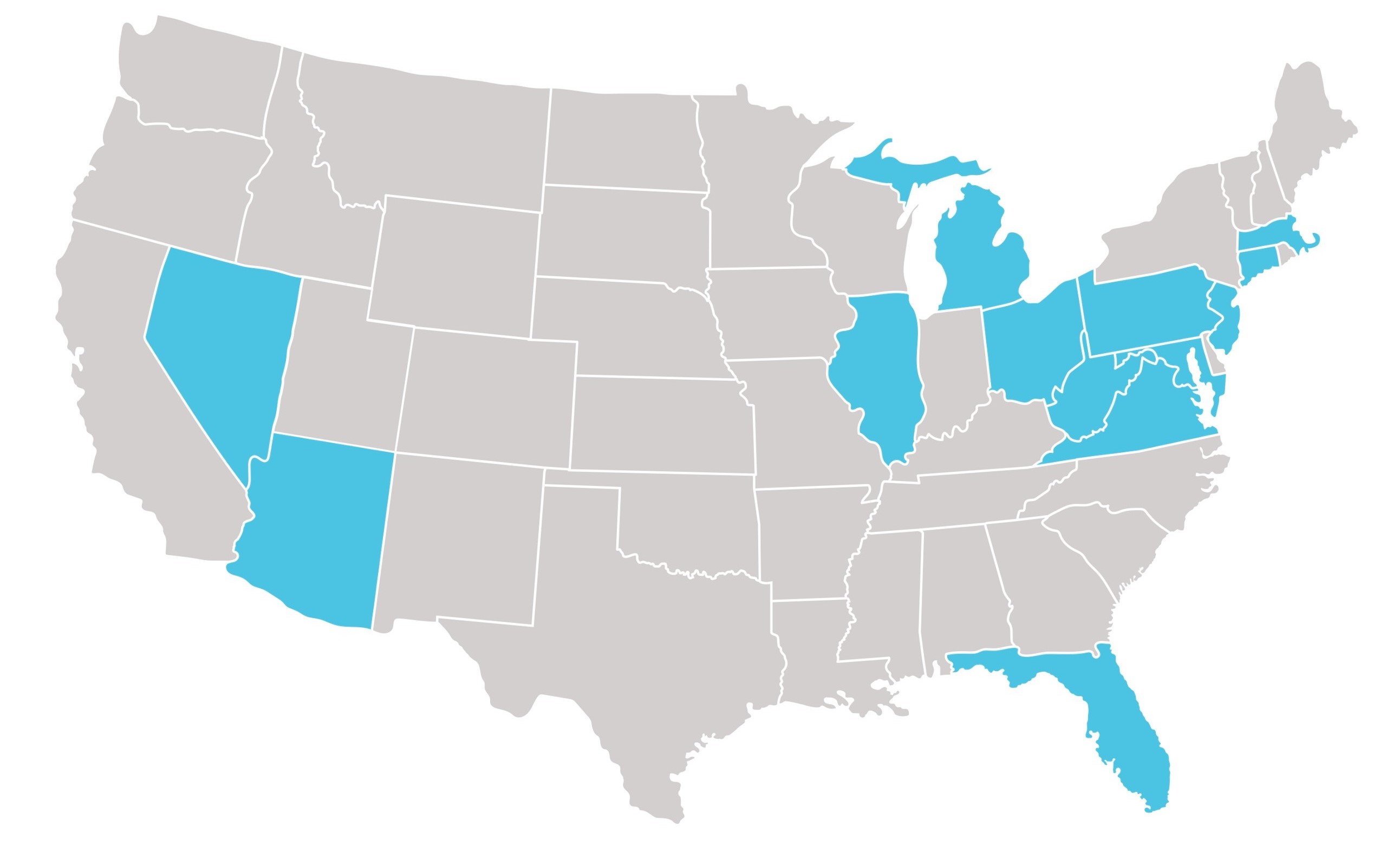
Our business plan includes the continued growth of our wholesale and retail operations by entering new markets and expanding in our current markets, including when medical markets expand into adult use markets. Growth plans include applying for new licenses, acquiring existing licensed businesses in limited license markets and maximizing operations under our existing licenses.
Research and Development
Our research and development activities have primarily focused on the development and improvement of efficient and sustainable cannabis cultivation and manufacturing methodologies and technologies to increase yields and maintain and improve the quality of our products. This includes research on lighting methods, air controls, racking and stacking, growing media, nutrient mixtures, pest management techniques, ambient controls, and automation.
We also engage in research and development activities focused on creating new extracted or infused products, and breeds of new cannabis strains and varietals. Our product development team includes members from all relevant product disciplines, who actively monitor existing and prospective markets, as well as test and evaluate the financial viability of all new proposed products.
Intellectual Property
We believe that intellectual property rights and brand protection are important parts of our business strategy. We regularly seek to protect our intellectual property rights in connection with our operating names, our consumer-packaged goods, and certain proprietary goods and services. Such rights include patented and non-patented technology, trade secrets, and state and federal trademarks. The U.S. federal trademark statute, The Lanham Act, allows for the protection of trademarks and service marks on products and services used, or intended for use, lawfully. Because cannabis-related products and services remain illegal at the U.S. federal level under the Controlled Substances Act, we are not able to register all our trademarks at the U.S. federal level for all products and services; therefore, we currently utilize trademark protection at the state level where commercially feasible. We have also sought protection of our trademarks internationally in countries where we may use the marks or license the right to use the marks. Nonetheless, our success depends upon other areas of our business such as brand awareness, product development and design, production and marketing and not exclusively upon trademarks, patents and trade secrets.
25
The Company, through our subsidiaries and affiliates, has a portfolio of approximately 130 active trademarks registered or pending registration with the U.S. Patent and Trademark Office or other state entities and approximately 100 active trademarks registered or pending registration with non-U.S. governmental entities, including trademarks with respect to products and retail branding. Product trademarks include various brands such as: Encore™, Avexia™, MÜV™, Savvy™, (the) Essence™, BITS™, HYPHEN™, Swift Lifts™ and Verano™, and dispensary brands Zen Leaf™ and MÜV™. We anticipate feedback on outstanding submitted applications on a rolling basis and will continue to rely on common law protection for our brands during the trademark registration process. We plan to renew our trademarks on an ongoing basis, and we plan to proactively seek intellectual property protection for products, services, and brand expansions in current markets as well as any new market expansion.
Since we became licensed to cultivate cannabis, we have developed proprietary manufacturing techniques for operating ethanol, butane, and carbon dioxide extraction equipment, including what we believe are best-in-class production practices, operating procedures, and methods. This requires specialized skills in cultivation, extraction and refining. Five U.S. and seventeen foreign patents and patent applications are held by our subsidiaries and affiliates for cannabinoid formulations related to transdermal and oral delivery. For additional details, see “Item 1A. Risk Factors — Risks Related to Our Business and Operations — Information Technology, Cybersecurity and Intellectual Property.”
We have several website domains, including www.verano.com, numerous social media accounts across all major platforms, and various phone and web application platforms. We rely on contractual protection, including non-disclosure and confidentiality agreements to protect our intellectual property rights, including trade secrets. To the extent the Company describes or discloses its proprietary cultivation or extraction techniques in its applications for cultivation or processing licenses, the Company’s policy is to redact or request redactions of such information prior to public disclosure. For additional details on the risks associated with the Company’s intellectual property, see “Item 1A. Risk Factors — Risks Related to Our Business and Operations — Information Technology, Cybersecurity and Intellectual Property.”
Competitive Conditions
The fast-growing market for legalized cannabis in the U.S. has created a competitive environment for cannabis producers as well as other types of companies who provide goods and services to the cannabis industry. We compete with a variety of different operators across the states in which we currently operate. In many of these states, there are specific license caps that create high barriers to entry. Management of the Company views multi-state operators that have vertical operations as our most direct competition, including the following U.S. based public reporting companies: Green Thumb Industries Inc., Cresco Labs, Inc., Curaleaf Holdings, Inc., and Trulieve Cannabis Corp.
Aside from existing direct competition in states in which we currently operate, out-of-state operators that are capitalized well enough to enter state markets are also considered part of the competitive landscape. Similarly, as we pursue our national footprint growth strategy, operators in our target markets will inevitably become direct competitors. Additionally, we, along with all legally operating competitors, face competition from the illicit markets, including from psychoactive hemp-based products. See “Item 1A. Risk Factors — Risks Related to our Business and Operations — The Cannabis Industry.” However, as federal, state and local regulators increase scrutiny on these illicit markets, the Company believes this competitive threat will be reduced.
There remains a significant lack of traditional sources of bank lending and equity capital available to fund the operations of companies in the cannabis sector. Financing for companies in the cannabis sector is more difficult than other sectors, particularly in the U.S., due to cannabis’s classification as a Schedule I drug under the Controlled Substance Act and federal illegality, which create barriers to entry. Additionally, the dynamics of the changing regulatory environment at the state level further complicate financing for companies in the cannabis sector. Competitors, particularly those that sell hemp products which are currently legal in the U.S., may have better access than we do to financing sources and the capital markets. The Executive Order, and any rescheduling as a result of the Executive Order, may change the availability of bank lending and equity capital to companies in the cannabis sector, but we cannot yet predict how this may change or if it will change at all.
26
Marketing and Sales
As of March 10, 2026, through our subsidiaries and affiliates we operate businesses in 13 states, including 160 retail dispensaries and 14 cultivation and processing facilities with over 1.1 million square feet of cultivation capacity. Our sales revenue is derived from our wholesale business and our national chain of retail dispensaries operating under our brands, including Zen Leaf™ and MÜV™.
For the fiscal year ended December 31, 2025, approximately 32.1% of our consolidated revenue, net of discounts, were generated by our wholesale operations and approximately 67.9% of our consolidated revenue, net of discounts were generated by our retail dispensary operations, in each case, excluding intersegment eliminations. For the fiscal year ended December 31, 2025, medical-use sales and adult use sales contributed approximately 53% and 47% of our consolidated revenues, respectively.
For the fiscal year ended December 31, 2025, approximately 14% and 11% of our consolidated sales were generated in Illinois and New Jersey, respectively, where 79% and 91% of sales were in adult use products in each market, respectively. For the fiscal year ended December 31, 2025, approximately 28% of our consolidated sales were generated by our Florida operations, where all sales are for medical products and are generated solely by our retail stores given the vertical integration requirements of Florida’s cannabis regulations. Verano is not dependent upon any single customer, or a few customers, noting that a customer is a single retail customer or an individual dispensary customer. No loss of any single customer would have a material adverse effect on our business or financial results.
The states in which we operate have regulations that restrict marketing and sales activities of cannabis products. Restrictions may specify what, where and to whom cannabis product information and descriptions may appear or be advertised. Marketing, advertising, packaging and labeling regulations for cannabis products also vary from state to state, potentially limiting the consistency and scale of consumer branding communications and product education efforts. We strive to deploy a diverse range of marketing and brand recognition strategies that comply with applicable local and state laws and regulations.
In medical cannabis markets we seek to educate patients and potential patients about our products and medical dispensaries through certifying physicians, community outreach events and on-going staff training and education. For adult use markets, we seek to educate customers and potential customers about our products and retail dispensaries through community outreach events, advertising and on-going staff training and education, in each case, where allowed under applicable regulations. In Florida we operate a patient care call center with staff that provide support via direct phone, email and online chat customer service communication for customers across our multi-state footprint.
Market data for more established medical markets expanding into adult use of cannabis are generally more reliable than market data for medical cannabis in states launching their medical initial programs. We rely largely on our own market research to forecast sales based upon historical sales, demographics, regulatory changes, demand, competition and similar consumer driven research. Using market data for medical and adult use cannabis can be difficult due to ongoing regulatory changes, limited information given the age of the industry and unreliable market information on supply levels. See “Item 1A. Risk Factors — Our sales volumes are difficult to forecast and a failure in the expected demand for our products to materialize could have a material adverse effect on our business, financial condition and results of operations” for more information.
Cultivation and Production
The cultivation and production of cannabis products requires licensing and permitting by each state where operations are conducted. As of March 10, 2026, we actively operate 14 cultivation and production facilities with over 1.1 million square feet of cultivation capacity. Nine of these production facilities are Current Good Manufacturing Practices certified.
We only use state-permitted products in our cultivation sites to meet testing, inventory, and other applicable state regulatory requirements. We have implemented standard operating procedures across all of our production facilities.
Although cannabis is an agricultural product, our cultivation methodologies employ a perpetual harvest system whereby plants are propagated and harvested on a staggered schedule. This ensures limited variability in the availability of finished products and minimizes the otherwise cyclical or seasonal nature of the plant-based business.
27
Components
The principal components in the production of our consumer packaged products include cannabis grown internally or acquired through wholesale channels, as well as other agricultural products, and packaging materials (including glass, plastic and cardboard) acquired through wholesale channels. Almost all raw material inputs, except packaging materials, used to produce our cannabis consumer packaged goods are cultivated or processed internally for further use in the manufacturing process. Due to the U.S. federal prohibition on cannabis, we must source cannabis within each state in which we operate.
Seasonality
Our business operates year-round; however, operations and sales trends in certain markets are subject to seasonal fluctuations. In particular, the Company’s retail dispensaries in Florida and Arizona have historically experienced increased customer traffic and higher sales volumes during the winter months due to the influx of seasonal residents and tourists. We also experience increases in sales from promotional activity around specific industry and holiday events, including 4/20, 7/10, and Green Wednesday (the Wednesday before Thanksgiving).
Environmental
Cannabis cultivation is energy-intensive, particularly when grown indoors. Energy is essential for lighting, environmental controls, and hydration at indoor cultivation operations. Access to energy infrastructure, such as power grids, can pose challenges, leading to temporary reliance on generators powered by fossil fuels that can impact air quality. Despite these challenges, indoor cultivation remains our primary method of cultivating cannabis, driven by market demand for consistent, high-quality cannabis products year-round, independent of adverse weather and fluctuating daylight. Currently, all of the Company’s cultivation is done indoors, including in enclosed greenhouse facilities.
Historically, expenditures for compliance with environmental laws and regulations have not been material to the Company’s financial results. In addition, we have not, and do not currently anticipate, material capital expenditures for environmental control facilities. However, they could become an increasing expense for the Company as we develop environmentally sustainable practices, especially if enhanced environmental laws and regulations are enacted for the cannabis industry.
Employees and Human Capital
The Company recruits, hires and promotes individuals that it believes are best qualified for each position, priding itself on using a selection process that recruits people who are trainable, cooperative and share our core values as a company. As of March 10, 2026, the Company had approximately 3,800 employees across its consolidated operating jurisdictions, including corporate, retail, cultivation and processing, both full- and part-time employees, and including but not limited to: finance and accounting, legal, human resources, regulatory and compliance, supply chain and operations, sales and marketing, commercial and cannabis agriculture, chemists, customer service, construction and project management, and real estate.
We offer a comprehensive package of company-sponsored benefits to our employees. Eligibility depends on the full-time or part-time status, employee location and other factors, and benefits include medical, vision and dental plans, disability insurance, a 401(k) retirement and savings plan, employee assistance programs, paid time off, life insurance and voluntary pet insurance. Additionally, we believe in aligned incentives and utilize employee stock and incentive plans for a competitive total rewards program. We did not experience any work stoppages in 2025 that had a material impact on us, and we consider our relationship with our employees to be good.
As of March 10, 2026, approximately 550 employees at various cultivation and dispensary operations across our network are covered under one of 16 collective bargaining agreements (“CBAs”).
28
Available Information
The Company’s website address is www.verano.com. Through this website, the Company’s filings with the SEC, including annual reports on Form 10-K, quarterly reports on Form 10-Q, current reports on Form 8-K, and all amendments to those reports, will be accessible (free of charge) as soon as reasonably practicable after materials are electronically filed with or furnished to the SEC. The information provided on the Company’s website is not part of this Form 10-K, unless otherwise noted.
The SEC maintains an Internet site (http://www.sec.gov) that contains reports, proxy and information statements and other information regarding issuers that file electronically with the SEC. Canadian securities authorities also maintain an Internet site (www.sedarplus.ca) that contains reports and other information regarding the Company as an SEC Foreign Issuer in Canada.
29
ITEM 1A. RISK FACTORS
The Company is subject to risks, certain of which are described below. The occurrence of any one or more of these risks or uncertainties could have a material adverse effect on the value of any investment in the Company and the financial condition or operating results of the Company. Additional risks and uncertainties not presently known to the Company or that the Company currently deems immaterial may also impair the Company’s business operations. Due to the nature of the Company and its business, investors should carefully consider all such risks, including those set out in the discussion below, together with the other information in this Form 10-K and our other filings with the SEC and Canadian Securities Administrators.
Summary Risk Factors
The following is a summary of some of the risks and uncertainties that could materially adversely affect our business, financial condition and results of operations. You should read this summary together with the more detailed description of each risk factor contained below.
•the current illegality of cannabis under federal law, the U.S. federal regulatory landscape and enforcement related to medical or adult use cannabis, including political risks, civil asset forfeiture and regulation by additional regulatory authorities;
•regulatory and political changes to U.S. federal, state and local laws related to medical or adult use cannabis, including political risks and regulation by additional regulatory authorities;
•rescheduling may lower the barriers to entry for well-capitalized institutional competitors;
•the federal rescheduling process is subject to significant procedural delays and legal challenges;
•the impacts of economic uncertainty stemming from disruptions in U.S. and global markets, inflation, rising interest rates, and changes in consumer and business confidence;
•our outstanding indebtedness and potential future indebtedness, including our ability to repay such indebtedness;
•reliance on key management;
•market acceptance of existing and new products and potential returns or recalls of our products;
•potential cultivation biosecurity failures;
•consumer acceptance of our brand portfolio;
•the accuracy of our forecasted demand for our products;
•our ability to accurately forecast, manage and monetize inventory;
•the potential for fraudulent activity by employees, contractors and consultants;
•our exposure to growth-related operational and execution risks;
•potential negative findings in our clinical research with respect to our products;
•potential product liability claims;
•our exposure to natural phenomena and resulting potential uninsured or under insured losses;
•the risk that our property will be subject to civil asset forfeiture;
•our corporate structure and our resulting reliance on the performance of our subsidiaries and affiliates;
•our expansion-by-acquisition strategy;
•our ability to acquire businesses and cannabis licenses in desired markets and the integration and operation of acquired businesses;
•the typically limited operations of businesses we acquire;
•the unconventional due diligence process in the cannabis industry;
•our ability to acquire and lease properties suitable for the cultivation, production and sale of cannabis;
•potential limited representations and warranties of businesses we may acquire;
•our acquisition of businesses in developing cannabis markets;
•our lack of portfolio diversification by industry and geographic concentration;
•our use of joint ventures, strategic partnerships and alliances;
•our contractual relationships with our consolidated variable interest entities;
•existing competition and new market entrants;
•the introduction of synthetic alternatives to cannabis products by pharmaceutical and other companies;
•the immaturity of the cannabis industry and limited comparable, competitive and established industry best practices;
•the availability of and our reliance on third-party suppliers, service providers, contractors and manufacturers, and any significant interruption of these relationships, including negative changes to quality, availability, pricing, trade policy and other economics;
•changes in U.S. trade policy, including the imposition of tariffs and the resulting consequences;
30
•wholesale and retail price fluctuations;
•public opinion and perception of the cannabis industry;
•the availability of raw or other materials;
•rising or volatile energy costs;
•agricultural and environmental risks and the impacts of environmental regulations on the cannabis industry and environmental protections;
•physical security risks, such as theft;
•disparate state-by-state regulatory landscapes and licensing regimes for medical and adult use cannabis;
•the difficulties cannabis businesses face accessing and maintaining banking or financial services due to federal regulations;
•the cost and difficulty of complying with various regulatory schemes;
•the impact of state social equity legislation as it relates to the cannabis industry;
•the risk of high bonding and insurance costs;
•environmental regulations;
•effects of changes in laws and policies governing employees and by union organizing activity;
•increased unionization efforts and labor shortages;
•potential scrutiny from Canadian authorities due to our status as an SEC Foreign Issuer;
•potential divestment of licenses if required by regulatory authorities;
•our dependency on the banking industry;
•required public disclosure and governmental filings containing personal information of our officers, investors and other stakeholders;
•potential findings by regulatory authorities that one of our stockholders is unsuitable;
•the risk that our directors, officers, employees or investors are barred from entering the U.S.;
•the ability to, and constraints on, promoting and marketing cannabis products;
•potential U.S. Food and Drug Administration governance of the cannabis industry;
•the potential limitations on our ability to enforce our contracts or any liens granted to us;
•the potential lack of access to federal bankruptcy protections in the U.S.;
•reliance on information technology systems, the potential disclosure of personal information of patients and customers and cybersecurity risks;
•our increasing use of, or failure to effectively implement, artificial intelligence (AI) and automated systems;
•our reliance on third-party software providers;
•costs related to preserving our brand identity;
•our ability to protect our intellectual property due to limited intellectual property protection available for cannabis products and the potential infringement by third parties;
•potential infringement or misappropriation claims;
•the risk of financial crimes;
•the inability to realize the anticipated benefits of the Continuance, or to do so within the anticipated timeframe;
•the risk of receiving no return on our securities;
•our elimination of individual liability and indemnification rights against our directors, officers and employees under Nevada law;
•our organizational documents contain provisions that may prevent transactions that could be beneficial to our stockholders and may insulate our management from removal;
•the time and resources necessary to comply with corporate governance practices and securities rules and regulations;
•our management’s ability to maintain effective internal controls;
•potential dilution if we issue additional shares of Common Stock;
•market perception of sales of a substantial amount of Common Stock;
•transfer restrictions on our Common Stock;
•price volatility of our Common Stock;
•our stockholders’ limited participation in our affairs;
•our expectation to not declare or pay out dividends;
•certain of our stockholders holding Common Stock representing greater than 5% of our voting power;
•the taxation of cannabis companies in the U.S., including the impact of Section 280E of the Code; and
•other risks described in this Form 10-K, as more particularly described herein.
31
Risks Related to Our Business and Operations – General
Cannabis, other than hemp, remains illegal under U.S. federal law, and therefore any change in federal enforcement could have material adverse impact on our business, financial condition and results of operations.
To date, in the U.S. 40 states plus the District of Columbia and the U.S. territories of Puerto Rico, Guam, the Commonwealth of Northern Marina Islands, and the U.S. Virgin Islands have authorized comprehensive medical cannabis programs, 24 states plus the District of Columbia and the U.S. territories of Guam, the Commonwealth of Northern Mariana Islands, and the U.S. Virgin Islands have authorized comprehensive programs for medical and adult use (i.e. recreational) cannabis, and eight states allow the use of low THC and high CBD products for specified medical uses.
Under U.S. federal law, however, those activities are illegal. Cannabis, other than hemp, is currently a Schedule I controlled substance under the CSA, which means it is viewed by the U.S. federal government as a drug that has a high potential for abuse and no therapeutic value. Therefore, even in U.S. states and territories that have legalized cannabis to some extent, the cultivation, possession and sale of cannabis violates the Controlled Substances Act and is punishable by imprisonment, substantial fines and forfeiture. Moreover, individuals and entities may violate U.S. federal law if they aid and abet another in violating the Controlled Substances Act, or conspire with another to violate the law. Violating the Controlled Substances Act is also a predicate for other crimes in the U.S., including money laundering laws and the Racketeer Influenced and Corrupt Organizations Act. The U.S. Supreme Court has ruled that the U.S. federal government has the authority to regulate and criminalize the sale, possession and use of cannabis in the U.S., even for individual medical purposes, regardless of whether it is legal under state law. To date, however, the U.S. federal government has not enforced those laws against companies (and their vendors) complying with state cannabis law. In October of 2022, the Biden Administration announced its intention to review the regulation of cannabis under the CSA by directing the Secretary of Health and Human Services and the Attorney General to initiate the administrative process to expeditiously review cannabis’s Schedule I status. In August of 2023, the HHS recommended to the DEA that cannabis be rescheduled to Schedule III under the CSA. On December 2, 2024, the DEA held a preliminary formal hearing regarding the rescheduling of cannabis, and additional hearings were scheduled from January 21, 2025 to March 6, 2025. On January 13, 2025, Chief Administrative Law Judge presiding over the rescheduling of cannabis ordered that the hearing scheduled for January 21, 2025 was cancelled, and that the proceedings in the matter were stayed, pending a resolution of an interlocutory appeal to the DEA Administrator. A joint status update must be provided to the tribunal ninety (90) days from the issuance of the order, and every ninety (90) days thereafter. In addition, in November 2024, Donald Trump was elected president of the U.S. and announced that Pam Bondi would be his pick for attorney general. On December 18, 2025, President Trump issued the Executive Order, which directs federal agencies to expedite the process of rescheduling cannabis from a Schedule I to a Schedule III controlled substance under the CSA. The effect of the Executive Order may be that the cultivation, manufacturing, distribution, sale or possession of cannabis in the U.S. is no longer federally illegal and would lessen criminal penalties at the federal level and remove Section 280E tax considerations, however, the final effects are dependent on other government actions. Despite such actions and the ongoing rule making process, there can be no guarantees that the rescheduling rule making process will continue on a certain timeline or at all under this administration or that any rules will come out of the rule making process that will benefit the Company. The Executive Order, and agency implementation of the Executive Order does not federally legalize adult use and would not federally authorize or approve state sanctioned medical programs. Although we believe that our business activities are compliant with applicable state and local laws in the United States, strict compliance with state and local cannabis laws would not provide a defense to any federal proceeding which may be brought against us. Any such proceedings may result in a material adverse effect on us. We derive substantially all of our revenues from the cannabis industry. The enforcement of applicable U.S. federal laws poses a significant risk to us.
The likelihood of any future adverse enforcement against companies complying with state cannabis laws remains uncertain. In 2018, then-U.S. Attorney General Jeff Sessions issued the Sessions Memorandum rescinding the DOJ’s previous guidance under the Cole Memorandum that had given federal prosecutors discretion not to enforce federal law in states that legalized cannabis, as long as the state’s legal regime adequately addressed specified federal priorities. The Sessions Memorandum, which remains in effect, states that each U.S. Attorney’s Office should follow established principles that govern all federal prosecutions when deciding which cannabis activities to prosecute. As a result, federal prosecutors can use their prosecutorial discretion to decide to prosecute state-legal cannabis activities. Since the Sessions Memorandum was issued, however, U.S. Attorneys have not targeted state law compliant cannabis entities. The policy of not prosecuting companies complying with state cannabis laws continued under U.S. Attorney General Merrick Garland. The DOJ may change its enforcement policies at any time, with or without advance notice, under current U.S. Attorney General, Pam Bondi.
32
Additionally, since 2014, versions of the U.S. omnibus spending bill have included a provision prohibiting the DOJ from using appropriated funds to prevent states from implementing their medical-use cannabis laws. While the omnibus spending bill affords some protection to medical cannabis businesses, we also operate adult use cannabis businesses that are permissible under state and local laws. Consequently, some of our operations may be outside any protections extended to medical-use cannabis under the spending bill provision. This could subject us to greater and different U.S. federal legal and other risks as compared to businesses where cannabis is sold exclusively for medical use, which, in turn, could materially and adversely affect our business. Furthermore, any change in the U.S. federal government’s enforcement posture with respect to state-licensed cannabis sales, including the enforcement postures of individual federal prosecutors in judicial districts where we operate, would lead to an inability to execute our business plan, likely resulting in significant losses with respect to our customer base and adversely affecting our business, financial condition and results of operations.
In addition to criminal liability for producing, manufacturing, distributing and selling cannabis, other subsections of the CSA criminalize related activities with expanded sentences and increased penalties for corporations. For example, entities or persons who manage or control a property and knowingly make that property available for the purposes of manufacturing, distributing or using any controlled substances can be found liable under the Controlled Substances Act. We own properties on which activities prohibited by the Controlled Substances Act occur. Therefore, a federal prosecutor could prosecute us as an owner of “drug-involved premises” and we could be found to violate U.S. federal law by virtue of these assets. Additionally, we intend to acquire and invest in businesses that are directly or indirectly engaged in the medical and adult use cannabis industry in the U.S. where state and local law permits such activities.
Our anticipated funding of businesses engaged in the medical and adult use cannabis industry, whether through loans or through other forms of investment, is currently illegal under applicable U.S. federal laws. Any criminal charges brought against us could result not only in the inability to execute our business plan, but the cessation of our operations and could further result in significant fines, penalties and losses, which would adversely affect our business, financial condition and results of operations.
THE CONSEQUENCES OF SUCH GOVERNMENTAL ENFORCEMENT WOULD BE MATERIALLY DETRIMENTAL TO US, OUR BUSINESS AND THE VALUE OF OUR COMMON STOCK AND COULD RESULT IN THE FORFEITURE OR SEIZURE OF ALL OR SUBSTANTIALLY ALL OF OUR ASSETS.
33
There is a substantial risk of regulatory or political change to federal, state and local laws permitting cannabis activities. Such changes could have a material adverse impact on our business, financial condition and results of operations.
Continued development of the U.S. cannabis industry depends upon legislative authorization of cannabis at the federal, state and local level. The status quo of, or progress in, the federal or state regulated U.S. cannabis industry, while encouraging, is not assured and any number of factors could slow or halt further progress in this area. The political environment surrounding the cannabis industry in the U.S. in general can be volatile and the regulatory framework remains in flux. While there may be ample public support for legislative action permitting the production and use of cannabis, numerous factors impact and can delay the legislative and regulatory processes. If pro-cannabis regulations are not enacted, or enacted but subsequently repealed or amended, or enacted with prolonged phase-in periods, our growth targets and prospects, and thus, the effect on the return of investor capital, could be extended or reduced.
Further, there is no guarantee that, at some future date, voters or the applicable state legislative bodies will not repeal, overturn or limit any such legislation legalizing the cultivation, manufacture, sale, distribution or consumption of medical or adult use cannabis. Local and city ordinances may strictly limit or restrict the applicability of state laws to their jurisdictions and the distribution of cannabis in their jurisdictions in a manner that may make it extremely difficult or impossible to transact business that is necessary for the continued operation of the cannabis industry generally and us specifically. Although our operations are legal under the laws of the states in which our business operates, local governments have the ability to limit, restrict and ban cannabis businesses from operating within their jurisdiction. Land use, zoning, ordinances and similar federal, state and local laws could be adopted or changed and have a material adverse effect on our business.
In addition, the rule making process to reschedule cannabis to a Schedule III substance under the CSA is ongoing at the time of this filing. We cannot predict the effects such rescheduling would have on our business, and there is no guarantee that the formal rule making process will happen within a certain timeframe or that cannabis will be rescheduled. If cannabis were rescheduled to a Schedule III substance, we cannot predict the federal regulations that may be put into place regarding the cannabis industry. On December 18, 2025, President Trump issued the Executive Order, which directs federal agencies to expedite the process of rescheduling cannabis from a Schedule I to a Schedule III controlled substance under the CSA. The effect of the Executive Order may be that the cultivation, manufacturing, distribution, sale or possession of cannabis in the U.S. is no longer federally illegal and would lessen criminal penalties at the federal level and remove Section 280E tax considerations; however, the final effects are dependent on other government actions. Despite such actions and the ongoing rule making process, there can be no guarantees that the rescheduling rule making process will continue on a certain timeline or at all under this administration or that any rules will come out of the rule making process that will benefit the Company. The Executive Order, and agency implementation of the Executive Order does not federally legalize adult use and would not federally authorize or approve state sanctioned medical programs. Cannabis would still be subject to the same FDA drug approval process as all other substances, and sales outside of FDA approval, would still be criminal at the federal level. In addition, particularly considering the U.S. congressional elections that occurred in 2024, there is no guarantee that on-going pro-cannabis federal legislative efforts such as the State Reform Act or the SAFER Act will continue, that the Executive Order will result in the rescheduling of cannabis on a particular timeframe or at all, that certain legislation, such as certain banking restrictions, will change as a result of the Executive Order, or that legislation that further restricts the cannabis industry at the federal U.S. level will not be proposed or passed. We cannot predict if newly-elected state officials will adversely change the regulatory schemes regarding cannabis in the states where we operate.
Any one of these factors could slow or halt additional legislative authorization of cannabis, which could harm our business, financial condition and results of operations. If the U.S. federal government begins to enforce U.S. federal laws relating to cannabis in states where the sale and use of cannabis is currently legal, or if existing state laws are repealed or curtailed, our business or operations in those states or under those laws would be materially and adversely affected. As they amend or develop legislation and regulations, state and local regulators and legislatures may use the regulatory process to slow the growth of multi-state operators like us, with the intent of creating increased opportunities for resident farmers and entrepreneurs, which could severely restrict our ability to operate in those jurisdictions. Federal actions against any individual or entity engaged in the cannabis industry or a substantial repeal of cannabis related legislation could adversely affect our business and our assets or investments. Maintaining compliance with complex and ever-changing regulations and laws, including sometimes unclear regulations and laws, can be a difficult task, and a materially compliant business can be found in violation of one or more laws, rules or regulations while remaining materially or substantially compliant with applicable state cannabis laws.
34
Rescheduling may lower the barriers to entry for well-capitalized institutional competitors.
For years, the Schedule I status of cannabis acted as a barrier to entry that kept large-scale pharmaceutical, tobacco, and consumer packaged goods companies from entering the industry. Schedule III status may provide the legal cover these entities need to enter the market. These competitors possess significantly greater financial resources, global supply chains, and experience with federal regulatory agencies. Due to the uncertainty of rescheduling and the potential timeline for these competitors to enter the market, the impact is unclear.
The federal rescheduling process is subject to significant procedural delays and legal challenges that could postpone or nullify any anticipated benefits.
The process of moving cannabis to Schedule III is governed by the Administrative Procedure Act, which requires a public comment period and potentially lengthy administrative hearings. Opponents of rescheduling may file lawsuits to stay or vacate the final rule, alleging procedural flaws or conflicts with international treaty obligations. Any such litigation could leave us in a state of regulatory uncertainty for years.
Challenging U.S. and global economic conditions may negatively impact our business, financial condition and results of operations.
Any disruptions and volatility in U.S. and global financial markets, inflation, potential recession and declining consumer and business confidence could lead to decreased levels of consumer spending and higher costs. Our operations have been, and could continue to be affected by inflation, and could be effected by any potential recession, real or perceived market disruptions, the unemployment level, the impact of a federal government shutdown, or rising or elevated interest rates that reach levels that influence consumer trends and spending and, consequently, impact our sales volume, pricing, cost of goods and profitability. In addition, economic uncertainty may make it more difficult to access financing at the rates we have received previously. Further, continued high interest rates may increase the cost of servicing our debt, which may limit our ability to fund capital expenditures for new cultivation facilities. Additionally, as cannabis remains a discretionary purchase for many, inflationary pressure on household essentials, such as food, fuel and rent, could lead consumers to trade down to lower-margin value brands or reduce their overall frequency of purchase, potentially leading to further price compression in certain markets.
These macroeconomic developments could negatively impact our business, which depends on the general economic environment and levels of consumer spending. In addition, macroeconomic conditions could cause budgetary pressures for our wholesale and end customers, which could result in a delay or reduction in their spending, and in turn could adversely affect our business. We may not be able to maintain our existing customers or attract new customers, or we may be forced to increase or reduce the price of our products. We are unable to predict the likelihood of the occurrence, duration, or severity of a recession or other disruptions in the U.S. credit and financial markets and adverse U.S. and global economic conditions. Any general or market-specific economic downturn could have a material adverse effect on our business, financial condition and results of operations.
35
The Company and certain of our subsidiaries are borrowers under secured debt facilities, and we may be unable to repay, renew or refinance our indebtedness when it becomes due. Further, our debt facilities contain covenants that restrict our business and they may be difficult or costly for us to comply with. If we are unable to repay, renew or refinance our debts as they become due, it would have a material adverse effect on our business, financial condition and results of operations and the value of our Common Stock.
The Company and certain of our subsidiaries are borrowers of secured indebtedness and are subject to risks typically associated with secured debt financing, which are heightened by the cannabis regulatory environment in the U.S. Our cash flows could be insufficient to satisfy the amount of required payments of principal and interest and we may not be able to repay our indebtedness. Our ability to make scheduled payments of principal and interest on our indebtedness when due depends on our future cash flow which is subject to the financial performance and results of our business, the value of our assets, prevailing economic conditions, the cannabis regulatory environment, prevailing interest rate levels and other financial, competitive and operational factors impacting the cannabis industry, many of which are beyond our control.
The covenants of our indebtedness limit our ability to engage in activities that may be in the Company’s long-term best interest. In addition, compliance with the financial, operational and reporting covenants, including obligations to maintain minimum cash balances at certain financial institutions, increases our legal and financial costs, make certain activities more difficult or restricted, and may be time-consuming or costly and increase demand on the Company’s systems and resources. Our failure to comply with any of these covenants could result in a default, which could result in increased default interest rates, the acceleration of repayment of our debt or our lenders’ foreclosure on our assets securing our indebtedness.
We may not be able to renew or refinance our indebtedness on substantially similar terms, or at all, particularly in an environment of economic uncertainty such as the one discussed above in “—Challenging U.S. and global economic conditions may negatively impact our business, financial condition and results of operations.” Our ability to access short-term and long-term lending and capital markets to obtain, and the availability of acceptable terms and conditions of, financing are impacted by many factors, including the liquidity and volatility of the overall lending and capital markets, the cannabis regulatory environment and the current state of the economy, including the cannabis industry. There can be no assurances that we will be able to access the lending and capital markets to refinance our indebtedness. We may have to pay higher interest rates and additional fees and expenses, and we may have to agree to terms that could increase the cost of our indebtedness structure. If we are unable to renew or refinance our indebtedness on terms that are not materially less favorable than the terms currently available to us or obtain alternative or additional financing arrangements, we may not be able to timely repay our indebtedness, which may result in a default under our indebtedness, which could result in our lenders’ foreclosure on our assets securing our indebtedness.
The Company and our subsidiaries may incur additional indebtedness, and we may be unable to borrow on better or substantially similar terms to our existing indebtedness. New indebtedness facilities may contain covenants that further restrict our business and they may be difficult or costly for us to comply with. If we were to incur additional indebtedness that increases the cost of our indebtedness structure, it would have a material adverse effect on our business, financial condition and results of operations and the value of our Common Stock.
We may incur additional indebtedness. As funds are borrowed, additional interest and debt service increases the expense of operating our business. In addition, lenders of future borrowings may require additional restrictions on our business and operations and additional assets to secure our obligations. Our ability to access short-term and long-term lending and capital markets to obtain, and the availability of acceptable terms and conditions of, financing are impacted by many factors, including the liquidity and volatility of the overall lending and capital markets, the cannabis regulatory environment and the current state of the economy, including the cannabis industry. We may have to pay higher interest rates and additional fees and expenses, and we may have to agree to terms that could increase the cost of our indebtedness structure.
36
We rely on the expertise of our management team and other employees experienced in the cannabis industry, and the loss of key personnel could negatively affect our business, financial condition and results of operations.
Our success largely depends upon the continued services of our executive officers and management team members. If one or more of our executive officers or management members is unable or unwilling to continue in his or her present position, we may not be able to replace such individual readily, if at all. Additionally, we may incur additional expenses to recruit and retain new executive officers and management members and personnel with experience in the cannabis industry. We do not maintain “key person” life insurance on any of our executive officers. Because of these factors, the loss of the services of any key persons could adversely affect our business, financial condition and results of operations.
We face risks related to our products.
We have committed and expect to continue committing significant resources and capital to develop and market existing products and new products and services. These products are relatively untested in the marketplace, and we cannot assure that we will achieve market acceptance for new products and services that we may offer in the future, or that our products that achieve market acceptance will maintain that acceptance over time. Moreover, these and other new products and services may be subject to significant competition with offerings by new and existing competitors. In addition, new products and services may pose a variety of challenges and require us to attract additional qualified employees. The failure to successfully develop and market these new products and services could have a material adverse effect on our business, financial condition and results of operations. We also face competition from hemp and illicit market products that are not subject to testing or regulation by state agencies and that are not subject to the same taxes state-legal cannabis businesses face, and may be priced significantly lower than our products.
Our products may be returned or recalled, which could damage our brand identity and adversely affect our business, financial condition and results of operations.
Despite quality control procedures, cultivators, manufacturers and distributors of cannabis products are sometimes subject to the recall or return of their products for a variety of reasons, including product defects, such as contamination, unintended harmful side effects or interactions with other substances, packaging safety and inadequate or inaccurate labeling disclosure. While we employ testing procedures, there is no guarantee such procedures will catch all defects. If any of our products or any of the products that we purchase from a third party are recalled due to an alleged product defect or for any other reason, we could be required to incur the unexpected expense of the recall and any legal proceedings that might arise in connection with the recall, and may lose a significant amount of sales and may not be able to replace those sales at an acceptable margin or at all. A recall or return of our products could lead to a deterioration in our brand identity, decreased demand for our products or limit our ability to purchase from a third-party and could have a material adverse effect on our business, financial condition and results of operations.
Cultivation biosecurity failures, including the introduction or spread of plant pathogens such as Hop Latent Viroid (“HpLVd”), could materially adversely affect our yields, product quality, and operating results.
HpLVd can remain asymptomatic for extended periods while significantly reducing plant vigor, yield, and cannabinoid potency, which may delay detection and amplify losses. Despite the testing processes we employ, pathogens may spread through infected clones, tools, personnel movement, or shared environments, and our biosecurity, testing, sanitation, and quarantine controls may prove insufficient or inconsistently executed. An outbreak could require crop destruction, facility remediation, replacement of genetics, and extended production downtime, resulting in inventory write-downs, higher operating costs, supply shortfalls, margin compression, and reputational harm. Limitations in diagnostic accuracy or timing, reliance on third-party inputs, and human execution risk may further constrain prevention and response efforts. If we are unable to effectively prevent, detect, or mitigate such biosecurity incidents, our business, financial condition, and results of operations could be materially adversely affected.
37
We are dependent on the popularity of consumer acceptance of our brand portfolio.
Our ability to generate revenue and be successful in the implementation of our business plan is dependent on consumer acceptance of and demand for our products. Acceptance of our products depends on several factors, including availability, cost, ease of use, familiarity of use, convenience, effectiveness, safety and reliability. If customers do not accept our products, or if such products fail to adequately meet customers’ needs and expectations, our ability to continue generating revenues could be reduced. As the number of available licenses increase in the markets in which we operate, and the illicit market and psychoactive hemp-based products proliferate, additional competition and increased product availability may result in competitors undercutting our prices. From time to time, we may need to reduce our prices in response to competitive and customer pressures and to maintain our market share, which could materially reduce our revenues.
Our sales volumes are difficult to forecast and a failure in the expected demand for our products to materialize could have a material adverse effect on our business, financial condition and results of operations.
As a result of the early stage of the cannabis industry, ongoing U.S. state and federal regulatory and policy changes for medical and adult use cannabis and unreliable levels of market supply, the market data available for cannabis demand can be limited. We must rely largely on our own market research to forecast sales, as detailed forecasts are not generally obtainable from other sources in the states in which our business operates. Additionally, any market research and our own projections of sales, demographics, demand and similar consumer research, are based on assumptions from limited and unreliable market data. A failure in the expected level of demand for our products to materialize as a result of competition, regulatory changes, technological change or other factors could have a material adverse effect on our business, financial condition and results of operations.
Our ability to accurately forecast, manage, and monetize inventory is subject to uncertainty and could materially adversely affect our operating results.
As a multi-state cannabis operator, inventory predictability is affected by biological variability in cultivation cycles, inconsistent yields and potency, biosecurity events, regulatory testing and hold periods, processing capacity constraints, and variability in consumer demand across markets and product categories. Forecasting errors or operational disruptions may result in excess, obsolete, or aged inventory requiring discounting, reprocessing, or destruction, as well as inventory write-downs or impairments. Conversely, inventory shortfalls may limit our ability to meet customer demand, fulfill wholesale commitments, or maintain retail shelf availability, adversely affecting revenue, margins, and brand equity. Additionally, inventory planning relies on assumptions regarding market growth, pricing, regulatory conditions, and execution across cultivation, manufacturing, and distribution functions, which may not prove accurate. If we are unable to effectively predict and align inventory levels with demand and operational capacity, our business, financial condition, and results of operations could be materially adversely affected.
There is a risk of fraudulent or illegal activity by our employees, contractors and consultants, and any fraudulent or illegal acts could negatively affect our business, financial condition and results of operations.
We are exposed to the risk that our employees, independent contractors and consultants may engage in fraudulent or other illegal activity. Misconduct by these parties could include intentional, reckless or negligent conduct or disclosure of unauthorized activities that violates: (i) government regulations; (ii) manufacturing standards; (iii) federal and state healthcare fraud and abuse laws and regulations; (iv) laws that require the true, complete and accurate reporting of financial information or data; (v) our contractual agreements; or (vi) our policies and code of ethics. It may not always be possible for us to identify and deter misconduct by our employees and other third parties, and the precautions taken by us to detect and prevent this activity may not be effective in controlling unknown or unmanaged risks or losses or in protecting us from governmental investigations or other actions or lawsuits stemming from a failure to be in compliance with such laws or regulations. If any such investigations or actions are instituted against us, and we are not successful in defending them or asserting our rights, those actions could have a significant impact on our business, including the imposition of civil, criminal and administrative penalties, damages, monetary fines, contractual damages, reputational harm, diminished profits and future earnings and curtailment of our operations, any of which could have a material adverse effect on our business, financial condition and results of operations.
38
We are subject to growth-related operational and execution risks and our inability to mitigate and address these risks would have a material adverse effect on our business plan, financial results and financial condition.
We are subject to growth-related operational and execution risks, including integration of acquired businesses, facilities, systems, personnel, and other capacity constraints, efficient management of assets and pressure on our internal systems and controls. Our ability to manage growth effectively will require us to continue to implement and improve our integration processes and operational and financial systems and to expand, train and manage our employee base. Our inability to effectively manage our growth may have a material adverse effect on our business financial results and financial condition.
Past performance is not necessarily indicative of future results, and if our actual operations differ materially from management’s expectations, it could have a material adverse effect on our business, financial condition and results of operations.
Our growth is in large part attributable to acquisitions of existing cannabis businesses and licenses. Our past operational performance may not be indicative of our future operating results. There can be no assurance that the revenue growth, cashflow, operating margins and other historical operating results achieved by us will be achieved by us going forward, and our financial performance and operating results may be materially different.
Clinical research with respect to our products is ongoing, and negative findings could lead to rollbacks of state legalizations laws and negative public perceptions of cannabis, which would negatively affect our business, financial condition and results of operations.
Research in the U.S. and internationally regarding the medical benefits, viability, safety, efficacy, dosing and social acceptance of cannabis or isolated cannabinoids remains in early stages. There have been relatively few clinical trials on the benefits of cannabis or isolated cannabinoids. Although we rely on the articles, reports and studies that support our beliefs regarding the medical benefits, viability, safety, efficacy, dosing and social acceptance of cannabis, future research and clinical trials may prove such beliefs to be incorrect, or could raise concerns regarding, and public perceptions relating to, cannabis. Further, the cannabis industry is highly dependent upon consumer perception, which can be significantly influenced by scientific research or findings, regulatory investigations, litigation, media attention and other publicity regarding the consumption of cannabis products. There can be no assurance that future scientific research or findings, regulatory investigations, litigation, media attention or other publicity will be favorable to the cannabis market or any particular product, or consistent with earlier publicity.
Future research studies and clinical trials may reach negative conclusions regarding the medical benefits, viability, safety, efficacy, dosing, social acceptance or other facts and perceptions related to cannabis, which could lead to rollbacks in state regulation or otherwise have a material adverse effect on the demand for our products with the potential to lead to a material adverse effect on our business, financial condition and results of operations. There is no assurance that such adverse research studies or clinical trials will not arise.
We may be subject to litigation.
We may become party to litigation from time to time in the ordinary course of business, which could adversely affect our business. Should any litigation in which we become involved be determined against us, such a decision could adversely affect our ability to continue operating and the market price for the Common Stock. Even if we are involved in litigation and win, litigation can redirect significant financial and other resources of the Company.
39
We may be subject to product liability claims which could adversely affect our business, financial condition and results of operations.
We manufacture, process and distribute products designed to be ingested and used topically by humans, and therefore we face an inherent risk of exposure to product liability claims, regulatory action and litigation if our products are alleged to have caused loss or injury. In addition, the manufacture and sale of cannabis products involve risk of injury to consumers due to tampering by unauthorized third parties or product contamination. Previously unknown adverse reactions resulting from human consumption and use of cannabis products alone or in combination with other medications or substances could occur. Although we have quality control procedures in place, we may be subject to various product liability claims, including, among others, that the products produced by us, or the products that we purchase from third party licensed producers, caused injury or illness, include inadequate instructions for use or include inadequate warnings concerning possible side effects or interactions with other substances. A product liability claim or regulatory action against us could result in increased costs, could adversely affect our reputation, and could have a material adverse effect on our business, financial condition and results of operations. There can be no assurances that product liability insurance will be obtained or maintained on acceptable terms or with adequate coverage against potential liabilities.
We are exposed to various operational risks and natural phenomena, any of which may be uninsured or underinsured, and uninsured losses could have a material adverse effect on our business, financial condition and results of operations.
We may be affected by a number of operational risks and natural phenomena for which we may not be adequately insured, including labor disputes; catastrophic accidents; fires; blockades or other acts of social activism; equipment defects, malfunction and failures; changes in the regulatory environment; impact of non-compliance with laws and regulations (both related and unrelated to the cannabis industry); the outbreak of a global pandemic; and inclement weather conditions, hurricanes, floods, earthquakes and other natural disasters. Such risks can cause interruption of operations, shortage of staff, disruption of supply chain, market volatility, personal injury, loss of life, suspension of operations, damage to facilities, damage to or destruction of property, equipment and the environment. There is no assurance that the foregoing risks and hazards will not result in damage to, or destruction of, our properties, dispensary facilities and cultivation and production facilities, or cause personal injury or death, environmental damage or have an adverse impact on our operations, costs, monetary losses, potential legal liability and adverse governmental action, any of which could have a material adverse effect on our business, financial condition and results of operations.
In addition, there can be no assurance that we will not encounter hazardous conditions, such as asbestos or lead, at the sites of the real estate used to operate our business, which may delay the development of our business. Climate change or significant weather events may accelerate or exacerbate environmental conditions in ways that adversely affect the business due to potential negative effects on agricultural conditions, increased difficulty in construction projects to support our operations, and ownership or leasing of real property generally. Upon encountering a hazardous condition, work at our facilities may be suspended. If we receive notice of a hazardous condition, we may be required to correct the condition prior to continuing construction. If additional hazardous conditions were present, it would likely delay construction and may require significant expenditure of our resources to correct the conditions. Such conditions could have a material adverse effect on our business, financial condition and results of operations.
We plan to continuously monitor our operations for quality control and safety and to mitigate risk. However, there are no assurances that our safety procedures will always prevent damage and we may be affected by liability or sustain losses in respect of risks and hazards. Although we maintain insurance coverage, such insurance does not cover all of the potential risks associated with our business and operations, including natural disasters.
The cost of insurance for companies engaged in cannabis-related activities is higher than many other industries and we may be unable to maintain insurance to cover these risks at economically feasible premiums, in part or at all. In addition, insurance coverage may not be available to us or may not be adequate to cover any resulting liability. In certain locations where we operate, such as Florida, it may be difficult to get insurance at reasonable costs, or at all, that will adequately cover adverse weather events such as hurricanes. Moreover, insurance against risks such as environmental pollution or other hazards encountered in our operations is not generally available on acceptable terms. The occurrence of a significant uninsured claim, a claim in excess of the insurance coverage limits then maintained by us, or a claim at a time when we are not able to obtain liability insurance, could have a material adverse effect on our business, financial condition and results of operations.
40
Our property is subject to risk of civil asset forfeiture.
Because the cannabis industry remains illegal under U.S. federal law, any property owned by participants in the cannabis industry that is either used in the course of conducting or comprises the proceeds of a cannabis business could be subject to seizure by law enforcement and subsequent civil asset forfeiture. Even if the owner of the property were never charged with a crime, the property in question could still be seized and subject to an administrative proceeding by which, with minimal process, it could become subject to forfeiture.
Changes in U.S. trade policy, including the imposition of tariffs and the resulting consequences, may have a material adverse impact on our business, operating results, and financial condition.
Our business requires significant packaging, construction, and other materials. We strategically and proactively procure these materials from our suppliers in sufficient quantities to facilitate supply chain demands and on relevant construction timelines. On February 20, 2026, the U.S. Supreme Court ruled that certain previously imposed tariffs under the International Emergency Economic Powers Act (“IEEPA”) were unauthorized. While this ruling may lead to potential refunds of duties previously paid, President Trump immediately transitioned to a new 15% global import tariff under Section 122 of the Trade Act of 1974 (the “Trade Act”). We cannot yet predict the effect of these new tariffs, recently imposed or future U.S. tariffs on imports or the extent to which other countries will impose quotas, duties, tariffs, taxes or other similar restrictions upon the import of materials in the future, nor can we predict future trade policy or the terms of any renegotiated trade agreements and their impact on our business.
The U.S. government has adopted new approaches to trade policy and in some cases, may renegotiate, or potentially terminate, certain existing bilateral or multi-lateral trade agreements. While the Supreme Court has limited the President’s authority to impose open-ended tariffs under IEEPA, the administration has utilized alternative statutory authorities, such as Section 122, to impose time-limited surcharges, and has raised the possibility of seeking congressional extensions or imposing significant additional tariff increases under Section 232 or Section 301of the Trade Act or expanding the tariffs to capture other countries and certain types of foreign goods. A significant portion of our operational infrastructure, including LED lighting, climate control systems, extraction hardware, and specialized packaging, is sourced from international markets, particularly China and Southeast Asia. Recent and proposed shifts in U.S. trade policy, including the current 15% global tariff and other tariffs on certain imports, could drastically increase the cost of building out or maintaining our facilities. These costs are difficult to pass on to consumers in a highly competitive, price-sensitive market. Additionally, the legal and administrative uncertainty following the recent U.S. Supreme Court ruling, including the process for seeking duty refunds and the potential for rapid shifts between different statutory tariff regimes, may make it more difficult or costly for us to procure packaging, construction, and other materials. As a result, we may experience supply chain interruptions or increased pricing of such procured materials and planned projects may be delayed, which could have a material adverse effect on our current and expansion strategy as well as our business, operating results and financial condition.
In addition, in response to both the invalidated IEEPA tariffs and the newly imposed Section 122 tariffs, other countries have implemented or may implement retaliatory tariffs on U.S. goods. Political tensions as a result of trade policies could reduce trade volume, investment, technological exchange, and other economic activities between major international economies, resulting in a material adverse effect on global economic conditions and the stability of global financial markets, which could in turn have a material adverse impact on our business, operating results and financial condition.
41
Risks Related to Our Business and Operations – Organizational Structure and Acquisition-Based Strategy
The Company is the ultimate holding company in its corporate organizational structure. As such, the Company depends on the performance of its subsidiaries and affiliates and therefore any material declines in the financial health or prospects of these entities will adversely affect our business, liquidity, financial condition and results of operations.
We are a holding company, and the vast majority of our assets are the ownership interests we hold in our subsidiaries. As a result, our investors, lenders and creditors are subject to the risks attributable to our subsidiaries. As a holding company, we conduct all of our business operations through our subsidiaries and affiliates, which generate all of our revenues. Consequently, to the extent we cannot raise funds from the issuance of debt or equity securities, our cash flow and ability to complete our business plan and growth objectives are dependent on the earnings of our subsidiaries and the distribution of those earnings to us. The ability of our subsidiaries and affiliates to pay dividends and other distributions to us or to any of our other subsidiaries will depend on their operating results and are subject to laws and regulations which require that solvency and capital standards be maintained as well as contractual restrictions contained in mortgages, credit facilities and other similar agreements. In the event of a liquidation or reorganization of any of our subsidiaries or affiliates, lenders and trade creditors may be entitled to payment of their claims from the assets of such subsidiaries or affiliates before us. Accordingly, any decline in the financial performance or prospects of any of our subsidiaries or affiliates will adversely affect our investment in such subsidiaries or affiliates, the value of our assets and our ability to receive cashflow and realize a return on our investment.
We engage in acquisitions, dispositions and other strategic transactions, which present numerous execution risks. We may encounter unforeseen obstacles related to these transactions that would negatively impact our business, financial condition and results of operations and our Common Stock.
Material acquisitions, dispositions and other strategic transactions involve a number of execution risks, including: (i) potential disruptions to our ongoing business; (ii) distraction of management; (iii) our becoming more financially leveraged; (iv) the anticipated benefits and cost savings of those transactions not being realized fully, or taking longer to realize than expected; (v) an increase in the scope and complexity of our operations, including in employee relations as a result of growth or acquiring existing union and collective bargaining agreements; and (vi) a loss or reduction of control over our assets. Additionally, we may issue Common Stock and other equity interests as consideration in such transactions, which issuances would dilute our existing stockholders’ equity holdings in the Company.
Our acquisitions are subject to varying degrees of approval which include in some cases, among other things, (i) approval by the Company’s stockholders; (ii) approval by local and state authorities of the change in ownership in the cannabis licensee or the deemed sale, transfer or assignment of the cannabis-related licenses; and (iii) other state and local regulatory approvals. We are unable to predict when all required approvals or authorizations will be obtained, if at all.
After acquisitions are consummated, the presence of one or more material liabilities of an acquired company or limitations on its operations that are unknown to us at the time of acquisition could have a material adverse effect on our business, financial condition and results of operations.
We may not be able to identify and acquire businesses and cannabis licenses in desired markets or successfully integrate acquired businesses and assets that we deem necessary to achieve our desired growth, which would negatively impact our business plans, financial condition and results of operations.
The ability to achieve desired growth will depend in part on our ability to identify, evaluate, successfully negotiate and consummate acquisition and investment opportunities with target companies on prices that reflect the value of such target companies. Achieving this objective in a cost-effective manner is a product of our sourcing capabilities, our management of the negotiation and investment process, the ability to structure and provide purchase prices on terms that are attractive to target companies as well as our access to financing on acceptable terms. Failure to successfully consummate and integrate suitable acquisitions and investments could have a material adverse effect on our business, financial condition and results of operations.
42
Many of the businesses that we acquire or invest in are early-stage companies that may have limited operations or revenues. These businesses may underperform our targets and projections and thus negatively impact our business, financial condition and results of operations.
We may acquire and make investments in businesses that we perceive to have potential future value but have little operating history, no significant sources of operating cash flow and no revenues from operations. Our resources and opportunity costs spent on these companies are subject to risks and uncertainties that new businesses with no operating history or limited financial results may face. In particular, there is a risk that these early-stage businesses will not be able to meet anticipated performance targets or financial projections, which could have a material adverse effect on our business plans, financial condition and results of operations.
The uncertain, fragmented and early-stage nature of the cannabis industry often results in an unconventional due diligence process and acquisition and transaction terms that could result in unknown and materially detrimental consequences to us.
The uncertainty inherent in various aspects of the cannabis industry can result in what otherwise would be considered inadequate acquisition and investment due diligence information and assumption of uncertain legal consequences relative to a target acquisition or investment. The reluctance of banks and other financial institutions to facilitate financial transactions in the cannabis industry can result in inadequate and unverifiable financial information about target acquisitions and investments, as well as cash management practices that are vulnerable to theft and fraud. The lack of established, traditional sources of financing for industry participants can result in unusual and uncertain arrangements affecting the ownership and obligations of a target investment. The reluctance of some professionals and advisors to represent cannabis-industry participants in financings and other business transactions can result in the lack of documentation setting forth the terms of agreements and understandings, inadequately documented transactions, and transactions that in whole or in part do not comply with applicable state or local laws, among other detrimental consequences. We have acquired or invested in, and may in the future acquire or invest in, businesses and companies that are or may become party to unforeseen legal proceedings, have inadequate financial and other due diligence information, employ vulnerable cash management practices, lack written or adequate legal documents governing significant transactions, lack policies and processes with respect to compliance with laws and otherwise have known or unknown conditions that could be detrimental to its business and assets, which in turn could have a material adverse effect on our business, financial condition and results of operations.
43
Competition for the acquisition and leasing of properties suitable for the cultivation, production and sale of medical and adult use cannabis may impede our ability to make acquisitions or increase the cost of these acquisitions, which could negatively impact our business, financial condition and results of operation.
We compete for the acquisition of properties suitable for the cultivation, production and sale of medical and adult use cannabis with entities engaged in agriculture and real estate investment activities, including corporate agriculture companies, cultivators, producers and sellers of cannabis. In addition, in certain markets the local governments have authority to choose where any cannabis establishment will be located. These authorized areas are frequently removed from other retail operations. Because the cannabis industry remains illegal under U.S. federal law, the disadvantaged tax status of businesses deriving their income from cannabis, and the reluctance of the banking industry to support cannabis businesses, it may be difficult for us to locate and obtain the rights to operate at various preferred locations. Property owners may violate their mortgages by leasing to us, and those property owners that are willing to allow use of their facilities may require payment of above fair market value rents to reflect the scarcity of such locations and the risks and costs of providing such facilities. All of these factors may prevent us from acquiring and leasing desirable properties, may cause an increase in the price we must pay for properties or may result in us having to lease our properties on less favorable terms than we expect.
Our competitors may have greater financial and operational resources than we do and may be willing to pay more for certain assets or may be willing to accept more risk than we believe can be prudently managed. In particular, larger companies may enjoy significant competitive advantages that result from, among other things, a lower cost of capital and enhanced operating efficiencies.
Our competitors may also adopt transaction structures similar to ours, which would decrease our competitive advantage in offering flexible transaction terms. In addition, due to a number of factors, including but not limited to potential greater clarity of the laws and regulations governing medical cannabis by state and federal governments, the number of entities and the amount of funds competing for suitable investment properties may increase, resulting in increased demand and increased prices paid for these properties. If we pay higher prices for properties or enter into leases for such properties on less favorable terms than we expect, our profitability and ability to generate cash flow may be adversely impacted. Increased competition for properties may also preclude us from acquiring those properties that would generate attractive returns to us.
We may purchase businesses and assets with limited representations and warranties from, or recourse to, the sellers of those businesses and assets. These limited representations and warranties and lack of recourse could result in no or limited legal remedies for unknown and materially detrimental problems with the business or assets we acquire, which in turn could negatively impact our business, financial condition and results of operations.
We may acquire businesses and assets with only limited representations and warranties from the sellers regarding the quality of the business, its operating results, liabilities and risks and quality of assets. We may have limited or no recourse to the sellers if they breach their representations or warranties in the applicable transaction documents. As a result, if defects or liabilities are subsequently discovered, we may not be able to pursue a claim for damages against the sellers. The extent of damages that we may incur as a result of such matters cannot be predicted, but potentially could have a material adverse effect on the value of our assets and revenue streams and financial performance. Further, some of our remedies and recourse may consist of obligations of cannabis operations, and our remedies may be limited if deemed unenforceable under federal laws or for other regulatory reasons.
We may enter or acquire businesses in developing markets where regulation of medical or adult use cannabis is uncertain or in process, exposing us to additional risks and expenses with respect to regulatory compliance.
We may enter markets or acquire businesses and assets in developing markets where the regulation of cannabis is uncertain. The medical or adult use cannabis regulatory regime in a market may not be settled at such time and final regulations with respect to cannabis licenses may still be unknown. If final regulations differ from our expectations, or the existing terms of the acquired license are changed by the adoption of final regulations, we may realize less value from the expansion or acquisition than expected. This possibility, as well as other general uncertainties surrounding cannabis markets with regulation that is not established, could have consequences detrimental to our business plan and asset values, which in turn could have a material adverse effect on our business, financial condition and results of operations.
44
Our business and asset portfolio are not highly diversified by industry and our sales are geographically concentrated. If our cannabis business and assets underperform, our business, financial condition and results of operations would be negatively impacted.
Our assets are associated with the medical and adult use cannabis industry. While we may purchase other assets and make investments not limited to the cannabis industry, we intend to maintain and continue to acquire businesses, licenses and assets related to the cannabis industry. Thus, we have, and are expected to have, limited industry diversity as to asset type and revenue generation. Additionally, our business is geographically concentrated in the U.S. states in which we hold licenses to operate cannabis-related businesses. In particular, we have substantial operations in Florida, which accounted for approximately 28% of our consolidated sales as of December 31, 2025, where all sales are for medical products and are generated solely by our retail stores given the vertical integration requirements of Florida’s cannabis regulations. As a result, our business, financial condition, and results of operations are particularly sensitive to economic, regulatory, and competitive conditions in Florida. Should economic conditions deteriorate, competitive pressure intensify, or adverse regulatory changes occur within the region, our results of operations and financial position would be negatively impacted. In addition, Florida is prone to extreme weather events and natural disasters, such as hurricanes, which could cause significant property damage, business interruption, or supply chain disruptions. Insurance coverage for such events may be unavailable, inadequate, or prohibitively expensive. Furthermore, any adverse changes in state law, delays in the potential legalization of adult-use cannabis, or unfavorable regulatory actions could materially impact our business. See “--We are exposed to various operational risks and natural phenomena, any of which may be uninsured or underinsured, and uninsured losses could have a material adverse effect on our business, financial condition and results of operations” for more information. This lack of industry and geographic diversification increases the risk associated with the revenue streams we expect to receive from our businesses and assets and, as a result, could have a material adverse effect on our business, financial condition and results of operations.
Our use of joint ventures, strategic partnerships and alliances may expose us to risks associated with jointly owned investments.
We currently operate parts of our business through joint ventures with other companies or individuals, and we may enter into additional joint ventures and strategic alliances in the future. Joint venture investments may involve risks not otherwise present in investments made solely by us, including: (i) we may not control the joint ventures; (ii) our joint venture partners may not agree to distributions that we believe are appropriate; (iii) where we do not have substantial decision-making authority, we may experience impasses or disputes with our joint venture partners on certain decisions, which could require us to expend additional resources to resolve such impasses or disputes, including litigation or arbitration; (iv) our joint venture partners may become insolvent or bankrupt, fail to fund their share of capital contributions or fail to fulfill their obligations as a joint venture partner; (v) the arrangements governing our joint ventures may contain certain conditions or milestone events that may never be satisfied or achieved; (vi) our joint venture partners may have business or economic interests that are inconsistent with ours and may take actions contrary to our interests; (vii) we may suffer losses as a result of actions taken by our joint venture partners with respect to our joint venture investments; and (viii) it may be difficult for us to exit a joint venture if an impasse arises or if we desire to sell our interest for any reason. Any of the foregoing risks could have a material adverse effect on our business, financial condition and results of operations. In addition, we may, in certain circumstances, be liable for the actions of our joint venture partners.
The contractual arrangements we have with our consolidated variable interest entities (“VIEs”) are not as secure as direct ownership of such entities.
We have, and may in the future, enter into financing arrangements with certain VIEs to provide funding for potential capital expenditures including, but not limited to, the construction of dispensaries and other facilities. Our existing VIEs are, and may in the future be, owned by certain of our employees or their affiliates. We may enter into Management Service Agreements with these VIEs, which grant us the ability to make business operating decisions, manage and staff employees, determine product mix, and direct allocation of cash. The Management Service Agreements may also allow us to limit distributions from the entity.
We consolidate VIEs with the Company for financial reporting purposes. If we were to hold such entities directly, we would be able to exercise our rights as an equity holder directly to effect changes in the boards, managers or employees of those entities, which could affect changes at the management and operational level. In contrast, under our current contractual arrangements with these VIEs, we may not be able to directly change the members of the boards, managers or employees of these entities and would have to rely on the entities and the entities’ equity holders to perform their obligations in order to exercise our control over the entities. If any of these affiliated entities or their equity holders fail to perform their respective obligations under the contractual arrangements, we may have to incur substantial costs and expend additional resources to enforce such arrangements.
45
Risks Related to our Business and Operations – The Cannabis Industry
If we are unable to compete effectively with current and potential participants in the cannabis industry and the illicit and psychoactive hemp-based markets, or if competition with current and potential market participants results in pricing pressure on our products, our business, financial condition and results of operations will be adversely impacted.
The U.S. cannabis industry is, and is expected to continue to be, competitive. A number of other companies engage in, and may in the future engage in, cannabis-related businesses, operate businesses in competition with us, purchase businesses and assets and/or make investments that we will also seek to purchase or make. This competition may increase the price we must pay for acquisitions, make it more difficult for us to acquire licenses and purchase additional businesses and assets and put pricing pressure on our products, making it more difficult to operate at a profit. The inability to operate at a profit and acquire licenses, businesses and assets on terms favorable to us may adversely impact the revenue stream, geographic footprint and growth that we anticipate achieving.
Large conglomerates and companies who also recognize the potential for financial success through acquisitions and investment in the cannabis industry could strategically purchase or assume control of dispensaries and cultivation and production facilities in the states in which we operate or plan to operate. In doing so, these larger competitors could establish price setting and cost controls which would effectively “price out” many of the participants in the varied businesses operating in the cannabis industry. While the trend in most state laws and regulations seemingly deters this type of takeover, the industry in the U.S. is young and the future regulatory landscapes at both the state and federal level remain largely unknown.
We also face competition from the psychoactive hemp-based market and the illicit market, along with illegal dispensaries and cultivation operations that are unlicensed and unregulated, and that are selling cannabis products, including products with higher concentrations of active ingredients, and using delivery methods that we may be prohibited from offering due to laws and regulations. Any inability or unwillingness by law enforcement authorities to enforce existing laws prohibiting the unlicensed production and sale of cannabis and cannabis products could result in increased competition for us. Any or all these events could have a material adverse effect on our business, financial condition and results of operations.
Synthetic products may compete with cannabis and cannabis products resulting in increased competition and downward pressure on demand, volume and the profitability of our products, which could adversely affect our business, financial conditions and results of operations.
The pharmaceutical industry may attempt to compete with or dominate the cannabis industry through the development and distribution of synthetic products that emulate the effects and treatment of organic cannabis. If they are successful, the widespread popularity of such synthetic products could change the demand, volume and profitability of cannabis and cannabis related products. This competition could adversely affect our ability to secure long-term profitability and success through sustainable and profitable operations and could have a material adverse effect on our business, financial condition and results of operations.
We face risks due to industry immaturity and limited comparable, competitive or established industry best practices.
As a relatively new industry, there are not many established operators in the cannabis industry with business models we can follow or build upon. Similarly, there is limited information about comparable companies available to industry participants and potential investors to review in making business and investment decisions.
Stockholders and investors should consider, among other factors, our prospects for success in light of the risks and uncertainties encountered by companies like us. For example, unanticipated expenses and problems or technical difficulties may occur, which may result in material delays in the expansion or operation of our business. We may fail to successfully address these risks and uncertainties or fail to successfully implement our operating strategies. If we fail to do so, it could materially harm our business to the point of having to cease operations and could impair the value of our Common Stock such that investors may lose their entire investments.
46
We rely on third-party suppliers, manufacturers and contractors based in the U.S., and any significant interruption or negative change in the quality, availability, trade policy, pricing and other economics of these relationships could have a material adverse effect on our business, financial condition and results of operations.
The cultivation, extraction, production, sale and distribution of cannabis and cannabis products is dependent on a number of key inputs from third-party suppliers based in the U.S. and their related costs, including raw materials, electricity, water and other local utilities. Many of these inputs are provided by local suppliers, manufacturers and contractors operating in the same state or U.S. region as our operations, especially with respect to energy sources and other utilities. Some of these inputs may only be available from a single supplier or a limited group of suppliers. If a sole source supplier were to go out of business, fail to ship products in a timely manner, fail to produce products that meet our quality standards, have limited supply, become unwilling to do business with a cannabis business or substantially raise its prices, we might be unable to find a replacement for such source locally, regionally or anywhere within the U.S. in a cost-effective or timely manner or at all, which could materially and adversely impact our reputation and operations. Further, the rates charged for electricity and other energy sources may increase due to diminished supply, general economic conditions, rising inflation or general economic recessions, and the cost of raw materials and other components, natural gas and electricity may be adversely affected by geopolitical disruptions, such as ongoing conflicts between Russia and Ukraine and Israel and Hamas, changes in trade policies, including the imposition of new tariffs or increases in existing tariffs between the United States, Mexico, China or other countries, or reactionary measures including retaliatory tariffs, legal challenges, or currency manipulation, climate change and harvesting conditions. If our suppliers were to increase costs for any reason, we may need to increase costs to our end consumers, which may not be successful in offsetting cost pressures. Consumers may be less willing to pay a price differential for our branded products and may increasingly purchase lower-priced offerings from us or our competitors, or may forego some purchases altogether, particularly of our premium products, during an economic downturn or times of increased inflationary pressure.
We also rely on relationships with numerous business partners and third-party service providers located in the U.S. Unless and until the U.S. federal legal landscape with respect to cannabis changes, there is a significant risk that U.S. business partners and third party service providers may be required or otherwise decide to suspend, limit or withdraw services and business relationships to avoid prosecution by federal authorities under U.S. federal laws. Any inability to secure partners and required services or to do so on appropriate terms could have a material adverse effect on our business plans, financial condition and results of operations.
A drop in the wholesale or retail price of cannabis products in the geographic areas in which we operate would negatively impact our business, financial condition and results of operations.
The price and demand for our products is determined on a state-by-state basis and depends in part on the price and supply of commercially-grown cannabis in the particular state, and costs of cannabis are affected by various state regulations that limit the sourcing and procurement of cannabis products. Fluctuations in economic and market conditions and changes in regulations that impact the prices and supply of commercially grown cannabis, such as increases in the supply of cannabis and the decrease in the price of products using commercially grown cannabis, could cause increased competition and restrictions on selling products, resulting in our revenues and profitability declining, which would have a negative impact on our business, financial condition and results of operations.
47
Inconsistent public opinion and perception of the medical and adult use cannabis industry may hinder market growth and state adoption of cannabis, which would adversely impact our growth plans and current operations and result in an adverse effect on our business, financial condition and results of operations.
Public opinion and support for medical and adult use cannabis has traditionally been inconsistent and varies from state to state. While public opinion and support appears to be rising generally in the U.S. for legalizing medical and adult use cannabis, it remains an issue subject to differing opinions surrounding the level of legalization (for example, medical cannabis only as opposed to legalization in general). Inconsistent public opinion and perception of medical and adult use cannabis hinders the growth of the cannabis industry and state adoption, which could have a material adverse effect on our business plans, financial condition and results of operations.
Our dependence upon consumer perceptions means that adverse scientific research reports, findings, regulatory proceedings, litigation, media attention or other publicity, regardless of accuracy or merit, could have a material adverse effect on us. Further, adverse publicity reports or other media attention regarding the safety, efficacy and quality of cannabis generally, or our products specifically, or associating the consumption of cannabis with illness or other negative effects or events, could have a material adverse effect on our sales and profits. Adverse publicity reports or other media attention could arise even if the adverse effects associated with such products resulted from consumers’ failure to consume the products appropriately or as directed.
The cannabis industry is subject to the risks inherent in an agricultural business, including environmental factors and the risk of crop failure. These risks could negatively impact our business, financial condition and results of operations.
The growing of cannabis is an agricultural process. As such, we are subject to the risks inherent in an agricultural business, including risks of climate change, crop failure and destruction presented by water scarcity, power failure, fires, insects, plant diseases and similar agricultural risks. These factors could have an adverse effect on our business, financial condition and results of operations.
We may be adversely impacted by rising or volatile energy costs and available supply.
Cannabis cultivation and processing consumes considerable energy, which makes us vulnerable to rising energy costs and available supply, including the price and availability of oil and natural gas. Accordingly, recent rising or volatile energy costs and supply disruptions caused by global supply constraints, inflation, limits on U.S. production and sanctions imposed on certain imports may adversely impact our business operations, financial condition and results of operations.
We face physical security risks. Any theft or other security event could lead to human injury and financial losses that would negatively affect our business, financial condition and results of operations. If a security breach resulted in substantial cannabis diversion, we could become a target for federal cannabis enforcement.
The business premises and assets of our operating locations are targets for theft. While we have implemented security measures at each of our locations and continue to monitor and seek to improve our security measures, our cultivation, production and dispensary facilities could be subject to break-ins, robberies and other breaches in security. If there was a breach in security and we fell victim to a robbery or theft, our employees or customers could be harmed and the loss of cannabis products, cultivation and production equipment or cash may be uninsured or underinsured, all of which could have a material adverse effect on our business, financial condition and results of operations. Furthermore, if such losses resulted in cannabis diversion, especially diversion to minors or across state lines, we could become a target for federal enforcement action, which could lead to criminal or civil sanctions that would materially impact our business, financial condition and results of operations.
48
Risks Related to our Business and Operations – Government Regulation of Cannabis
Disparate state-by-state regulatory landscapes and the constraints related to holding cannabis licenses in various states results in operational and legal structures that could have materially detrimental consequences to our business, financial condition and results of operations.
We realize, and will continue to realize, the benefits from cannabis licenses pursuant to several different operational and legal structures, depending on the regulatory requirements for specific states, including realizing the economic benefit of cannabis licenses through Management Service Agreements, which are often with third parties who hold the cannabis license. Management Service Agreements may be required to comply with applicable state laws and regulations or are in response to perceived risks that we determine warrants such arrangements.
The foregoing structures present various risks to us, including the following risks, each of which could have a material adverse effect on our business, financial condition and results of operations:
•A regulatory authority may determine that these Management Service Agreement structures are in violation of an existing legal or regulatory requirement or it may change the legal or regulatory requirements such that this contractual structure violates such changed requirements. We cannot provide assurance that a license application submitted by a third party for operations that would be governed by a Management Service Agreement will be approved or renewed.
•There could be a material and adverse impact on the revenue stream we intend to receive from a Management Service Agreement structure. If a Management Service Agreement is terminated, we will no longer receive any economic benefit from the applicable dispensary or cultivation license previously subject to the Management Service Agreement.
•These structures could potentially result in the funds invested by us for the development and operation of the business subject to the applicable license being used for unintended purposes, such as to fund litigation or damages from a contractual breach by the license holder.
•Under a Management Service Agreement structure, we will not be the holder of the applicable cannabis license, and therefore, we only would have contractual rights with respect to any interest in any such license. If the license holder fails to adhere to its contractual agreement with the us, or if the license holder makes, or fails to make, decisions in respect of the license that we disagree with, we will only have contractual recourse and will not have recourse to any regulatory authority.
•The license holder may renege on its obligation to pay fees and other compensation pursuant to a Management Service Agreement or violate other provisions of these agreements.
•The license holder’s acts or omissions may violate the applicable license, thus jeopardizing the status and economic value of the license holder and, by extension, us.
•The license holder may attempt to terminate the Management Service Agreement with us in violation of its express terms.
In any or all of the above situations, it would be difficult and expensive for us to protect our rights through litigation, arbitration or similar proceedings.
49
Our business is subject to a variety of laws regarding financial transactions related to cannabis, which could subject us to legal claims or otherwise adversely affect our business, financial condition or results of operations.
We are subject to a variety of laws and regulations that prohibit money laundering, including the Money Laundering Control Act and any related or similar rules, regulations or guidelines issued, administered or enforced by governmental authorities in the U.S. or any other jurisdiction in which we have business operations. Financial institutions in the U.S. that we rely on are subject to the Bank Secrecy Act. The penalties for violation of these laws include imprisonment, substantial fines and forfeiture.
In 2014, the DOJ directed federal prosecutors to exercise restraint in prosecuting money laundering violations arising in the state legal cannabis programs and to consider the federal enforcement priorities enumerated in the Cole Memorandum when determining whether to charge institutions or individuals based upon cannabis-related activity. In the same year, the Treasury Department issued guidance that clarified how financial institutions can provide services to cannabis-related businesses, consistent with financial institutions’ obligations under the Bank Secrecy Act. Then Attorney General Sessions’ rescission of the DOJ’s guidance on the state cannabis programs increased uncertainty and heightened the risk that U.S. federal law enforcement authorities could seek to pursue money laundering charges against entities or individuals, engaged in supporting the U.S. cannabis industry. In January 2018, the Treasury Department issued additional guidance that the 2014 guidance would remain in place until further notice, despite the rescission of the DOJ’s earlier guidance memoranda. While proposed legislation such as the SAFE Banking Act, SAFER Banking Act and the CLIMB Act may make it easier for cannabis companies to access U.S. financial institutions, there is no guarantee that these acts will pass in the near future or at all, or that they will not significantly change prior to passing.
If any of our business activities, any dividends or distributions therefrom, or any profits or revenue accruing thereby are found to be in violation of money laundering statutes, we could be subject to criminal liability and significant penalties and fines. Any violations of these laws, or allegations of violations could disrupt our operations and involve significant management distraction and expenses. As a result, money laundering charges could materially and adversely affect our business, financial condition and results of operations. Additionally, proceeds from our business activities could be subject to seizure or forfeiture if they are found to be illegal proceeds of a crime transmitted in violation of anti-money laundering laws, which could have a material adverse effect on our business, financial condition and results of operations.
THE CONSEQUENCES OF SUCH GOVERNMENTAL ENFORCEMENT WOULD BE MATERIALLY DETRIMENTAL TO US, OUR BUSINESS AND THE VALUE OF OUR COMMON STOCK AND COULD RESULT IN THE FORFEITURE OR SEIZURE OF ALL OR SUBSTANTIALLY ALL OF THE COMPANY’S ASSETS.
Compliance with regulations regarding cannabis is difficult and costly because the regulation of cannabis differs by jurisdiction, is uncertain and frequently changes. Compliance with applicable regulatory laws may be costly and take an extended period of time which may adversely affect our business, financial condition and financial results. If we fail to comply with applicable laws regarding cannabis, our business, financial condition and results of operations may be adversely affected.
Achievement of our business objectives is contingent, in part, upon our compliance with regulatory requirements enacted by governmental authorities and obtaining all regulatory approvals, where necessary, for the operation of our business and the sale of our products. We cannot predict the impact of the compliance regime regulatory bodies where we operate (to the extent we are subject to such regulations) are implementing or may implement that may affect our business. Similarly, we cannot predict the cost and time that will be required to secure or renew all appropriate regulatory licenses and approvals for the operation of our business or the sale of our products, or the cost and extent of testing, tracking, documentation, reporting and other compliance requirements that may be required by governmental authorities. The impact of governmental compliance regimes, the cost in obtaining and maintaining regulatory approvals and any delays in obtaining, or failure to obtain regulatory approvals may significantly delay or impact existing markets and the development of new markets, products and sales initiatives and could have a material adverse effect on our business plans, results of operations and financial condition.
50
Recent and proposed state legislation throughout the U.S. has prioritized minority and diversity participation in the cannabis industry, including providing licensing preferences to minority owners, individuals with specified criminal convictions, local residents and individuals and businesses from economically depressed or disadvantaged areas. Social equity state legislation could prevent, limit or discourage us from obtaining new licenses, renewing licenses or participating in new or existing markets, which would have a material adverse impact on our business, financial condition and results of operations.
Recent and proposed state legislation throughout the U.S. has prioritized minority and diversity participation in the cannabis industry, including providing licensing preferences to minority owners, individuals with specified criminal convictions, local residents and individuals and businesses from economically depressed or disadvantaged areas. As new medical and adult use legislation is passed, multi-state operators such as us may be prevented, limited or discouraged from obtaining new licenses, renewing licenses or from participating in new markets or existing markets, or may be required to partner with specific individuals, who may be difficult to find and agree to terms with. Social equity initiatives could adversely impact our ability to increase or maintain market share and revenues in certain states, expand our geographic footprint or obtain a positive return on our acquisitions or investments, all of which could have a material adverse impact on our business, financial condition and results of operations. However, on January 20, 2025, President Trump issued an executive order ending certain federal diversity, equity and inclusion programs. While this order targets federal-level programs, its implementation has created significant uncertainty for state-level cannabis social equity initiatives that rely on federal administrative cooperation or grant funding. As such, we are uncertain whether the programs discussed above will continue in the cannabis industry. Furthermore, the legal landscape for state social equity programs has become increasingly volatile due to a split in federal appellate court rulings. While some circuits have upheld local residency preferences, others, including the Second Circuit in late 2025, have found that prioritizing in-state applicants is illegal. These conflicting rulings and subsequent lawsuits have led to significant delays and freezes in the issuance of new licenses in several of our core markets. We cannot predict whether these programs will be struck down, amended, or indefinitely delayed by litigation, which could disrupt our expansion timelines and increase our legal and compliance costs.
There is a risk of high bonding and insurance costs which could materially impact our business, financial condition and results of operations.
There is risk that some or all state and local regulatory agencies will require entities and individuals engaged in aspects of the cannabis business to post a bond and maintain specified levels of insurance when applying for a cannabis-related license or renewal as a guarantee of payment of sales and franchise tax. It remains an unknown cost that could have a negative impact on our ultimate success or our participation in the business opportunities ultimately selected.
Unknown additional or increased regulatory fees, required fundings and taxes may be assessed in the future, which could materially impact our business, financial condition and results of operations.
Various states and localities have imposed (or may in the future impose) licensing and other fees to fund, among other things, schools, road improvements, low-income and moderate-income housing and financing for social equity operators. Additionally, multiple states in the U.S. are considering, or may in the future consider, special taxes, funding requirements or increasing or adding fees on businesses in the cannabis industry, including substantial licensing fees. The imposition of additional taxes, required fundings or increased fees would adversely affect our operating results and expected returns on acquisitions, investments and business opportunities.
We are subject to environmental regulations, and future changes in environmental regulations could have a material adverse effect on our business, financial condition and results of operations.
Our operations are subject to environmental regulations in the various jurisdictions in which we operate. These regulations mandate, among other things, the maintenance of air and water quality standards, emissions standards and land reclamation. They also set forth limitations on the generation, transportation, storage and disposal of solid and hazardous waste. Environmental legislation is evolving in a manner which will require stricter standards and enforcement, increased compliance costs, increased fines and penalties for non-compliance, more stringent environmental assessments of proposed projects, and a heightened degree of responsibility for companies and their officers, directors and employees. There is no assurance that future changes in environmental regulation will not have a material adverse effect on our business, financial condition, and results of operations.
51
Our operating results may be adversely affected by changes in laws and policies governing employers and by union organizing activity.
Congress and certain state legislatures continue to consider and pass legislation that increases our costs of doing business, including increased minimum wages and requiring employers to provide paid sick leave or paid family leave. In addition, our employee-related operating costs may be increased by union organizing activity, and the National Labor Relations Board adopted regulatory changes that could facilitate union organizing. If we are unable to reflect these increased expenses in our pricing or otherwise modify our operations to mitigate the effects of such increases, our operating results will be adversely affected.
Increased unionization efforts and labor shortages could increase our operating costs and disrupt our ability to maintain consistent production levels.
The cannabis industry is seeing a surge in organized labor activity, often incentivized by state Labor Peace Agreement requirements (e.g., in New Jersey). If a significant portion of our cultivation or retail workforce were to unionize, we could experience higher labor costs, more rigid work rules, and the potential for work stoppages or strikes. Furthermore, the specialized nature of cannabis cultivation requires skilled labor; an intensely competitive labor market may force us to increase wages and benefits beyond our current projections to retain talent, which would further squeeze our operating margins.
As an SEC Foreign Issuer in Canada with cannabis-related business activities, the Company may be subject to heightened scrutiny by Canadian authorities, which could negatively affect our business, financial condition and results of operations.
Because Verano is classified as an SEC Foreign Issuer in Canada, its business, operations and investments , and any future businesses, operations and investments, may become the subject of heightened scrutiny by regulators, stock exchanges and other authorities in Canada. As a result, we may be subject to significant direct and indirect interaction with Canadian public officials.
We may be required by regulatory authorities to divest licenses, which would adversely impact our business, financial condition and results of operations.
Some states in which we operate, or expect to operate, limit or may in the future limit, the number of licenses that can be held by one consolidated entity within that state. We may hold more than the prescribed number of licenses in a state, including after consummating an acquisition of a business that also holds licenses in the applicable state, and accordingly we may be required to divest licenses and related operations in order to comply with applicable regulations or in order to receive approval to consummate such acquisition. The required divestiture of licenses and related operations may result in us accepting sales prices below market value and the incurrence of divestiture costs and disruptions which could have a material adverse effect on our business, financial condition and results of operations.
52
We are dependent on the banking industry, and we have difficulty accessing or consistently maintaining banking or other financial services due to the federal illegality of cannabis businesses, which could adversely impact our business, financial condition and results of operations.
Our participation in the cannabis industry limits our ability to do business or establish collaborative relationships with U.S. financial institutions that may fear disruption or increased regulatory scrutiny of their own activities.
We are dependent on the banking industry. Our business operating functions, including payroll for employees, equipment and property lease payments, and the payment of other vendor and operating expenses, are reliant on having access to traditional banking services. We require access to banking services to make and receive payments in a timely manner, and these could be jeopardized if we lose access to bank accounts. Most federal and federally insured banks currently do not serve cannabis businesses on the stated ground that growing and selling cannabis is illegal under federal law, even though the Treasury Department issued guidelines to banks in February 2014 that clarified how financial institutions can provide services to cannabis-related businesses, consistent with financial institutions’ obligations under the Bank Secrecy Act. When cannabis businesses are able to find a bank that will provide services, they face extensive customer due diligence in light of complex state regulatory requirements and guidance from the Treasury Department, and these reviews are time-consuming and costly, creating additional barriers to financial services for, and imposing additional compliance requirements on, us. While the U.S. federal government has generally not initiated financial crime prosecutions against state-law compliant cannabis companies or their vendors, the U.S. federal government theoretically could initiate such prosecutions, at least against companies in the adult use cannabis markets. The continued uncertainty surrounding financial transactions related to cannabis activities, including legislation such as the SAFE Banking Act, the SAFER Banking Act and the CLIMB Act, and the subsequent risks this uncertainty presents to U.S. financial institutions may result in their discontinuing services to the cannabis industry or limiting their ability to provide services to the cannabis industry or ancillary businesses providing services to the cannabis industry. Additionally, increased institutional interest in the cannabis sector may lead to more rigorous know your customer and anti-money laundering scrutiny from financial partners. If our internal controls are deemed insufficient to track source of funds or related-party transactions with the granularity required by major national banks, we may be denied access to the very banking services that rescheduling from Schedule I to Schedule III was intended to provide. This could result in a continued reliance on expensive, non-traditional financing.
We, our directors, officers, investors and other stakeholders may be required to disclose personal information to regulatory authorities. Failing to do so could put our licenses in jeopardy and negatively impact our business, financial condition and results of operations.
We own, operate, manage, and provide products or services to various U.S. state-licensed cannabis businesses. Acquiring even a minimal or indirect interest in a U.S. state-licensed cannabis business can trigger requirements to disclose directors’, officers’, investors’ and other stakeholders’ personal information to applicable regulatory authorities. While these requirements vary by jurisdiction, some require interest holders to personally apply for regulatory approval and to provide tax returns, compensation agreements, fingerprints for background checks, criminal history records and other personal documents and information. Some states require disclosures of directors, officers and holders of more than a specified percentage of equity of the applicant. While some states allow exceptions for investments in publicly traded companies like us, not all states do so, and some of these public company exceptions are limited to companies traded on a U.S. stock exchange, which we are not. If these regulations apply to us, our directors, investors, officers and other stakeholders are required to comply with the regulations or face the possibility that our relevant cannabis license could be revoked or cancelled by the state licensing authority.
53
If one of our stockholders is found unsuitable by one of our licensing authorities, we may seek to redeem such stockholder’s ownership interests and we may be forced to use our cash or incur debt to fund such redemption of our securities. If we are unable to redeem our securities, such failure could result in the loss of current or potential cannabis licenses which would have an adverse effect on our revenues, financial performance and growth objectives.
We may seek to redeem our securities held by certain stockholders in the event (i) a licensing authority has determined that the stockholder is unsuitable to own securities of a cannabis licensee, or (ii) we have determined that the stockholder’s ownership of our securities may result in the loss, suspension or revocation (or similar action) with respect to our cannabis licenses or in us being unable to obtain any new cannabis licenses, in each case including as a result of the evaluation of such person’s suitability review or such person otherwise failing to comply with the requirements of a licensing authority. Any redemption and the price of such redemption would be determined by our board of directors (the “Board”) and, if a license application has been filed, after consultation with the applicable licensing authority. Any redemption may be required to be made at a premium to the market value of such securities, and a redemption diverts our cash resources from other productive uses and may require us to obtain additional financing which may involve additional restrictive covenants and further leveraging of our assets. In the event we seek to redeem specified securities and are unable to do so, such failure may result in the loss of one or more current or potential cannabis licenses which would have an adverse effect on our revenues, financial performance, growth objectives and geographic diversity.
Our employees, business partners and investors may be subject to the risk of being barred from entry into the U.S. If our business partners, investors or personnel are barred from entering the United States, it could negatively impact our business, financial condition and results of operations.
Because cannabis remains illegal under U.S. federal law, non-U.S. citizens employed at, conducting business with or investing in U.S. state licensed cannabis businesses could face detention, denial of entry or lifetime bans from the U.S. for their associations with U.S. cannabis businesses. Entry happens at the sole discretion of the officers on duty of the U.S. Customs and Border Protection and these officers have wide latitude to ask questions to determine the admissibility of a foreign national.
Applicable state laws may prevent us from maximizing our potential income, including by restricting our sales and marketing activities. If our profits are constrained by such regulations, it could negatively impact our business, financial condition and results of operations.
The development of our business and operating results may be hindered by applicable restrictions on sales and marketing activities imposed by government regulatory bodies. The cannabis regulatory environment in the U.S. limits our ability to grow sales among existing customers and reach new customers in a manner similar to other industries. If we are unable to effectively market our products and compete for market share, or if the costs of compliance with government legislation and regulation cannot be absorbed through increased prices for our products, our sales and operating results could be adversely affected.
54
Cannabis may become subject to increased regulation by the FDA or the Bureau of Alcohol, Tobacco, Firearms and Explosives (the “ATF”). If we are unable to comply with applicable regulations, it could have a material adverse effect on our business, financial condition and results of operations.
At this time, cannabis remains a Schedule I controlled substance under U.S. federal law. On December 18, 2025, President Trump issued the Executive Order, which directs federal agencies to expedite the process of rescheduling cannabis from a Schedule I to a Schedule III controlled substance. The effect of this executive order would lessen criminal penalties at the federal level and remove Section 280E tax considerations, however, the final effects of this executive order are dependent on other government actions. The Executive Order, and agency implementation of the Executive Order does not federally legalize adult use and would not federally authorize or approve state sanctioned medical programs. Cannabis would still be subject to the same FDA drug approval process as all other substances, and sales outside of FDA approval, would still be criminal at the federal level.
Additionally, the FDA may issue rules and regulations, including good manufacturing practices, related to the growth, cultivation, harvesting and processing of cannabis. Clinical trials may be needed to verify the efficacy and safety of cannabis products. It is also possible that the FDA would require facilities that grow medical-use cannabis to register with the FDA and comply with federally prescribed regulations. In the event that some or all of these regulations are imposed, the impact on the cannabis industry is unknown, including what costs, requirements and possible prohibitions may be enforced. If we become subject to these enhanced regulations prescribed by the FDA and are unable to comply, it may have a material adverse effect on our business, financial condition and results of operations.
It is also possible that the federal government could seek to regulate cannabis under the ATF. The ATF may issue rules and regulations related to the use, transporting, sale and advertising of cannabis or cannabis products, including smokeless cannabis products.
Because cannabis is illegal at the U.S. federal level, we may be unable to enforce our contracts, which could negatively impact our business, financial condition and results of operations.
Judges in multiple U.S. states have on several occasions refused to enforce contracts for the repayment of money when the loan was used in connection with activities that violate federal law, even if there is no violation of state law. Therefore, there is uncertainty that we will be able to legally enforce our agreements through U.S. legal proceedings because cannabis is illegal at the U.S. federal level.
Because states may not allow or enforce the pledge of cannabis assets as collateral, we may not be able to obtain financing or obtain better terms of financing on a secured basis or enforce any liens we may be granted on the inventory or licenses of third parties that secure our payment and other rights.
In general, the laws of the states that have legalized the sale and cultivation of cannabis do not expressly or impliedly allow for the pledge of cannabis inventory as collateral for the benefit of third parties that do not possess the requisite licenses and entitlements to cultivate, sell or possess cannabis pursuant to the applicable state law. Likewise, the laws of those states generally do not allow for the transfer of licenses and entitlements to sell or produce cannabis products to third parties that were not directly granted such licenses and entitlements by the applicable state agency. The inability to enforce liens on cannabis inventory and licenses that secure the payment of debt and other contractual rights increases the risk of loss resulting from breaches of the applicable agreements by the contracting parties, which, in turn, could have a material adverse effect on our ability to obtain secured financing, or obtain better terms on financing, or secure any loans or advances we make to third parties in the cannabis industry.
55
Because cannabis is illegal under U.S. federal law, we may lack access to U.S. bankruptcy protections, which could negatively impact our business, financial condition and results of operations.
Because the use of cannabis is illegal under U.S. federal law, certain U.S. federal courts have denied cannabis businesses bankruptcy protections, thus making it difficult for lenders and investors to quantify the risk of being able to recoup their investments in the cannabis industry in the event of an insolvency. If we were to become insolvent, there is no guarantee that U.S. federal bankruptcy protections would be available, the unavailability of which would have a material adverse effect on any restructuring transaction.
Additionally, there is no guarantee that we will be able to effectively enforce any interests we may have in our subsidiaries, affiliates and investments. A bankruptcy or other similar insolvency event of an entity in which we hold an interest that precludes such entity from performing its obligations owed to us under an agreement may have a material adverse effect on our business, financial condition and results of operations. Further, should an entity in which we hold an interest have insufficient assets to pay its liabilities, it is possible that other liabilities will be satisfied prior to the liabilities or equity owed to us. In addition, bankruptcy or other similar insolvency proceedings are often a complex and lengthy process, the outcome of which may be uncertain and could result in a material adverse effect on our business, financial condition and results of operations.
Also, some state cannabis laws preclude entities which become insolvent from holding medical or adult use cannabis licenses. Any insolvency proceedings by the Company could therefore put the operations of our subsidiaries or affiliates at risk, which would have a negative impact on theirs and our consolidated business, financial condition and results of operations.
56
Risks Related to our Business and Operations – Information Technology, Cybersecurity and Intellectual Property
We are subject to risks related to our information technology systems, including cyber-security risks. Successful cyber-attacks or technological malfunctions can result in, among other things, financial losses, the inability to process transactions, the unauthorized release of confidential information and reputational risk, all which would negatively impact our business, financial condition and results of operations.
Our use of technology is critical to our continued operations. We are susceptible to operational, financial and information security risks resulting from cyber-attacks or technological malfunctions. Successful cyber-attacks or technological malfunctions affecting us or our respective service providers can result in, among other things, financial losses, the inability to process transactions, the unauthorized release of customer information or other confidential information and reputational risk. Depending on the severity of a potential cybersecurity incident, our customers’ data, our employees’ data, our intellectual property (including trade secrets and research and development), and other third-party data (such as suppliers and vendors) could be compromised, which could adversely affect our business. As cybersecurity threats continue to evolve, we may be required to use additional resources to continue to modify or enhance protective measures or to investigate security vulnerabilities, which could have a material adverse effect on our business, financial condition and results of operations. Traditional cybersecurity defenses may be insufficient against AI-enhanced threats. We have seen a global rise in cyber-enabled fraud, where bad actors use AI to impersonate executives or vendors to authorize fraudulent wire transfers. As a cannabis operator handling significant cash-equivalent transactions and sensitive patient health data, a breach could lead to severe regulatory fines, loss of licensure, and irreparable brand damage. Our reliance on third-party seed-to-sale software also introduces concentration risk, where a single vulnerability in a common vendor could halt operations across multiple states simultaneously.
In connection with our products and services, we may receive, process, store and transmit sensitive business information and, in certain circumstances, personal medical and other information. To the extent that any disruption or security breach were to result in a loss of, or damage to, our data, including any personal information, we could incur liability and reputational damage and could be subject to civil fines and penalties, including under the Health Insurance Portability and Accountability Act of 1966 (“HIPAA”), and other relevant state and federal privacy laws in the U.S.
Our increasing use of, or failure to effectively implement, artificial intelligence (AI) and automated systems could lead to operational disruptions, data inaccuracies, or legal liabilities.
We are exploring and integrating AI technologies into our cultivation monitoring, supply chain forecasting, and retail customer engagement platforms. These technologies are complex and rapidly evolving. If the algorithms we use are flawed, or if the data used to train them is biased or inaccurate, it could lead to suboptimal cultivation yields, inventory imbalances, or discriminatory marketing practices. Furthermore, the use of generative AI by our employees or third-party vendors could result in the unintended disclosure of trade secrets or intellectual property. The regulatory landscape for AI is nascent; new laws may impose costly compliance requirements or restrict our ability to use certain automated tools for hiring or customer profiling.
We rely on third-parties to provide numerous capabilities that we depend upon on to operate, and a disruption of these systems could adversely affect our business.
We are dependent on vendors and third-party software providers, such as our seed-to-sale tracking software providers and point of sale transaction processing providers to operate our business. A serious disruption to any of these could significantly limit our ability to serve our customers and operate profitably. The failure of one or more such providers to provide the expected services, provide them on a timely basis or provide them at the prices we expect, or otherwise meet our performance standards and expectations (including with respect to data security, compliance and data privacy and protection laws) may adversely affect our business. Further, if we found it necessary to replace any such service provider, disruptions arising from the transition of functions to an alternative provider, or the costs developing our own software if we were unable to find an alternate provider, may have a material adverse effect on our results of operations or financial condition. Any disruption could cause our business and competitive position to suffer and cause our operating results to be reduced.
57
Strong brand identities are important to our success, and we may have to incur significant expenses to maintain our brand identities. If we are unable to protect our brands or if the cost is excessive, it could negatively affect our business, financial condition and results of operations.
We believe that establishing and maintaining the brand identities of our retail dispensaries and products are critical aspects of attracting, expanding and keeping a large customer base. Promotion and enhancement of brands will depend largely on our success in operating our dispensaries and providing high-quality products. If customers and patients do not perceive our retail operations and products to consistently be of high quality and value, or if we introduce new products, change products or enter into new business ventures that are not favorably received by customers and patients, we risk diluting our brand identities and decreasing their attractiveness to existing and potential customers. Moreover, in order to attract and retain customers and to promote and maintain brand equity in response to competitive pressures, we may have to substantially increase our financial commitment to creating and maintaining distinct brand loyalty among customers. We may incur significant expenses in an attempt to promote and maintain our brands, and if such efforts are not successful it could have a material adverse effect on our business, financial condition and results of operations.
We are reliant on intellectual property rights. If we fail to protect our intellectual property it could negatively affect our business, financial condition and results of operations.
Our success will depend in part on our ability to use and develop new extraction technologies, recipes, formulations, know-how and novel cannabis genetics. We may be vulnerable to competitors who develop competing technology, whether independently or as a result of acquiring access to the proprietary products and trade secrets of acquired businesses. In addition, effective future patent, copyright and trade secret protection may be diminished or limited based on significant innovation and advances within the market. If we fail to adequately maintain and enhance protection over our proprietary techniques and processes, as well as over our unregistered intellectual property, including our policies, procedures and training manuals, it could have a material adverse effect on our business, financial condition and results of operations.
There is limited trademark protection for cannabis products. If we are unable to protect our trademarks, it could negatively affect our business, financial condition and results of operations.
Because producing, manufacturing, processing, possessing, distributing, selling and using cannabis is illegal under the Controlled Substances Act, the United States Patent and Trademark Office will not permit the registration of any trademark that identifies cannabis products. As a result, we likely will be unable to protect our cannabis related trademarks beyond the geographic areas in which we conduct business. The use of our trademarks outside the states in which we operate by one or more other persons could have a material adverse effect on the value of our trademarks and as a result, on our business, financial condition and results of operations.
58
Our trade secrets may be difficult to protect. Our failure to maintain meaningful trade secret protection could adversely affect our competitive position and our business, financial condition and results of operations.
Our success depends upon the skills, knowledge, and experience of our scientific and technical personnel, our consultants and advisors, as well as our contractors. Because we operate in a highly competitive industry, we rely in part on trade secrets to protect our proprietary technologies and processes. However, trade secrets are difficult and costly to protect. We enter into business protection, confidentiality and non-disclosure agreements with our partners, employees, consultants, outside scientific collaborators, developers and other advisors. These agreements generally require that the receiving party will keep confidential and not disclose to third parties our confidential information developed by the receiving party or made known to the receiving party by us during the course of the receiving party’s relationship with us. These agreements also generally provide that inventions conceived by the receiving party in the course of rendering services to us will be our exclusive property. In addition, we enter into assignment agreements to further perfect our rights in our intellectual property, including trade secrets, inventions, work product and confidential information.
These confidentiality, inventions, assignment and business protection agreements may be breached and may not effectively assign intellectual property rights to us. Our trade secrets also could be independently discovered or reverse engineered by competitors, in which case we would not be able to prevent the use of such trade secrets by our competitors. The enforcement of a claim alleging that a party illegally obtained and was using our trade secrets could be difficult, expensive and time consuming and the outcome would be unpredictable. In addition, courts may be less willing to protect trade secrets related to cannabis activities. The failure to obtain or maintain meaningful trade secret protection could adversely affect our competitive position.
We may be exposed to infringement or misappropriation claims by third parties, which, if determined adversely to us, could subject us to significant liabilities and other costs, negatively impacting our business, financial condition and results of operations.
Our success will depend in part on our ability to use and develop new extraction technologies, recipes, know-how and new strains of cannabis without infringing the intellectual property rights of third parties. We cannot assure that third parties will not assert intellectual property claims against us or companies we acquire. We are subject to additional risks if entities licensing intellectual property to us do not have adequate rights in the licensed materials. If third parties assert trademark, copyright or patent infringement or violation of other intellectual property rights against us or companies we acquire, we will be required to defend ourselves in litigation or administrative proceedings, which can be both costly and time consuming and may significantly divert the efforts and resources of our personnel. An adverse determination in any such litigation or proceeding to which we may become a party could subject us to significant liability to third parties, require us to seek licenses from third parties or pay ongoing royalties or subject us to injunctions prohibiting the development and operation of our applications.
Our business may be adversely affected by an increasing prevalence of fraud and other financial crimes.
We are susceptible to fraudulent activity that may be committed against us or our customers which may result in financial losses or increased costs to us or our customers, disclosure or misuse of our information or our customers' information, misappropriation of assets, privacy breaches against our customers, litigation or damage to our reputation. Such fraudulent activity may take many forms, including check fraud, electronic fraud, wire fraud, phishing, social engineering and other dishonest acts. Nationally, reported incidents of fraud and other financial crimes have increased year-over-year. We have also experienced losses due to apparent fraud and other financial crimes. While we have policies and procedures designed to prevent such losses, there can be no assurance that such losses will not occur.
59
Risks Related to our Securities, Internal Controls and Governance
We may be unable to realize the anticipated benefits of the Continuance, or we may be unable to do so within the anticipated timeframe.
On November 3, 2025, we completed the Continuance from British Columbia to the State of Nevada. While we believe this move will enhance shareholder value by reducing administrative costs and providing greater corporate flexibility, these benefits may not be fully realized, or we may be unable to realize the benefits within the anticipated timeframe. Our expectations are based on several assumptions that could prove incorrect, leading to the following risks, among others:
•The laws of the State of Nevada differ in material respects from the British Columbia Business Corporations Act. Nevada law provides broader discretion and greater protection for directors and officers against personal liability, which may be perceived by shareholders as a reduction in their ability to hold management accountable. These differences in corporate governance may lead to shareholder dissatisfaction or litigation, which could be costly and time-consuming to defend.
•The integration of our corporate identity into the Nevada legal framework requires significant management time and focus. If our leadership is diverted from our core business strategy to manage the administrative and legal complexities of the Continuance, our operational results could suffer. Furthermore, if we fail to update our internal controls and procedures to meet Nevada’s specific regulatory environment in a timely manner, we could face compliance failures.
If we are unable to realize the anticipated benefits of the Continuance within the expected timeframe, or at all, it could have a material adverse effect on our business, financial condition, and the market price of our Common Stock
A return on our securities is not guaranteed.
There is no guarantee that our Common Stock will earn any positive return in the short or long term. A holding of Common Stock is speculative, involves a high degree of risk and should be undertaken only by holders whose financial resources are sufficient to enable them to assume such risks and who have no need for immediate liquidity in their investment. An investment in Common Stock is appropriate only for investors who have the capacity to absorb a loss of some or all of their investment.
The elimination of individual liability against our directors and officers under Nevada law and the existence of indemnification rights for our directors and officers may result in substantial expenditures by us and may discourage claims for wrongful acts against our directors and officers, which could negatively impact our business, financial condition and results of operations.
Our articles of incorporation contain a provision permitting the elimination of personal liability of our directors and officers to us and our stockholders for damages caused by a director or officer to the extent provided for under Nevada law. We may also incur contractual indemnification obligations under employment agreements with our officers or agreements entered into with our directors. These indemnification obligations could result in us incurring substantial expenditures to cover the cost of settlement or damage awards against our directors and officers, which may be uninsured or underinsured and for which we may be unable to recoup. These agreements and the resulting costs may also discourage us from bringing a lawsuit against directors and officers for breaches of their fiduciary duties, and may similarly discourage the filing of derivative litigation by our stockholders against our directors and officers even though such actions, if successful, might otherwise benefit us and our stockholders.
60
Our organizational documents contain provisions that may prevent transactions that could be beneficial to our stockholders and may insulate our management from removal.
Our articles of incorporation and bylaws:
•require certain procedures to be followed and time periods to be met for any stockholder to propose matters to be considered at annual or special meetings of stockholders, including nominating directors for election at those meetings; and
•authorize our Board to issue up to 1,000,000,000 shares of preferred stock (the “Preferred Stock”) without stockholder approval and to set the rights, preferences and other designations, including voting rights, of those shares as the Board may determine.
In addition, we may be subject to the provisions of certain Nevada statutes that could have the effect of prohibiting or limiting certain transactions with our stockholders or discouraging acquisitions of our capital stock
Nevada’s “combinations with interested stockholders” statutes (Sections 78.411 through 78.444, inclusive, of the Nevada Revised Statutes, or NRS) provide that specified types of business “combinations” between certain Nevada corporations and any person deemed to be an “interested stockholder” of the corporation are prohibited for two years after such person first becomes an “interested stockholder” unless the corporation’s board of directors approves the combination (or the transaction by which such person becomes an “interested stockholder”) in advance, or unless the combination is approved by the board of directors and 60% of the corporation’s voting power not beneficially owned by the interested stockholder, its affiliates and associates. Furthermore, in the absence of prior approval certain restrictions may apply even after such two-year period. For purposes of these statutes, an “interested stockholder” is any person who is (1) the beneficial owner, directly or indirectly, of 10% or more of the voting power of the outstanding voting shares of the corporation, or (2) an affiliate or associate of the corporation and at any time within the two previous years was the beneficial owner, directly or indirectly, of 10% or more of the voting power of the then-outstanding shares of the corporation. The definition of the term “combination” is sufficiently broad to cover most significant transactions between a corporation and an “interested stockholder.” These statutes generally apply to Nevada corporations with 200 or more stockholders of record. However, a Nevada corporation may elect in its articles of incorporation not to be governed by these particular laws, but if such election is not made in the corporation’s original articles of incorporation, the amendment (1) must be approved by the affirmative vote of the holders of stock representing a majority of the outstanding voting power of the corporation not beneficially owned by interested stockholders or their affiliates and associates, and (2) is not effective until 18 months after the vote approving the amendment and does not apply to any combination with a person who first became an interested stockholder on or before the effective date of the amendment. We have made such an opt-out election in our articles of incorporation.
Nevada’s “acquisition of controlling interest” statutes (NRS 78.378 to 78.3793, inclusive) prohibit an acquirer, under certain circumstances, from voting its shares of a target corporation’s stock after crossing certain ownership threshold percentages, unless the acquirer obtains approval of the target corporation’s disinterested stockholders. The statute specifies three thresholds: one-fifth or more but less than one-third, one-third but less than a majority, and a majority or more, of the outstanding voting power. Generally, once an acquirer crosses one of the above thresholds, those shares in an offer or acquisition and acquired within 90 days thereof become “control shares” and such control shares are deprived of the right to vote until disinterested stockholders restore the right. These provisions also provide that if control shares are accorded full voting rights and the acquiring person has acquired a majority or more of all voting power, all other stockholders who do not vote in favor of authorizing voting rights to the control shares are entitled to demand payment for the fair value of their shares in accordance with Nevada’s dissenter’s rights statutes. A corporation may elect to not be governed by, or “opt out” of, the control share provisions by making an election in its articles of incorporation or bylaws, provided that the opt-out election must be in place on the 10th day following the date an acquiring person has acquired a controlling interest, that is, crossing any of the three thresholds described above. We have opted out of the control share statutes in our bylaws.
These provisions of our organizational documents and the NRS, alone or in combination with each other, may discourage transactions involving actual or potential changes of control, including transactions that otherwise could involve payment of a premium over prevailing market prices to holders of common stock, could limit the ability of stockholders to approve transactions that they may deem to be in their best interests, and could make it considerably more difficult for a potential acquirer to replace management.
61
The Company is a public issuer in the U.S. and is classified as an SEC Foreign Issuer in Canada. The Board and management must devote time and resources to compliance initiatives, corporate governance practices and securities rules and regulations that impose various requirements on public companies. These additional costs and management attention could negatively impact our business, financial condition and results of operations.
As a public issuer in the U.S., the Company is subject to the rules and regulations of the SEC and the reporting requirements of the Securities Exchange Act of 1934, as amended (the “Exchange Act”). As an SEC Foreign Issuer in Canada with the Common Stock listed on Cboe, the Company is also subject to certain reporting requirements and rules and regulations under Canadian securities laws and the rules of Cboe. Application of both existing or new U.S. or Canadian regulatory requirements applicable to us may have adverse consequences on our ability to issue securities to acquire companies or to raise capital in private placements or prospectus offerings.
As a public company, there are costs associated with legal, accounting and other expenses related to regulatory and stock exchange listing compliance in the U.S. as well as in Canada. Securities legislation and the rules and policies of the SEC, Canadian Securities Administrators and Cboe require reporting and listed companies to, among other things, adopt corporate governance and related practices, and to continuously prepare and disclose material information, all of which add to a company’s legal and financial compliance costs. Complying with these U.S. and applicable Canadian statutes, regulations and requirements has historically occupied a significant amount of time of the Board and management.
Stockholder activism, the political environment and a high level of government intervention and regulatory reform may lead to substantial new regulations and disclosure obligations, which could then result in additional compliance costs and affect the manner in which we operate our business. We also devote greater resources than a non-reporting company otherwise would to communications and other activities involving stockholders, investors and analysts which are typically considered important for publicly traded companies. Any new regulations or disclosure obligations or additional stockholder communications and activities may increase our legal and financial compliance costs and may make some compliance activities more time-consuming and costly.
Our management must devote substantial time and cost to effective internal controls required by Section 404(a) of the Sarbanes-Oxley Act of 2002 (“SOX”). These requirements take time and resources and increase our legal and financial compliance costs. If we are unable to maintain effective internal controls, our ability to produce timely and accurate financial statements could be impaired, investors could lose confidence in our financial information and the price of our Common Stock could decline.
As a U.S. reporting company and an SEC Foreign Issuer in Canada, we are required to maintain effective disclosure controls and procedures and internal controls over financial reporting. Our management is required to furnish a report on our internal controls over financial reporting in our Annual Reports on Form 10-K. In addition, our independent registered public accounting firm is required, pursuant to Section 404(b) of SOX, to attest to the effectiveness of our internal control over financial reporting and we are required to include such attestation in our Annual Reports on Form 10-K.
We have incurred significant costs related to maintaining our internal controls over financial reporting, and cannot predict or estimate the amount of time resources and additional costs we may incur or the impact and timing of such use of resources and costs. We may encounter problems or delays in implementing any changes necessary to make a favorable assessment of our internal controls over financial reporting.
Any testing by us conducted in connection with Section 404 of SOX may reveal deficiencies in our internal controls over financial reporting that are deemed to be material weaknesses that may require prospective or retrospective changes to our consolidated financial statements, or identify other areas for further attention or improvement. Inferior internal controls could impair our ability to produce timely and accurate financial statements and cause investors to lose confidence in our reported financial information, which could have a negative effect on the trading price of our Common Stock.
Despite the efforts we have undertaken, there is a risk in the future that we will not be able to conclude, within the prescribed time frame or at all, that our internal control over financial reporting is effective as required by Section 404 of SOX. If within the prescribed time frame, we cannot favorably assess the effectiveness of our internal control over financial reporting, or if our independent registered public accounting firm is unable to provide an unqualified attestation report on our internal controls, investors could lose confidence in our financial information and the price of our Common Stock could decline.
62
Additional issuances of Common Stock, or securities convertible into Common Stock, may result in voting and economic dilution to our stockholders.
We plan to issue additional securities in the future in connection with acquisitions, equity incentives, securities offerings and financing transactions (including through the sale of securities convertible into or exchangeable or exercisable for shares of our capital stock), which will dilute our stockholders’ holdings in the Company. Our articles of incorporation permit the issuance of 5,000,000,000 shares of Common Stock and 1,000,000,000 shares of Preferred Stock, and our stockholders have no pre-emptive rights in connection with any further issuances. The Board has discretion to determine the price and the terms of further issuances, and such terms could include rights, preferences, and privileges superior to those of our existing outstanding securities. We cannot predict the size or nature of future issuances or the effect that future issuances and sales of our securities will have on the market price of our Common Stock. Issuances of a substantial number of additional securities by us, or the perception that such issuances could occur, may adversely affect the prevailing market price of our Common Stock. With any additional issuance of our securities, investors will suffer dilution to their voting power and we may experience dilution in our revenue and earnings per share.
Sales of substantial amounts of Common Stock in the public market or the perception that such substantial sales may occur may have an adverse effect on the market price of our Common Stock.
Sales of a substantial number of shares of our Common Stock in the public market could occur at any time by existing holders of Common Stock. These sales, or the market perception that stockholders intend to sell a large number of shares of Common Stock, could reduce the market price of our Common Stock. If this occurs and continues, it could impair our ability to issue Common Stock as consideration in our acquisitions, raise additional capital through the sale of securities, and attract investors, along with other adverse consequences.
Upon issuance, transfer restrictions under securities laws or contractual terms may apply to our Common Stock. When transfer restrictions expire or are otherwise lifted, the holders of the unrestricted Common Stock may seek to sell the shares in the public markets, and the increase in the volume of available Common Stock for sale may have an adverse effect on the market price of our Common Stock.
When issued, Common Stock may be subject to restrictions on transfer under applicable securities laws or contractual terms. In anticipation of and following the expiration or lifting of these transfer restrictions, the sales price of our Common Stock may experience a decline due to additional shares of Common Stock being available for sale on the public markets. The sale of a significant amount of shares of Common Stock by existing stockholders or the perception by investors that such sales may occur, could adversely affect the prevailing market price for our Common Stock.
63
Our Common Stock is subject to price volatility.
The market price for our Common Stock may be volatile and subject to wide fluctuations in response to numerous factors, many of which will be beyond our control, including the following:
•actual or anticipated fluctuations in our annual and quarterly results of operations;
•operating and financial performance that varies from the expectations of management, securities analysts and investors;
•changes or anticipated changes in U.S. federal cannabis regulations, including the rescheduling of cannabis as a controlled substance and the ability of cannabis companies to access banking services;
•changes or anticipated changes in state cannabis regulations affecting our business and operations;
•the public announcement of pending or consummated material acquisitions, business combinations, divestitures, investments or partnerships by us or our competitors;
•recommendations by securities research analysts;
•changes in the economic performance or market valuations of companies in the cannabis industry;
•the addition or departure of our directors or executive officers and other key personnel;
•sales or perceived sales of additional shares of Common Stock;
•announcements of developments and other material events by us or our competitors;
•fluctuations to our costs of vital production materials and services;
•changes in financial markets and economies and general market conditions, such as inflation, interest rates, recessions and product price volatility; and
•news reports relating to trends, concerns, technological or competitive developments, regulatory changes and other related issues in the cannabis industry or our target markets.
In recent years, the securities markets in the U.S. and Canada have experienced a high level of price and volume volatility, and the market prices of securities of many cannabis companies have experienced wide fluctuations in price which have not necessarily been related to the operating performance, underlying asset values or prospects of such companies. Increased levels of volatility and resulting market turmoil may adversely impact the price of our Common Stock. There can be no assurance that the fluctuations in the price of our Common Stock will not occur.
64
A decline in the price or trading volume of our Common Stock could affect our ability to consummate acquisitions, expand existing operations, or raise further capital and could cause increased dilution to stockholders and adversely impact our ability to continue current operations, which would have a negative impact on our revenues and profitability.
A prolonged decline in the price or trading volume of our Common Stock could in the future result in a reduction in the liquidity of our Common Stock and inhibit our ability to raise capital. Because a significant portion of our acquisitions and operations have been, and may continue to be, financed through the issuance of equity securities, a decline in the price or trading volume of our Common Stock could be especially detrimental to our growth strategy, liquidity and operations and may cause us to issue additional shares of Common Stock we otherwise would not need to, which would be dilutive to our stockholders. Such reductions may force us to reallocate funds from other planned uses and may have a material adverse effect on our business plan and operations, including our ability to operationalize existing licenses, consummate acquisitions and complete planned capital expenditures. If the price or trading volume of our Common Stock declines, there can be no assurance that we will be able to raise additional capital or generate funds from operations sufficient to meet our obligations. If we are unable to raise sufficient capital in the future, we may not have the resources to continue our normal operations.
If securities or industry analysts do not publish research or reports about us or publish misleading, inaccurate, or unfavorable research about us, our business, share price and trading volume could decline.
The trading market for our Common Stock may be influenced by the research and reports that securities or industry analysts publish about us, our business, prospects, market, or competitors. If few securities or industry analysts cover us, the trading price and volume of our Common Stock would likely be negatively impacted. If one or more of the analysts who covers us downgrades our Common Stock, publishes inaccurate or unfavorable research about our business, or provides more favorable relative recommendations about competitors, the price of our Common Stock would likely decline. If one or more of these analysts ceases coverage of us or fails to publish reports on us regularly, demand for our Common Stock could decrease, which could cause the price or trading volume of our Common Stock to decline.
An investor may face liquidity risks with an investment in our Common Stock.
There is a significant liquidity risk associated with an investment in our Common Stock. Our Common Stock currently trades on Cboe in Canada and is quoted on the OTCQX in the U.S. We cannot predict at what prices our Common Stock will continue to trade or be quoted, and there is no assurance that an active trading market will be sustained. Our Common Stock does not currently trade on a U.S. national securities exchange. In the event our Common Stock begins trading on any U.S. national securities exchange, we cannot predict at what prices our Common Stock will trade and there is no assurance that an active trading market will develop or be sustained.
Trading in securities quoted on the OTCQX is often thin and characterized by wide fluctuations in trading prices due to many factors, some of which may have little to do with our financial results, operations or business prospects. This volatility could depress the market price of our Common Stock for reasons unrelated to our operating performance or financial results. Moreover, the OTCQX is not a U.S. national securities exchange, and trading of securities on the OTCQX is often more sporadic than the trading of securities listed on a U.S. national securities exchange such as the Nasdaq Stock Market or the New York Securities Exchange. These factors may result in investors having difficulty reselling our Common Stock on the OTCQX.
Stockholders have little or no rights to participate in our business affairs.
Other than the limited rights of stockholders under our articles of incorporation and bylaws, and pursuant to applicable Canadian, U.S. federal and Nevada laws, the day-to-day decisions regarding the management of our affairs will be made exclusively by the Board and our officers acting under the authority and supervision of the Board. Our stockholders will have little or no control over our current or future business, investment decisions, or other affairs, including the selection and investment in licensees, dispensaries, cultivation operations and real estate. Further, Nevada law provides that the selection of a period for the achievement of corporate goals is the responsibility of the directors. We may also retain consultants, advisors and agents to provide various services to us, over which the stockholders will have no control.
65
We do not expect to declare or pay dividends, and restrictions in our credit facilities restrict our ability to pay cash dividends.
Holders of our Common Stock, will not have a right to receive dividends on such shares unless declared by the Board. We have not paid dividends in the past, and we do not anticipate that we will declare or pay any dividends in the foreseeable future. The declaration of dividends is at the discretion of the Board, even if we have sufficient funds, net of our liabilities, to pay dividends, and the declaration of any dividend will depend on our financial results, cash requirements, future prospects, credit facility restrictions and other factors deemed relevant by the Board. Any dividends paid by us would be subject to withholding taxes as further summarized under the heading “Risks Related to Taxation.”
Certain stockholders hold over 5% of the Company’s voting power.
As of March 10, 2026, George Archos, our Chairman and Chief Executive Officer, exercises in the aggregate, approximately 7.5% of the voting power in respect of our outstanding Common Stock. In addition, per a public ownership filing made by the entity, Eminence Capital, LP beneficially owned 27,786,719 shares of Common Stock as of November 14, 2025, the date of Eminence Capital LP’s latest filing regarding its holdings of Verano equity, which represents approximately 7.7% of the voting power in respect of our outstanding shares. As a result, Mr. Archos and Eminence Capital, LP each has the ability to impact the outcome of matters submitted to our stockholders for approval, including the election and removal of directors and any material business transactions. Even if Mr. Archos does not retain any employment with us, he will continue to have the ability to exercise this voting power.
As our Chairman and Chief Executive Officer, Mr. Archos has control over our day-to-day management and the implementation of major strategic decisions, subject to authorization and oversight by the Board. As a member of the Board, Mr. Archos owes a fiduciary duty to the Company and is obligated to act honestly and in good faith.
Such impact on voting power could have the effect of delaying, deterring, or preventing a change of control or other business combination, which could, in turn, have an adverse effect on the market price of our Common Stock or prevent our stockholders from realizing a premium over the then-prevailing market price for their Common Stock. In addition, sales of significant amounts of shares beneficially held by Mr. Archos or Eminence Capital, LP or the prospect of these sales, could adversely affect the market price of our Common Stock.
66
Risks Related to Taxation
As a cannabis business, the IRS takes the view that we are subject to certain tax provisions that have a material adverse effect on our business, financial condition, and results of operations. We may not be successful in defending our tax filing positions, which could adversely impact our financial condition and results of operations.
Under Section 280E of the Code, “no deduction or credit shall be allowed for any amount paid or incurred during the taxable year in carrying on any trade or business if such trade or business (or the activities which comprise such trade or business) consists of trafficking in controlled substances (within the meaning of Schedule I and II of the CSA) which is prohibited by Federal law or the law of any state in which such trade or business is conducted.” The IRS has interpreted this provision to apply to cannabis operations, prohibiting cannabis operators such as us, from deducting expenses directly associated with cannabis businesses. Section 280E and related IRS enforcement activity has had a significant impact on the operations of cannabis companies. As a result, an otherwise profitable business may, in fact, operate at a loss, after taking into account its United States income tax expenses. The Company has taken a position that it may deduct ordinary and necessary business expenses and that such expenses are not limited to the application of Section 280E of the Code.
The IRS has asserted against various state-legal cannabis businesses in the U.S that Section 280E applies to limit deductions for such businesses. Although the IRS has clarified its position by allowing the deduction of certain expenses, the IRS has interpreted this allowance very narrowly, deeming substantial other customary operating and general administrative costs as non-deductible. While there are currently several pending cases before various administrative and federal courts challenging the applicability of Section 280E, there is no guarantee that these administrative and/or federal courts will issue an interpretation of Section 280E that aligns with our position or that is otherwise favorable to the cannabis industry.
The IRS’s interpretations of Section 280E of the Code substantially limits our ability to deduct certain expenses from our federal taxable income for U.S. tax purposes.
If the IRS determined, and courts upheld that Section 280E does apply to restrict our deduction of business expenses, our U.S. federal taxable income would likely exceed our actual profits, and the IRS would likely continue to apply Section 280E to us indefinitely. This result may change if cannabis is rescheduled as a Schedule III substance under the CSA or if federal legislation affects Section 280E. We cannot predict whether such rescheduling or federal legislation will occur within a given timeframe or at all, and thus cannot predict the future applicability or effect of Section 280E on our business or operations.
ITEM 1B. UNRESOLVED STAFF COMMENTS
None.
67
ITEM 1C. CYBERSECURITY
The Company faces cybersecurity threats such as ransomware and denial-of-service. The Company’s customers, vendors and business partners face similar cybersecurity threats, and a cybersecurity incident impacting the Company or any of these third-party entities could materially adversely affect our operations, performance and results of operations. In particular, the Company emphasizes the importance of cybersecurity as it may receive, store and transmit personal medical and other information relating to its customers, and believes it is imperative to protect this information from potential threats.
Additionally, the Board recognizes the importance of maintaining the trust and confidence of the Company’s customers, vendors, business partners and employees. The Board oversees the Company’s risk management program, and cybersecurity represents an important component of the Company’s overall approach to enterprise risk management (“ ERM ”). The Company’s Cybersecurity Incident Response Plan (the “Cybersecurity Plan”), which includes the Company’s standards, processes and practices are a component of the Company’s ERM program and are based on recognized frameworks established by the National Institute of Standards and Technology, the International Organization for Standardization and other applicable industry standards. In general, the Company’s Cybersecurity Plan states that it seeks to address cybersecurity risks through a comprehensive, cross-functional approach that is focused on (i) preserving restrictions on information access and disclosing, including means for protecting the confidentiality of personal private and proprietary information, (ii) guarding against improper information modification or destruction, and (iii) ensuring timely and reliable access to the Company’s information systems.
Risk Management and Strategy
As one of the important elements of the Company’s overall ERM approach, the Company’s cybersecurity program is focused on the following key areas:
The Company’s Cybersecurity Plan lays out on-going processes for incident response and prevention, including processes for bettering Company cybersecurity response following any cybersecurity incidents. All employees undergo training to aid in understanding the Company’s expectations for safeguarding all data stored on Company cyber networks. In addition to its Cybersecurity Plan, the Company has established risk management guidelines (the “Risk Management Guidelines”) that address the Company’s response to risks, including a cybersecurity incident. The Risk Management Guidelines describe the Company’s policy of managing enterprise risk, including external risks arising from cybersecurity threats and provide that the audit committee of the Board (the “Audit Committee”) will coordinate with and assist the Board in its oversight of risk.
The Risk Management Guidelines also dictate that the Board will review and discuss with management the Company’s risk assessment process, risk management framework, control and reporting mechanisms, implementation process and monitoring.
The Cybersecurity Plan dictates an approach to identify and confirm expected incidents, to determine the severity of the risk and promptly take basic initial containment steps. The Cybersecurity Plan includes notification processes for certain cybersecurity incidents which aim to inform and activate an incident response team consisting of officers and employees at the Company and certain external service providers.
The Company’s Cybersecurity Plan includes processes for containing ongoing cybersecurity threats if they occur and preventing past malicious activity, providing proposed solutions to malicious activity, and recovering any business processes with the goal of restoring business operations.
68
Governance
The Board has reviewed and discussed with management, the Company’s risk assessment process, risk management framework and reporting mechanisms, implementation and monitoring, including as each of these relates to cybersecurity risks. The Audit Committee coordinates and assists the Board in its oversight of risk. The Board and Audit Committee each receive presentations and reports on Company risks, including cybersecurity risks. The Cybersecurity Plan also contemplates that the Board will also receive prompt and timely information regarding any cybersecurity incident that meets established reporting thresholds, as well as ongoing updates regarding any such incident until it has been addressed. The Board has discussed the Company’s approach to cybersecurity risk management with the members of management, including the Company’s Vice President, IT - Business Operations.
The Company has a Cyber Incident Response Team (the “IRT”), which is comprised of employees including, among others, the Company’s Vice President, IT - Business Operations, the Chief Financial Officer (“CFO”), the Chief Operations Officer (“COO”) and the Chief Legal Officer (“CLO”), as well as potential outside advisors and service providers, as deemed appropriate. The Cybersecurity Plan contemplates that, in the case of a cybersecurity risk, the Vice President, IT - Business Operations, in coordination with the IRT, will work collaboratively across the Company to implement a program designed to protect the Company’s information systems from cybersecurity threats and to promptly respond to any cybersecurity incidents in accordance with the Company’s incident response and recovery plans. To facilitate the success of the Company’s cybersecurity risk management program, the Cybersecurity Plan contemplates that multidisciplinary teams throughout the Company will be deployed to address cybersecurity threats and to respond to cybersecurity incidents. Through ongoing communications with these teams, the Cybersecurity Plan dictates that the Company’s Vice President, IT - Business Operations and the IRT monitor the prevention, detection, mitigation and remediation of cybersecurity threats and incidents in real time, and report such threats and incidents to the Board when appropriate.
The Company’s Vice President, IT - Business Operations has served in various roles in information technology and information security for over 10 years, including serving as a Chief Technology Officer at other companies.
Past Incidents
69
ITEM 2. PROPERTIES
The following tables set forth the Company’s owned and leased physical properties as of March 10, 2026, which includes the corporate principal office, a call center, locations of operating dispensaries, dispensaries under construction and actively being planned, and locations for operating cultivation and processing facilities and cultivation and processing facilities under construction. In some cases, dispensary sites under construction or being planned are intended to be re-location sites. The cultivation and processing facilities in operation comprise over 1.1 million square feet.
| State/City | Comments/Description | County | Owned/Leased | Use | Operational | ||||||||||||
| *Subject to Mortgage | |||||||||||||||||
| ARIZONA | Two operating cultivation facilities, one non-operational cultivation facility, one office, eight operating dispensary sites, one vacant leased site and one parking lease for the Prescott dispensary | ||||||||||||||||
| Chandler | Maricopa | Leased | Office | Yes | |||||||||||||
| Chandler | Maricopa | Leased | Dispensary | Yes | |||||||||||||
| Chino Valley | Yavapai | Leased | Cultivation | Yes | |||||||||||||
| Coolidge* | Pinal | Owned | Cultivation | Yes | |||||||||||||
| Mesa* | Maricopa | Owned | Dispensary | Yes | |||||||||||||
| Mesa | Maricopa | Leased | Dispensary | Yes | |||||||||||||
| Phoenix | Vacant (operations moved to below owned Phoenix site) | Maricopa | Leased | Dispensary | No | ||||||||||||
| Phoenix* | Maricopa | Owned | Dispensary | Yes | |||||||||||||
| Phoenix | Maricopa | Leased | Dispensary | Yes | |||||||||||||
| Phoenix* | Maricopa | Owned | Dispensary | Yes | |||||||||||||
| Prescott | Yavapai | Leased | Dispensary | Yes | |||||||||||||
| Prescott | Yavapai | Leased | Parking | Yes | |||||||||||||
| Tempe | Maricopa | Leased | Dispensary and Cultivation | Yes | |||||||||||||
| Winslow* | Navajo | Owned | Cultivation | No | |||||||||||||
| CONNECTICUT | One cultivation facility and seven operating dispensary sites and one office and storage site | ||||||||||||||||
| Enfield* | Hartford | Owned | Dispensary | Yes | |||||||||||||
| Newington | Hartford | Leased | Dispensary | Yes | |||||||||||||
| Rocky Hill* | Hartford | Owned | Cultivation | Yes | |||||||||||||
| Meriden | New Haven | Leased | Dispensary | Yes | |||||||||||||
| Meriden* | New Haven | Owned | Office/Storage | Yes | |||||||||||||
| Naugatuck | New Haven | Leased | Dispensary | Yes | |||||||||||||
| Waterbury | New Haven | Leased | Dispensary | Yes | |||||||||||||
| Norwich | New London | Leased | Dispensary | Yes | |||||||||||||
| Ashford | Windham | Leased | Dispensary | Yes | |||||||||||||
70
| State/City | Comments/Description | County | Owned/Leased | Use | Operational | ||||||||||||
| FLORIDA | One call center/office, two operating cultivation facilities, eighty-three operating dispensary sites, two dispensary sites under construction, eight planned dispensary sites, one planned cultivation facility | ||||||||||||||||
| Gainesville | Alachua | Leased | Dispensary | Yes | |||||||||||||
| Panama City | Bay | Leased | Dispensary | Yes | |||||||||||||
| Melbourne* | Brevard | Owned | Dispensary | Yes | |||||||||||||
| West Melbourne | Brevard | Leased | Dispensary | Yes | |||||||||||||
| Merritt Island | Brevard | Leased | Dispensary | Yes | |||||||||||||
| Satellite Beach | Brevard | Leased | Dispensary | Yes | |||||||||||||
| Titusville | Brevard | Leased | Dispensary | Yes | |||||||||||||
| Deerfield Beach | Broward | Leased | Dispensary | Yes | |||||||||||||
| Hollywood | Broward | Leased | Dispensary | Yes | |||||||||||||
| Tamarac | Broward | Leased | Dispensary | Yes | |||||||||||||
| Port Charlotte* | Charlotte | Owned | Dispensary | Yes | |||||||||||||
| Orange Park | Clay | Leased | Dispensary | Yes | |||||||||||||
| Crystal River | Citrus | Leased | Dispensary | Yes | |||||||||||||
| Marco Island | Collier | Leased | Dispensary | Yes | |||||||||||||
| Lake City | Columbia | Leased | Dispensary | Yes | |||||||||||||
| Jacksonville Beach | Duval | Leased | Dispensary | Yes | |||||||||||||
| Jacksonville | Duval | Leased | Dispensary | Yes | |||||||||||||
| Jacksonville | Duval | Leased | Dispensary | Yes | |||||||||||||
| Jacksonville* | In Planning | Duval | Owned | Dispensary | No | ||||||||||||
| Jacksonville | In Planning | Duval | Leased | Dispensary | No | ||||||||||||
| Pensacola | Escambia | Leased | Dispensary | Yes | |||||||||||||
| Spring Hill | Hernando | Leased | Dispensary | Yes | |||||||||||||
| Sebring | Highlands | Leased | Dispensary | Yes | |||||||||||||
| Apollo Beach* | Hillsborough | Owned | Cultivation | Yes | |||||||||||||
| Apollo Beach* | Hillsborough | Owned | Dispensary | Yes | |||||||||||||
| Apollo Beach* | Hillsborough | Owned | Office | Yes | |||||||||||||
| Brandon | Hillsborough | Leased | Dispensary | Yes | |||||||||||||
| Tampa | Hillsborough | Leased | Dispensary | Yes | |||||||||||||
| Tampa | Hillsborough | Leased | Dispensary | Yes | |||||||||||||
| Tampa | Hillsborough | Leased | Dispensary | Yes | |||||||||||||
| Tampa | Hillsborough | Leased | Dispensary | Yes | |||||||||||||
| Sebastian | Indian River | Leased | Dispensary | Yes | |||||||||||||
| Lady Lake | Lake | Leased | Dispensary | Yes | |||||||||||||
| Bonita Springs | Lee | Leased | Dispensary | Yes | |||||||||||||
| Cape Coral | Lee | Leased | Dispensary | Yes | |||||||||||||
| Fort Myers | Lee | Leased | Dispensary | Yes | |||||||||||||
| Fort Myers* | Lee | Owned | Dispensary | Yes | |||||||||||||
| Fort Myers | Lee | Leased | Dispensary | Yes | |||||||||||||
| Tallahassee* | Leon | Owned | Dispensary | Yes | |||||||||||||
| Tallahassee | In Planning | Leon | Leased | Dispensary | No | ||||||||||||
| Bradenton | Manatee | Leased | Dispensary | Yes | |||||||||||||
| Bradenton | Manatee | Leased | Dispensary | Yes | |||||||||||||
| Ocala | Marion | Leased | Dispensary | Yes | |||||||||||||
| Hobe Sound | Martin | Leased | Dispensary | Yes | |||||||||||||
| Stuart | Martin | Leased | Dispensary | Yes | |||||||||||||
| Miami | Miami-Dade | Leased | Dispensary | Yes | |||||||||||||
| Naranja | Miami-Dade | Leased | Dispensary | Yes | |||||||||||||
| North Miami* | Miami-Dade | Owned | Dispensary | Yes | |||||||||||||
| North Miami Beach | Miami-Dade | Leased | Dispensary | Yes | |||||||||||||
| Palmetto Bay | In Planning | Miami-Dade | Leased | Dispensary | No | ||||||||||||
71
| State/City | Comments/Description | County | Owned/Leased | Use | Operational | ||||||||||||
| Key West | Monroe | Leased | Dispensary | Yes | |||||||||||||
| Yulee | Nassau | Leased | Dispensary | Yes | |||||||||||||
| Shalimar | Okaloosa | Leased | Dispensary | Yes | |||||||||||||
| Apopka | Orange | Leased | Dispensary | Yes | |||||||||||||
| Orlando | Orange | Leased | Dispensary | Yes | |||||||||||||
| Orlando | Orange | Leased | Dispensary | Yes | |||||||||||||
| Orlando | Orange | Leased | Dispensary | Yes | |||||||||||||
| Okeechobee | Palm Beach | Leased | Dispensary | Yes | |||||||||||||
| Wellington | Palm Beach | Leased | Dispensary | Yes | |||||||||||||
| West Palm Beach | Palm Beach | Leased | Dispensary | Yes | |||||||||||||
| West Palm Beach | Palm Beach | Leased | Dispensary | Yes | |||||||||||||
| Boynton Beach | Palm Beach | Leased | Dispensary | Yes | |||||||||||||
| Lutz | Pasco | Leased | Dispensary | Yes | |||||||||||||
| Port Richey | Pasco | Leased | Dispensary | Yes | |||||||||||||
| Zephyrhills | Pasco | Leased | Dispensary | Yes | |||||||||||||
| Clearwater | Pinellas | Leased | Dispensary | Yes | |||||||||||||
| Clearwater | Pinellas | Leased | Dispensary | Yes | |||||||||||||
| Pinellas Park | Pinellas | Leased | Dispensary | Yes | |||||||||||||
| St. Petersburg | Pinellas | Leased | Dispensary | Yes | |||||||||||||
| Tarpon Springs | Pinellas | Leased | Dispensary | Yes | |||||||||||||
| Auburndale | Polk | Leased | Dispensary | Yes | |||||||||||||
| Haines City | Polk | Leased | Dispensary | Yes | |||||||||||||
| Lakeland | Polk | Leased | Dispensary | Yes | |||||||||||||
| Winter Haven | Polk | Leased | Dispensary | Yes | |||||||||||||
| Palatka* | Putnam | Owned | Cultivation | Yes | |||||||||||||
| Palatka | Putnam | Leased | Dispensary | Yes | |||||||||||||
| Navarre | Santa Rosa | Leased | Dispensary | Yes | |||||||||||||
| North Port | Sarasota | Leased | Dispensary | Yes | |||||||||||||
| Sarasota | Sarasota | Leased | Dispensary | Yes | |||||||||||||
| Sarasota | Sarasota | Leased | Dispensary | Yes | |||||||||||||
| Venice | Sarasota | Leased | Dispensary | Yes | |||||||||||||
| Longwood* | Seminole | Owned | Dispensary | Yes | |||||||||||||
| Winter Springs | Seminole | Leased | Dispensary | Yes | |||||||||||||
| St Augustine | St. Johns | Leased | Dispensary | Yes | |||||||||||||
| Fort Pierce | St. Lucie | Leased | Dispensary | Yes | |||||||||||||
| Port Saint Lucie | St. Lucie | Leased | Dispensary | Yes | |||||||||||||
| Orange City | Volusia | Leased | Dispensary | Yes | |||||||||||||
| Ormond Beach | Volusia | Leased | Dispensary | Yes | |||||||||||||
| Port Orange | Volusia | Leased | Dispensary | Yes | |||||||||||||
| Daytona Beach | In Planning | Volusia | Leased | Dispensary | No | ||||||||||||
| Miramar Beach | Under Construction | Walton | Leased | Dispensary | No | ||||||||||||
| Palm Bay | In Planning | Brevard | Leased | Dispensary | No | ||||||||||||
| Deltona | Volusia | Leased | Dispensary | Yes | |||||||||||||
| Englewood | In Planning | Charlotte | Leased | Dispensary | No | ||||||||||||
| New Smyrna Beach | Volusia | Leased | Dispensary | Yes | |||||||||||||
| Lehigh Acres | Under construction | Lee | Leased | Dispensary | No | ||||||||||||
| Ocala* | In Planning | Marion | Owned | Cultivation | No | ||||||||||||
72
| State/City | Comments/Description | County | Owned/Leased | Use | Operational | ||||||||||||
| ILLINOIS | One corporate office, one storage space, one cultivation facility, ten dispensary sites, and one leased warehouse | ||||||||||||||||
| Chicago | Cook | Leased | Dispensary | Yes | |||||||||||||
| Chicago | Cook | Leased | Office/Storage | Yes | |||||||||||||
| Chicago | Cook | Leased | Dispensary | Yes | |||||||||||||
| Chicago | Cook | Leased | Office | Yes | |||||||||||||
| Chicago* | Cook | Owned | Dispensary | Yes | |||||||||||||
| Evanston | Cook | Leased | Dispensary | Yes | |||||||||||||
| Prospect Heights | Cook | Leased | Dispensary | Yes | |||||||||||||
| Lombard | DuPage | Leased | Dispensary | Yes | |||||||||||||
| Naperville | DuPage | Leased | Dispensary | Yes | |||||||||||||
| Albion* | Edwards | Owned | Cultivation | Yes | |||||||||||||
| Albion | Edwards | Leased | Warehouse | Yes | |||||||||||||
| Aurora | Kane | Leased | Dispensary | Yes | |||||||||||||
| St. Charles | Kane | Leased | Dispensary | Yes | |||||||||||||
| Highland Park* | Lake | Owned | Dispensary | Yes | |||||||||||||
| MARYLAND | One cultivation facility and four operating dispensaries | ||||||||||||||||
| Towson | Baltimore | Leased | Dispensary | Yes | |||||||||||||
| Elkridge | Howard | Leased | Dispensary | Yes | |||||||||||||
| Jessup* | Howard | Owned | Cultivation | Yes | |||||||||||||
| Germantown | Montgomery | Leased | Dispensary | Yes | |||||||||||||
| Pasadena* | Anne Arundel | Owned | Dispensary | Yes | |||||||||||||
| MASSACHUSETTS | One non-operating cultivation facility and two operating dispensaries | ||||||||||||||||
| Sharon | Norfolk | Leased | Dispensary | Yes | |||||||||||||
| Sharon* | Norfolk | Owned | Cultivation | No | |||||||||||||
| Plymouth | Plymouth | Leased | Dispensary | Yes | |||||||||||||
| MICHIGAN | One operating dispensary | ||||||||||||||||
| Buchanan* | Berrien | Owned | Dispensary | Yes | |||||||||||||
| NEVADA | One operating cultivation facility, five operating dispensary sites and one non-operational dispensary | ||||||||||||||||
| Carson City | Carson City | Leased | Dispensary | Yes | |||||||||||||
| North Las Vegas* | Clark | Owned | Dispensary | Yes | |||||||||||||
| Las Vegas* | Clark | Owned | Dispensary | No | |||||||||||||
| North Las Vegas* | Clark | Owned | Cultivation | Yes | |||||||||||||
| North Las Vegas | Clark | Leased | Dispensary | Yes | |||||||||||||
| Spring Valley | Clark | Leased | Dispensary | Yes | |||||||||||||
| Reno | Washoe | Leased | Dispensary | Yes | |||||||||||||
73
| State/City | Comments/Description | County | Owned/Leased | Use | Operational | ||||||||||||
| NEW JERSEY | One cultivation facility, four dispensary sites, and one parking lease for Lawrence dispensary | ||||||||||||||||
| Mount Holly | Burlington | Leased | Dispensary | Yes | |||||||||||||
| Branchburg* | Hunterdon | Owned | Cultivation | Yes | |||||||||||||
| Lawrence | Mercer | Leased | Parking | Yes | |||||||||||||
| Lawrence | Mercer | Leased | Dispensary | Yes | |||||||||||||
| Neptune | Monmouth | Leased | Dispensary | Yes | |||||||||||||
| Elizabeth | Union | Leased | Dispensary | Yes | |||||||||||||
| OHIO | One cultivation facility, six operating dispensaries, and one parking lot | ||||||||||||||||
| Cincinnati | Hamilton | Leased | Dispensary | Yes | |||||||||||||
| Dayton | Montgomery | Leased | Dispensary | Yes | |||||||||||||
| Canton | Stark | Leased | Dispensary | Yes | |||||||||||||
| Canton* | Stark | Owned | Cultivation | Yes | |||||||||||||
| Bowling Green | Wood | Leased | Dispensary | Yes | |||||||||||||
| Newark* | Licking | Owned | Dispensary | Yes | |||||||||||||
| Antwerp | Paulding | Leased | Dispensary | Yes | |||||||||||||
| Antwerp | Paulding | Owned | Parking | Yes | |||||||||||||
| PENNSYLVANIA | One cultivation facility, eighteen dispensary sites, one cultivation facility that is not operational, one parking lease, one leased storage space, one office space, two vacant dispensary sites | ||||||||||||||||
| Monroeville* | Allegheny | Owned | Dispensary | Yes | |||||||||||||
| Pittsburgh | Allegheny | Leased | Dispensary | Yes | |||||||||||||
| Pittsburgh | Allegheny | Leased | Dispensary | Yes | |||||||||||||
| Fairless Hills | Bucks | Leased | Dispensary | Yes | |||||||||||||
| Sellersville | Bucks | Leased | Parking | Yes | |||||||||||||
| Sellersville | Bucks | Leased | Dispensary | Yes | |||||||||||||
| Cranberry* | Butler | Owned | Dispensary | Yes | |||||||||||||
| Malvern | Chester | Leased | Dispensary | Yes | |||||||||||||
| Malvern | Chester | Leased | Storage | Yes | |||||||||||||
| Harrisburg | Dauphin | Leased | Dispensary | Yes | |||||||||||||
| Chester* | Delaware | Owned | Cultivation | Yes | |||||||||||||
| Chester | Delaware | Leased | Cultivation | No | |||||||||||||
| Chester* | Delaware | Owned | Dispensary | No | |||||||||||||
| Clifton Heights | Delaware | Leased | Dispensary | Yes | |||||||||||||
| West Chester | Delaware | Leased | Dispensary | Yes | |||||||||||||
| Altoona | Logan | Leased | Dispensary | Yes | |||||||||||||
| Abington* | Montgomery | Owned | Dispensary | Yes | |||||||||||||
| Abington | Montgomery | Leased | Dispensary | No | |||||||||||||
| Jenkintown | Montgomery | Leased | Office | No | |||||||||||||
| Wynnewood* | Montgomery | Owned | Dispensary | Yes | |||||||||||||
| Norristown | Montgomery | Leased | Dispensary | Yes | |||||||||||||
| Philadelphia | Philadelphia | Leased | Dispensary | Yes | |||||||||||||
| Washington* | Washington | Owned | Dispensary | Yes | |||||||||||||
| New Kensington | Westmoreland | Leased | Dispensary | Yes | |||||||||||||
| York | York | Leased | Dispensary | Yes | |||||||||||||
74
| State/City | Comments/Description | County | Owned/Leased | Use | Operational | ||||||||||||
| VIRGINIA | One cultivation facility and six operating dispensaries | ||||||||||||||||
| Hampton | Hampton | Leased | Dispensary | Yes | |||||||||||||
| Norfolk | Norfolk | Leased | Dispensary | Yes | |||||||||||||
| Portsmouth | Portsmouth | Leased | Cultivation and Dispensary | Yes | |||||||||||||
| Suffolk | Suffolk | Leased | Dispensary | Yes | |||||||||||||
| Virginia Beach | Virginia Beach | Leased | Dispensary | Yes | |||||||||||||
| Williamsburg | York | Leased | Dispensary | Yes | |||||||||||||
| WEST VIRGINIA | One cultivation facility and six operating dispensaries | ||||||||||||||||
| Clarksburg | Harrison | Leased | Dispensary | Yes | |||||||||||||
| Morgantown | Monongalia | Leased | Dispensary | Yes | |||||||||||||
| Westover | Monongalia | Leased | Dispensary | Yes | |||||||||||||
| Wheeling | Ohio | Leased | Dispensary | Yes | |||||||||||||
| Beaver | Raleigh | Leased | Cultivation | Yes | |||||||||||||
| Buckhannon | Upshur | Leased | Dispensary | Yes | |||||||||||||
| Charleston | Kanawha | Leased | Dispensary | Yes | |||||||||||||
Properties Subject to an Encumbrance.
A substantial portion of the real property owned by the Company’s subsidiaries is subject to mortgages that secure outstanding indebtedness for borrowed money or are otherwise pledged as collateral securing the obligations of the Real Estate Subsidiaries under the Revolver and the 2026 Borrowers under the 2026 Credit Agreement. In addition, the 2026 Borrowers have pledged a substantial portion of their other assets to secure, on a joint and several basis, the obligations under the 2026 Credit Agreement, including their cash, accounts receivable, inventory, licenses and permits, intellectual property, equipment and ownership interests in other 2026 Borrowers. Dollar amounts below are in thousands.
On June 29, 2022, the Company entered into a real estate loan with a community bank to borrow an initial principal amount of $18,000 secured by real estate and improvements thereon in Branchburg, New Jersey. The mortgage bears an interest rate of 4% and matures in July 2047.
On March 9, 2023, the Company entered into a real estate loan with a community bank to borrow an initial principal amount of $20,000 secured by real estate and improvements thereon in Rocky Hill, Connecticut. The loan bears an interest rate of 5.75% and matures in March 2028, and may be extended for four additional five-year periods.
On March 23, 2023, the Company entered into a real estate loan with a community bank to borrow an initial principal amount of $3,710 secured by real estate and improvements in Highland Park, Illinois. The loan bears an interest rate of 7.25% and matures in March 2028.
On September 29, 2023, the Company entered into a real estate loan with a community bank to borrow an initial principal amount of $14,500 secured by real estate in Chester, Pennsylvania. The loan bore interest at a rate of 7.5% until January 1, 2026 and now bears an interest rate of 8% and matures in October 2028.
On December 26, 2023, the Company entered into a real estate loan with a community bank to borrow an initial principal amount of $27,999 secured by real estate in Apollo Beach, Florida. The loan bears an interest rate of 8.34% and matures in December 2028.
On March 14, 2025, the Company entered into a loan with Rainbow Realty Group IV, LLC to borrow a principal amount of $12,000 secured by real estate in Coolidge, Arizona and North Las Vegas, Nevada. The loan bears an interest rate of 11% per annum and matures in March 2030.
75
ITEM 3. LEGAL PROCEEDINGS
On January 31, 2022, the Company entered into an Arrangement Agreement (the “Arrangement Agreement”) with Vireo Growth Inc. (“Vireo”), formerly known as Goodness Growth Holdings, Inc., pursuant to which the Company agreed to acquire all of the issued and outstanding equity interests of Vireo in exchange for equity interests in the Company, subject to the conditions set forth in the Arrangement Agreement. On October 13, 2022, the Company provided written notice to Vireo of Vireo’s breach of the Arrangement Agreement and exercised the Company’s termination rights under the Arrangement Agreement. On October 21, 2022, Vireo filed suit against the Company in a notice of Civil Claim captioned Goodness Growth Holdings, Inc. v. Verano Holdings Corp. in the Supreme Court of British Columbia , Canada, Vancouver Registry, Case No. S-228521, alleging that the Company breached (i) the Arrangement Agreement through, among other things, the purported wrongful repudiation of the Arrangement Agreement, (ii) the duty of good faith, and (iii) the duty of honest performance in contract. On November 14, 2022, the Company filed a response and counterclaim asserting that Vireo owed it a termination fee in the amount of $14,875,000, or alternatively, the reimbursement of out-of-pocket fees and expenses of up to $3,000,000 as a result of our termination of the Arrangement Agreement, which was based upon our belief that Vireo breached covenants and representations in the Arrangement Agreement and the occurrence of other termination events.
Subsequent court filings were made by the parties, including on May 2, 2024 when Vireo filed an application with the Supreme Court of British Columbia seeking $860,900,000 in damages, plus costs and interest. On October 28, 2025, the Company and Vireo executed a comprehensive settlement agreement, with settlement terms that included a mutual release of all claims arising or resulting from the issues underlying the litigation and the dismissal of all outstanding litigation claims between Vireo and the Company pending before the Supreme Court of British Columbia. The settlement consideration consisted of (i) a $1,000,000 cash payment from the Company to Vireo and (ii) the Company’s conveyance to Vireo of a real estate parcel with an unfinished and non-operational cultivation facility, with such real estate valued by the parties at $9,000,000. On November 20, 2025, in accordance with the settlement agreement, the Supreme Court of British Columbia entered a consent order dismissing all claims pending against Vireo and the Company, concluding this matter.
ITEM 4. MINE SAFETY DISCLOSURES
Not Applicable.
76
PART II
ITEM 5. MARKET FOR REGISTRANT’S COMMON EQUITY, RELATED STOCKHOLDER MATTERS AND ISSUER PURCHASES OF EQUITY SECURITIES
Market Information
The Company’s common stock; par value $0.001 per share, is traded on Cboe Canada under the stock symbol, “VRNO” and is traded over-the-counter in the U.S. on the OTCQX under the symbol “VRNO.” Any over-the-counter market quotations reflect inter-dealer prices, without retail mark-up, mark-down or commission and may not necessarily represent actual transactions.
Stockholders
As of March 10, 2026, there were 571 qualified active holders of record of our Common Stock and no registered holders of record of our Preferred Stock as none has been issued.
Dividends
There are no restrictions in the Company’s articles of incorporation that prevent the Company from paying dividends. However, the Company has not paid dividends in the past, and it is not anticipated that the Company will pay any dividends in the foreseeable future. Rather, the Company currently intends to retain future earnings, if any, to fund the development and growth of its business, pay indebtedness and does not intend to pay any cash dividends on its shares for the foreseeable future. Any decision to pay dividends in the future will be made by the Board on the basis of earnings, financial requirements and other conditions existing at the time. In the event any dividends are declared and paid, the outstanding Common Stock will share in the dividends. In the event the Board determines that a dividend is in the best interest of the Company, the terms and payment of such dividend must comply with the restrictions and covenants set forth in the Company’s credit facilities.
Recent Sales of Unregistered Securities
The following information represents securities sold by the Company for the period covered by this Form 10-K which were not registered under the Securities Act and which were not previously disclosed on a Quarterly Report on Form 10-Q or Current Report on Form 8-K. Included are new issuances, securities issued in exchange for property, services or other securities, and securities issued upon conversion or vesting of other Company securities not required to be disclosed in Quarterly Reports on Form 10-Q and Current Reports on Form 8-K. Certain sales of unregistered securities were reported on Current Reports on Form 8-K during 2025.
Acquisition Sales
On December 28, 2023, the Company became contractually obligated, upon the completion of certain conditions precedent, to issue $1,250,000 worth of Subordinate Voting Shares, as consideration for the acquisition of certain assets. During 2024, 297,225 Subordinate Voting Shares, were issued to the seller of such acquired assets as a portion of such consideration, representing a value of $625,000. During 2025 the Company issued an additional 297,555 Subordinate Voting Shares to the seller of such acquired assets, representing a value of $625,000. All Subordinate Voting Shares were converted to Common Stock on a one-for-one basis in connection with the Continuance. All of such shares were issued in reliance upon the exemptions from registration afforded by Section 4(a)(2) and Rule 506 promulgated under the Securities Act.
77
Stock Performance Graph
The information contained in this Stock Performance Graph section shall not be deemed to be “soliciting material” or “filed” or incorporated by reference in future filings with the SEC, or subject to the liabilities of Section 18 of the Exchange Act, except to the extent that we specifically incorporate it by reference into a document filed under the Securities Act or the Exchange Act.
The following graph compares the cumulative total stockholder return on the Subordinate Voting Shares from February 17, 2021 to November 3, 2025 and on shares of our Common Stock from November 3, 2025 to December 31, 2025, with the comparable cumulative return of the Russell 2000 Index and a selected peer group of companies. From February 17, 2021 through October 17, 2023, the Subordinate Voting Shares were traded on the CSE under the stock symbol VRNO. On October 18, 2023, the Subordinate Voting Shares began trading on Cboe under the stock symbol VRNO. On the Continuance Effective Date, as part of the Continuance, the previously authorized, issued and outstanding Subordinate Voting Shares of the Company were exchanged for authorized, issued and outstanding shares of Common Stock on a one-for-one basis. The below chart shows cumulative total stockholder returns for Verano and the comparison assumes all dividends have been reinvested (if any) and an initial investment of $100 on February 17, 2021. The returns of each company in the peer group have been weighted to reflect their market capitalization. The stock price performance on the following graph is not necessarily indicative of future stock price performance.
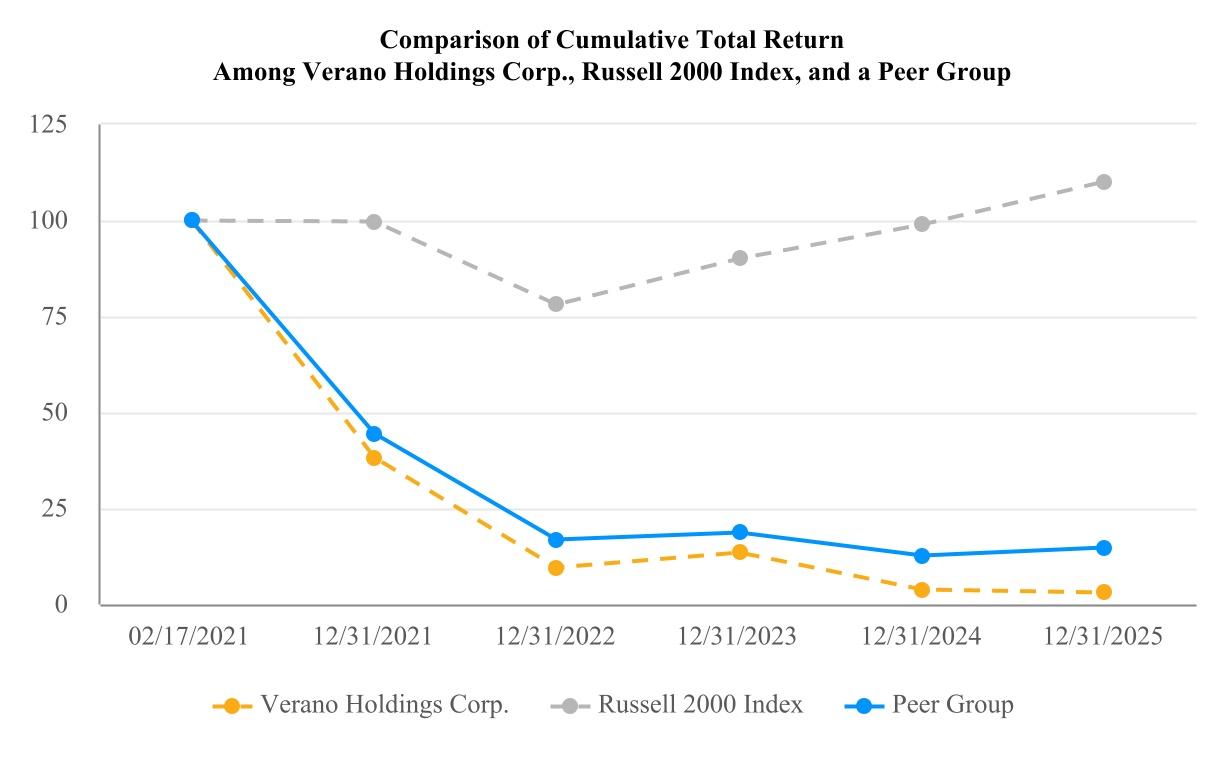
| Base Period | Years Ending | |||||||||||||||||||||||||||||||||||||
| Company/Index | 2/17/2021 | 12/31/2021 | 12/31/2022 | 12/31/2023 | 12/31/2024 | 12/31/2025 | ||||||||||||||||||||||||||||||||
| Verano Holdings Corp. | 100 | 38.22 | 9.62 | 13.47 | 3.71 | 3.01 | ||||||||||||||||||||||||||||||||
| Russell 2000 Index | 100 | 99.52 | 78.07 | 89.85 | 98.85 | 110.01 | ||||||||||||||||||||||||||||||||
| Peer Group | 100 | 44.31 | 16.89 | 18.63 | 12.74 | 14.67 | ||||||||||||||||||||||||||||||||
Below are the specific companies included in the peer group.
| Peer Group Companies | |||||
–Cresco Labs Inc. | –Trulieve Cannabis Corp. | ||||
–Curaleaf Holdings, Inc. | –Green Thumb Industries Inc. | ||||
Repurchases
During the year ended December 31, 2025, the Company did not repurchase any securities.
78
ITEM 6. [RESERVED]
79
ITEM 7. MANAGEMENT’S DISCUSSION AND ANALYSIS OF FINANCIAL CONDITION AND RESULTS OF OPERATIONS
This discussion contains forward-looking statements that involve risks and uncertainties. Our actual results could differ materially from those projected, forecasted, or expected in these forward-looking statements as a result of various factors, including, but not limited to, those discussed below and elsewhere in this Form 10-K. See “Cautionary Note on Forward-Looking Statements” and “Risk Factors” in this Form 10-K. Our management believes the assumptions underlying the Company’s financial statements and accompanying notes are reasonable. However, the Company’s financial statements and accompanying notes may not be an indication of our financial condition and results of operations in the future. We have omitted discussion of the earliest of the three years covered by our consolidated financial statements presented in this report because that disclosure was already included in our Annual Report on Form 10-K for the fiscal year ended December 31, 2024, filed with the SEC on February 27, 2025. You are encouraged to reference Part II, Item 7, within that report, for a discussion of our financial condition and result of operations for the fiscal year ended December 31, 2024 compared to the fiscal year ended December 31, 2023.
This management discussion and analysis (this “MD&A”) of the financial condition and results of operations of Verano is for the years ended December 31, 2025 and December 31, 2024. It is supplemental to, and should be read in conjunction with, the Company’s audited consolidated financial statements and the accompanying notes for the years ended December 31, 2025 and December 31, 2024. The financial statements referenced in this MD&A are prepared in accordance with U.S. GAAP. Financial information presented in this MD&A is presented in United States dollars (“$” or “US$”) and expressed in thousands, unless otherwise indicated.
80
OVERVIEW OF THE COMPANY
Verano Holdings Corp., a Nevada corporation (“Verano,” the “Company,” “we,” “us,” or “our”), one of the U.S. cannabis industry’s leading companies based on historical revenue, geographical scope and brand performance, is a vertically integrated, multi-state operator embracing a mission of saying Yes to plant progress and the bold exploration of cannabis. As an operator of licensed cannabis cultivation, processing, wholesale distribution and retail facilities, our goal is to support communal wellness by providing responsible access to regulated medical and adult use cannabis products. As of March 10, 2026, through our subsidiaries and affiliates we operate businesses in 13 states, including 160 retail dispensaries and 14 cultivation and processing facilities with over 1.1 million square feet of cultivation capacity. We produce a wide variety of cannabis products sold under our portfolio of consumer brands, including Encore™, Avexia™, MÜV™, Savvy™, (the) Essence™, BITS™, HYPHEN™, Swift Lifts™ and Verano™. We also design, build and operate branded dispensaries operating under the Zen Leaf™ and MÜV™ retail banners, among others, that deliver a cannabis shopping experience in both medical and adult use markets.
Notwithstanding the permissive regulatory environment of medical, and in some cases, also adult use (i.e., recreational) cannabis, at the state level, it remains illegal under U.S. federal law to cultivate, manufacture, distribute, sell or possess cannabis in the U.S. Because federal law prohibits transporting any federally restricted substance across state lines, cannabis cannot be transported across state lines. As a result of current federal law prohibitions, the U.S. cannabis industry is conducted on a state-by-state basis. To date, in the U.S. 40 states plus the District of Columbia and the U.S. territories of Puerto Rico, Guam, the Commonwealth of Northern Marina Islands, and the U.S. Virgin Islands have authorized comprehensive medical cannabis programs, 24 states plus the District of Columbia and the U.S. territories of Guam, the Commonwealth of Northern Mariana Islands, and the U.S. Virgin Islands have authorized comprehensive programs for medical and adult use (i.e. recreational) cannabis, and eight states allow the use of low THC and high CBD products for specified medical uses. Verano operates within states where cannabis use, medical or both medical and adult use, has been approved by state and local regulatory bodies. Strict compliance with state and local laws with respect to cannabis may neither absolve the Company of liability under U.S. federal law, nor may it provide a defense to any federal proceeding which may be brought against the Company or any of its subsidiaries. On December 18, 2025, President Trump issued the Executive Order which directs federal agencies to expedite the process of rescheduling cannabis from a Schedule I to a Schedule III controlled substance under the CSA. The effect of the Executive Order may be that the cultivation, manufacturing, distribution, sale or possession of cannabis in the U.S. is no longer federally illegal and would lessen criminal penalties at the federal level and remove Section 280E tax considerations, however, the final effects of the Executive Order are dependent on other government actions. Despite such actions and the ongoing rule making process, there can be no guarantees that the rescheduling rule making process will continue on a certain timeline or at all under this administration or that any rules will come out of the rule making process that will benefit the Company. The Executive Order, and agency implementation of the Executive Order does not federally legalize adult use and would not federally authorize or approve state sanctioned medical programs. Cannabis would still be subject to the same FDA drug approval process as all other substances, and sales outside of FDA approval, would still be criminal at the federal level.
Substantially all of the Company’s business, operating results and financial condition relate to U.S. cannabis-related activities. Our strategy is to vertically integrate as a single cohesive company in multiple states through the consolidation of seed-to-sale cultivating, manufacturing, distributing, and dispensing cannabis brands and products at scale. Our cultivation, processing and distribution of cannabis consumer packaged goods are designed to support our retail dispensaries, as well as to develop and foster long term wholesale supply relationships with third-party retail operators. Our model includes establishing a diverse geographic footprint that allows us to adapt to changes in both industry and market conditions.
The United States government has recently adopted new approaches to trade policy and has announced tariffs on certain foreign goods and the possibility of significant additional tariff increases or expansions of tariffs. On February 20, 2026, the U.S. Supreme Court ruled that certain broad tariffs previously imposed under the IEEPA were unauthorized, leading to the termination of those specific duties. However, President Trump has since invoked Section 122 of the Trade Act to impose a new 15% global import tariff. The timing and scope of further tariffs by the United States, including potential congressional extensions of the 150-day Section 122 surcharge, and retaliatory tariffs by other countries in response to such tariffs is currently uncertain. Such tariffs and the administrative uncertainty surrounding the transition between different statutory tariff regimes could create supply chain disruptions or increased pricing of procured materials, which could impact our current and expansion strategy as well as our business, operating results and financial condition. See “Risk Factors” in Part I, Item 1A in this Form 10-K.
81
SELECTED RESULTS OF OPERATIONS
The following presents selected financial data derived from the audited consolidated financial statements for the years ended December 31, 2025 and 2024. The selected consolidated financial information below may not be indicative of the Company’s future performance.
Year Ended December 31, 2025, as Compared to Year Ended December 31, 2024
| For the Years Ended December 31, | ||||||||||||||||||||
| ($ in thousands) | 2025 | 2024 | $ Change | |||||||||||||||||
| Revenues, net of Discounts | $ | 821,504 | $ | 878,585 | $ | (57,081) | ||||||||||||||
| Gross Profit | 413,497 | 443,931 | (30,434) | |||||||||||||||||
| Net Loss attributable to Verano Holdings Corp. & Subsidiaries | (257,908) | (341,859) | 83,951 | |||||||||||||||||
| Net Loss per share – basic & diluted | $ | (0.71) | $ | (0.98) | $ | 0.27 | ||||||||||||||
Revenues, net of Discounts
Revenues, net of discounts for the year ended December 31, 2025 was $821,504, a decrease of $(57,081) or (6.5)%, compared to revenues, net of discounts of $878,585 for the year ended December 31, 2024. The year-over-year decrease in revenues, net of discounts, was driven primarily by third-party price compression in established markets coupled with the Company's accounts receivable strategy in the cultivation (wholesale) segment, of maintaining a number of accounts on hold for non-payment. This was partially offset by an increase in the retail segment revenues, net of discounts, driven by product availability in the Florida market and the acquisition of CC East Virginia and Cannabist AZ in August 2024, which increased the Company’s retail footprint. During the year ended December 31, 2025, the Company opened seven new retail stores, two in Connecticut, three in Florida, one in Ohio and one in West Virginia. Retail revenues, net of discounts, for the year ended December 31, 2025 comprised 67.9% of revenues, net of discounts, compared to 65.5% of revenues, net of discounts, for the year ended December 31, 2024, excluding intersegment eliminations. Cultivation (wholesale) revenues, net of discounts, made up 32.1% of revenues, net of discounts for the year ended December 31, 2025, as compared to 34.5% for the year ended December 31, 2024, excluding intersegment eliminations. Please see “Results of Operations by Segment” for information regarding year over year performance of our retail revenue and cultivation (wholesale) revenues.
Gross Profit
Gross profit for the year ended December 31, 2025 was $413,497, representing a gross profit margin of 50.3%. This is compared to gross profit for the year ended December 31, 2024 of $443,931, representing a 50.5% gross profit margin. The slight decrease was primarily driven by overall top-line revenue decline coupled with increased promotional activity in established markets, partially offset by more efficient harvests from expanded cultivation facilities.
Net Loss
Net Loss attributable to the Company for purposes of this “Management’s Discussion and Analysis”, for the year ended December 31, 2025, was $(257,908) a decrease of $83,951, compared to a Net Loss of $(341,859) for the year ended December 31, 2024. The decrease in net loss year-over-year was attributable to lower comparative impairments and lower operating expenses, partially offset by a higher provision for income taxes for the year ended December 31, 2025, when compared to the year ended December 31, 2024.
82
| For the Years Ended December 31, | ||||||||||||||||||||
| ($ in thousands) | 2025 | 2024 | $ Change | |||||||||||||||||
| Cost of Goods Sold, net | $ | 408,007 | $ | 434,654 | $ | (26,647) | ||||||||||||||
| Total Operating Expenses | 520,590 | 681,107 | (160,517) | |||||||||||||||||
| Other Income (Expense), net | (59,137) | (62,739) | 3,602 | |||||||||||||||||
| Provision for Income Taxes | (91,678) | (41,944) | (49,734) | |||||||||||||||||
Cost of Goods Sold, net
Cost of goods sold, net includes the costs directly attributable to product sales and includes amounts paid for finished goods, such as flower, edibles, and concentrates, as well as packaging and other supplies, fees for services and processing, rent, utilities, and related costs. Cost of goods sold, net, for the year ended December 31, 2025 was $408,007, a decrease of $(26,647) or (6.1)%, from the year ended December 31, 2024. The decrease was primarily driven by overall decline in top-line revenue coupled with more efficient harvests from expanded cultivation facilities. Additionally, the decrease was also attributable to third party price compression in the cultivation (wholesale) segment.
Total Operating Expenses
Total operating expenses for the year ended December 31, 2025 were $520,590, a decrease of $(160,517) or (23.6)%, compared to total operating expenses of $681,107 for the year ended December 31, 2024. For the years ended December 31, 2025 and December 31, 2024, total operating expenses included selling, general and administrative expenses (“SG&A”), impairments of intangibles - goodwill and impairments of intangibles, fixed assets and held for sale assets.
SG&A expenses as a percentage of revenues, net of discounts, was 41.1% and 40.2% for the years ended December 31, 2025 and 2024, respectively. The year over year decrease in SG&A was driven by a decrease in depreciation and amortization expense coupled with ongoing efficiencies generated across the business for the year ended December 31, 2025 when compared to the year ended December 31, 2024.
During the year ended December 31, 2025, the Company recorded goodwill impairment charges of (i) $40,827 associated with its Connecticut cultivation (wholesale) reporting unit, (ii) $35,649 associated with its Illinois retail reporting unit, (iii) $8,377 associated with its Connecticut retail reporting unit, and (iv) $1,738 associated with its Arizona retail reporting unit, as the carrying values of the reporting units exceeded the estimated fair value by such amounts. Comparatively, during the year ended December 31, 2024, the Company recognized impairment charges of $8,179 associated with its Arizona cultivation (wholesale) reporting unit.
During the year ended December 31, 2025, the Company determined that a license associated with its Pennsylvania cultivation (wholesale) reporting unit was impaired and as such, the Company recorded intangible asset impairment charges of $90,849. Additionally, during the year ended December 31, 2025 the Company recorded a fixed asset impairment charge of $428 associated with a Massachusetts cultivation facility as the carrying value exceeded the fair value by such amount and an impairment charge of $5,400 resulting from a reduction in the carrying value of a cultivation facility in Pennsylvania. Comparatively, during the year ended December 31, 2024, the Company recorded intangible asset impairment charges of (i) $293,688 related to the Company’s Pennsylvania retail licenses, (ii) $5,687 related to the Company’s Arizona cultivation (wholesale) tradenames, (iii) $34 related to the Company’s Maryland retail tradenames; and (iv) $425 related to the Company’s Arizona cultivation (wholesale) technology, on the remaining net book value. Additionally, during the year ended December 31, 2024, the Company recorded a fixed asset impairment charge of $10,526 associated with an Arizona cultivation facility, and an impairment on a held-for-sale asset related to a cultivation facility in Pennsylvania of $9,160 as the carrying value exceeded the fair value less cost to sell by such amount.
83
Other Income (Expense), net
Other income (expense), net for the year ended December 31, 2025 was $(59,137), a change of $3,602, as compared to other income (expense), net of $(62,739) for the year ended December 31, 2024. The change in other income (expense), net, during the year ended December 31, 2025 was attributable to the voluntary partial payoff agreement for the CC East Virginia Promissory Note resulting in a Gain on Debt Extinguishment partially offset by a Loss on Debt Extinguishment related to the Permitted Partial Optional Prepayment under the 2022 Credit Agreement and a loss of $10,000 related to a litigation settlement. Additionally, the total other income (expense), net variance was attributable to less interest expense on our debt obligations coupled with a Gain on Deconsolidation relating to our Arkansas operations during January 2025, which no longer met the criteria for consolidation as a result of termination of contracts providing us with control over the applicable entity's operations, when comparing the year ended December 31, 2025 to the year ended December 31, 2024.
Provision for Income Taxes
Provision for income taxes for the year ended December 31, 2025 was $91,678, an increase of $49,734 or 118.6% as compared to the year ended December 31, 2024. The year-over-year change in income tax expense was primarily driven by impacts from impairment losses recognized in each respective period. For the year ended December 31, 2024, the provision for income taxes was mainly impacted by the loss on impairment of intangibles and fixed assets. In contrast, for the year ended December 31, 2025, the provision reflected lower impairment losses on intangibles, fixed assets, and assets held for sale. The variation in the amounts of impairment charges between the two years resulted in the comparative fluctuation in income tax expense.
Results of Operations by Segment
The Company has two reportable segments: (i) cultivation (wholesale) and (ii) retail. Due to the vertically integrated nature of our business, the Company reviews revenue at the cultivation (wholesale) and retail levels while reviewing operating results on a consolidated basis.
The following tables summarize revenues, net of discounts, by segment for the years ended December 31, 2025 and 2024:
| For the Years Ended December 31, | ||||||||||||||||||||||||||
| ($ in thousands) | 2025 | 2024 | $ Change | % Change | ||||||||||||||||||||||
| Revenues, net of Discounts | ||||||||||||||||||||||||||
| Cultivation (Wholesale) | $ | 318,389 | $ | 353,476 | (35,087) | (9.9) | % | |||||||||||||||||||
| Retail | 672,661 | 672,252 | 409 | 0.1 | % | |||||||||||||||||||||
| Intersegment Eliminations | (169,546) | (147,143) | (22,403) | 15.2 | % | |||||||||||||||||||||
| Total Revenues, net of Discounts | $ | 821,504 | $ | 878,585 | $ | (57,081) | (6.5) | % | ||||||||||||||||||
Revenues, net of discounts, for the cultivation (wholesale) segment was $318,389 for the year ended December 31, 2025, a decrease of $(35,087) or (9.9)%, excluding intersegment eliminations, compared to the year ended December 31, 2024. Markets that were top contributors to the cultivation (wholesale) revenues, net of discounts were Illinois and New Jersey during the year ended December 31, 2025. The decrease in cultivation (wholesale) revenues, net of discounts, was primarily attributable to the expected third-party price compression in established markets coupled with the Company's accounts receivable strategy, which was to maintain a number of accounts on hold for non-payment when comparing the year ended December 31, 2025 to the year ended December 31, 2024.
Revenues, net of discounts, for the retail segment was $672,661 for the year ended December 31, 2025, an increase of $409 or 0.1%, excluding intersegment eliminations, compared to the year ended December 31, 2024. Top contributors to retail revenues, net of discounts, during the year ended December 31, 2025, were mainly in the Florida, New Jersey and Illinois markets coupled with the acquisition of CC East Virginia and Cannabist AZ in August 2024, which increased the Company’s retail footprint. In addition, when comparing the year ended December 31, 2025 to the year ended December 31, 2024, the increase in retail revenues, net of discounts, was driven by product availability in the Florida market.
84
Drivers of Operational Performance
Revenue
The Company derives its revenue from both its cultivation (wholesale) business in which it cultivates, produces and sells cannabis products to third-party retail customers, and its retail business, in which it directly sells cannabis products to retail patients and consumers. For the year ended December 31, 2025, approximately 32.1% of the Company’s revenue was generated from the cultivation (wholesale) business and approximately 67.9% from the retail business, excluding intersegment eliminations. For the year ended December 31, 2024, approximately 34.5% of the Company’s revenue was generated from the cultivation (wholesale) business and approximately 65.5% from the retail business, excluding intersegment eliminations.
Gross Profit
Gross profit is revenue less cost of goods sold, net. Cost of goods sold includes the costs directly attributable to product sales and includes amounts paid for finished goods, such as flower, edibles, and concentrates, as well as packaging and other supplies, fees for services and processing, rent, utilities, and related costs. Cannabis costs are affected by various state regulations that limit the sourcing and procurement of cannabis product, which may create fluctuations in gross profit over comparative periods as the regulatory environment changes. Gross profit margin measures the Company’s gross profit as a percentage of revenue.
The Company’s expansion strategy and revenue growth have taken priority and will continue to do so for the foreseeable future as it expands its footprint, by exploring new markets and opening or acquiring new dispensary locations, and scales production within certain markets. In the core markets in which the Company is already operational and, as the state markets mature, the Company has experienced pressure on margins within the cultivation (wholesale) and retail channels and expects this to continue as markets mature. The Company’s current production capacity has not been fully realized and it is expected that price compression at the cultivation (wholesale) level, will be partially offset by operational optimization.
Total Expenses
Total expenses other than the cost of goods sold consist of selling costs to support customer relationships and to deliver product to the Company’s retail stores. It also includes a significant investment in the corporate infrastructure required to support ongoing business.
Selling costs generally correlate to revenue. As a percentage of sales, selling costs are expected to continue to increase slightly in currently operational markets as facility and market expansion occurs. The increase is expected to continue to be driven primarily by the growth of the Company’s retail and cultivation (wholesale) channels and new retail openings.
SG&A expenses also include personnel costs incurred, including salaries, incentive compensation, benefits, stock-based compensation and professional service costs. SG&A expenses may increase in connection with supporting the business and the Company could experience an increase in expenses related to recruiting and hiring talent, along with legal and professional fees associated with being a public-reporting company.
Provision for Income Taxes
The Company is subject to income taxes in the jurisdictions in which it operates and, consequently, income tax expense is a function of the allocation of taxable income by jurisdiction and the various activities that impact the timing of taxable events. As the Company operates in the cannabis industry, it is subject to the limits of Section 280E of the Code under which the Company is only allowed to deduct expenses directly related to the sale of products. This results in permanent differences between ordinary and necessary business expenses deemed non-allowable under Section 280E of the Code and a higher effective tax rate than most industries. The Company has taken a position that it does not owe taxes attributable to the application of Section 280E of the Code.
85
LIQUIDITY, FINANCING ACTIVITIES AND CAPITAL RESOURCES
As of December 31, 2025 and 2024, the Company had total current liabilities of $140,261 and $203,112, respectively, and had cash and cash equivalents of $82,724 and $87,796, respectively, to meet its current obligations. The Company had working capital of $264,390 and $159,541, for the years ended December 31, 2025 and 2024, respectively. This increase in working capital of $104,849 for the year ended December 31, 2025 when compared to the year ended December 31, 2024, was attributable to an increase in inventory driven by higher production volumes and more efficient harvests from expanded cultivation facilities coupled with a reduced income tax payable balance due in part to the Company's treatment of Section 280E of the Code which shifted a portion of the short-term liability to a long-term liability on the Company's Condensed Consolidated Balance Sheets.
The Company generates cash from revenues and deploys its capital to acquire and develop assets capable of producing additional revenues and earnings over both the immediate and long term. Capital is primarily being utilized for facility improvements, strategic investment opportunities, and general and administrative expenses.
Liquidity Requirements
Our short-term liquidity requirements consist primarily of funds necessary to pay for our acquisitions, to repay borrowings, maintain our operations and other general business needs. We believe that internally generated funds and other sources of liquidity discussed below will be sufficient to meet working capital needs, capital expenditures, and other business requirements for at least the next 12 months. We believe we will meet known or reasonably likely future cash requirements through the combination of cash generated from operating activities, available cash balances and available borrowings. If these sources of liquidity need to be augmented, additional cash requirements would likely be financed through the issuance of equity securities or additional borrowings; however, there can be no assurances that we will be able to obtain additional equity financing or debt financing on acceptable terms, or on terms similar to our existing financings, in the future.
Our long-term liquidity requirements consist primarily of completing additional acquisitions, scheduled debt payments, future payments of income tax payables, maintaining and expanding our operations and other general business needs. We expect to meet our long-term liquidity requirements through various sources of capital, which may include future debt or equity issuances, net cash provided by operations and other secured and unsecured borrowings. We believe that the foregoing sources of capital will provide sufficient funds for our operations, anticipated expansion and scheduled debt payments for the long-term. Our ability to fund our operating needs will depend on our future ability to continue to generate positive cash flow from operations and our ability to obtain debt or equity financing on acceptable terms.
86
2022 Credit Facility
On October 27, 2022, Verano and certain of its subsidiaries and affiliates, as the Borrowers, entered into the 2022 Credit Agreement with Chicago Atlantic, as administrative agent for the Lenders, and the Lenders party thereto, pursuant to which the Lenders advanced the Borrowers a $350,000 senior secured term loan, and which also provides the Borrowers with the right, subject to conditions, to request an additional incremental term loan of up to $100,000; provided that the Lenders elect to fund such incremental term loan. At funding, all the proceeds of the loans made under the 2022 Credit Agreement were used to repay the amounts owing under the Company's previous senior secured term loan credit facility. In connection with such repayment, such previous credit facility was terminated and is no longer in force or effect.
The 2022 Credit Agreement provides the Borrowers with the right, subject to conditions, to request an additional incremental term loan in the aggregate principal amount of up to $100,000; provided that the Lenders elect to fund such incremental term loan. Beginning in October 2023, the loan requires scheduled amortization payments of $350 per month and the remaining principal balance is due in full on October 30, 2026.
The 2022 Credit Agreement also provides the Borrowers with the right to (a) incur up to $120,000 of additional indebtedness from third-party lenders secured by real estate excluded as collateral under the 2022 Credit Agreement, (b) incur additional mortgage financing from third-party lenders secured by real estate acquired after the closing date, and (c) upon the SAFE Banking Act or similar legislation making banking services available to U.S. cannabis companies being passed by the United States Congress, incur up to $50,000 pursuant to a revolving credit facility from third-party lenders that is pari passu or subordinated to the 2022 Credit Agreement obligations, each of which are subject to customary conditions.
The obligations under the 2022 Credit Agreement are secured by substantially all of the assets of the Borrowers, excluding vehicles, specified parcels of real estate and other customary exclusions.
The 2022 Credit Agreement provides for a floating annual interest rate equal to the prime rate then in effect plus 6.50%, which rate may be increased by 3.00% upon an event of default that is not a material event of default or 6.00% upon a material event of default as provided in the 2022 Credit Agreement.
At any time, the Company may voluntarily prepay up to $100,000 of the principal balance, subject to a one-time $1,000 prepayment premium upon the first prepayment, and may prepay the remaining outstanding principal balance for a prepayment premium at varying rates based on the timing of any subsequent prepayments. The Borrowers may not voluntarily prepay more than $100,000 of the principal balance without prepaying the entire outstanding principal balance of the loan.
On April 30, 2024, the Company made a Permitted Partial Optional Prepayment (as defined in the 2022 Credit Agreement) in the amount of $50,000 pursuant to the 2022 Credit Agreement and paid a $1,000 prepayment premium in connection therewith. In connection with such Permitted Partial Optional Prepayment, Chicago Atlantic and certain Lenders agreed to (a) release certain Borrowers from their obligations under, and as parties to, the 2022 Credit Agreement and related agreements and (b) release all liens over such Borrowers’ property, including real estate, held by Chicago Atlantic for the benefit of the Lenders, in each case, pursuant to a limited consent and waiver, dated as of April 29, 2024, by and among Borrowers, certain of the lenders party thereto and Chicago Atlantic.
On September 30, 2025, the Company made a Permitted Partial Optional Prepayment (as defined in the 2022 Credit Agreement) in the amount of $50,000 pursuant to the 2022 Credit Agreement, without any penalty or premium.
The 2022 Credit Agreement includes customary representations, warranties, covenants and customary events of default, including, without limitation, payment defaults, breaches of representations and warranties, covenant defaults, cross-defaults to material indebtedness, and events of bankruptcy and insolvency.
The 2022 Credit Agreement also includes customary negative covenants limiting the Borrowers’ ability to incur additional indebtedness and grant liens that are not otherwise permitted, and the ability to enter into or consummate acquisitions or dispositions that are not otherwise permitted, among others. Additionally, the 2022 Credit Agreement requires the Borrowers to meet certain financial tests regarding minimum cash balances, minimum levels of Adjusted EBITDA (as defined in the 2022 Credit Agreement) and a minimum fixed charge coverage ratio.
As of December 31, 2025, the Company was in compliance with such covenants.
George Archos, the Chairman and Chief Executive Officer of the Company, participated in the 2022 Credit Agreement as a lender funding $1,000 of the $350,000 principal amount. Mr. Archos is excluded from certain approval rights of the lenders and any penalties and fees due to Mr. Archos under the 2022 Credit Agreement are immaterial to the Company.
87
Revolver
On September 30, 2025, the Company entered into the Revolver, by and among the Company, as a guarantor, the Real Estate Subsidiaries, lenders from time-to-time party thereto, and Chicago Atlantic, as administrative agent for the lenders.
The Revolver initially provided for a $75,000 revolving loan facility, $50,000 of which was drawn on September 30, 2025 and was used to prepay, without any penalty or premium, $50,000 of outstanding obligations due under the 2022 Credit Agreement. The Revolver provides for a floating annual interest rate on amounts drawn equal to one-month Term SOFR (subject to a minimum 4% SOFR floor) plus 6%, which rate may be increased by 3% upon an event of default or by 6% upon a material event of default as provided in the Revolver. The Company incurred debt issuance costs of $2,210 in connection with the establishment of the Revolver.
The Revolver may be drawn in $2,500 increments upon ten business days prior notice and any outstanding amount under the Revolver may be voluntarily prepaid in $2,500 increments upon five business days prior notice without any penalty or premium, unless such prepayment occurs within six months of the applicable advance, in which case, such prepayment will be subject to a six-month interest make whole. Any amounts prepaid may be redrawn subject to funding requirements set forth therein. The Revolver was initially subject to a borrowing base which required the outstanding principal balance under the Revolver to be equal to or less than 60% of the appraised value, net of certain indebtedness, of the owned real estate serving as collateral for the Revolver from time to time.
On January 12, 2026, the Company, the Real Estate Subsidiaries, the Revolver Lenders and Chicago Atlantic entered into the Revolver First Amendment to Credit Agreement and Omnibus First Amendment to Credit Documents, to amend the Revolver and related credit documents initially entered into on September 30, 2025. The Revolver First Amendment increased the lending commitment of the Revolver from $75,000 to $100,000 and amended the date on which all outstanding amounts are due in full from September 29, 2028 to February 28, 2029. Additionally, the Revolver First Amendment amended the borrowing base for the Revolver to an advance rate of up to 80%, rather than 60%, of the appraised value, net of certain indebtedness, of the owned real estate serving as collateral for the Revolver. The Revolver First Amendment also includes certain other immaterial updates to the Revolver. No additional collateral was pledged to secure the Revolver and certain real estate may be released as collateral upon specified conditions, as originally provided. Amounts drawn under the Revolver do not require amortization payments with all outstanding amounts being due in full on the maturity date of September 29, 2028.
The obligations under the Revolver are secured by substantially all of the assets of the Real Estate Subsidiaries, which primarily consistent of owned real estate, and are guaranteed by the Company on an unsecured basis. Additionally, the Revolver allows for the proportionate release of certain Real Estate Subsidiaries upon request of the Company so long as the outstanding principal balance under the Revolver does not exceed 60% of the appraised value, net of certain indebtedness, of the owned real estate serving as collateral after giving effect to such release.
The Revolver includes customary representations, warranties, covenants and customary events of default, including, without limitation, payment defaults, breaches of representations and warranties, covenant defaults, cross-defaults to material indebtedness, and events of bankruptcy and insolvency. The Revolver also includes customary covenants, including, without limitation, limiting the Real Estate Subsidiaries’ ability to incur additional indebtedness, make guarantees and grant liens that are otherwise not permitted and enter into or consummate acquisitions or dispositions that are not otherwise permitted, among others. As of December 31, 2025, the Company was in compliance with such covenants.
88
Revolver First Amendment
On January 12, 2026, the Company, the Real Estate Subsidiaries, the Revolver Lenders and Chicago Atlantic entered into a First Amendment (the “Revolver First Amendment”) to Credit Agreement and Omnibus First Amendment to Credit Documents, to amend the Revolver and related credit documents initially entered into on September 30, 2025. The Revolver First Amendment increased the lending commitment of the Revolver from $75,000 to $100,000 and amended the date on which all outstanding amounts are due in full from September 29, 2028 to February 28, 2029. Additionally, the Revolver First Amendment amended the borrowing base for the Revolver to an advance rate of up to 80%, rather than 60%, of the appraised value, net of certain indebtedness, of the owned real estate serving as collateral for the Revolver. The Revolver First Amendment also includes certain other immaterial updates to the Revolver. No additional collateral was pledged to secure the Revolver and certain real estate may be released as collateral upon specified conditions, as originally provided. Amounts drawn under the Revolver do not require amortization payments with all outstanding amounts being due in full on the maturity date of February 28, 2029. On March 11, 2026, the Company drew $50,000 under the Revolver, bringing the total amount drawn under the Revolver to $100,000, which was used to repay the amounts owing under the 2022 Credit Agreement.
2026 Credit Agreement
On March 11, 2026, Verano and certain of its subsidiaries and affiliates from time-to-time party thereto (collectively, the “2026 Borrowers”), entered into a Credit Agreement (the “2026 Credit Agreement”) with Needham Bank (“Needham”), as collateral agent and administrative agent for the lenders, Chicago Atlantic Financial Services, LLC, as co-administrative agent for the lenders, and the lenders from time-to-time party thereto (the “2026 Lenders”), pursuant to which the 2026 Lenders advanced the 2026 Borrowers a $195,000 senior secured term loan, all of which was used to repay the amounts owing under the 2022 Credit Agreement. In connection with such repayment, the Company paid a prepayment premium of approximately $4,345 and the 2022 Credit Agreement was terminated and is no longer in force or effect. Beginning in April 2026, Verano will be required to make scheduled amortization payments of $875 per month and the remaining principal balance is due in full on March 11, 2029; provided that the maturity date may be extended to March 11, 2030 upon the election of the Company, the payment of 1.5% of the then outstanding principal balance by the Company, and the consent of the 2026 Lenders. The 2026 Credit Agreement may be prepaid in part (in increments of $5,000 and in an amount not less than $10,000) or in full at any time, subject to a 1.5% prepayment premium during the first two years of the 2026 Credit Agreement and 0% thereafter; provided, that if the maturity date is extended to March 11, 2030, the prepayment premium will be 1.5% in all cases.
The obligations under the 2026 Credit Agreement are secured by substantially all of the assets of the 2026 Borrowers, excluding vehicles, specified parcels of real estate, other customary exclusions and subject to compliance with the terms of the 2026 Credit Agreement, entities, assets and parcels of real estate acquired after the closing of the 2026 Credit Agreement. The 2026 Credit Agreement provides for a floating annual interest rate equal to one-month Term SOFR (subject to a minimum 4% SOFR floor) plus 5.5%, which rate may be increased by 5% upon an event of default as provided in the 2026 Credit Agreement. The 2026 Credit Agreement included customary representations and warranties, covenants and customary events of default, including, without limitation, payment defaults, breaches of representations and warranties, covenant defaults, cross-defaults to material indebtedness, and events of bankruptcy and insolvency.
Additionally, the 2026 Credit Agreement requires the Borrowers to meet certain financial tests regarding minimum cash balances and a minimum fixed charge coverage ratio.
George Archos, the Chairman, Chief Executive Officer and President of the Company, funded, through an affiliated entity, $10,000,000 of the amount provided by a 2026 Lender. As a result of this participation, Mr. Archos will receive his pro rata share of all interest and principal payments made by the Company to such 2026 Lender under the 2026 Credit Agreement.
89
Columbia Care Eastern Virginia LLC
On July 29, 2024, the Company entered into the Virginia EPA to purchase all of the issued and outstanding equity interests of CC East Virginia. The transaction closed on August 21, 2024. Pursuant to the Virginia EPA, the Company issued the CC East Virginia Promissory Note in the amount of $26,700, which was amended to $27,852 on May 27, 2025 in connection with a purchase price adjustment. The CC East Virginia Promissory Note has an estimated fair value of $26,068, and bears interest at a rate of 7% per annum beginning on the closing date, through maturity on the two-year anniversary of the closing date. Subsequently, on May 27, 2025, the Company entered into a waiver and partial payoff agreement related to a portion of the CC East Virginia Promissory Note. During the year ended December 31, 2025, the Company partially extinguished the CC East Virginia Promissory Note.
Mortgage
On March 14, 2025, the Company entered into a loan with Rainbow Realty Group IV, LLC to borrow a principal amount of $12,000 secured by real estate in Coolidge, Arizona and North Las Vegas, Nevada. The loan bears an interest rate of 11% per annum and matures in March 2030.
Tax Liabilities
The Company has U.S. income tax payable liabilities. These income tax payable liabilities will require payment from our liquidity sources, and we believe we have sufficient liquidity for both short-term and long-term payments of our income tax payable liabilities in addition to our other obligations. The Company expects to retain additional cash from operations, due in part to the Company's treatment of Section 280E of the Code as not applying to limit its deduction of ordinary and necessary business expenses.
90
Sources and Uses of Cash
Cash Provided by (Used in) Operating, Investing and Financing Activities
Net cash provided by (used in) operating, investing, and financing activities for the years ended December 31, 2025 and 2024, were as follows:
| For the Years Ended December 31, | ||||||||||||||||||||
| 2025 | 2024 | $ Change | ||||||||||||||||||
| Net Cash Provided by Operating Activities | $ | 52,855 | $ | 112,195 | $ | (59,340) | ||||||||||||||
| Net Cash Used In Investing Activities | (32,601) | (133,251) | 100,650 | |||||||||||||||||
| Net Cash Used In Financing Activities | (25,321) | (65,926) | 40,605 | |||||||||||||||||
Cash Flows from Operating Activities. Cash flow generated from operating activities provides us with a significant source of liquidity. Our cash flows from operating activities result from cash received from our customers, offset by cash payments we make for products and services, operational costs, and income taxes. During the year ended December 31, 2025 and 2024, the Company had net cash inflows of $52,855 and $112,195, respectively. The $59,340 decrease was largely driven by an increase in inventory driven by higher production volumes and more efficient harvests from expanded cultivation facilities coupled with the income tax payments during the year ended December 31, 2025.
Cash Flows from Investing Activities. During the year ended December 31, 2025 and 2024, the Company had net cash outflows of $(32,601) and $(133,251), respectively. The $100,650 decrease in net cash outflows during the year ended December 31, 2025 compared to the year ended December 31, 2024 was primarily driven by lower purchases of property, plant and equipment of $(41,226) during the year ended December 31, 2025, compared to purchases of property, plant and equipment of $(99,048) during the year ended December 31, 2024, as well as acquisition activity during the year ended December 31, 2024.
Cash Flows from Financing Activities. During the year ended December 31, 2025 and 2024, the Company had net cash outflows of $(25,321) and $(65,926), respectively. The $40,605 decrease in net cash outflows during the year ended December 31, 2025 compared to the year ended December 31, 2024 was attributable to proceeds from debt related to the loan with Rainbow Realty Group IV, LLC, which was offset by principal repayments of debt during the year ended December 31, 2025. During the year ended December 31, 2024, the net cash outflow was primarily attributable to the Company's Permitted Partial Optional Prepayment (as defined in the 2022 Credit Agreement) pursuant to the 2022 Credit Agreement.
The Company expects capital expenditures for 2026 to be between $30,000 and $50,000. The Company’s 2026 capital expenditures are expected to support cultivation operational efficiency, selective expansion of retail operations in existing and potential new markets, retail store enhancements, and continued investment in technology and infrastructure.
91
Changes in or Adoption of Accounting Practices
Refer to the discussion of recently adopted/issued accounting pronouncements within the Notes to the Consolidated Financial Statements, Note 2 — Significant Accounting Policies.
CRITICAL ACCOUNTING ESTIMATES
The preparation of the Company’s consolidated financial statements requires management to make judgments, estimates and assumptions that affect the application of policies and reported amounts of assets and liabilities, and revenue and expenses. Actual results may differ from these estimates. The estimates and underlying assumptions are reviewed by the Company on an ongoing basis. Revisions to accounting estimates are recognized in the period in which the estimate is revised if the revision affects only that period or in the period of the revision and future periods if the review affects both current and future periods. Significant judgments, estimates, and assumptions that have the most significant effect on the amounts recognized in the consolidated financial statements are described below.
Goodwill and Indefinite-lived Intangible Asset Impairment
Goodwill and indefinite-lived intangible assets are evaluated for impairment annually during the fourth quarter, or more frequently if an event occurs or circumstances change that could more likely than not reduce the fair value of a reporting unit or indefinite-lived intangible asset below its carrying value. In performing our annual goodwill impairment test, we may start with an optional qualitative assessment as allowed for under the accounting guidance. As part of the qualitative assessment, we evaluate all events and circumstances, including both positive and negative events, in their totality, to determine whether it is more likely than not that the fair value of a reporting unit is less than its carrying amount. If we bypass the qualitative assessment, or if the qualitative assessment indicates that a quantitative analysis should be performed, we perform a quantitative test for impairment. As part of the Company’s quantitative impairment analysis, the fair value of a reporting unit or indefinite-lived intangible asset is generally determined using both the income and market approaches. The income approach requires management to estimate a number of factors for each reporting unit or indefinite-lived intangible asset, including projected future operating results, economic projections, anticipated future cash flows and discount rates. The market approach estimates fair value using comparable marketplace fair value data from within a comparable industry grouping, as well as recent guideline transactions.
The determination of the fair value of the reporting units or indefinite-lived intangible assets requires the Company to make significant estimates and assumptions with respect to the business and financial performance of the Company’s reporting units or indefinite-lived intangible assets. These estimates and assumptions primarily include, but are not limited to, the selection of appropriate peer group companies, control premiums appropriate for acquisitions in the industries in which we compete, discount rates, terminal growth rates, forecasts of revenue, operating income, depreciation, amortization, working capital requirements and capital expenditures. With regard to the Company’s goodwill reporting units, the Company also compares the sum of estimated fair values of reporting units to the Company’s fair value as implied by the market value of its equity. This comparison provides an indication that, in total, assumptions and estimates are reasonable. Future declines in the overall market value of the Company’s equity securities may provide an indication that the fair value of one or more reporting units has declined below its carrying value.
Although the Company believes its estimates of fair value are reasonable, actual financial results could differ from those estimates due to the inherent uncertainty involved in making such estimates. Changes in assumptions concerning future financial results or other underlying assumptions, could have a significant impact on either the fair value of the reporting units and indefinite-lived intangibles, the amount of any goodwill and indefinite-lived intangible impairment charges, or both. These estimates can be affected by a number of factors including, but not limited to, general economic conditions, availability of market information as well as the Company's profitability. The Company continues to monitor these potential impacts and economic, industry and market trends, and the impact these may have on the reporting units or indefinite-lived intangible assets.
92
Finite-Lived Intangible Assets and Other Long-lived Assets Recoverability
The Company evaluates the recoverability of finite-lived intangible assets and other long-lived assets whenever events or changes in circumstances indicate that the carrying value of such an asset may not be recoverable. The evaluation of finite-lived intangible assets and other long-lived assets is performed at the lowest level of identifiable cash flows.
If the asset group fails the recoverability test, then an impairment charge is determined based on the difference between the fair value of the asset group compared to its carrying value. The fair value of the long-lived assets included in an impaired asset group may be determined using an income, market, or cost approach, or a combination thereof. The income approach utilizes assumptions including management’s best estimates of the expected future cash flows and the estimated useful life of the asset group. The cost approach utilizes assumptions for the current replacement costs of similar assets adjusted for estimated depreciation and deterioration of the existing equipment and economic obsolescence. The market approach requires the use of judgment in evaluating market comparable assets.
The determination of the fair value of the asset group requires management to estimate a number of factors including anticipated future cash flows, discount rates, and the identification of market comparable assets. Although we believe these estimates are reasonable, actual results could differ from those estimates due to the inherent uncertainty involved in making such estimates.
Business Combinations
In a business combination, all identifiable assets, liabilities and contingent liabilities acquired are recorded at their fair values. The determination of fair values of assets and liabilities acquired requires estimates and the use of valuation techniques when market value is not readily available. For any intangible asset identified, depending on the type of intangible asset and the complexity of determining its fair value, an independent valuation expert or management may develop the fair value, using appropriate valuation techniques, which are generally based on a forecast of the total expected future net cash flows. For intangible assets, the Company generally uses the income approach to determine fair value. The income approach requires management to make significant estimates and assumptions. These estimates and assumptions primarily include, but are not limited to, discount rates, terminal growth rates, royalty rates, forecasts of revenue, operating income, depreciation, amortization and capital expenditures. The discount rates applied to the projections reflect the risk factors associated with those projections. Judgment is also required in determining the intangible asset’s useful life.
Although the Company believes its estimates of fair value are reasonable, actual financial results could differ from those estimates due to the inherent uncertainty involved in making such estimates. Changes in assumptions concerning future financial results or other underlying assumptions could have a significant impact on the determination of the fair value of the intangible assets acquired. Certain fair values may be estimated at the transaction date pending confirmation or completion of the valuation process. Where provisional values are used in accounting for a business combination, they may be adjusted in subsequent periods.
Provision for Income Tax
Provision for income taxes are made using the best estimate of the amount expected to be paid based on a qualitative assessment of all relevant factors. The Company reviews the adequacy of these provisions at the end of the reporting period. Although we believe our assumptions, judgments and estimates are reasonable, changes in tax laws or our interpretation of tax laws and the resolution of any tax audits could significantly impact the amounts provided for income taxes.
We recognize tax benefits from uncertain tax positions only if we believe that it is more likely than not that the tax position will be sustained on examination by the taxing authorities based on the technical merits of the position. These uncertain tax positions include our estimates related to uncertainties that are based on an assessment of whether our available documentation corroborating the nature of our activities supporting the tax positions will be sufficient. However, it is possible that at some future date an additional liability could result from audits by taxing authorities. If the final outcome of these tax related matters is different from the amounts that were initially recorded, such differences will affect the tax provisions in the period in which such determination is made. The IRS has taken the position that cannabis companies are subject to the limits of Section 280E of the Code under which they are only allowed to deduct expenses directly related to costs of goods sold. The Company has taken a position that its deduction of ordinary and necessary business expenses is not limited by Section 280E of the Code.
93
ITEM 7A. QUANTITATIVE AND QUALITATIVE DISCLOSURES ABOUT MARKET RISK
Financial Risk Management
The Company is exposed, to varying degrees, to a variety of financial instrument related risks. The Board and the Audit Committee mitigate these risks by assessing, monitoring and approving the Company’s risk management processes:
Credit Risk
The Company reviews its trade receivable accounts regularly and reduces amounts to their expected realizable values by adjusting the allowance for credit losses when management determines that the account may not be fully collectable. The Company applies ASC 326 Financial Instruments – Credit Losses for the measurement of expected credit losses, which uses an expected loss allowance model for all trade receivables. The Company has adopted standardized credit policies and performs assessments in an effort to minimize those risks.
The Company provides credit to its customers in the normal course of business and has established credit evaluation and monitoring processes to mitigate credit risk, but has limited risk as the majority of its sales are transacted with cash.
Financial instruments that potentially subject the Company to concentrations of banking and credit risk consist primarily of cash and cash equivalents. The Company’s cash and cash equivalents primarily consisted of bank deposits and cash on hand. Concentrations of credit risk with respect to our cash and cash equivalents is limited primarily to amounts held with financial institutions in excess of federally insured limits.
Liquidity Risk
Liquidity risk is the risk that the Company will not be able to meet its financial obligations associated with financial liabilities. The Company manages liquidity risk through the management of its capital structure. The Company’s approach to managing liquidity is to ensure that it will have sufficient liquidity to settle obligations and liabilities when due.
Market Risk
Market risk is the risk of loss arising from adverse changes in market rates and prices, such as interest rates, foreign exchange rates, raw materials and other commodity prices. As domestic economic conditions change, trends in discretionary consumer spending also become unpredictable and subject to reductions due to uncertainties about the future. A general reduction in consumer discretionary spending due to a recession in the domestic economy, or uncertainties regarding future economic prospects, could have a material adverse effect on our results of operations. The Company takes steps to mitigate this risk through diversifying Verano branded products at price points suitable for our customer base.
Interest Rate Risk
Interest rate risk is the risk that the fair value or future cash flows of a financial instrument will fluctuate because of changes in market interest rates. Cash and cash equivalents bear interest at market rates. Management believes that if the Company’s rates of interest associated with its debt obligations were to hypothetically change 10% in the relative interest rate, it would not have a material effect on the Company’s consolidated annual results of operations or cash flows.
Commodities Price Risk
Commodities price risk is the risk of variability in fair value due to movements in equity or market prices. The primary raw materials used by the Company aside from those cultivated internally are labels and packaging. Management believes a hypothetical 10% change in the price of these raw materials would not have a significant effect on the Company’s consolidated annual results of operations or cash flows, as these costs are generally passed through to its customers. However, such an increase could have an impact on our customers’ demand for our products, and we are not able to quantify the impact of such potential change in demand on our combined annual results of operations or cash flows.
94
Banking Risk
Notwithstanding that a majority of states have legalized medical or adult use cannabis, or both, and the Executive Order there has been no change in U.S. federal banking laws related to the deposit and holding of funds derived from activities related to the cannabis industry. Given that U.S. federal law currently provides that the production and possession of cannabis is illegal, there is a strong argument that banks cannot accept for deposit, funds from businesses involved with the cannabis industry. Consequently, businesses involved in the cannabis industry often have difficulty accessing the U.S. banking system and traditional financing sources. The inability to open bank accounts with certain institutions may make it difficult to operate the businesses of the Company and leaves their cash holdings vulnerable.
Asset Forfeiture Risk
Because the cannabis industry remains illegal under U.S. federal law, any property owned by participants in the cannabis industry, which either are used in the course of conducting such business, or are the proceeds of such business, could be subject to seizure by law enforcement and subsequent civil asset forfeiture. Even if the owner of the property was never charged with a crime, the property in question could still be seized and subject to an administrative proceeding by which, with minimal due process, it could be subject to forfeiture.
Concentration Risk
The Company has substantial operations located in Florida, which accounted for approximately 28% of our consolidated sales as of December 31, 2025, where all sales are for medical products and are generated solely by our retail stores given the vertical integration requirements of Florida’s cannabis regulations. As a result, our business, financial condition, and results of operations are particularly sensitive to economic, regulatory, and competitive conditions in Florida. Should economic conditions deteriorate, competitive pressure intensify, or adverse regulatory changes occur within the region, our results of operations and financial position would be negatively impacted. In addition, Florida is prone to extreme weather events and natural disasters, such as hurricanes, which could cause significant property damage, business interruption, or supply chain disruptions. Insurance coverage for such events may be unavailable, inadequate, or prohibitively expensive. Furthermore, any adverse changes in state law, delays in the potential legalization of adult-use cannabis, or unfavorable regulatory actions could materially impact our business. We continue to monitor these risks and pursue geographic diversification to mitigate potential adverse effects.
Regulatory Risk
Regulatory risk pertains to the risk that the Company’s business objectives are contingent, in part, upon the compliance of regulatory requirements. Due to the nature of the industry, the Company recognizes that regulatory requirements are more stringent and punitive in nature. Any delays in obtaining, or failure to obtain regulatory approvals can significantly delay operational and product development and can have a material adverse effect on the Company’s business, results of operation, and financial condition.
The Company is cognizant of the advent of regulatory changes occurring in the cannabis industry on the city, state, and national levels. Although regulatory outlook on the cannabis industry has been moving in a positive trend, the Company is aware of the effect that unforeseen regulatory changes can have on the goals and operations of the business as a whole.
Tax Risk
Tax risk is the risk of changes in the tax environment that would have a material adverse effect on the Company’s business, results of operations, and financial condition. Currently, state licensed cannabis businesses are assessed a comparatively high effective federal tax rate due to Section 280E of the Code which bars businesses from deducting all expenses except their cost of sales when calculating federal tax liability. The Company has taken a position that its deduction of ordinary and necessary business expenses is not limited by Section 280E of the Code. Any increase in tax levies resulting from additional tax measures may have a further adverse effect on the operations of the Company, while any decrease in such tax levies will be beneficial to future operations.
95
ITEM 8. FINANCIAL STATEMENTS AND SUPPLEMENTARY DATA
The financial information required by Item 8 is located beginning on page F-1 of this report.
ITEM 9. CHANGES IN AND DISAGREEMENTS WITH ACCOUNTANTS ON ACCOUNTING AND FINANCIAL DISCLOSURE
None.
ITEM 9A. CONTROLS AND PROCEDURES
Disclosure Controls and Procedures
Our disclosure controls and procedures are designed to ensure that information we are required to disclose in reports that we file or submit under the Exchange Act is recorded, processed, summarized, and reported within the time periods specified in SEC rules and forms, and that such information is accumulated and communicated to our management, including our Chief Executive Officer and Chief Financial Officer, as appropriate, to allow timely decisions regarding required disclosure. As required by Rule 13a-15(b) and Rule 15d-15(b) under the Exchange Act, our management, including our Chief Executive Officer and Chief Financial Officer, evaluated, as of December 31, 2025, the end of the period covered by this Form 10-K, the effectiveness of our disclosure controls and procedures as defined in Exchange Act Rule 13a-15(e) and Rule 15d-15(e). Based on this evaluation, our Chief Executive Officer and Chief Financial Officer concluded that our disclosure controls and procedures were effective as of the end of the period covered by this Form 10-K.
We believe that a controls system, no matter how well designed and operated, cannot provide absolute assurance that the objectives of the controls systems are met, and no evaluation of controls can provide absolute assurance that all control issues and instances of fraud or error, if any, within a company have been detected.
Management’s Report on Internal Controls over Financial Reporting
Our management is responsible for establishing and maintaining effective internal control over financial reporting as defined in Rules 13a-15(f) and 15d-15(f) under the Exchange Act. This system is designed to provide reasonable assurance regarding the reliability of financial reporting and the preparation of consolidated financial statements for external purposes in accordance with U.S. GAAP. Because of the inherent limitations of internal control over financial reporting, including the possibility of collusion or improper management override of controls, misstatements due to error or fraud may not be prevented or detected on a timely basis.
Our management performed an assessment of the effectiveness of our internal control over financial reporting at December 31, 2025, utilizing the criteria discussed in the “Internal Control – Integrated Framework (2013)” issued by the Committee of Sponsoring Organizations of the Treadway Commission. The objective of this assessment was to determine whether our internal control over financial reporting were effective as of December 31, 2025. Based on management's assessment, management has concluded that our internal controls over financial reporting were effective as of December 31, 2025.
Our disclosure controls and procedures and internal controls over financial reporting are designed to provide reasonable assurance of achieving their objectives as specified above. Management does not expect, however, that our disclosure controls and procedures and internal controls over financial reporting will prevent or detect all error and fraud. Any control system, no matter how well designed and operated, is based upon certain assumptions and can provide only reasonable, not absolute, assurance that its objectives will be met. Further, no evaluation of controls can provide absolute assurance that misstatements due to error or fraud will not occur or that all control issues and instances of fraud, if any, within the Company have been detected.
The effectiveness of the Company’s internal control over financial reporting as of December 31, 2025, has been audited by our independent registered public accounting firm as stated in their report which appears herein.
Changes in Internal Control over Financial Reporting
There have not been any changes in our internal control over financial reporting during the last fiscal quarter of the year ended December 31, 2025, that have materially affected, or are reasonably likely to materially affect, our internal control over financial reporting.
96
ITEM 9B. OTHER INFORMATION
Rule 10b5-1 Trading Plans
During the fourth quarter ended December 31, 2025, none of our directors or officers adopted terminated
Form 8-K Disclosures
Annual Bonus Plan
We are providing the following disclosure in lieu of filing a Current Report on Form 8-K under Item 5.02.
The Board and its Compensation Committee from time to time review the Company’s Annual Bonus Plan as part of compensation oversight. On March 11, 2026, the Board, following the Compensation Committee’s recommendation, adopted amendments to the Company’s Annual Bonus Plan (the “Annual Bonus Plan”) regarding the Continuance, the timing of bonuses payments, and compliance with certain U.S. tax law provisions.
The description of the Annual Bonus Plan is not complete and is qualified in its entirety by reference to the full text of the Annual Bonus Plan, a copy of which is attached to this Annual Report on Form 10-K as Exhibit 10.11 and is incorporated herein by reference.
Credit Agreement
We are providing the following disclosure in lieu of filing a Current Report on Form 8-K under Items 1.01, 1.02, 2.03 and 8.01. Terms that are not defined below are defined elsewhere in this Annual Report on Form 10-K.
Item 1.01 Disclosure – Entry into a Material Definitive Agreement
On March 11, 2026, the 2026 Borrowers entered into the 2026 Credit Agreement with Needham, as collateral agent and administrative agent for the lenders, Chicago Atlantic Financial Services, LLC, as co-administrative agent for the lenders, and 2026 Lenders, pursuant to which the 2026 Lenders advanced the 2026 Borrowers a $195,000,000 senior secured term loan, all of which was used to repay the amounts owing under the 2022 Credit Agreement. In connection with such repayment, the Company paid a prepayment premium of approximately $4,345,000 and the 2022 Credit Agreement was terminated and is no longer in force or effect. Beginning in April 2026, Verano will be required to make scheduled amortization payments of $875,000 per month and the remaining principal balance is due in full on March 11, 2029; provided that the maturity date may be extended to March 11, 2030 upon the election of the Company, the payment of 1.5% of the then outstanding principal balance by the Company, and the consent of the 2026 Lenders. The 2026 Credit Agreement may be prepaid in part (in increments of $5,000,000 and in an amount not less than $10,000,000) or in full at any time, subject to a 1.5% prepayment premium during the first two years of the 2026 Credit Agreement and 0% thereafter; provided, that if the maturity date is extended to March 11, 2030, the prepayment premium will be 1.5% in all cases.
The obligations under the 2026 Credit Agreement are secured by substantially all of the assets of the 2026 Borrowers, excluding vehicles, specified parcels of real estate, other customary exclusions and subject to compliance with the terms of the 2026 Credit Agreement, entities, assets and parcels of real estate acquired after the closing of the 2026 Credit Agreement. The 2026 Credit Agreement provides for a floating annual interest rate equal to one-month Term SOFR (subject to a minimum 4% SOFR floor) plus 5.5%, which rate may be increased by 5% upon an event of default as provided in the 2026 Credit Agreement. The 2026 Credit Agreement included customary representations and warranties, covenants and customary events of default, including, without limitation, payment defaults, breaches of representations and warranties, covenant defaults, cross-defaults to material indebtedness, and events of bankruptcy and insolvency.
Additionally, the 2026 Credit Agreement requires the Borrowers to meet certain financial tests regarding minimum cash balances and a minimum fixed charge coverage ratio.
97
George Archos, the Chairman, Chief Executive Officer and President of the Company, funded, through an affiliated entity, $10,000,000 of the amount provided by a 2026 Lender. As a result of this participation, Mr. Archos will receive his pro rata share of all interest and principal payments made by the Company to such 2026 Lender under the 2026 Credit Agreement.
The foregoing descriptions of the 2026 Credit Agreement are only summaries, do not purport to be complete and are qualified in their entirety by reference to the full texts of the Credit Agreement, which is attached as an exhibit to this Annual Report on Form 10-K.
Item 1.02 Disclosure – Termination of Material Definitive Agreement
As noted above, on March 11, 2026, the Company repaid the amounts owing under the 2022 Credit Agreement. The 2022 Credit Agreement was then terminated and is no longer in force or effect. All information included above to satisfy the disclosure requirements of Item 1.01 is incorporated as disclosure under Item 1.02.
Item 2.03 Disclosure – Creation of a Direct Financial Obligation or an Obligation under an Off-Balance Sheet Arrangement of the Registrant
The information set forth above to satisfy the disclosure requirements of Item 1.01 is incorporated by reference as disclosure under Item 2.03.
Item 8.01 Disclosures – Other Events
On March 11, 2026, the Company drew $50,000,000 under the Revolver, bringing the total amount drawn under the Revolver to $100,000,000, which was used to repay the amounts owing under the 2022 Credit Agreement.
ITEM 9C. DISCLOSURE REGARDING FOREIGN JURISDICTIONS THAT PREVENT INSPECTION
Not applicable.
98
PART III
ITEM 10. DIRECTORS, EXECUTIVE OFFICERS AND CORPORATE GOVERNANCE
The information required by this item is incorporated by reference to our definitive proxy statement for our 2026 Annual Meeting of Stockholders (our “2026 Proxy Statement”), which will be filed with the SEC not later than 120 days subsequent to December 31, 2025.
ITEM 11. EXECUTIVE COMPENSATION
The information required by this item is incorporated by reference to our 2026 Proxy Statement, which will be filed with the SEC not later than 120 days subsequent to December 31, 2025.
ITEM 12. SECURITY OWNERSHIP OF CERTAIN BENEFICIAL OWNER AND MANAGEMENT AND RELATED STOCKHOLDER MATTERS
The information required by this item is incorporated by reference to our 2026 Proxy Statement, which will be filed with the SEC not later than 120 days subsequent to December 31, 2025.
ITEM 13. CERTAIN RELATIONSHIPS AND RELATED TRANSACTIONS, AND DIRECTOR INDEPENDENCE
The information required by this item is incorporated by reference to our 2026 Proxy Statement, which will be filed with the SEC not later than 120 days subsequent to December 31, 2025.
ITEM 14. PRINCIPAL ACCOUNTANT FEES AND SERVICES
The information required by this item is incorporated by reference to our 2026 Proxy Statement, which will be filed with the SEC not later than 120 days subsequent to December 31, 2025.
99
PART IV
ITEM 15. EXHIBITS AND FINANCIAL STATEMENT SCHEDULES
(a)Financial Statement and Schedules
The following Consolidated Financial Statements are included on the pages indicated:
| Verano Holdings Corp. Audited Consolidated Financial Statements | Page | |||||||
(MGO PCAOB ID: | ||||||||
(b)Exhibits
A list of exhibits filed with this Form 10-K is included in the Exhibit Index with Appendix A immediately preceding and is incorporated herein by reference:
| Exhibit Number | Description of Exhibit | |||||||
| 2.1 | ||||||||
| 3.1 | ||||||||
| 3.2 | ||||||||
| 3.3 | ||||||||
| 4.1 | ||||||||
| 10.1† | ||||||||
| 10.2††† | ||||||||
| 10.3††† | ||||||||
100
| Exhibit Number | Description of Exhibit | |||||||
| 10.4††† | ||||||||
| 10.5††† | ||||||||
| 10.6†††* | ||||||||
| 10.7†††* | ||||||||
| 10.8†† | ||||||||
| 10.9†† | ||||||||
| 10.10†† | ||||||||
| 10.11†††* | ||||||||
| 10.12† | ||||||||
| 10.13†† | ||||||||
| 10.14†† | ||||||||
| 10.15†† | ||||||||
| 10.16 | ||||||||
| 10.17† | ||||||||
| 10.18# | ||||||||
| 10.19 | ||||||||
| 10.20†† | ||||||||
101
| Exhibit Number | Description of Exhibit | |||||||
| 10.21† | ||||||||
| 10.22† | ||||||||
| 10.23† | ||||||||
| 10.24*† | ||||||||
| 14.1* | ||||||||
| 19.1* | ||||||||
| 21.1* | ||||||||
| 23.1* | ||||||||
| 31.1* | ||||||||
| 31.2* | ||||||||
| 32.1* | ||||||||
| 32.2* | ||||||||
| 97.1* | ||||||||
| 101.INS | Inline XBRL Instance Document | |||||||
| 101.SCH | Inline XBRL Taxonomy Extension Schema Document | |||||||
| 101.CAL | Inline XBRL Taxonomy Extension Calculation Linkbase Document | |||||||
| 101.DEF | Inline XBRL Taxonomy Extension Definition Linkbase Document | |||||||
| 101.LAB | Inline XBRL Taxonomy Extension Label Linkbase Document | |||||||
| 101.PRE | Inline XBRL Taxonomy Extension Presentation Linkbase Document | |||||||
| 104 | Cover Page Interactive Data File (embedded within the Inline XBRL Document) | |||||||
* | Filed or furnished herewith. The certifications attached as Exhibit 32.1 and Exhibit 32.2 that accompany this Form 10‑K are not deemed filed with the SEC and are not to be incorporated by reference into any filing of Verano Holdings Corp. under the Securities Act of 1933, as amended, or the Securities Exchange Act of 1934, as amended, whether made before or after the date of this Form 10‑K, irrespective of any general incorporation language contained in such filing. | |||||||
† | Certain confidential portions of this exhibit have been omitted and replaced with “[***]”. Such identified information has been excluded from this exhibit because it (i) is not material and (ii) would likely cause competitive harm to the Company if disclosed. | |||||||
102
| Exhibit Number | Description of Exhibit | |||||||
†† | Management contract, compensatory plan or arrangement. | |||||||
# | Certain information contained in this exhibit has been omitted pursuant to 601(b)(10) because such information (i) is not material and (ii) is the type of information that the Company both customarily and actually treats as private and confidential. | |||||||
103
Appendix A
| List of Licenses of Verano Holdings Corp. | ||||||||||||||
| Licenses in the State of Arizona | ||||||||||||||
| Holding Entity | License/Permit | City | Renewal Date | Description | ||||||||||
| 203 Organix, LLC | 00000074DCGW00540313 | Prescott | 8/7/2026 | Medical Marijuana Dispensary Registration Certificate | ||||||||||
| 203 Organix, LLC | 00000070ESCO78837103 | Prescott | 8/7/2026 | Adult-Use Marijuana Establishment License | ||||||||||
| Azgm 3, LLC | 00000126DCSO00060479 | Chandler | 1/21/2027 | Medical Marijuana Dispensary Registration Certificate | ||||||||||
| Azgm 3, LLC | 00000040ESDX57445071 | Chandler | 1/21/2027 | Adult-Use Marijuana Establishment License | ||||||||||
| Fort Consulting, LLC | 00000105DCOU00194638 | Phoenix | 1/21/2027 | Medical Marijuana Dispensary Registration Certificate | ||||||||||
| Fort Consulting, LLC | 00000064ESAK09838873 | Phoenix | 1/21/2027 | Adult-Use Marijuana Establishment License | ||||||||||
| Patient Alternative Relief Center, LLC | 00000091DCWY00555666 | Phoenix | 8/7/2026 | Medical Marijuana Dispensary Registration Certificate | ||||||||||
| Patient Alternative Relief Center, LLC | 00000086ESQZ01367420 | Phoenix | 8/7/2026 | Adult-Use Marijuana Establishment License | ||||||||||
| Perpetual Healthcare, LLC | 00000033DCCK00134006 | Phoenix | 8/7/2026 | Medical Marijuana Dispensary Registration Certificate | ||||||||||
| Perpetual Healthcare, LLC | 00000105ESDR54985961 | Phoenix | 8/7/2026 | Adult-Use Marijuana Establishment License | ||||||||||
| Salubrious Wellness Clinic, Inc. | 00000097DCGK00454998 | Tempe | 8/7/2026 | Medical Marijuana Dispensary Registration Certificate | ||||||||||
| Salubrious Wellness Clinic, Inc. | 00000071ESFP14031510 | Tempe | 8/7/2026 | Adult-Use Marijuana Establishment License | ||||||||||
| The Medicine Room, LLC | 00000037DCDM00904008 | Mesa | 8/7/2026 | Medical Marijuana Dispensary Registration Certificate | ||||||||||
| The Medicine Room, LLC | 00000084ESFH12297246 | Mesa | 8/7/2026 | Adult-Use Marijuana Establishment License | ||||||||||
| Vending Logistics, LLC | 00000112DCLK00614860 | Mesa | 1/21/2027 | Medical Marijuana Dispensary Registration Certificate | ||||||||||
| Vending Logistics, LLC | 00000043ESPE02331128 | Mesa | 1/21/2027 | Adult-Use Marijuana Establishment License | ||||||||||
| Licenses in the State of Connecticut | ||||||||||||||
| Holding Entity | License/Permit | City | Renewal Date | Description | ||||||||||
| Caring Nature EJV2, LLC | AMHF.0008262 | Naugatuck | 4/23/2026 | Adult-Use Cannabis Medical Hybrid Retailer License | ||||||||||
| Caring Nature, LLC | AMHF.0008287 | Waterbury | 1/26/2027 | Adult-Use Cannabis Medical Hybrid Retailer License | ||||||||||
| Connecticut Pharmaceutical Solutions, LLC | MMPR.0000002 | Rocky Hill | 2/10/2027 | Medical Marijuana Producer License | ||||||||||
| CTPharma Newington, LLC | AMHF.0008258 | Newington | 10/11/2026 | Adult-Use Cannabis Medical Hybrid Retailer License | ||||||||||
| CTPharma Norwich, LLC | AMHF.0008257 | Norwich | 7/6/2026 | Adult-Use Cannabis Medical Hybrid Retailer License | ||||||||||
| Willow Brook Enfield, LLC | AMHF.0008260 | Enfield | 3/20/2027 | Adult-Use Cannabis Medical Hybrid Retailer License | ||||||||||
| Willow Brook Stratford LLC | AMHF.0008259 | Ashford | 3/20/2027 | Adult-Use Cannabis Medical Hybrid Retailer License | ||||||||||
| Willow Brook Wellness, LLC | AMHF.0008254 | Meriden | 12/17/2026 | Adult-Use Cannabis Medical Hybrid Retailer License | ||||||||||
104
| Licenses in the State of Florida | ||||||||||||||
| Holding Entity | License/Permit | City | Renewal Date | Description | ||||||||||
| Plants of Ruskin, LLC | MMTC-2017-0010 | Apollo Beach | 6/22/2026 | Medical Marijuana Treatment Center License | ||||||||||
| Licenses in the State of Illinois | ||||||||||||||
| Holding Entity | License/Permit | City | Renewal Date | Description | ||||||||||
| 420 Capital Management, LLC | 280.000054-DISP | Chicago | 4/3/2026 | Registered Medical Cannabis Dispensing Organization License | ||||||||||
| 420 Capital Management, LLC | 284.000128-AUDO | Chicago | 3/31/2028 | Adult-Use Cannabis Dispensing Organization License | ||||||||||
| 420 Capital Management, LLC | 284.000127-AUDO | Lombard | 3/31/2028 | Adult-Use Cannabis Dispensing Organization License | ||||||||||
| Ataraxia, LLC | 1503060700 | Albion | 3/9/2027 | Medical Cannabis Cultivation Center Permit | ||||||||||
| Ataraxia, LLC | 7435572913 | Albion | 3/31/2027 | Adult-Use Cultivation Center License | ||||||||||
| Ataraxia, LLC | TR00000010 | Albion | 7/13/2026 | Transporter License | ||||||||||
| Elevele, LLC | 280.000032-DISP | Highland Park | 3/18/2027 | Registered Medical Cannabis Dispensing Organization License | ||||||||||
| Elevele, LLC | 284.000135-AUDO | Highland Park | 3/31/2028 | Registered Adult-Use Cannabis Dispensing Organization License | ||||||||||
| Elevele, LLC | 284.000136-AUDO | Prospect Heights | 3/31/2028 | Adult-Use Cannabis Dispensing Organization License | ||||||||||
| Healthway Services of West Illinois, LLC | 280.000020-DISP | St. Charles | 12/23/2026 | Registered Medical Cannabis Dispensing Organization License | ||||||||||
| Healthway Services of West Illinois, LLC | 284.000139-AUDO | St. Charles | 3/31/2028 | Registered Adult-Use Cannabis Dispensing Organization License | ||||||||||
| Healthway Services of West Illinois, LLC | 284.000140-AUDO | Naperville | 3/31/2028 | Adult-Use Cannabis Dispensing Organization License | ||||||||||
| MME Aurora Retail, LLC | 284.000132-AUDO | Aurora | 3/31/2028 | Adult-Use Cannabis Dispensing Organization License | ||||||||||
| MME Evanston Retail, LLC | 280.000009-DISP | Evanston | 11/9/2026 | Registered Medical Cannabis Dispensing Organization License | ||||||||||
| MME Evanston Retail, LLC | 284.000131-AUDO | Evanston | 3/31/2028 | Adult-Use Cannabis Dispensing Organization License | ||||||||||
| The Herbal Care Center, Inc. | 280.000051-DISP | Chicago | 1/13/2027 | Registered Medical Cannabis Dispensing Organization License | ||||||||||
| The Herbal Care Center, Inc. | 284.000133-AUDO | Chicago | 3/31/2028 | Adult-Use Cannabis Dispensing Organization License | ||||||||||
| The Herbal Care Center, Inc. | 284.000134-AUDO | Chicago | 3/31/2028 | Adult-Use Cannabis Dispensing Organization License | ||||||||||
| Licenses in the State of Maryland | ||||||||||||||
| Holding Entity | License/Permit | City | Renewal Date | Description | ||||||||||
| AGG Wellness, LLC | DA-23-00102 | Towson | 6/30/2028 | Medical & Adult Use Cannabis Establishment License | ||||||||||
| FGM Processing, LLC | PA-23-00025 | Jessup | 6/30/2028 | Medical & Adult Use Cannabis Establishment License | ||||||||||
| Freestate Wellness, LLC | GA-23-00004 | Jessup | 6/30/2028 | Medical & Adult Use Cannabis Establishment License | ||||||||||
| Freestate Wellness, LLC | DA-23-00010 | Elkridge | 6/30/2028 | Medical & Adult Use Cannabis Establishment License | ||||||||||
| Maryland Natural Treatment Solutions, LLC | DA-23-00047 | Pasadena | 6/30/2028 | Medical & Adult Use Cannabis Establishment License | ||||||||||
| Mikran, LLC | DA-23-00044 | Germantown | 6/30/2028 | Medical & Adult Use Cannabis Establishment License | ||||||||||
| Licenses in the Commonwealth of Massachusetts | ||||||||||||||
| Holding Entity | License/Permit | City | Renewal Date | Description | ||||||||||
| Four Daughters Compassionate Care, Inc. | RMD1691 | Sharon | 4/15/2026 | Medical Marijuana Treatment Center License | ||||||||||
| Four Daughters Compassionate Care, Inc. | MC282243 | Sharon | 12/12/2026 | Marijuana Cultivator License | ||||||||||
| Four Daughters Compassionate Care, Inc. | MP281715 | Sharon | 12/12/2026 | Marijuana Product Manufacturer License | ||||||||||
| Four Daughters Compassionate Care, Inc. | MR281552 | Sharon | 12/12/2026 | Marijuana Retailer License | ||||||||||
| Four Daughters Compassionate Care, Inc. | MR282232 | Plymouth | 2/7/2027 | Marijuana Retailer License | ||||||||||
105
| Licenses in the State of Michigan | ||||||||||||||
| Holding Entity | License/Permit | City | Renewal Date | Description | ||||||||||
| Buchanan Development, LLC | PC-000069 | Buchanan | 4/25/2027 | Facility License Provisioning Center | ||||||||||
| Buchanan Development, LLC | AU-R-000183 | Buchanan | 3/16/2027 | Establishment License Marihuana Retailer | ||||||||||
| Licenses in the State of Nevada | ||||||||||||||
| Holding Entity | License/Permit | City | Renewal Date | Description | ||||||||||
| Lone Mountain Partners, LLC | C122 | North Las Vegas | 6/30/2026 | Adult-Use Cultivation License | ||||||||||
| Lone Mountain Partners, LLC | P077 | North Las Vegas | 6/30/2026 | Adult-Use Production License | ||||||||||
| Lone Mountain Partners, LLC | T048 | North Las Vegas | 6/30/2026 | Adult-Use Distribution License | ||||||||||
| Lone Mountain Partners, LLC | RD592 | North Las Vegas | 11/30/2026 | Adult-Use Retail Store License | ||||||||||
| Lone Mountain Partners, LLC | RD590 | Spring Valley | 11/30/2026 | Adult-Use Retail Store License | ||||||||||
| Naturex, LLC | D081 | Las Vegas | 6/30/2026 | Adult-Use Retail Store License | ||||||||||
| WSCC, Inc. | D149 | Carson City | 6/30/2026 | Adult-Use Retail Store License | ||||||||||
| WSCC, Inc. | D111 | Reno | 6/30/2026 | Adult-Use Retail Store License | ||||||||||
| Licenses in the State of New Jersey | ||||||||||||||
| Holding Entity | License/Permit | City | Renewal Date | Description | ||||||||||
| Verano NJ, LLC | MC000407 | Branchburg | 12/31/2026 | ATC Permit - Cultivation/Processing | ||||||||||
| Verano NJ, LLC | MM000207 | Branchburg | 12/31/2026 | ATC Permit - Manufacturing | ||||||||||
| Verano NJ, LLC | C000009 | Branchburg | 4/17/2026 | Class 1 - Adult-Use Cultivator License | ||||||||||
| Verano NJ, LLC | M000007 | Branchburg | 4/17/2026 | Class 2 - Adult-Use Manufacturer License | ||||||||||
| Verano NJ, LLC | MRE000816 | Elizabeth | 12/31/2026 | ATC Permit - Medical Dispensing | ||||||||||
| Verano NJ, LLC | RE000001 | Elizabeth | 4/20/2026 | Class 5 - Adult-Use Cannabis Retailer License | ||||||||||
| Verano NJ, LLC | MRE000822 | Neptune | 12/31/2026 | ATC Permit - Medical Dispensing | ||||||||||
| Verano NJ, LLC | RE000030 | Neptune | 8/1/2026 | Class 5 - Adult-Use Cannabis Retailer License | ||||||||||
| Verano NJ, LLC | MRE000815 | Lawrence | 12/31/2026 | ATC Permit - Medical Dispensing | ||||||||||
| Verano NJ, LLC | RE000002 | Lawrence | 4/20/2026 | Class 5 - Adult-Use Cannabis Retailer License | ||||||||||
| Zen Leaf Mount Holly, LLC | RE000913 | Mount Holly | 11/11/2026 | Class 5 - Adult-Use Cannabis Retailer License | ||||||||||
| Licenses in the State of Ohio | ||||||||||||||
| Holding Entity | License/Permit | City | Renewal Date | Description | ||||||||||
| Mother Grows Best, LLC | CCC000033-00 | Canton | 11/24/2026 | Dual Use Cultivation Certificate of Operation | ||||||||||
| Mother Grows Best, LLC | CCP000034-00 | Canton | 11/24/2026 | Dual Use Processor Certificate of Operation | ||||||||||
| Mother Grows Best, LLC | CCD000184-00 | Antwerp | 5/11/2027 | Dual Use Dispensary Certificate of Operation | ||||||||||
| Mother Knows Best, LLC | CCD000058-00 | Canton | 6/29/2026 | Dual Use Dispensary Certificate of Operation | ||||||||||
| Ohio Natural Treatment Solutions, LLC | CCD000057-00 | Newark | 6/29/2026 | Dual Use Dispensary Certificate of Operation | ||||||||||
| GreenRx, LLC | CCD000045-00 | Cincinnati | 6/30/2026 | Dual Use Dispensary Certificate of Operation | ||||||||||
| Glass City Alternatives, LLC | CCD000056-00 | Bowling Green | 12/28/2026 | Dual Use Dispensary Certificate of Operation | ||||||||||
| Mad River Remedies, LLC | CCD000047-00 | Riverside | 7/7/2027 | Dual Use Dispensary Certificate of Operation | ||||||||||
106
| Licenses in the Commonwealth of Pennsylvania | ||||||||||||||
| Holding Entity | License/Permit | City | Renewal Date | Description | ||||||||||
| Agri-Kind, LLC | GP18-1006 | Chester | 7/31/2026 | Medical Marijuana Grower/Processor Facility | ||||||||||
| Agronomed Biologics, LLC | CR06-GP19-1102 | Chester | 6/19/2026 | Medical Marijuana Grower/Processor Facility | ||||||||||
| Agronomed Biologics, LLC | CR06-D19-1103 | West Chester | 6/19/2026 | Medical Marijuana Dispensary Facility | ||||||||||
| Agronomed Biologics, LLC | CR06-D19-1103 | Fairless Hills | 6/19/2026 | Medical Marijuana Dispensary Facility | ||||||||||
| Agronomed Biologics, LLC | CR06-D19-1103 | Pittsburgh | 6/19/2026 | Medical Marijuana Dispensary Facility | ||||||||||
| Agronomed Biologics, LLC | CR06-D19-1103 | New Kensington | 6/19/2026 | Medical Marijuana Dispensary Facility | ||||||||||
| Agronomed Biologics, LLC | CR06-D19-1103 | Pittsburgh | 6/19/2026 | Medical Marijuana Dispensary Facility | ||||||||||
| Agronomed Biologics, LLC | CR06-D19-1103 | Norristown | 6/19/2026 | Medical Marijuana Dispensary Facility | ||||||||||
| Local Dispensaries, LLC | D18-3015 | Harrisburg | 12/18/2026 | Medical Marijuana Dispensary Facility | ||||||||||
| Local Dispensaries, LLC | D18-3015 | York | 12/18/2026 | Medical Marijuana Dispensary Facility | ||||||||||
| Local Dispensaries, LLC | D18-3015 | Altoona | 12/18/2026 | Medical Marijuana Dispensary Facility | ||||||||||
| NSE Pennsylvania, LLC | D18-1034 | Philadelphia | 12/18/2026 | Medical Marijuana Dispensary Facility | ||||||||||
| NSE Pennsylvania, LLC | D18-1034 | Wynnewood | 12/18/2026 | Medical Marijuana Dispensary Facility | ||||||||||
| NSE Pennsylvania, LLC | D18-1034 | Clifton Heights | 12/18/2026 | Medical Marijuana Dispensary Facility | ||||||||||
| TerraVida Holistic Centers, LLC | D-1053-17 | Sellersville | 6/29/2026 | Medical Marijuana Dispensary Facility | ||||||||||
| TerraVida Holistic Centers, LLC | D-1053-17 | Abington | 6/29/2026 | Medical Marijuana Dispensary Facility | ||||||||||
| TerraVida Holistic Centers, LLC | D-1053-17 | Malvern | 6/29/2026 | Medical Marijuana Dispensary Facility | ||||||||||
| The Healing Center, LLC | D-5026-17 | Cranberry | 6/29/2026 | Medical Marijuana Dispensary Facility | ||||||||||
| The Healing Center, LLC | D-5026-17 | Monroeville | 6/29/2026 | Medical Marijuana Dispensary Facility | ||||||||||
| The Healing Center, LLC | D-5026-17 | Washington | 6/29/2026 | Medical Marijuana Dispensary Facility | ||||||||||
| Licenses in the State of Virginia | ||||||||||||||
| Holding Entity | License/Permit | City | Renewal Date | Description | ||||||||||
| Columbia Care Eastern Virginia LLC | VA000002 | Portsmouth | 4/30/2026 | Medical Cultivation & Dispensary | ||||||||||
| Columbia Care Eastern Virginia LLC | VA000016 | Hampton | 1/31/2027 | Medical Dispensary | ||||||||||
| Columbia Care Eastern Virginia LLC | VA000018 | Norfolk | 2/28/2027 | Medical Dispensary | ||||||||||
| Columbia Care Eastern Virginia LLC | VA000021 | Suffolk | 7/31/2026 | Medical Dispensary | ||||||||||
| Columbia Care Eastern Virginia LLC | VA000008 | Virginia Beach | 12/31/2026 | Medical Dispensary | ||||||||||
| Columbia Care Eastern Virginia LLC | VA000014 | Williamsburg | 11/30/2026 | Medical Dispensary | ||||||||||
| Licenses in the State of West Virginia | ||||||||||||||
| Holding Entity | License/Permit | City | Renewal Date | Description | ||||||||||
| Verano WV, LLC | G410007 | Beaver | 9/30/2026 | Medical Cannabis Grower Permit | ||||||||||
| Verano WV, LLC | P410002 | Beaver | 11/12/2026 | Medical Cannabis Processor Permit | ||||||||||
| Verano WV, LLC | D310033 | Morgantown | 1/28/2027 | Medical Cannabis Dispensary Permit | ||||||||||
| Verano WV, LLC | D310032 | Westover | 1/28/2027 | Medical Cannabis Dispensary Permit | ||||||||||
| Verano WV, LLC | D350029 | Wheeling | 1/28/2027 | Medical Cannabis Dispensary Permit | ||||||||||
| Verano WV, LLC | D170030 | Clarksburg | 1/28/2027 | Medical Cannabis Dispensary Permit | ||||||||||
| Verano WV, LLC | D490034 | Buckhannon | 1/28/2027 | Medical Cannabis Dispensary Permit | ||||||||||
| Verano WV, LLC | D100031 | Oak Hill | 7/28/2026 | Medical Cannabis Dispensary Permit | ||||||||||
| Verano WV, LLC | D200035 | Charleston | 1/28/2027 | Medical Cannabis Dispensary Permit | ||||||||||
107
ITEM 16. FORM 10-K SUMMARY
None.
108
SIGNATURES
Pursuant to the requirements of Section 13 or 15(d) of the Securities Exchange Act of 1934, the registrant has duly caused this report to be signed on its behalf by the undersigned, thereunto duly authorized.
Dated: March 12, 2026
| VERANO HOLDINGS CORP. | ||||||||
| By: | /s/ George Archos | |||||||
| Name: | George Archos | |||||||
| Title: | Chairman, Chief Executive Officer & President | |||||||
Pursuant to the requirements of the Securities Exchange Act of 1934, this report has been signed below by the following persons on behalf of the registrant and in the capacities and on the dates indicated.
Signature | Title | Date | ||||||||||||||||||||||||
| /s/ George Archos | Chairman, Chief Executive Officer & President | March 12, 2026 | ||||||||||||||||||||||||
| George Archos | (Principal Executive Officer) | |||||||||||||||||||||||||
| /s/ Richard C. Tarapchak | Chief Financial Officer & Treasurer | March 12, 2026 | ||||||||||||||||||||||||
| Richard C. Tarapchak | (Principal Financial Officer) | |||||||||||||||||||||||||
| /s/ Josh Heine | Vice President, Finance & Corporate Controller | March 12, 2026 | ||||||||||||||||||||||||
| Josh Heine | (Principal Accounting Officer) | |||||||||||||||||||||||||
| /s/ Charles F. Mueller | Director | March 12, 2026 | ||||||||||||||||||||||||
| Charles F. Mueller | ||||||||||||||||||||||||||
| /s/ John Tipton | Director | March 12, 2026 | ||||||||||||||||||||||||
| John Tipton | ||||||||||||||||||||||||||
| /s/ Cristina Nuñez | Director | March 12, 2026 | ||||||||||||||||||||||||
| Cristina Nuñez | ||||||||||||||||||||||||||
| /s/ Lawrence Hirsh | Director | March 12, 2026 | ||||||||||||||||||||||||
| Lawrence Hirsh | ||||||||||||||||||||||||||
109
Report of Independent Registered Public Accounting Firm
To the Stockholders and Board of Directors of Verano Holdings Corp.
Opinion on the Financial Statements and Internal Control Over Financial Reporting
We have audited the accompanying consolidated balance sheets of Verano Holdings Corp. and its subsidiaries (the “Company”) as of December 31, 2025 and 2024, and the related consolidated statement of operations, changes in stockholders’ equity and cash flows for each of the three years in the period ended December 31, 2025 and the related notes (collectively referred to as the “financial statements”). We also have audited Verano Holdings Corp.’s internal control over financial reporting as of December 31, 2025, based on criteria established in 2013 Internal Control—Integrated Framework issued by the Committee of Sponsoring Organizations of the Treadway Commission (COSO).
In our opinion, the financial statements referred to above present fairly, in all material respects, the financial position of the Company as of December 31, 2025 and 2024, and the results of its operations and its cash flows for each of the three years in the period ended December 31, 2025, in conformity with accounting principles generally accepted in the United States of America. Also in our opinion, the Company maintained, in all material respects, effective internal control over financial reporting as of December 31, 2025, based on criteria established in 2013 Internal Control—Integrated Framework issued by the Committee of Sponsoring Organizations of the Treadway Commission (COSO).
Basis for Opinion
The Company’s management is responsible for these financial statements, for maintaining effective internal control over financial reporting, and for its assessment of the effectiveness of internal control over financial reporting, included in the accompanying Management’s Report on Internal Controls over Financial Reporting appearing under Item 9A. Our responsibility is to express an opinion on the entity’s financial statements and an opinion on the entity’s internal control over financial reporting based on our audits. We are a public accounting firm registered with the Public Company Accounting Oversight Board (United States) (“PCAOB”) and are required to be independent with respect to the Company in accordance with the U.S. federal securities laws and the applicable rules and regulations of the Securities and Exchange Commission and the PCAOB.
We conducted our audits in accordance with the standards of the PCAOB. Those standards require that we plan and perform the audits to obtain reasonable assurance about whether the financial statements are free of material misstatement, whether due to error or fraud, and whether effective internal control over financial reporting was maintained in all material respects.
Our audits of the financial statements included performing procedures to assess the risks of material misstatement of the financial statements, whether due to error or fraud, and performing procedures that responds to those risks. Such procedures included examining, on a test basis, evidence regarding the amounts and disclosures in the financial statements. Our audits also included evaluating the accounting principles used and significant estimates made by management, as well as evaluating the overall presentation of the financial statements. Our audit of internal control over financial reporting included obtaining an understanding of internal control over financial reporting, assessing the risk that a material weakness exists, and testing and evaluating the design and operating effectiveness of internal control based on the assessed risk. Our audits also included performing such other procedures as we considered necessary in the circumstances. We believe that our audits provide a reasonable basis for our opinions.
Definition and Limitations of Internal Control Over Financial Reporting
An entity’s internal control over financial reporting is a process designed to provide reasonable assurance regarding the reliability of financial reporting and the preparation of financial statements for external purposes in accordance with accounting principles generally accepted in the United States of America. An entity’s internal control over financial reporting includes those policies and procedures that (1) pertain to the maintenance of records that, in reasonable detail, accurately and fairly reflect the transactions and dispositions of the assets of the entity; (2) provide reasonable assurance that transactions are recorded as necessary to permit preparation of financial statements in accordance with accounting principles generally accepted in the United States of America, and that receipts and expenditures of the entity are being made only in accordance with authorizations of management and directors of the entity; and (3) provide reasonable assurance regarding prevention or timely detection of unauthorized acquisition, use, or disposition of the entity’s assets that could have a material effect on the financial statements.
F-1
Because of its inherent limitations, internal control over financial reporting may not prevent or detect misstatements. Also, projections of any evaluation of effectiveness to future periods are subject to the risk that controls may become inadequate because of changes in conditions, or that the degree of compliance with the policies or procedures may deteriorate.
Critical Audit Matters
Description of the Matter:
The critical audit matters communicated below are matters arising from the current period audit of the financial statements that were communicated or required to be communicated to the audit committee and that: (1) relate to accounts or disclosures that are material to the financial statements and (2) involved our especially challenging, subjective, or complex judgments. The communication of critical audit matters does not alter in any way our opinion on the financial statements, taken as a whole, and we are not, by communicating the critical audit matters below, providing separate opinions on the critical audit matters or on the accounts or disclosures to which they relate.
As discussed in Notes 2, 5, and 6 to the financial statements, goodwill is tested for impairment at least annually, and whenever events or changes in circumstances indicate that the carrying amount of goodwill may be impaired, in accordance with the provisions of ASC No. 350, “Intangibles-Goodwill and Other” (“ASC No. 350”). Additionally, the Company evaluates its long-lived assets, which primarily include intangible assets associated with license rights and tradenames, as well as property, plant, and equipment, for impairment whenever events or changes in circumstances indicate that the carrying amounts of such assets may not be recoverable in accordance with ASC No. 360, “Long Lived Assets” (ASC No. 360). We identified the impairment assessment of the Company’s goodwill and intangible assets and long-lived assets as a critical audit matter as of December 31, 2025. Auditing the Company’s impairment tests was complex and highly judgmental because (i) there was significant judgment used by management to develop the fair value measurements/estimates as it pertains to their reporting units and asset groups, which led to a high degree of audit judgment, subjectivity, and effort in performing procedures and evaluating management’s significant assumptions related to forecasted cash flows, discount rates, terminal growth rates, and earnings multiples; and (ii) the audit effort involved the use of professionals with specialized skill and knowledge.
How We Addressed the Matter in our Audit:
The primary procedures we performed to address this critical audit matter included:
•We tested internal controls over the Company’s annual impairment analysis, including assumptions used by management in conducting its impairment analysis.
•Substantively tested, with the assistance of our audit specialist in the application of fair value and valuation methodologies, the appropriateness of the judgments and assumptions used by management in conducting its impairment analysis, including:
◦Tested the appropriateness of the reporting units evaluated in performing management’s impairment analysis.
◦Evaluated management’s assessment of potential triggering events indicating potential impairment.
◦Tested the mathematical accuracy of the calculations performed along with assessing the completeness and accuracy of the information used in the calculations.
◦Evaluated the appropriateness of the valuation methodologies used, as well as the key assumptions and inputs used, including anticipated future cash flows, discount rates, market multiples, risk-free rate, capex spend and weighted-average cost of capital.
◦Performed sensitivity analyses to evaluate the changes in the fair value of the reporting units that would result from changes in certain assumptions.
◦Compared significant assumptions used by management to historical results of operations, industry and market data, and other evidence obtained in the performance of the integrated audit, as deemed necessary based on auditor judgments.
◦Tested impairment for asset groups in accordance with ASC 360, which entailed evaluation of the undiscounted cash flows as well as comparing carrying values of the asset groups to fair values, in instances where the carrying values exceed undiscounted cash flows.
/s/ Macias Gini & O’Connell LLP
We have served as the Company's auditor since 2022.
March 12, 2026
F-2
| As of December 31, | |||||||||||
| 2025 | 2024 | ||||||||||
| ASSETS | |||||||||||
| Current Assets: | |||||||||||
| Cash and Cash Equivalents | $ | $ | |||||||||
| Accounts Receivable, net | |||||||||||
| Held for Sale Assets | |||||||||||
| Inventory | |||||||||||
| Income Tax Receivable | |||||||||||
| Prepaid Expenses and Other Current Assets | |||||||||||
| Total Current Assets | |||||||||||
| Property, Plant and Equipment, net | |||||||||||
| Right-of-Use Assets, net | |||||||||||
| Intangible Assets, net | |||||||||||
| Goodwill | |||||||||||
| Deposits and Other Assets | |||||||||||
| TOTAL ASSETS | $ | $ | |||||||||
| LIABILITIES AND STOCKHOLDERS’ EQUITY | |||||||||||
| LIABILITIES | |||||||||||
| Current Liabilities: | |||||||||||
| Accounts Payable | $ | $ | |||||||||
| Accrued Liabilities | |||||||||||
| Income Tax Payable | |||||||||||
| Current Portion of Lease Liabilities | |||||||||||
| Current Portion of Debt | |||||||||||
| Acquisition Consideration Payable | |||||||||||
| Total Current Liabilities | |||||||||||
| Long-Term Liabilities: | |||||||||||
| Debt, net of Current Portion | |||||||||||
| Lease Liabilities, net of Current Portion | |||||||||||
| Uncertain Tax Positions | |||||||||||
| Deferred Income Taxes | |||||||||||
| Other Long-Term Liabilities | |||||||||||
| Total Long-Term Liabilities | |||||||||||
| TOTAL LIABILITIES | $ | $ | |||||||||
| STOCKHOLDERS’ EQUITY | |||||||||||
Subordinate Voting Shares (as converted); no par value; unlimited shares authorized. | |||||||||||
Common Stock; $ | |||||||||||
Preferred Stock; $ | |||||||||||
| Share Capital | |||||||||||
| Accumulated OCI | |||||||||||
| Accumulated Deficit | ( | ( | |||||||||
| TOTAL STOCKHOLDERS’ EQUITY | |||||||||||
| NON-CONTROLLING INTEREST | ( | ( | |||||||||
| TOTAL LIABILITIES AND STOCKHOLDERS’ EQUITY | $ | $ | |||||||||
The accompanying notes are an integral part of these consolidated financial statements.
F-3
VERANO HOLDINGS CORP. Consolidated Statements of Operations ($ in Thousands except per share amounts) | ||
| For the Years Ended December 31, | |||||||||||||||||
| 2025 | 2024 | 2023 | |||||||||||||||
| Revenues, net of Discounts | $ | $ | $ | ||||||||||||||
| Cost of Goods Sold, net | |||||||||||||||||
| Gross Profit | |||||||||||||||||
| Operating Expenses | |||||||||||||||||
| Selling, General, and Administrative Expenses | |||||||||||||||||
| Loss on Impairment - Investment in Associates | |||||||||||||||||
| Loss on Impairment of Intangibles – Goodwill | |||||||||||||||||
| Loss on Impairment of Intangibles, Fixed Assets & Held For Sale Assets | |||||||||||||||||
| Total Operating Expenses | |||||||||||||||||
| Loss from Investments in Associates | ( | ||||||||||||||||
| Income (Loss) from Operations | ( | ( | |||||||||||||||
| Other Income (Expense), net: | |||||||||||||||||
| Loss on Disposal of Property, Plant and Equipment | ( | ( | ( | ||||||||||||||
| Gain on Deconsolidation | |||||||||||||||||
| Gain (Loss) on Debt Extinguishment | ( | ( | |||||||||||||||
| Interest Expense, net | ( | ( | ( | ||||||||||||||
| Other Income (Expense), net | ( | ( | |||||||||||||||
| Total Other Income (Expense), net | ( | ( | ( | ||||||||||||||
| Income (Loss) Before Provision for Income Taxes and Non-Controlling Interest | ( | ( | |||||||||||||||
| Provision For Income Taxes | ( | ( | ( | ||||||||||||||
| Net Loss Attributable to Verano Holdings Corp. & Subsidiaries | $ | ( | $ | ( | $ | ( | |||||||||||
| Net Loss per share – basic & diluted | $ | ( | $ | ( | $ | ( | |||||||||||
| Basic & Diluted – weighted average shares outstanding | |||||||||||||||||
The accompanying notes are an integral part of these consolidated financial statements.
F-4
VERANO HOLDINGS CORP. Consolidated Statements of Changes in Stockholders’ Equity ($ in Thousands) | ||
| Subordinate Voting Shares (as converted) | Common Stock | Share Capital | Accumulated Other Comprehensive Income (Loss) | Accumulated Earnings (Deficit) | Non- Controlling Interest | Total | |||||||||||||||||||||||||||||||||||||||||
| Shares | Amount | ||||||||||||||||||||||||||||||||||||||||||||||
| Balance as of January 1, 2023 | $ | $ | $ | ( | $ | ( | $ | $ | |||||||||||||||||||||||||||||||||||||||
| Stock-based compensation | — | — | — | — | — | ||||||||||||||||||||||||||||||||||||||||||
| Issuance of shares to relieve liability obligations, net | — | — | — | — | — | ||||||||||||||||||||||||||||||||||||||||||
| Foreign Currency Translation Adjustment | — | — | — | — | ( | — | — | ( | |||||||||||||||||||||||||||||||||||||||
| Contingent consideration & other adjustments to purchase accounting | — | — | — | — | — | — | — | ||||||||||||||||||||||||||||||||||||||||
| Net Loss | — | — | — | — | — | ( | — | ( | |||||||||||||||||||||||||||||||||||||||
| Balance as of December 31, 2023 | $ | $ | $ | ( | $ | ( | $ | $ | |||||||||||||||||||||||||||||||||||||||
| Balance as of January 1, 2024 | $ | $ | $ | ( | $ | ( | $ | $ | |||||||||||||||||||||||||||||||||||||||
| Stock-based compensation | — | — | — | — | — | ||||||||||||||||||||||||||||||||||||||||||
| Issuance of shares in conjunction with acquisitions | — | — | — | — | — | ||||||||||||||||||||||||||||||||||||||||||
| Foreign Currency Translation Adjustment | — | — | — | — | — | — | |||||||||||||||||||||||||||||||||||||||||
| Contingent consideration & other adjustments to purchase accounting | — | — | — | — | — | ||||||||||||||||||||||||||||||||||||||||||
| Distributions paid to non-controlling interest holders | — | — | — | — | — | — | ( | ( | |||||||||||||||||||||||||||||||||||||||
| Net Loss | — | — | — | — | — | ( | — | ( | |||||||||||||||||||||||||||||||||||||||
| Balance as of December 31, 2024 | $ | $ | $ | $ | ( | $ | ( | $ | |||||||||||||||||||||||||||||||||||||||
| Balance as of January 1, 2025 | $ | $ | $ | $ | ( | $ | ( | $ | |||||||||||||||||||||||||||||||||||||||
| Stock-based compensation | — | — | — | ||||||||||||||||||||||||||||||||||||||||||||
| Subordinate Voting Shares (as converted) exchanged for Common Stock | ( | ( | — | — | — | ||||||||||||||||||||||||||||||||||||||||||
| Foreign Currency Translation Adjustment | — | — | — | — | ( | — | — | ( | |||||||||||||||||||||||||||||||||||||||
| Contingent consideration & other adjustments to purchase accounting | — | — | — | — | — | — | — | ||||||||||||||||||||||||||||||||||||||||
| Distributions paid to non-controlling interest holders | — | — | — | — | — | — | ( | ( | |||||||||||||||||||||||||||||||||||||||
| Non-controlling interest adjustment for change in ownership | — | — | — | — | — | — | |||||||||||||||||||||||||||||||||||||||||
| Net Loss | — | — | — | ( | — | ( | |||||||||||||||||||||||||||||||||||||||||
| Balance as of December 31, 2025 | $ | $ | $ | $ | ( | $ | ( | $ | |||||||||||||||||||||||||||||||||||||||
The accompanying notes are an integral part of these consolidated financial statements.
F-5
VERANO HOLDINGS CORP. Consolidated Statements of Cash Flows ($ in Thousands) | ||
| For the Years Ended December 31, | |||||||||||||||||
| 2025 | 2024 | 2023 | |||||||||||||||
| CASH FLOW FROM OPERATING ACTIVITIES | |||||||||||||||||
| Net loss attributable to Verano Holdings Corp. and Subsidiaries | $ | ( | $ | ( | $ | ( | |||||||||||
| Adjustments to reconcile net loss to net cash provided by operating activities: | |||||||||||||||||
| Depreciation and amortization | |||||||||||||||||
| Right-of-use assets amortization | |||||||||||||||||
| Loss on disposal of property, plant and equipment | |||||||||||||||||
| Gain on deconsolidation | ( | ||||||||||||||||
| (Gain) Loss on debt extinguishment | ( | ||||||||||||||||
| Loss on impairment of intangibles - goodwill | |||||||||||||||||
| Loss on impairment of intangibles, fixed assets & held for sale assets | |||||||||||||||||
| Loss on impairment of investment in associates | |||||||||||||||||
| Decrease in fair value of contingent consideration | ( | ||||||||||||||||
| Stock-based compensation | |||||||||||||||||
| Other, net | |||||||||||||||||
| Changes in assets and liabilities: | |||||||||||||||||
| Accounts receivable, net | ( | ( | |||||||||||||||
| Inventory | ( | ( | |||||||||||||||
| Income tax receivable | ( | ||||||||||||||||
| Accounts payable | ( | ( | |||||||||||||||
| Income tax payable | ( | ( | ( | ||||||||||||||
| Uncertain tax positions | |||||||||||||||||
| Deferred income taxes | ( | ( | ( | ||||||||||||||
| Other assets, net | ( | ||||||||||||||||
| Other liabilities, net | ( | ( | |||||||||||||||
| NET CASH PROVIDED BY OPERATING ACTIVITIES | |||||||||||||||||
| CASH FLOW FROM INVESTING ACTIVITIES | |||||||||||||||||
| Acquisition of business, net of cash acquired | ( | ||||||||||||||||
| Purchases of property, plant and equipment | ( | ( | ( | ||||||||||||||
| Proceeds from disposal of assets | |||||||||||||||||
| Proceeds from deconsolidation | |||||||||||||||||
| Other investing activities | ( | ||||||||||||||||
| NET CASH USED IN INVESTING ACTIVITIES | ( | ( | ( | ||||||||||||||
| CASH FLOW FROM FINANCING ACTIVITIES | |||||||||||||||||
| Payment of deferred acquisition price payable | ( | ( | ( | ||||||||||||||
| Proceeds from issuance of debt | |||||||||||||||||
| Principal repayments of debt | ( | ( | ( | ||||||||||||||
| Debt issuance costs paid | ( | ( | |||||||||||||||
| Payment of debt extinguishment | ( | ||||||||||||||||
| Distributions paid to non-controlling interest holders | ( | ||||||||||||||||
| Other financing activities | ( | ( | |||||||||||||||
| NET CASH PROVIDED BY (USED IN) FINANCING ACTIVITIES | ( | ( | |||||||||||||||
| NET INCREASE (DECREASE) IN CASH AND CASH EQUIVALENTS | $ | ( | $ | ( | $ | ||||||||||||
| Effects of exchange rate fluctuations on cash and cash equivalents | $ | ( | $ | $ | ( | ||||||||||||
| CASH AND CASH EQUIVALENTS, BEGINNING OF PERIOD | $ | $ | $ | ||||||||||||||
| CASH AND CASH EQUIVALENTS, END OF PERIOD | $ | $ | $ | ||||||||||||||
F-6
VERANO HOLDINGS CORP. Consolidated Statements of Cash Flows (Continued) ($ in Thousands) | ||
| For the Years Ended December 31, | |||||||||||||||||
| 2025 | 2024 | 2023 | |||||||||||||||
| SUPPLEMENTAL DISCLOSURE OF CASH FLOW INFORMATION | |||||||||||||||||
| Interest paid, net | $ | $ | $ | ||||||||||||||
| Cash paid for taxes | $ | $ | $ | ||||||||||||||
| Issuance of shares to relieve liability obligations, net | $ | $ | $ | ||||||||||||||
| NONCASH INVESTING AND FINANCING ACTIVITIES | |||||||||||||||||
| Debt extinguishment in connection with deconsolidation | $ | $ | $ | ||||||||||||||
| Accrued capital expenditures | $ | $ | $ | ||||||||||||||
| Issuance of debt for acquisition of business | $ | $ | $ | ||||||||||||||
| Issuance of shares under business combinations | $ | $ | $ | ||||||||||||||
| Acquisitions | |||||||||||||||||
| Tangible and intangible assets acquired, net of cash | $ | $ | $ | ||||||||||||||
| Liabilities | ( | ( | |||||||||||||||
| Acquisition consideration payable | ( | ||||||||||||||||
| Goodwill | |||||||||||||||||
| $ | $ | $ | |||||||||||||||
The accompanying notes are an integral part of these consolidated financial statements.
F-7
VERANO HOLDINGS CORP. Notes to the Consolidated Financial Statements ($ in Thousands except shares and per share amounts) | ||||||||
1. NATURE OF OPERATIONS | ||
Unless otherwise stated or the context requires otherwise, references herein to the “Company,” “Verano,” “we,” “us,” and “our” mean Verano Holdings Corp. and its direct and indirect subsidiaries, and controlled and managed entities.
The Company is a vertically integrated cannabis operator that focuses on limited-licensed markets in the United States (“U.S.”). As a vertically integrated operator, the Company owns, operates, manages, controls, and/or has licensing, consulting or other commercial agreements with cultivation, processing, and retail licenses across 13 state markets (Arizona, Connecticut, Florida, Illinois, Maryland, Massachusetts, Michigan, Nevada, New Jersey, Ohio, Pennsylvania, Virginia and West Virginia).
The Company also conducts pre-licensing activities in other markets. In these markets, the Company has either received a conditional license, applied for licenses, or plans on applying for licenses, but does not currently operate or manage any operational cultivation, processing, or retail licenses.
On November 3, 2025 (the “Effective Date”), the Company filed articles of domestication and articles of incorporation with the Secretary of State of the State of Nevada to continue out from the jurisdiction of the Province of British Columbia, Canada, to the jurisdiction of the U.S. State of Nevada (the “Continuance”). The Continuance was consummated pursuant to a Plan of Arrangement, which was approved by the Company’s stockholders at a special meeting of the stockholders held on October 27, 2025, and a Final Order issued by the Supreme Court of British Columbia, Canada on October 30, 2025. As part of the Continuance, the previously authorized, issued and outstanding Subordinate Voting Shares of the Company were deemed to be exchanged as of November 3, 2025 for authorized, issued and outstanding shares of common stock, par value $0.001 per share, of the Company (“Common Stock”) on a one -for-one basis. The Proportionate Voting Shares were no longer authorized, and all rights and restrictions of the Proportionate Voting Shares were removed from the Company’s governing documents. This conversion did not result in a change in the reporting entity or affect the rights or economic interests of stockholders. The Continuance was approved by stockholders and the Supreme Court of British Columbia, and is further described in Note 10 - Share Capital in the Notes to the Consolidated Financial Statements.
The Company’s Common Stock; par value $0.001 per share are listed on Cboe Canada (“Cboe”) under the ticker symbol “VRNO” and is quoted in the United States on the OTCQX marketplace operated by the OTC Market Group, under the ticker symbol “VRNO”.
The Company’s corporate headquarters is located at 224 W. Hill Street, Suite 400, Chicago, Illinois 60610.
F-8
VERANO HOLDINGS CORP. Notes to the Consolidated Financial Statements ($ in Thousands except shares and per share amounts) | ||||||||
| 2. SIGNIFICANT ACCOUNTING POLICIES | ||
(a)Basis of Presentation
The consolidated financial statements for the years ended December 31, 2025, December 31, 2024 and December 31, 2023, have been prepared in accordance with accounting principles generally accepted in the U.S. (“GAAP”) and in accordance with the rules and regulations of the U.S. Securities and Exchange Commission (“SEC”). Certain prior year financial statement line items have been reclassified or aggregated to conform to the current year’s presentation. These changes did not affect previously reported results of operations or financial position.
(b)Basis of Measurement
The consolidated financial statements have been prepared on the going concern basis, under the historical cost convention, except for certain financial instruments that are measured at fair value as described herein.
(c)Functional and Presentation Currency
The Company’s functional currency, as determined by management, is the U.S. dollar. Unless otherwise indicated, all references to “$” or “US$” refer to U.S. dollars, and all references to “C$” refer to Canadian dollars.
(d)Basis of Consolidation
The consolidated financial statements include the accounts of the Company and its subsidiaries, as well as the accounts of any entities over which the Company has a controlling financial interest in accordance with Accounting Standards Codification (“ASC”) 810, Consolidation (“ASC 810”). All transactions and balances between these entities have been eliminated upon consolidation.
The Company’s ownership percentages for owned subsidiaries and entities over which the Company has control, in some cases may not match state regulatory records because for purposes of presentation the approval of certain pending, planned, or anticipated state regulatory transfers. The Company will update its regulatory filings in those states where it is permitted to do so as soon as practical and will continue to operate, where and as applicable, in accordance with current practice and in compliance with applicable laws and regulations.
F-9
VERANO HOLDINGS CORP. Notes to the Consolidated Financial Statements ($ in Thousands except shares and per share amounts) | ||||||||
2. SIGNIFICANT ACCOUNTING POLICIES (Continued) | ||
(e)Variable Interest Entities & Non-Controlling Interests
A variable interest entity (“VIE”) is an entity that either (i) has insufficient equity to finance its activities without additional subordinated financial support or (ii) has equity investors who lack the characteristics of a controlling financial interest. A VIE is consolidated by its primary beneficiary. The primary beneficiary has both the power to direct the activities that most significantly impact the VIE economic performance and the obligation to absorb losses or the right to receive benefits from the VIE that could potentially be significant to the VIE.
If the Company determines that it has operating power over an entity and the obligation to absorb losses or receive benefits from such entity, the Company consolidates such entity as a VIE in its capacity as the primary beneficiary, and if the Company determines it does not, then the Company does not consolidate the entity. The Company’s involvement constitutes power that is most significant to the entity when it has unconstrained decision-making ability over key operational functions within the entity.
Assets recognized as a result of consolidating VIEs do not represent additional assets that could be used to satisfy claims against the Company’s general assets. Conversely, liabilities recognized as a result of consolidating VIEs do not represent additional claims on the Company’s general assets; rather, they represent claims against the specific assets of the applicable consolidated VIEs.
Non-controlling interests (“NCI”) represent equity interests owned by third parties not affiliated with the Company. NCI may be initially measured at fair value or at the NCI’s proportionate share of the recognized amounts of the acquiree’s identifiable net assets. The choice of measurement is made by the Company on a transaction-by-transaction basis. The share of net assets attributable to NCI are presented as a component of equity. NCI’s share of net income or loss and comprehensive income or loss is recognized by the Company directly in equity.
Total comprehensive income or loss of subsidiaries is attributed to the stockholders of the Company and to the NCI, even if this results in the NCI having a deficit balance.
(f)Cash and Cash Equivalents
Cash and cash equivalents include cash deposits in financial institutions, other deposits that are readily convertible into cash, with original maturities of three months or less, and cash held at retail locations. The Company has banking or similar relationships in all jurisdictions in which it operates. In addition, the Company has cash balances in excess of Federal Deposit Insurance Corporation. The Company has historically not experienced losses related to these deposits.
(g)Accounts Receivable and Expected Credit Loss
F-10
VERANO HOLDINGS CORP. Notes to the Consolidated Financial Statements ($ in Thousands except shares and per share amounts) | ||||||||
2. SIGNIFICANT ACCOUNTING POLICIES (Continued) | ||
(h)Inventory
Inventory of purchased finished goods and packing materials are initially valued by the Company at cost and subsequently at the lower of cost and net realizable value. Cultivated inventory include direct and indirect costs of production, including costs of materials, labor, stock-based compensation, and depreciation related to cultivation. Such costs are capitalized as incurred, and subsequently included within cost of goods sold within the Company’s Consolidated Statements of Operations, at the time the products are sold. Net realizable value is determined by the Company as the estimated selling price in the ordinary course of business, less reasonable costs associated with the sale. Cost is determined using the weighted average cost basis. Products for resale and supplies and consumables are valued by the Company at lower of cost and net realizable value. Lastly, in calculating final inventory values, the Company is required to compare the inventory cost to estimated net realizable value.
The net realizable value of inventory represents the estimated selling price for inventory in the ordinary course of business, less all estimated costs of completion and costs necessary to make the sale. The determination of net realizable value requires significant judgment by the Company, including consideration of factors such as shrinkage, the aging of and future demand for inventory, expected future selling price of the inventory, and any contractual arrangements with customers. Reserves established by the Company for excess and obsolete inventory are based upon quantities on hand, projected volumes from demand forecasts and net realizable value. The estimates are judgmental in nature and are made by the Company at a point in time, using available information, expected business plans, and expected market conditions. As a result, the actual amount received on the sale of inventory could differ from its estimated value. The Company performs periodic reviews on the inventory balance. The impact of changes in inventory reserves made by the Company is reflected in cost of goods sold.
F-11
VERANO HOLDINGS CORP. Notes to the Consolidated Financial Statements ($ in Thousands except shares and per share amounts) | ||||||||
2. SIGNIFICANT ACCOUNTING POLICIES (Continued) | ||
(i)Property, Plant and Equipment
| Land | Not Applicable | ||||
| Building | |||||
| Construction in Progress | Not Applicable | ||||
| Leasehold Improvements | Shorter of: remaining lease term or | ||||
| Tools & Equipment | |||||
| Kitchen & Lab Equipment | |||||
| Other Machinery & Equipment | |||||
| Furniture & Fixtures | |||||
| Electronic & Security Equipment | |||||
| Vehicles | |||||
| Land Improvements | |||||
The assets’ residual values, useful lives and methods of depreciation are reviewed by the Company at each financial year-end and adjusted prospectively, if deemed appropriate. An item of equipment is derecognized upon disposal or when no future economic benefits are expected from its use. Any gain or loss arising on derecognition of the asset (calculated as the difference between the net disposal proceeds and the carrying value of the asset) is included in the Consolidated Statements of Operations in the year the asset is derecognized.
Depreciation of property, plant and equipment is dependent upon estimates of useful lives which are determined by the Company through the exercise of judgment. The assessment of any impairment of these assets is dependent upon estimates of recoverable amounts that take into account factors such as economic and market conditions and the useful lives of such assets.
Property, plant and equipment classified as construction in progress are transferred when placed in service, at which time depreciation of the asset begins. Assets under construction are related to facilities not yet completed or otherwise not placed in service which, the majority, are pending future legislative changes.
During the year ended December 31, 2025, the Company recorded a fixed asset impairment charge of $428 associated with a Massachusetts cultivation facility as the carrying value exceeded the fair value by such amount.
During the year ended December 31, 2024, the Company recorded a fixed asset impairment charge of $10,526 associated with an Arizona cultivation facility as the carrying value exceeded the fair value by such amount.
During the year ended December 31, 2023, the Company recorded a of $8,573 associated with a Massachusetts cultivation facility.
F-12
VERANO HOLDINGS CORP. Notes to the Consolidated Financial Statements ($ in Thousands except shares and per share amounts) | ||||||||
2. SIGNIFICANT ACCOUNTING POLICIES (Continued) | ||
(j)Intangible Assets
| Licenses | |||||
| Tradenames | |||||
| Technology | |||||
During the fourth quarter of the years ended December 31, 2025, 2024 and 2023, the Company performed quantitative analyses over its intangible assets.
During the year ended December 31, 2025, the Company determined that a license associated with its Pennsylvania cultivation (wholesale) reporting unit was impaired and as such, the Company recorded intangible asset impairment charges of $90,849 . As of December 31, 2025, and after recognizing the aforementioned impairment charge, the remaining carrying value of the license associated with its Pennsylvania cultivation (wholesale) reporting unit was $5,588 .
During the year ended December 31, 2024, the Company determined that (i) certain Pennsylvania retail licenses were impaired (ii) Arizona cultivation (wholesale) and Maryland retail tradenames were impaired and (iii) Arizona cultivation (wholesale) technology was impaired. The Company recorded intangible asset impairment charges of $293,688 related to the Pennsylvania retail licenses, $5,687 related to the Arizona cultivation (wholesale) tradenames, $34 related to the Maryland retail tradenames and $425 related to the Arizona cultivation (wholesale) technology, on the remaining net book value during the year ended December 31, 2024.
During the year ended December 31, 2023, the Company determined that a license associated with its Massachusetts cultivation (wholesale) reporting unit was fully impaired and recorded an of $5,113 associated with the intangible asset as of and for the year ended December 31, 2023.
F-13
VERANO HOLDINGS CORP. Notes to the Consolidated Financial Statements ($ in Thousands except shares and per share amounts) | ||||||||
2. SIGNIFICANT ACCOUNTING POLICIES (Continued) | ||
(k)Goodwill
Goodwill represents the excess of the purchase price paid for the acquisition of an entity over the fair value of the net tangible and intangible assets acquired. Goodwill is either assigned to a specific reporting unit or allocated between reporting units based on the relative fair value of each reporting unit.
Goodwill is not subject to amortization and is tested annually for impairment, or more frequently if events or changes in circumstances indicate that they might be impaired. During the year ended December 31, 2022, the Company voluntarily changed the assessment date of its the annual goodwill and indefinite-lived intangible asset impairment testing, in accordance with Financial Accounting Standards Board (“FASB”) ASC 350, Intangibles–Goodwill and Other, from the end of the year (12/31), as applicable, to the beginning of the fourth quarter of the fiscal year (10/1), for all reporting units.
The Company applies the guidance in Accounting Standards Update (“ASU”) 2011-08, Intangibles-Goodwill and Other-Testing Goodwill for Impairment. In performing the Company’s annual goodwill impairment analysis, the Company is required to make assumptions and judgments including, but not limited to, the following: the evaluation of macroeconomic conditions as related to the Company’s business, industry and market trends, and the overall future financial performance of its reporting units and future opportunities in the markets in which they operate.
The analysis performed included estimating the fair value of each reporting unit using either an income or market approach. The income approach requires management to estimate a number of factors for each reporting unit, including projected future operating results, economic projections, anticipated future cash flows, discount rates, and the allocation of shared or corporate costs. The market approach estimates fair value using comparable marketplace fair value data from within a comparable industry grouping.
The determination of fair value in the quantitative assessment requires the Company to make significant estimates and assumptions. These estimates and assumptions primarily include but are not limited to: the discount rate; terminal growth rates; and forecasts of revenue, operating income, depreciation and amortization and capital expenditures.
During the year ended December 31, 2025, the Company recorded impairment charges of (i) $40,827 associated with its Connecticut cultivation (wholesale) reporting unit, (ii) $35,649 associated with its Illinois retail reporting unit, (iii) $8,377 associated with its Connecticut retail reporting unit, and (iv) $1,738 associated with its Arizona retail reporting unit, as the carrying values of the reporting units exceeded the estimated fair value by such amounts. As of December 31, 2025, and after recognizing the aforementioned impairment charges, these reporting units were fully impaired.
During the year ended December 31, 2024, the Company recognized impairment charges of $8,179 associated with its Arizona cultivation (wholesale) reporting unit. As of December 31, 2024, and after recognizing the aforementioned impairment charges, the Arizona cultivation reporting unit was fully impaired.
During the year ended December 31, 2023, the Company recorded goodwill impairment charges of (i) $33,622 associated with its Arizona cultivation (wholesale) reporting unit, (ii) $4,245 associated with its Nevada retail reporting unit, and (iii) $64 associated with its Massachusetts cultivation (wholesale) reporting unit, as the carrying values of the reporting units exceeded the estimated fair value by such amounts. Impairment charges stemmed from the competitive environment in the Arizona, Nevada, and Massachusetts cannabis markets. Furthermore, the Company evaluated whether the fourth quarter impairment could have pertained to an earlier interim period and concluded that the impairment was appropriately recognized in the fourth quarter ended December 31, 2023.
F-14
VERANO HOLDINGS CORP. Notes to the Consolidated Financial Statements ($ in Thousands except shares and per share amounts) | ||||||||
2. SIGNIFICANT ACCOUNTING POLICIES (Continued) | ||
(l)Leased Assets
At inception of a contract, the Company assesses whether a contract is, or contains, a lease. A contract is, or contains, a lease if the contract conveys the right to control the use of an identified asset for a period of time in exchange for consideration. To assess whether a contract conveys the right to control the use of an identified asset, the Company assesses whether:
•the contract involves the use of an identified asset,
•the Company has the right to obtain substantially all of the economic benefits from use of the asset through the period of use; and
•the Company has the right to direct the use of the asset.
Such standard is applied to contracts entered into, or changed, on or after January 1, 2019.
At inception or on reassessment of a contract that contains a lease component, the Company allocates consideration in the contract to the lease component on the basis of their relative stand-alone prices.
The Company recognizes a right-of-use (“ROU”) asset and a lease liability at the lease commencement date.
The ROU asset is initially measured at cost, which is comprised of (i) the initial amount of the lease liability, as adjusted for any lease payments made at or before the commencement date, plus (ii) the amount of any initial direct costs incurred, plus (iii) an estimate of the cost to dismantle and remove the underlying asset or to restore the underlying asset or the site on which it is located, less (iv) any lease incentives received by the Company.
The ROU asset is depreciated using the straight-line method from the commencement date to the earlier of the end of the estimated useful life of the ROU asset or the end of the lease term. For operating leases, the ROU asset depreciation fluctuates in relation to the interest expense on the lease liability, in combination, resulting in a straight-line rent expense attribution. The estimated useful lives of the ROU assets are determined on the same basis as the life of the lease. In addition, the ROU asset is periodically reduced by impairment losses, if any, and adjusted for certain remeasurements of the lease liability.
The lease liability is initially measured at the present value of the lease payments that are not paid at the commencement date, discounted using the interest rate implicit in the lease or, if that rate cannot be readily determined, the Company’s incremental borrowing rate. Generally, the Company uses its incremental borrowing rate as the discount rate. Lease payments included in the measurement of the lease liability comprise the following:
•fixed payments, including in-substance fixed payments;
•variable lease payments that depend on an index or a rate, initially measured using the index or rate as at the commencement date;
•amounts expected to be payable under a residual value guarantee; and
•the exercise price under a purchase option that the Company is reasonably certain to exercise, lease payments in an optional renewal period if the Company is reasonably certain to exercise an extension option, and penalties for early termination of a lease unless the Company is reasonably certain not to terminate early.
The lease liability is measured at amortized cost using the effective interest method. It is remeasured when there is a change in future lease payments arising from a change in an index or rate, if there is a change in the Company’s estimate of the amount expected to be payable under a residual value guarantee, or if the Company changes its assessment of whether it will exercise a purchase, extension, or termination option.
When the lease liability is remeasured by the Company, a corresponding adjustment is made to the carrying amount of the ROU asset, or is recorded as a profit or loss if the carrying amount of the ROU asset has been reduced to zero.
The Company has elected not to recognize right-of-use assets and lease liabilities for short-term leases that have a lease term of 12 months or less. The Company recognizes the lease payments associated with the leases as an expense on a straight-line basis over the lease term.
F-15
VERANO HOLDINGS CORP. Notes to the Consolidated Financial Statements ($ in Thousands except shares and per share amounts) | ||||||||
2. SIGNIFICANT ACCOUNTING POLICIES (Continued) | ||
(m)Advertising
(n)Income Taxes
Deferred taxes are determined by the Company using an asset and liability method whereby deferred tax assets are recognized for deductible temporary differences and operating loss carryforwards and deferred tax liabilities are recognized for taxable temporary differences. Temporary differences are the differences between the reported amounts of assets and liabilities and their tax basis. Deferred tax assets are reduced by a valuation allowance when, in the opinion of the Company, it is more likely than not that some portion or all of the deferred tax assets will not be realized.
Deferred tax assets and liabilities are measured using the enacted tax rates. The impact of a change in tax law or tax rates on deferred tax assets and liabilities is recognized by the Company in income in the period that enactment of the change occurs.
Provisions for taxes are made using the Company’s estimate of the amount expected to be paid based on a qualitative assessment of all relevant factors. The Company reviews the adequacy of these provisions at the end of each financial reporting period. However, it is possible that an additional liability could result from future audits by taxing authorities. Where the final amounts of these taxes are different from the amount that were initially recorded, such differences will affect the tax provisions in the financial reporting period in which such final determination is made.
As discussed further in Note 11 - Income Taxes, the IRS has taken the position that cannabis companies are subject to the limits of Internal Revenue Code of 1986, as amended (the “Code”), Section 280E for U.S. federal income tax purposes, under which, they are only allowed to deduct expenses directly related to costs of goods sold. The Company has taken a position that its deduction of ordinary and necessary business expenses is not limited by Section 280E of the Code.
During the years ended December 31, 2025 and December 31, 2024, the Company recorded an uncertain tax liability in uncertain tax positions on the Consolidated Balance Sheet for tax positions taken based on legal interpretations that challenge the Company's tax liability under Section 280E of the Code.
F-16
VERANO HOLDINGS CORP. Notes to the Consolidated Financial Statements ($ in Thousands except shares and per share amounts) | ||||||||
2. SIGNIFICANT ACCOUNTING POLICIES (Continued) | ||
(o)Revenue Recognition
Revenue is recognized by the Company in accordance with ASU 2014-09, Revenue from Contracts with Customers (ASC Topic 606) (“ASU 2014-09”).
In order to recognize revenue under ASU 2014-09, the Company applies the following five steps:
•identify a customer along with a corresponding contract;
•identify the performance obligation(s) in the contract to transfer goods or provide distinct services to a customer;
•determine the transaction price the Company expects to be entitled to in exchange for transferring promised goods or services to a customer;
•allocate the transaction price to the performance obligation(s) in the contract; and
•recognize revenue when or as the Company satisfies the performance obligation(s).
Revenues from the wholesale and retail sales are generally recognized by the Company at a point in time when control over the goods has been transferred to the customer and reflects the amount the Company expects to receive for such goods, net of discounts. Discounts issued with respect to retail sales are not variable consideration and represent a margin-driven decision. The variability is settled prior to determination of transaction price. Given a retail sale is a single performance obligation at a point in time, transaction price is a standalone selling price, and transaction price is fixed given it is ascertained by list price less discount.
Payment is typically due upon transferring the goods to the customer or within a specified time period permitted under the Company’s credit policy. Wholesale customers may have payment terms within a specified time-period permitted under the Company’s credit policy, typically within 30 days of transfer of the goods to the customer. The Company generally requires full payment from a customer for any previous purchase prior to entering into another purchase contract with such customer.
Revenue is recognized upon the satisfaction of the performance obligation. The Company satisfies its performance obligation and transfers control upon delivery and acceptance by the customer.
The Company has customer loyalty programs in which retail customers accumulate points for future product discounts that are based on each dollar paid for the Company’s products. These points are recorded by the Company as a contract liability until customers redeem their points for discounts on finished goods as part of an in-store sales transactions. In addition, the Company records a performance obligation as a reduction of revenue based on the Company’s estimated probability of point redemption, which is calculated based on a standalone selling price.
F-17
VERANO HOLDINGS CORP. Notes to the Consolidated Financial Statements ($ in Thousands except shares and per share amounts) | ||||||||
2. SIGNIFICANT ACCOUNTING POLICIES (Continued) | ||
(p)Fair Value of Financial Instruments
The Company applies fair value accounting for all financial assets and liabilities that are recognized or disclosed at fair value in its Consolidated Financial Statements on a recurring basis. Fair value is defined as the price that would be received from selling an asset or paid to transfer a liability in an orderly transaction between market participants at the measurement date. When determining the fair value measurements for assets and liabilities that are required to be recorded at fair value, the Company considers all related factors of the asset by market participants in which the Company would transact and the market-based risk measurements or assumptions that market participants would use in pricing the asset or liability, such as inherent risk, transfer restrictions, and credit risk.
The Company applies the following fair value hierarchy, which prioritizes the inputs used to measure fair value into three levels and bases the categorization within the hierarchy upon the lowest level of input that is available and significant to the fair value measurement.
Level 1 – Unadjusted quoted prices in active markets for identical assets or liabilities;
Level 2 – Inputs other than quoted prices that are observable for the asset or liability, either directly or indirectly; and
Level 3 – Inputs for the asset or liability that are not based on observable market data.
The individual fair values attributed to the different components of a financing transaction, derivative financial instruments, are determined using valuation techniques. The Company uses its judgment to select the methods used to make certain assumptions and in performing the fair value calculations to determine (i) the values attributed to each component of a transaction at the time of their issuance; (ii) the fair value measurements for certain instruments that require subsequent measurement at fair value on a recurring basis; and (iii) for disclosing the fair value of financial instruments subsequently carried at amortized cost. These valuation estimates could be significantly different because of the use of judgment and the inherent uncertainty in estimating the fair value of these instruments that are not quoted in an active market. For further details, see Note 17 – Fair Value Measurements.
(q)Commitments and Contingencies
The Company is subject to lawsuits, investigations and other claims related to employment, commercial, transactional, and other matters that arise out of its operations in the normal course of business. Periodically, the Company reviews the status of each significant matter and assesses the potential financial exposure. If the potential loss from any claim or legal proceeding is considered probable, and the amount can be reliably estimated, such amount is recognized as a liability on the Company’s Consolidated Balance Sheets.
Contingent liabilities are measured at management’s best estimate of the expenditure required to settle the obligation at the end of the reporting period and are discounted to present value where the effect is material. The Company performs evaluations to identify onerous contracts and, where applicable, records contingent liabilities for such contracts.
Contingent purchase price consideration is measured as of the acquisition and is estimated using probability weighting of potential payouts. Subsequent changes in the estimated contingent considerations from the final purchase price allocation are recognized in the Company’s Consolidated Statements of Operations.
F-18
VERANO HOLDINGS CORP. Notes to the Consolidated Financial Statements ($ in Thousands except shares and per share amounts) | ||||||||
2. SIGNIFICANT ACCOUNTING POLICIES (Continued) | ||
(r)Impairment of Other Long-Lived Assets
The Company evaluates the recoverability of other long-lived assets, including property, plant and equipment, and certain identifiable intangible assets, whenever events or changes in circumstances indicate that the carrying value of an asset or asset group may not be recoverable. The Company performs impairment tests of indefinite-lived intangible assets on an annual basis or more frequently in certain circumstances. Factors which could trigger an impairment review include significant underperformance relative to historical or projected future operating results, significant changes in the manner of use of the assets or the strategy for the overall business, a significant decrease in the market value of the assets or significant negative industry or economic trends.
When the Company determines that the carrying value of long-lived assets may not be recoverable based upon the existence of one or more of the indicators, the assets are assessed for impairment based on the estimated future undiscounted cash flows expected to result from the use of the asset and its eventual disposition. If the carrying value of an asset exceeds its estimated future undiscounted cash flows, an impairment loss is recorded for the excess of the asset’s carrying value over its fair value. The fair value of the long-lived assets included in an impaired asset group may be determined using an income, market, or cost approach, or a combination thereof. The income approach utilizes assumptions including management’s best estimates of the expected future cash flows and the estimated useful life of the asset group. The cost approach utilizes assumptions for the current replacement costs of similar assets adjusted for estimated depreciation and deterioration of the existing equipment and economic obsolescence. The market approach requires the use of judgment in evaluating market comparable assets. Fair value determinations require considerable judgment and are sensitive to changes in underlying assumptions and factors. The fair value measurements for the asset group fair values represent Level 3 measurements.
During the year ended December 31, 2025, the Company determined that a license associated with its Pennsylvania cultivation (wholesale) reporting unit was impaired and as such, the Company recorded intangible asset impairment charges of $90,849 . As of December 31, 2025, and after recognizing the aforementioned impairment charge, the remaining carrying value of the license associated with its Pennsylvania cultivation (wholesale) reporting unit was $5,588 .
During the year ended December 31, 2025, the Company recorded a fixed asset impairment charge of $428 associated with a Massachusetts cultivation facility as the carrying value exceeded the fair value by such amount.
During the year ended December 31, 2024, the Company determined that (i) certain Pennsylvania retail licenses were impaired, (ii) Arizona cultivation (wholesale) and Maryland retail tradenames were impaired, and (iii) Arizona cultivation (wholesale) technology was impaired. The Company recorded intangible asset impairment charges of $293,688 related to the Pennsylvania retail licenses, $5,687 related to the Arizona cultivation (wholesale) tradenames, $34 related to the Maryland retail tradenames and $425 related to the Arizona cultivation (wholesale) technology, on the remaining net book value during the year ended December 31, 2024.
During the year ended December 31, 2024, the Company recorded a fixed asset impairment charge of $10,526 associated with an Arizona cultivation facility as the carrying value exceeded the fair value by such amount.
During the year ended December 31, 2023, the Company recorded full impairment charges associated with its Massachusetts cultivation (wholesale) license of $5,113 . Additionally, during the year ended December 31, 2023, the Company recorded a fixed asset impairment charge of $8,573 associated with its Massachusetts cultivation facility. Impairment charges stemmed from the competitive environment in the Massachusetts and Arizona cannabis markets.
During the year ended December 31, 2023, the Company received notification that the DGV Group, LLC (“DGV”), an entity in which the Company held an equity interest, was permanently ceasing operations. The Company recorded an impairment loss for the full value of the equity method investment of $6,571 as DGV was previously held as an Investment in Associates on the Company’s Consolidated Balance Sheets.
F-19
VERANO HOLDINGS CORP. Notes to the Consolidated Financial Statements ($ in Thousands except shares and per share amounts) | ||||||||
2. SIGNIFICANT ACCOUNTING POLICIES (Continued) | ||
(s)Earnings (Loss) per Share
Basic earnings (loss) per share is calculated using the treasury stock method, by dividing the net earnings (losses) attributable to stockholders by the weighted average number of shares outstanding during each of the periods presented. Contingently issuable shares (including shares held in escrow) are not considered outstanding shares and consequently are not included in the earnings (loss) per share calculations. Diluted income per share is calculated by adjusting the weighted average number of shares outstanding to assume conversion of all dilutive potential shares.
(t)Business Combinations
Business combinations are accounted for using the acquisition method. The consideration transferred in a business combination is measured at fair value at the date of the transaction. Transaction related costs are expensed as incurred. Identifiable assets and liabilities, including intangible assets, of acquired businesses are recorded at their fair value at the date of the transaction. When the Company acquires control of a business, any previously held equity interest is also remeasured to fair value. The excess of the purchase consideration and any previously held equity interest over the fair value of identifiable net assets acquired is goodwill. If the fair value of identifiable net assets acquired exceeds the purchase consideration and any previously held equity interest, the difference is recognized in the Consolidated Statements of Operations immediately as a gain.
Contingent consideration is measured at its transaction-date fair value and included as part of the consideration transferred in a business combination. Contingent consideration that is classified as equity is not remeasured at subsequent reporting dates and its subsequent settlement is accounted for within equity. Contingent consideration that is classified as an asset or a liability is remeasured at subsequent reporting dates in accordance with ASC Topic 450, Contingencies, as appropriate, with the corresponding gain or loss being recognized in the Consolidated Statements of Operations.
The Company recognizes the identifiable assets acquired and the liabilities assumed at their acquisition date fair values in accordance with ASC Topic 820, Fair Value. Management exercises judgment in estimating the fair values of specific assets and liabilities such as inventory, fixed assets and intangible assets. In general, acquired current assets and liabilities are valued at cost basis as carrying value approximates fair value.
Inventory is recognized at net realizable value. Historical inventory costs are used to calculate the estimated fair value of inventory, also known as the inventory step-up. Management analyzes the acquirees’ historical performance and considers other factors that may impact the inventory step up such as operational, regulatory, legal or economic factors that may influence post-acquisition performance.
Where applicable, the Company engages independent valuation experts to perform fair value assessments on tangible assets, inclusive of property, plant and equipment. The valuation expert appraises the fair value of acquired fixed assets.
The Company identifies intangible assets and, depending on the type of intangible asset and the complexity of determining its fair value, an independent valuation expert or management may develop the fair value, using appropriate valuation techniques, which are generally based on a forecast of the total expected future net cash flows. The evaluations are linked closely to the assumptions made by management regarding the future performance of the assets concerned and any changes in the discount rate applied.
F-20
VERANO HOLDINGS CORP. Notes to the Consolidated Financial Statements ($ in Thousands except shares and per share amounts) | ||||||||
2. SIGNIFICANT ACCOUNTING POLICIES (Continued) | ||
Cannabis licenses are the primary intangible asset acquired in business combinations as they provide the Company with the ability to operate in each market. The key assumptions used in these cash flow projections include discount rates and terminal growth rates. Other significant assumptions include revenue, gross profit, operating expenses and anticipated capital expenditures which are based upon the Company’s historical operations along with management projections.
Certain fair values may be estimated at the transaction date pending confirmation or completion of the valuation process. Where provisional values are used in accounting for a business combination, they may be adjusted in subsequent periods. However, the measurement period will last for one year from the transaction date.
Judgment is applied in assessing whether the Company exercises control and has significant influence over entities in which the Company directly or indirectly owns an interest. The Company has control when it has the power over the entity, has exposure or rights to variable returns, and has the ability to use its power to affect the returns. Significant influence is defined as the power to participate in the financial and operating decisions of the entities. Where the Company is determined to have control, these entities are consolidated. Additionally, judgment is applied in determining the effective date on which control was obtained.
(u)Segment Reporting
The Company determines its segment reporting in accordance with ASC 280, Segment Reporting. As outlined in ASC 280, Segment Reporting, an operating segment is a component of the Company for which discrete financial information is available and whose operating results are regularly reviewed by the entity’s Chief Operating Decision Maker (“CODM”) to make decisions about resources to be allocated to the segment and assess its performance, and that engages in business activities from which it may earn revenue and incur expenses. The Company’s CODM is the Chief Executive Officer. The CODM utilizes each segment’s Adjusted EBITDA as the key indicator in assessing the segment’s performance and allocating resources. The Company has two reportable segments: (i) cultivation (wholesale), which is the cultivation, production and sale of cannabis to retail stores, and (ii) retail, which is the retailing of cannabis to patients and consumers.
All revenues were generated in the United States for the years ended December 31, 2025, 2024 and 2023.
(v)Stock-Based Payments
The Company operates a stock-based remuneration plan for its eligible directors, officers, and employees. All goods and services received in exchange for the grant of any stock-based payments are measured at their fair value unless the fair value cannot be estimated reliably. If the Company cannot estimate reliably the fair value of the goods and services received, the Company measures their value indirectly by reference to the fair value of the equity instruments granted. For transactions with employees, the Company measures the fair value of the services by reference to the fair value of the equity instruments granted.
Equity settled stock-based payments under stock-based payments plans are ultimately recognized as an expense in the Consolidated Statements of Operations with a corresponding credit to equity.
The Company recognizes compensation expense for restricted stock units (“RSUs”) and options on a straight-line basis over the requisite service period of the award and forfeitures are recorded as incurred. Non-market vesting conditions are included in the assumptions about the number of options or RSUs that are expected to achieve such vesting conditions. Estimates are subsequently revised if there is any indication that the number of options or RSUs expected to vest differs from the previous estimate. Any cumulative adjustment prior to vesting is recognized in the current period. No adjustment is made to any expense recognized in prior period if options ultimately exercised are different to that estimated on vesting. The fair value of stock options is estimated using the Black-Scholes valuation model, which requires assumptions for expected volatility, expected dividends, the risk-free interest rate and the expected term.
F-21
VERANO HOLDINGS CORP. Notes to the Consolidated Financial Statements ($ in Thousands except shares and per share amounts) | ||||||||
2. SIGNIFICANT ACCOUNTING POLICIES (Continued) | ||
(w)Defined Contribution Retirement Plan
(x)Assets Held for Sale
The Company classifies long-lived assets to be sold as held for sale in the period in which all of the following criteria are met: (i) management, having the authority to approve the action, commits to a plan to sell the asset; (ii) the asset is available for immediate sale in its present condition subject only to terms that are usual and customary for sales of such assets; (iii) an active program to locate a buyer and other actions required to complete the plan to sell the asset have been initiated; (iv) the sale of the asset is probable, and transfer of the asset or disposal group is expected to qualify for recognition as a completed sale within one year (v) the asset is being actively marketed for sale at a price that is reasonable in relation to its current fair value; and (vi) actions required to complete the plan indicate that it is unlikely that significant changes to the plan will be made or that the plan will be withdrawn.
During the year ended December 31, 2025, the Company recorded an impairment on a held-for-sale asset related to a cultivation facility in Pennsylvania of $5,400 as the carrying value exceed the fair value less the cost to sell by such amount.
During the year ended December 31, 2024, the Company recorded an impairment on a held-for-sale asset related to a cultivation facility in Pennsylvania of $9,160 as the carrying value exceeded the fair value less cost to sell by such amount.
F-22
VERANO HOLDINGS CORP. Notes to the Consolidated Financial Statements ($ in Thousands except shares and per share amounts) | ||||||||
2. SIGNIFICANT ACCOUNTING POLICIES (Continued) | ||
(y)Significant Accounting Judgments, Estimates, and Assumptions
The preparation of the Company’s consolidated financial statements requires management to make judgments, estimates and assumptions that affect the application of policies and reported amounts of assets and liabilities, and revenue and expenses. Actual results may differ from these estimates. The estimates and underlying assumptions are reviewed on an ongoing basis. Revisions to accounting estimates are recognized in the period in which the estimate is revised if the revision affects only that period or in the period of the revision and future periods if the review affects both current and future periods. Significant judgments, estimates, and assumptions that have the most significant effect on the amounts recognized in the consolidated financial statements are described below.
(i)Estimated Useful Lives and Amortization of Intangible Assets
Amortization of intangible assets is recorded on a straight-line basis over their estimated useful lives, which do not exceed the contractual period, if any. Intangible assets that have indefinite lives are not subject to amortization and are tested annually for impairment, or more frequently if events or changes in circumstances indicate that they may impaired.
(ii)Inventory
The net realizable value of inventory represents the estimated selling price for inventory in the ordinary course of business, less all estimated costs of completion and costs necessary to make the sale. The determination of net realizable value requires significant judgment, including consideration of factors such as shrinkage, the aging of and future demand for inventory, expected future selling price the Company expects to realize by selling the inventory, and any contractual arrangements with customers. Reserves for excess and obsolete inventory are based upon quantities on hand, projected volumes from demand forecasts and net realizable value. The estimates are judgmental in nature and are made at a point in time, using available information, expected business plans, and expected market conditions. As a result, the actual amount received on sale could differ from the estimated value of inventory. Periodic reviews are performed on the inventory balance. The impact of changes in inventory reserves is reflected in cost of goods sold.
(iii)Determination of Reporting Units
The Company’s assets are aggregated into two reportable segments: cultivation (wholesale) and retail. The Company analyzed its reporting units by first reviewing the operating segments based on the geographic areas in which the Company conducts business (or each market). The markets were then further divided into reporting units based on the market operations (retail and cultivation (wholesale)) which were primarily determined based on the licenses each market holds.
F-23
VERANO HOLDINGS CORP. Notes to the Consolidated Financial Statements ($ in Thousands except shares and per share amounts) | ||||||||
2. SIGNIFICANT ACCOUNTING POLICIES (Continued) | ||
(iv)Goodwill Impairment
Goodwill is tested for impairment annually and whenever events or changes in circumstances indicate that the carrying amount of goodwill has been impaired. In performing our annual goodwill impairment test, we may start with an optional qualitative assessment as allowed for under the accounting guidance. As part of the qualitative assessment, we evaluate all events and circumstances, including both positive and negative events, in their totality, to determine whether it is more likely than not that the fair value of a reporting unit is less than its carrying amount. If we bypass the qualitative assessment, or if the qualitative assessment indicates that a quantitative analysis should be performed, we perform a quantitative test for impairment. To determine if the value of goodwill has been impaired, the reporting unit to which goodwill has been assigned or allocated must be valued using present value techniques. When applying this valuation technique, the Company relies on a number of factors, including historical results, business plans, forecasts and market data. Changes in the conditions for these judgments and estimates can significantly affect the assessed value of goodwill.
During the year ended December 31, 2025, the Company recorded impairment charges of (i) $40,827 associated with its Connecticut cultivation (wholesale) reporting unit, (ii) $35,649 associated with its Illinois retail reporting unit, (iii) $8,377 associated with its Connecticut retail reporting unit, and (iv) $1,738 associated with its Arizona retail reporting unit, as the carrying values of the reporting units exceeded the estimated fair value by such amounts. As of December 31, 2025, and after recognizing the aforementioned impairment charges, these reporting units were fully impaired.
During the year ended December 31, 2024, the Company recognized impairment charges of $8,179 associated with its Arizona cultivation (wholesale) reporting unit. As of December 31, 2024, and after recognizing the aforementioned impairment charges, the Arizona cultivation reporting unit was fully impaired.
During the year ended December 31, 2023, the Company recorded goodwill impairment charges of (i) $33,622 associated with its Arizona cultivation (wholesale) reporting unit, (ii) $4,245 associated with its Nevada retail reporting unit, and (iii) $64 associated with its Massachusetts cultivation (wholesale) reporting unit, as the carrying values of the reporting units exceeded the estimated fair value by such amounts.
The analysis performed included estimating the fair value of each reporting unit using either an income or market approach. The income approach requires management to estimate a number of factors for each reporting unit, including, but not limited to, projected future operating results, economic projections, anticipated future cash flows, discount rates and the allocation of shared or corporate costs. The market approach estimates fair value using comparable marketplace fair value data from within a comparable industry grouping.
The determination of fair value in the quantitative assessment requires the Company to make significant estimates and assumptions. These estimates and assumptions primarily include but are not limited to: the discount rate; terminal growth rates; and forecasts of revenue, operating income, depreciation and amortization and capital expenditures.
As a result of the Company's goodwill impairment analysis for the years ended December 31, 2025, 2024 and 2023, the Company determined four , one and three of the reporting units, respectively, were impaired. See Note 6 - Goodwill for further details.
F-24
VERANO HOLDINGS CORP. Notes to the Consolidated Financial Statements ($ in Thousands except shares and per share amounts) | ||||||||
2. SIGNIFICANT ACCOUNTING POLICIES (Continued) | ||
(v)Property, Plant and Equipment Impairment
The Company evaluates the carrying value of long-lived assets at the end of each reporting period whenever there is any indication that a long-lived asset is impaired. Such indicators include evidence of physical damage, indicators that the economic performance of the asset is worse than expected, or that the decline in asset value is more than the passage of time or normal use, or significant changes occur with an adverse effect on the Company’s business. If any such indication exists, the Company estimates the recoverable amount of the asset. An asset is impaired when its carrying amount exceeds its recoverable amount. The Company measures impairment based on the amount by which the carrying value exceeds the estimated fair value of the long-lived asset. The fair value is determined primarily by using the projected future cash flows discounted at a rate commensurate with the risk involved as well as market valuations. Losses on long-lived assets to be disposed of are determined in a similar manner, except that the fair values are reduced for an estimate of the cost to dispose or abandon.
During the year ended December 31, 2025, the Company recorded a fixed asset impairment charge of $428 associated with a Massachusetts cultivation facility as the carrying value exceeded the fair value by such amount.
During the year ended December 31, 2024, the Company recorded a fixed asset impairment charge of $10,526 associated with an Arizona cultivation facility as the carrying value exceeded the fair value by such amount.
During the year ended December 31, 2023, the Company recorded a fixed asset impairment charge of $8,573 associated with its Massachusetts cultivation facility.
(vi)Discount Rate for Leases
ASC 842 requires lessees to discount lease payments using the rate implicit in the lease if that rate can be readily determined. If that rate cannot be readily determined, the Company generally uses the incremental borrowing rate when initially recording leases. Generally, the Company uses its incremental borrowing rate as the discount rate.
(vii)Business Combinations
In a business combination, all identifiable assets, liabilities and contingent liabilities acquired are recorded at their fair values. One of the most significant estimates relates to the determination of the fair value of these assets and liabilities. Contingent consideration is measured at its transaction-date fair value and included as part of the consideration transferred in a business combination. Contingent consideration that is classified as equity is not remeasured at subsequent reporting dates and its subsequent settlement is accounted for within equity. Contingent consideration that is classified as an asset or a liability is remeasured at subsequent reporting dates in accordance with ASC Topic 450, Contingencies, as appropriate, with the corresponding gain or loss being recognized in profit or loss. For any intangible asset identified, depending on the type of intangible asset and the complexity of determining its fair value, an independent valuation expert or management may develop the fair value, using appropriate valuation techniques, which are generally based on a forecast of the total expected future net cash flows. The evaluations are linked closely to the assumptions made by management regarding the future performance of the assets concerned and any changes in the discount rate applied. Certain fair values may be estimated at the transaction date pending confirmation or completion of the valuation process. Where provisional values are used in accounting for a business combination, they may be adjusted retrospectively in subsequent periods. However, the measurement period will last for one year from the transaction date.
F-25
VERANO HOLDINGS CORP. Notes to the Consolidated Financial Statements ($ in Thousands except shares and per share amounts) | ||||||||
2. SIGNIFICANT ACCOUNTING POLICIES (Continued) | ||
(viii) Consolidation
Judgment is applied in assessing whether the Company exercises control and has significant influence over entities in which the Company directly or indirectly owns an interest. The Company has control when it has the power over the entity, has exposure or rights to variable returns, and has the ability to use its power to affect the returns. Significant influence is defined as the power to participate in the financial and operating decisions of the entities. Where the Company is determined to have control, these entities are consolidated. Additionally, judgment is applied in determining the effective date on which control was obtained. See Note 16 – Consolidation for further details.
(ix) Expected Credit Loss
Management determines the expected credit loss by evaluating individual receivable balances and considering accounts and other receivable financial conditions and current economic conditions. Accounts receivable are written off when deemed uncollectible. Recoveries of accounts receivable previously written off are recorded as income when received. All receivables are expected to be collected within one year of the Consolidated Balance Sheet date.
(x) Fair Value of Financial Instruments
The individual fair values attributed to the different components of a financing transaction, derivative financial instruments, are determined using valuation techniques. The Company uses judgment to select the methods used to make certain assumptions and in performing the fair value calculations to determine (a) the values attributed to each component of a transaction at the time of their issuance; (b) the fair value measurements for certain instruments that require subsequent measurement at fair value on a recurring basis; and (c) for disclosing the fair value of financial instruments subsequently carried at amortized cost. Such valuation estimates could be significantly different because of the use of judgment and the inherent uncertainty in estimating the fair value of these instruments that are not quoted in an active market.
(xi) Income Tax
Provisions for taxes are made using the best estimate of the amount expected to be paid based on a qualitative assessment of all relevant factors. The Company reviews the adequacy of these provisions at the end of the reporting period. However, it is possible that at some future date an additional liability could result from audits by taxing authorities. Where the final outcome of these tax related matters is different from the amounts that were initially recorded, such differences will affect the tax provisions in the period in which such determination is made.
F-26
VERANO HOLDINGS CORP. Notes to the Consolidated Financial Statements ($ in Thousands except shares and per share amounts) | ||||||||
2. SIGNIFICANT ACCOUNTING POLICIES (Continued) | ||
(z) Recent Accounting Pronouncements
In December 2025, the Financial Accounting Standards Board issued Accounting Standards Update 2025-11, Interim Reporting (Topic 270): Narrow-Scope Improvements (“ASU 2025-11”) which amends the guidance in Topic 270, Interim Reporting. The amendments improves the navigability of the required interim disclosures and clarifying when that guidance is applicable. The amendments also provide additional guidance on what disclosures should be provided in interim reporting periods. The Topic 270 amendments add a principle that requires entities to disclose events since the end of the last annual reporting period that have a material impact on the entity. ASU 2025-11 does not change the fundamental nature of interim reporting or expand or reduce current interim disclosure requirements. ASU 2025-11 is effective for interim reporting periods within annual reporting periods beginning after December 15, 2027, with early adoption permitted. While the Company is currently evaluating the impact of ASU 2025-11 on the consolidated financial statements, we do not expect it to have a material impact on our financial position or results of operations and we do not intend to early adopt.
In September 2025, the Financial Accounting Standards Board issued Accounting Standards Update 2025-06, Intangibles - Goodwill and Other - Internal-Use Software (Subtopic 350-40): Targeted Improvements to the Accounting for Internal-Use Software (ASU “2025-06”) which amends the guidance in ASC 350-40, Intangibles-Goodwill and Other-Internal-Use Software. The amendments modernize the recognition and disclosure framework for internal-use software costs, removing the previous “development stage” model and introducing a more judgment-based approach. ASU 2025-06 is effective for fiscal years beginning after December 15, 2027, and for interim periods within those annual reporting periods, with early adoption permitted. While the Company is currently evaluating the impact of ASU 2025-06 on the consolidated financial statements, we do not expect it to have a material impact on our financial position or results of operations and we do not intend to early adopt.
In November 2024, the Financial Accounting Standards Board issued Accounting Standards Update 2024-03, Income Statement-Reporting Comprehensive Income-Expense Disaggregation Disclosures (“ASU 2024-03”): Disaggregation of Income Statement Expenses (as clarified by ASU 2025-01). ASU 2024-03 requires entities to provide more detailed disclosures about the components of significant expense categories, enhancing the transparency and decision-usefulness of financial statements. The standard is effective for annual periods of fiscal years beginning after December 15, 2026, and interim periods of fiscal years beginning after December 15, 2027 with early adoption permitted. The Company is currently assessing the impact of ASU 2024-03 on our financial statement disclosures. While we anticipate that the adoption of this standard will require additional disclosures, we do not expect it to have a material impact on our financial position or results of operations.
The Company has evaluated all other recently issued, but not yet effective, accounting pronouncements and do not believe that these accounting pronouncements will have any material impact on the consolidated financial statements or disclosures.
F-27
VERANO HOLDINGS CORP. Notes to the Consolidated Financial Statements ($ in Thousands except shares and per share amounts) | ||||||||
| 3. INVENTORY | ||
The Company’s inventory consists of the following as of December 31, 2025 and December 31, 2024:
| As of December 31, | ||||||||||||||
| 2025 | 2024 | |||||||||||||
| Raw Materials | $ | $ | ||||||||||||
| Work in Process | ||||||||||||||
| Packaging and Miscellaneous | ||||||||||||||
| Finished Goods | ||||||||||||||
| Total Inventory | $ | $ | ||||||||||||
F-28
VERANO HOLDINGS CORP. Notes to the Consolidated Financial Statements ($ in Thousands except shares and per share amounts) | ||||||||
| 4. PROPERTY, PLANT AND EQUIPMENT | ||
Property, plant and equipment and related accumulated depreciation consists of the following at December 31, 2025 and December 31, 2024:
| As of December 31, | ||||||||||||||
| 2025 | 2024 | |||||||||||||
| Land | $ | $ | ||||||||||||
| Buildings and Improvements | ||||||||||||||
| Furniture and Fixtures | ||||||||||||||
| Computer Equipment and Software | ||||||||||||||
| Leasehold Improvements | ||||||||||||||
| Tools and Equipment | ||||||||||||||
| Vehicles | ||||||||||||||
Assets Under Construction (1) | ||||||||||||||
| Total Property, Plant and Equipment, Gross | ||||||||||||||
| Less: Accumulated Depreciation | ( | ( | ||||||||||||
| Property, Plant and Equipment, Net | $ | $ | ||||||||||||
(1)Assets under construction represent construction in progress related to facilities not yet completed or otherwise not placed in service.
A reconciliation of the beginning and ending balances of property, plant and equipment is as follows:
| Property, Plant and Equipment, Gross | Accumulated Depreciation | Property, Plant and Equipment, Net | ||||||||||||||||||
| Balance as of January 1, 2024 | $ | $ | ( | $ | ||||||||||||||||
| Additions | — | |||||||||||||||||||
| Property, plant and equipment from business combination | — | |||||||||||||||||||
| Disposals and other | ( | ( | ||||||||||||||||||
| Impairment | ( | ( | ||||||||||||||||||
| Depreciation | — | ( | ( | |||||||||||||||||
| Balance as of December 31, 2024 | $ | $ | ( | $ | ||||||||||||||||
| Additions | — | |||||||||||||||||||
| Disposals and other | ( | ( | ||||||||||||||||||
| Impairment | ( | ( | ||||||||||||||||||
| Depreciation | — | ( | ( | |||||||||||||||||
| Balance as of December 31, 2025 | $ | $ | ( | $ | ||||||||||||||||
F-29
VERANO HOLDINGS CORP. Notes to the Consolidated Financial Statements ($ in Thousands except shares and per share amounts) | ||||||||
5. INTANGIBLE ASSETS | ||
Intangible assets are recorded at cost less accumulated amortization and impairment losses, if any. Intangible assets acquired in a business combination are measured at fair value as of the acquisition date. Amortization of definite life intangible assets is provided on a straight-line basis over their estimated useful lives. The estimated useful lives, residual values, and amortization methods for intangible assets are reviewed by the Company at each reporting period, and any changes in estimates are accounted for prospectively.
As of December 31, 2025 and December 31, 2024, intangible assets consisted of the following:
| Licenses | Tradenames | Technology | Total | |||||||||||||||||||||||
| Cost | ||||||||||||||||||||||||||
| Balance as of January 1, 2025 | $ | $ | $ | $ | ||||||||||||||||||||||
| Purchases | ||||||||||||||||||||||||||
| Impairment | ( | ( | ||||||||||||||||||||||||
| Balance as of December 31, 2025 | $ | $ | $ | $ | ||||||||||||||||||||||
| Accumulated Amortization | ||||||||||||||||||||||||||
| Balance as of January 1, 2025 | $ | $ | $ | $ | ||||||||||||||||||||||
| Amortization | ||||||||||||||||||||||||||
| Impairment | ( | ( | ||||||||||||||||||||||||
| Balance as of December 31, 2025 | $ | $ | $ | $ | ||||||||||||||||||||||
| Net Book Value | ||||||||||||||||||||||||||
| Balance as of January 1, 2025 | $ | $ | $ | $ | ||||||||||||||||||||||
| Balance as of December 31, 2025 | $ | $ | $ | $ | ||||||||||||||||||||||
| Licenses | Tradenames | Technology | Total | |||||||||||||||||||||||
| Cost | ||||||||||||||||||||||||||
| Balance as of January 1, 2024 | $ | $ | $ | $ | ||||||||||||||||||||||
| Additions from business combination | ||||||||||||||||||||||||||
| Adjustments to purchase price allocation | ||||||||||||||||||||||||||
| Impairment | ( | ( | ( | ( | ||||||||||||||||||||||
| Balance as of December 31, 2024 | $ | $ | $ | $ | ||||||||||||||||||||||
| Accumulated Amortization | ||||||||||||||||||||||||||
| Balance as of January 1, 2024 | $ | $ | $ | $ | ||||||||||||||||||||||
| Amortization | ||||||||||||||||||||||||||
| Impairment | ( | ( | ( | ( | ||||||||||||||||||||||
| Balance as of December 31, 2024 | $ | $ | $ | $ | ||||||||||||||||||||||
| Net Book Value | ||||||||||||||||||||||||||
| Balance as of January 1, 2024 | $ | $ | $ | $ | ||||||||||||||||||||||
| Balance as of December 31, 2024 | $ | $ | $ | $ | ||||||||||||||||||||||
F-30
VERANO HOLDINGS CORP. Notes to the Consolidated Financial Statements ($ in Thousands except shares and per share amounts) | ||||||||
5. INTANGIBLE ASSETS (Continued) | ||
The Company recorded amortization expense for the years ended December 31, 2025, 2024 and 2023 of $64,866 , $85,307 , and $91,457 , respectively.
Amortization periods of assets with finite lives are based on management’s estimates at the date of acquisition. On an annual basis, the Company reviews the estimated useful lives, residual values and amortization methods used for each identifiable intangible asset acquired.
During the year ended December 31, 2025, the Company determined that a license associated with its Pennsylvania cultivation (wholesale) reporting unit was impaired and as such, the Company recorded intangible asset impairment charges of $90,849 . As of December 31, 2025, and after recognizing the aforementioned impairment charge, the remaining carrying value of the license associated with its Pennsylvania cultivation (wholesale) reporting unit was $5,588 .
During the 2024 annual review, management determined that (i) certain Pennsylvania retail licenses were impaired (ii) Arizona cultivation (wholesale) and Maryland retail tradenames were impaired and (iii) Arizona cultivation (wholesale) technology was impaired. The Company recorded intangible asset impairment charges of $293,688 related to the Pennsylvania retail licenses, $5,687 related to the Arizona cultivation (wholesale) tradenames, $34 related to the Maryland retail tradenames and $425 related to the Arizona cultivation (wholesale) technology, on the remaining net book value during the year ended December 31, 2024.
During the 2023 annual review, management determined that the Massachusetts cultivation (wholesale) license was impaired. The Company recorded an intangible asset impairment charge of $5,113 on the remaining net book value during the year ended December 31, 2023.
The following table outlines the estimated annual amortization expense related to intangible assets as of December 31, 2025:
| Year Ending December 31: | Estimated Amortization | |||||||
| 2026 | $ | |||||||
| 2027 | ||||||||
| 2028 | ||||||||
| 2029 | ||||||||
| 2030 | ||||||||
| Thereafter | ||||||||
| Total | $ | |||||||
F-31
VERANO HOLDINGS CORP. Notes to the Consolidated Financial Statements ($ in Thousands except shares and per share amounts) | ||||||||
| 6. GOODWILL | ||
The Company’s assets are aggregated into two reportable segments: Cultivation (Wholesale) and Retail.
The changes in the carrying amount of goodwill, by reportable segment, for the years ended December 31, 2025 and 2024 were as follows:
| January 1, 2025 | Impairment | Adjustments to purchase price allocation | Acquisitions | December 31, 2025 | |||||||||||||||||||||||||
| Cultivation | $ | $ | ( | $ | $ | $ | |||||||||||||||||||||||
| Retail | ( | ||||||||||||||||||||||||||||
| $ | $ | ( | $ | $ | $ | ||||||||||||||||||||||||
| January 1, 2024 | Impairment | Adjustments to purchase price allocation | Acquisitions | December 31, 2024 | |||||||||||||||||||||||||
| Cultivation | $ | $ | ( | $ | $ | $ | |||||||||||||||||||||||
| Retail | ( | ||||||||||||||||||||||||||||
| $ | $ | ( | $ | $ | $ | ||||||||||||||||||||||||
During the year ended December 31, 2025 the Company recorded measurement period adjustments in connection with the Company’s acquisition activity related to 203 Organix L.L.C., Salubrious Wellness Clinic, Inc. and Columbia Care Eastern Virginia LLC (collectively the “2024 Business Combinations”). The net impact led to an increase in goodwill related to the cultivation (wholesale) reportable segment of $293 and an increase in goodwill related to the retail reportable segment of $1,077 for changes to prepaid expenses, deposits, other assets and note payable liabilities.
As part of the Company’s acquisition activity related to the 2024 Business Combinations, the Company recorded goodwill to the cultivation (wholesale) reportable segment of $4,810 and recorded goodwill to the retail reportable segment of $16,081 during the year ended December 31, 2024. Refer to Note 8 - Transactions for further discussion regarding the 2024 Business Combinations.
During the year ended December 31, 2024 the Company recorded measurement period adjustments in connection with the 2024 Business Combinations. The net impact led to an increase in goodwill related to the cultivation (wholesale) reportable segment of $2,648 and a decrease in goodwill related to the retail reportable segment of $421 , for changes to inventory, fixed assets, intangible assets, other assets and deferred tax liabilities.
Impairments
During the year ended December 31, 2025, the Company recorded impairment charges of (i) $40,827 associated with its Connecticut cultivation (wholesale) reporting unit, (ii) $35,649 associated with its Illinois retail reporting unit, (iii) $8,377 associated with its Connecticut retail reporting unit, and (iv) $1,738 associated with its Arizona retail reporting unit, as the carrying values of the reporting units exceeded the estimated fair value by such amounts. As of December 31, 2025, and after recognizing the aforementioned impairment charges, these reporting units were fully impaired.
During the year ended December 31, 2024, the Company recognized impairment charges of $8,179 associated with its Arizona cultivation (wholesale) reporting unit. As of December 31, 2024, and after recognizing the aforementioned impairment charges, the cultivation reporting unit was fully impaired.
F-32
VERANO HOLDINGS CORP. Notes to the Consolidated Financial Statements ($ in Thousands except shares and per share amounts) | ||||||||
7. EARNINGS (LOSSES) PER SHARE | ||
The Company presents basic earnings (losses) per share. Basic earnings (losses) per share is calculated by dividing the earnings (loss) attributable to stockholders by the weighted average number of Common Stock outstanding during the periods presented. Diluted earnings (losses) per share is computed based on the weighted average number of Common Stock outstanding, to the extent dilutive.
The computations of net earnings (losses) per share, on a basic basis and diluted basis, including reconciliations of the numerators and denominators, for the years ended December 31, 2025, 2024 and 2023 were as follows:
| For the Years Ended December 31, | |||||||||||||||||
| 2025 | 2024 | 2023 | |||||||||||||||
| Numerator | |||||||||||||||||
| Net Loss attributable to Verano Holdings Corp. | $ | ( | $ | ( | $ | ( | |||||||||||
| Denominator | |||||||||||||||||
| Basic | |||||||||||||||||
| Weighted-average shares outstanding – basic | |||||||||||||||||
| Diluted | |||||||||||||||||
| Weighted-average shares outstanding – diluted | |||||||||||||||||
| Net Loss per share - basic & diluted | $ | ( | $ | ( | $ | ( | |||||||||||
For the year ended December 31, 2025, outstanding RSUs of approximately 2,807,468 were anti-dilutive under the treasury stock method and were excluded from the computation of diluted earnings (losses) per share. RSU awards may be dilutive in the future. Potentially dilutive securities of approximately 1,215,720 for the year ended December 31, 2024, were not included in the computation of diluted earning (losses) per share because their effect would have been anti-dilutive.
F-33
VERANO HOLDINGS CORP. Notes to the Consolidated Financial Statements ($ in Thousands except shares and per share amounts) | ||||||||
| 8. TRANSACTIONS | ||
The Company has determined that the acquisitions described below are business combinations under ASC Topic 805, Business Combinations. Acquisitions that are determined to be the acquisition of a business are accounted for by applying the acquisition method, whereby the assets acquired, and the liabilities assumed are recorded at their fair values at the date of acquisition with any excess of the aggregate consideration over the fair values of the identifiable net assets allocated to goodwill. Operating results for the companies acquired have been included in these Consolidated Financial Statements from the date of the acquisition. Any goodwill recognized is attributed based on reporting units.
Business Combinations
203 Organix L.L.C. & Salubrious Wellness Clinic, Inc.
On July 29, 2024, the Company entered into two equity purchase agreements with (a) The Cannabist Company Holdings Inc. (“Cannabist”), CC VA Holdco LLC, Columbia Care – Arizona, Tempe, L.L.C., Thomas Allison and Salubrious Wellness Clinic, Inc. (“SWC”), pursuant to which the Company acquired all of the issued and outstanding equity interests of SWC, and (b) Cannabist, CC VA Holdco LLC, Columbia Care-Arizona, Prescott, L.L.C. and 203 Organix, LLC (“203” and together with SWC, “Cannabist AZ”), pursuant to which the Company acquired all of the issued and outstanding equity interests of 203. The Company added an active cultivation and production facility and increased the Company's retail footprint in Arizona. The transactions closed on August 16, 2024. Pursuant to the equity purchase agreement, the Company paid total cash consideration of $12,891 .
The Company's Consolidated Statements of Operations includes net revenue of $5,959 and net loss of $2,217 related to the acquired operations of Cannabist AZ for the year ended December 31, 2024. Cannabist AZ is reported in both the retail and cultivation (wholesale) reportable segments.
Columbia Care Eastern Virginia LLC
On July 29, 2024, the Company entered into an equity purchase agreement with Cannabist, Columbia Care Eastern Virginia LLC (“CC East Virginia”), and the members of CC East Virginia party thereto (the “Virginia EPA”), pursuant to which the Company acquired all of the issued and outstanding equity interests of CC East Virginia. CC East Virginia is the sole vertical cannabis operator in HSA 5 in Eastern Virginia. The transaction closed on August 21, 2024. Pursuant to the Virginia EPA, the Company paid $24,122 in cash consideration and equity consideration of 10,416,041 Subordinate Voting Shares with an estimated fair value of $34,453 , all of which was distributed on the closing date of the transaction. All Subordinate Voting Shares were exchanged for shares of Common Stock on a one -for-one basis in connection with the Continuance. In addition, on the closing date of the transaction, the Company issued a $26,700 promissory note, which was subsequently amended on May 27, 2025 to $27,852 in connection with a purchase price adjustment (the “CC East Virginia Promissory Note”). The CC East Virginia Promissory Note had an estimated fair value of $26,068 and bears interest at a rate of 7 % per annum and matures on the two-year anniversary of the transaction closing date. On May 27, 2025, the Company entered into a waiver and partial payoff agreement related to a portion of the CC East Virginia Promissory Note. During the year ended December 31, 2025, the Company partially extinguished the CC East Virginia Promissory Note.
The Company's Consolidated Statements of Operations includes net revenue of $17,565 and net income of $3,538 related to the acquired operations of CC East Virginia for the year ended December 31, 2024. CC East Virginia is reported in both the Retail and Cultivation segments.
F-34
VERANO HOLDINGS CORP. Notes to the Consolidated Financial Statements ($ in Thousands except shares and per share amounts) | ||||||||
8. TRANSACTIONS (Continued) | ||
For the acquisitions of CC East Virginia and Cannabist AZ, the purchase price allocation is complete.
For the acquisitions of CC East Virginia and Cannabist AZ, the major classes of assets and liabilities to which we have allocated the purchase price were as follows:
| CC East Virginia | Cannabist AZ | |||||||||||||
| Cash and Cash Equivalents | $ | $ | ||||||||||||
| Accounts Receivable | ||||||||||||||
| Inventory | ||||||||||||||
| Prepaid Expenses and Other Current Assets | ||||||||||||||
| Property, Plant and Equipment | ||||||||||||||
| Right-of-Use Assets | ||||||||||||||
| Deposits and Other Assets | ||||||||||||||
| Intangible Assets | ||||||||||||||
| Goodwill | ||||||||||||||
| Accounts Payable and Accrued Liabilities | ( | ( | ||||||||||||
| Income Tax Payable | ( | |||||||||||||
| Current Portion of Lease Liabilities | ( | ( | ||||||||||||
| Lease Liabilities, net of Current Portion | ( | ( | ||||||||||||
| Deferred Income Taxes | ( | |||||||||||||
| Other Long-Term Liabilities | ( | ( | ||||||||||||
| Purchase Price | $ | $ | ||||||||||||
Goodwill was assigned to both the retail and cultivation (wholesale) segments. The goodwill was primarily attributed to increased synergies that are expected to be achieved from the integration of CC East Virginia and Cannabist AZ. Substantially all of the goodwill is expected to be non-deductible for income tax purposes.
F-35
VERANO HOLDINGS CORP. Notes to the Consolidated Financial Statements ($ in Thousands except shares and per share amounts) | ||||||||
8. TRANSACTIONS (Continued) | ||
The following tables represent the supplemental consolidated financial results on an unaudited pro forma basis, as if the Cannabist AZ acquisition had been consummated on January 1, 2023:
| Years Ended December 31, | |||||||||||
| 2024 | 2023 | ||||||||||
| Revenues | $ | $ | |||||||||
| Net Loss | $ | ( | $ | ( | |||||||
The following tables represent the supplemental consolidated financial results on an unaudited pro forma basis, as if the CC East Virginia acquisition had been consummated on January 1, 2023:
| Years Ended December 31, | |||||||||||
| 2024 | 2023 | ||||||||||
| Revenues | $ | $ | |||||||||
| Net Loss | $ | ( | $ | ( | |||||||
These pro forma results were based on estimates and assumptions, which we believe are reasonable. They are not the results that would have been realized had we been a combined company during the periods presented and are not necessarily indicative of our consolidated results of operations in future periods. The pro forma results include adjustments related to purchase accounting, primarily amortization of intangible assets. Acquisition costs and other nonrecurring charges were immaterial and are included in the earliest period presented.
Dispositions
Noah's Ark, LLC
On January 13, 2025, Verano terminated certain of its contracts with Noah's Ark, LLC, an Arkansas limited liability company, and its members. In addition, the Company's subsidiary, Verano El Dorado, LLC, an Arkansas limited liability company, sold real property located in El Dorado, Arkansas. As a result of such transactions, Verano no longer has any commercial agreements or affiliated operational activity related to Arkansas.
The disposition resulted in a gain of $4,739 for the year ended December 31, 2025 which is classified as a component of Other Income (Expense) in the Consolidated Statements of Operations.
Other Acquisition Consideration Payable Adjustments
On December 28, 2023, the Company became contractually obligated, upon the completion of certain conditions precedent, to issue $1,250 worth of Subordinate Voting Shares, as consideration for the acquisition of certain assets from Ivy Hall Mount Holly, LLC. During 2024, 297,225 Subordinate Voting Shares were issued as a portion of such consideration, representing a value of $625 . During the year ended December 31, 2025, the Company made total cash payments in the amount of $708 and issued 297,225 Subordinate Voting Shares, representing a value of $625 . All Subordinate Voting Shares were exchanged for shares of Common Stock on a one -for-one basis in connection with the Continuance. The Company expects to make additional cash consideration payments of $292 , as the final portion of such consideration.
F-36
VERANO HOLDINGS CORP. Notes to the Consolidated Financial Statements ($ in Thousands except shares and per share amounts) | ||||||||
| 9. DEBT | ||
As of December 31, 2025 and December 31, 2024, debt consisted of the following:
| As of December 31, | |||||||||||
| 2025 | 2024 | ||||||||||
| Credit Facility | $ | $ | |||||||||
| Revolver | |||||||||||
| Promissory Notes | |||||||||||
| Mortgage Loans | |||||||||||
| Vehicle and Equipment Loans | |||||||||||
| Unamortized Debt Issuance Costs | ( | ( | |||||||||
| Total Debt | $ | $ | |||||||||
| Less: Current Portion of Debt | |||||||||||
| Total Long-Term Debt, net | $ | $ | |||||||||
2022 Credit Facility
On October 27, 2022, Verano and certain of its subsidiaries and affiliates, as the Borrowers, entered into the 2022 Credit Agreement with Chicago Atlantic, as administrative agent for the Lenders, and the Lenders from time-to-time party thereto, pursuant to which the Lenders advanced the Borrowers a $350,000 senior secured term loan, and which also provides the Borrowers with the right, subject to conditions, to request an additional incremental term loan of up to $100,000 ; provided that the Lenders elect to fund such incremental term loan. At funding, all the proceeds of the loans made under the 2022 Credit Agreement were used to repay the amounts owing under the Company's previous senior secured term loan credit facility. In connection with such repayment, such previous credit facility was terminated and is no longer in force or effect.
The 2022 Credit Agreement provides the Borrowers with the right, subject to conditions, to request an additional incremental term loan in the aggregate principal amount of up to $100,000 ; provided that the Lenders elect to fund such incremental term loan. Beginning in October 2023, the loan requires scheduled amortization payments of $350 per month and the remaining principal balance is due in full on October 30, 2026.
The 2022 Credit Agreement also provides the Borrowers with the right to (a) incur up to $120,000 of additional indebtedness from third-party lenders secured by real estate excluded as collateral under the 2022 Credit Agreement, (b) incur additional mortgage financing from third-party lenders secured by real estate acquired after the closing date, and (c) upon the SAFE Banking Act or similar legislation making banking services available to U.S. cannabis companies being passed by the United States Congress, incur up to $50,000 pursuant to a revolving credit facility from third-party lenders that is pari passu or subordinated to the 2022 Credit Agreement obligations, each of which are subject to customary conditions.
The obligations under the 2022 Credit Agreement are secured by substantially all of the assets of the Borrowers, excluding vehicles, specified parcels of real estate and other customary exclusions.
The 2022 Credit Agreement provides for a floating annual interest rate equal to the then in effect plus 6.50 %, which rate may be increased by 3.00 % upon an event of default that is not a material event of default or 6.00 % upon a material event of default as provided in the 2022 Credit Agreement.
At any time, the Company may voluntarily prepay up to $100,000 of the principal balance, subject to a one-time $1,000 prepayment premium upon the first prepayment, and may prepay the remaining outstanding principal balance for a prepayment premium at varying rates based on the timing of any subsequent prepayments. The Borrowers may not voluntarily prepay more than $100,000 of the principal balance without prepaying the entire outstanding principal balance of the loan.
F-37
VERANO HOLDINGS CORP. Notes to the Consolidated Financial Statements ($ in Thousands except shares and per share amounts) | ||||||||
9. DEBT (Continued) | ||
On April 30, 2024, the Company made a Permitted Partial Optional Prepayment (as defined in the 2022 Credit Agreement) in the amount of $50,000 pursuant to the 2022 Credit Agreement and paid a $1,000 prepayment premium in connection therewith. In connection with such Permitted Partial Optional Prepayment, Chicago Atlantic and certain Lenders agreed to (a) release certain Borrowers from their obligations under, and as parties to, the 2022 Credit Agreement and related agreements and (b) release all liens over such Borrowers’ property, including real estate, held by Chicago Atlantic for the benefit of the Lenders, in each case, pursuant to a limited consent and waiver, dated as of April 29, 2024, by and among Borrowers, certain of the lenders party thereto and Chicago Atlantic.
On September 30, 2025, the Company made a Permitted Partial Optional Prepayment (as defined in the 2022 Credit Agreement) in the amount of $50,000 pursuant to the 2022 Credit Agreement, without any penalty or premium.
The 2022 Credit Agreement includes customary representations, warranties, covenants and customary events of default, including, without limitation, payment defaults, breaches of representations and warranties, covenant defaults, cross-defaults to material indebtedness, and events of bankruptcy and insolvency.
The 2022 Credit Agreement also includes customary negative covenants limiting the Borrowers’ ability to incur additional indebtedness and grant liens that are not otherwise permitted, and the ability to enter into or consummate acquisitions or dispositions that are not otherwise permitted, among others. Additionally, the 2022 Credit Agreement requires the Borrowers to meet certain financial tests regarding minimum cash balances, minimum levels of Adjusted EBITDA (as defined in the 2022 Credit Agreement) and a minimum fixed charge coverage ratio.
As of December 31, 2025, the Company was in compliance with such covenants.
Refer to Note 19 - Subsequent Events for further discussion regarding the payoff and termination of the 2022 Credit Agreement.
Revolver
On September 30, 2025, the Company entered into a credit agreement (the “Revolver”), by and among the Company, as a guarantor, certain subsidiaries of the Company from time-to-time party thereto as borrowers (the “Real Estate Subsidiaries”), lenders from time-to-time party thereto, and Chicago Atlantic, as administrative agent for the Lenders.
The Revolver provides for a $75,000 revolving loan facility, $50,000 of which was drawn on September 30, 2025 and used to prepay, without any penalty or premium, $50,000 of outstanding obligations due under the 2022 Credit Agreement. Amounts drawn under the Revolver do not require amortization payments and all outstanding amounts are due in full on September 29, 2028 (Refer to Note 19 - Subsequent Events for further discussion). The Revolver provides for a floating annual interest rate on amounts drawn equal to one-month Term SOFR (subject to a minimum 4 % SOFR floor) plus 6 %, which rate may be increased by 3 % upon an event of default or 6 % upon a material event of default as provided in the Revolver. The Company incurred debt issuance costs of $2,209 in connection with the establishment of the Revolver. In accordance with ASC 835-30 Interest-imputation of interest (“ASC 835-30”), these costs are presented on the Condensed Consolidated Balance Sheet as a direct deduction from the carrying amount of the related debt liability. The debt issuance costs are amortized over the contractual term of the Revolver using the effective interest method. Amortization expense related to these costs is included in Interest Expense in the accompanying Consolidated Statements of Operations. Refer to Note 19 - Subsequent Events for further discussion regarding the Revolver.
F-38
VERANO HOLDINGS CORP. Notes to the Consolidated Financial Statements ($ in Thousands except shares and per share amounts) | ||||||||
9. DEBT (Continued) | ||
The Revolver may be drawn in $2,500 increments upon ten business days prior notice and any outstanding amount under the Revolver may be voluntarily prepaid in $2,500 increments upon five business days prior notice without any penalty or premium, unless such prepayment occurs within six months of the applicable advance, in which case, such prepayment shall be subject to a six-month interest make whole. Any amounts prepaid may be redrawn subject to the same requirements set forth above. The Revolver is subject to a borrowing base which requires the outstanding principal balance under the Revolver to be equal to or less than 60 % of the appraised value, net of certain indebtedness, of the owned real estate serving as collateral for the Revolver from time to time.
The obligations under the Revolver are secured by substantially all of the assets of the Real Estate Subsidiaries, which primarily consistent of owned real estate, and are guaranteed by the Company on an unsecured basis. Additionally, the Revolver allows for the proportionate release of certain Real Estate Subsidiaries upon request of the Company so long as the outstanding principal balance under the Revolver does not exceed 60 % of the appraised value, net of certain indebtedness, of the owned real estate serving as collateral after giving effect to such release.
The Revolver includes customary representations, warranties, covenants and customary events of default, including, without limitation, payment defaults, breaches of representations and warranties, covenant defaults, cross-defaults to material indebtedness, and events of bankruptcy and insolvency. The Revolver also includes customary covenants, including, without limitation, limiting the Real Estate Subsidiaries’ ability to incur additional indebtedness, make guarantees and grant liens that are otherwise not permitted and enter into or consummate acquisitions or dispositions that are not otherwise permitted, among others. As of December 31, 2025, the Company was in compliance with such covenants.
Columbia Care Eastern Virginia LLC
On July 29, 2024, the Company entered into the Virginia EPA to purchase all of the issued and outstanding equity interests of CC East Virginia. The transaction closed on August 21, 2024. Pursuant to the Virginia EPA, the Company issued the CC East Virginia Promissory Note in the amount of $26,700 , which was amended to $27,852 on May 27, 2025 in connection with a purchase price adjustment. The CC East Virginia Promissory Note had an estimated fair value of $26,068 and bears interest at a rate of 7 % per annum beginning on the closing date, through maturity on the two-year anniversary of the closing date. Subsequently, on May 27, 2025, the Company entered into a waiver and partial payoff agreement related to a portion of the CC East Virginia Promissory Note. During the year ended December 31, 2025, the Company partially extinguished the CC East Virginia Promissory Note.
F-39
VERANO HOLDINGS CORP. Notes to the Consolidated Financial Statements ($ in Thousands except shares and per share amounts) | ||||||||
9. DEBT (Continued) | ||
Mortgages
On March 14, 2025, the Company entered into a loan with Rainbow Realty Group IV, LLC to borrow a principal amount of $12,000 secured by real estate in Coolidge, Arizona and North Las Vegas, Nevada. The loan bears an interest rate of 11 % per annum and matures in March 2030.
Stated maturities of debt obligations are as follows:
| Principal Payments | Unamortized Debt Issuance Costs | Total Debt Payable | |||||||||||||||
| 2026 | $ | $ | $ | ||||||||||||||
| 2027 | |||||||||||||||||
| 2028 | |||||||||||||||||
| 2029 | |||||||||||||||||
| 2030 | |||||||||||||||||
| Thereafter | |||||||||||||||||
| Total | $ | $ | $ | ||||||||||||||
As of December 31, 2025, the Company’s 2022 Credit Agreement was contractually due within 12 months. Subsequent to year-end, but prior to the issuance of these financial statements, the Company extinguished the amounts due under and terminated the 2022 Credit Agreement. As a result, the outstanding balance is classified as long-term and is not included in the table of stated maturities due within the next 12 months. See Note 19 – Subsequent Events for further details.
F-40
VERANO HOLDINGS CORP. Notes to the Consolidated Financial Statements ($ in Thousands except shares and per share amounts) | ||||||||
| 10. SHARE CAPITAL | ||
On November 3, 2025, the Company filed articles of domestication and articles of incorporation with the Secretary of State of the State of Nevada to continue out from the jurisdiction of the Province of British Columbia, Canada, to the jurisdiction of the U.S. State of Nevada. The Continuance was consummated pursuant to a Plan of Arrangement, which was approved by the Company’s stockholders at a special meeting of the stockholders held on October 27, 2025, and a Final Order issued by the Supreme Court of British Columbia, Canada on October 30, 2025. As part of the Continuance, the previously authorized, issued and outstanding Subordinate Voting Shares of the Company were deemed to be exchanged on the November 3, 2025 for authorized, issued and outstanding shares of Common Stock, par value $0.001 per share, of the Company on a one -for-one basis. The Proportionate Voting Shares were no longer authorized, and all special rights and restrictions of the Proportionate Voting Shares were removed from the Company’s governing documents.
The Company’s Common Stock are classified as equity. Incremental costs directly attributable to the issuance of shares are recognized as a deduction from equity. The proceeds from the exercise of stock options or warrants together with amounts previously recorded in reserves over the vesting periods are recorded as share capital. Income tax relating to transaction costs of an equity transaction is accounted for in accordance with ASC 740, Income Taxes.
(a)Issued and Outstanding
As of December 31, 2025, the Company had 363,245,512 no two classes of stock, with each class having $0.001 par value:
(i)Common Stock
The stockholders of Common Stock are entitled to receive dividends issued by the Company and one vote per share at stockholder meetings of the Company. All Common Stock are ranked equally regarding the Company’s residual assets. The Company is authorized to issue 5,000,000,000 shares of Common Stock.
(ii)Preferred Stock
The Company currently does not have any Preferred Stock issued or outstanding. Our board of directors may, without further action by our stockholders, provide, out of the authorized but undesignated and unissued shares of preferred stock, for one or more series of preferred stock and, with respect to each such series, fix the number of shares constituting such series and the designation of such series, the voting powers (if any) of the shares of such series, and the powers, preferences and relative, participating, optional or other rights, if any, and any qualifications, limitations or restrictions thereof, of the shares of such series, any or all of which may be greater than the rights of our common stock. The Company is authorized to issue 1,000,000,000 shares of Preferred Stock.
(b)Incentive Based Compensation
In February 2021, the Company established the Verano Holdings Corp. Stock and Incentive Plan (the “Plan”), which provides for stock-based remuneration for its eligible directors, officers, employees, consultants, and advisors. The maximum number of RSUs, options and other stock-based awards that may be issued under the Plan cannot exceed 10 % of the Company’s then issued and outstanding share capital, determined on an as converted to Subordinate Voting Shares basis. In addition, in March 2024, the Company adopted the Long-Term Cash Incentive Plan, which provides for cash-based remuneration to eligible service providers of the Company. All goods and services received in exchange for the grant of any stock-based or cash-based awards are measured at their fair value. Equity-settled stock-based payments under stock-based payment plans are ultimately recognized as an expense in profit or loss with a corresponding credit to equity.
In connection with the Continuance, each outstanding option to purchase Subordinate Voting Shares was deemed to be adjusted to become one outstanding option to purchase an equal number of shares of Common Stock at the same exercise price per share and otherwise on the same terms and conditions under the Plan and applicable award agreement; and each outstanding restricted stock unit to receive Subordinate Voting Shares was deemed to be adjusted to become one outstanding restricted stock unit to receive an equal number of shares of Common Stock with the same terms and conditions under the Plan and applicable award agreement.
F-41
VERANO HOLDINGS CORP. Notes to the Consolidated Financial Statements ($ in Thousands except shares and per share amounts) | ||||||||
10. SHARE CAPITAL (Continued) | ||
The Company recognizes compensation expense on a straight-line basis over the requisite service period of the award. Estimates are subsequently revised if there is any indication that the number of shares or amount of cash expected to vest differs from the previous estimate. Any cumulative adjustment prior to vesting is recognized in the current period with no adjustment to prior periods for expense previously recognized.
Option and RSU grants generally vest in installments over 12 36 ten years .
Options
Option activity is summarized as follows: The Company had 23,588 fully vested and exercisable options, entitling the holder thereof to one Common Stock per each option upon exercise, with a weighted average exercise price of C$29.96 and a weighted average remaining contractual life of 5.17 years as of December 31, 2025.
During the year ended December 31, 2025, a total of 8,171 stock options expired unexercised. These options were not exercised prior to their expiration dates and, as a result, are no longer outstanding or exercisable as of December 31, 2025. The expiration of these options had no impact on the Company’s consolidated financial statements, as the related compensation expense had been fully recognized in prior periods.
RSUs
The following table summarizes the number of unvested RSU awards as of December 31, 2025 and December 31, 2024 and the changes during the year ended December 31, 2025:
| Number of Shares | Weighted Avg. Grant Date Fair Value C$ | ||||||||||
| Unvested RSUs at December 31, 2024 | |||||||||||
| Granted | |||||||||||
| Forfeited | |||||||||||
| Vested | |||||||||||
| Unvested RSUs at December 31, 2025 | |||||||||||
The stock-based compensation expense for the years ended December 31, 2025, 2024 and 2023, were as follows:
| Years Ended December 31, | ||||||||||||||||||||
| 2025 | 2024 | 2023 | ||||||||||||||||||
| Stock Options | $ | $ | $ | |||||||||||||||||
| Restricted Stock Units | ||||||||||||||||||||
| Total Stock Based Compensation Expense | $ | $ | $ | |||||||||||||||||
For the years ended December 31, 2025, 2024 and 2023, stock based compensation expense included in costs of goods sold, net totaled $1,731 , $2,130 , and $2,669 respectively. For the years ended December 31, 2025, 2024 and 2023, stock based compensation expense included in selling, general, and administrative expense totaled $9,775 , $14,816 , and $10,561 respectively.
As of December 31, 2025, total unrecognized stock-based compensation expense of $4,193 is expected to be recognized over the remaining contractual term.
F-42
VERANO HOLDINGS CORP. Notes to the Consolidated Financial Statements ($ in Thousands except shares and per share amounts) | ||||||||
| 11. INCOME TAXES | ||
The Company accounts for income taxes in accordance with ASC Topic 740 – Income Taxes, under which deferred tax assets and liabilities are recognized based upon anticipated future tax consequences attributable to differences between financial statement carrying values of assets and liabilities and the respective tax bases.
For the years ended December 31, 2025, 2024 and 2023, income taxes expense consisted of:
| For the Years Ended December 31, | |||||||||||||||||
| 2025 | 2024 | 2023 | |||||||||||||||
| Current: | |||||||||||||||||
| Federal | $ | $ | $ | ||||||||||||||
| State | |||||||||||||||||
| Foreign | |||||||||||||||||
| Total Current: | |||||||||||||||||
| Deferred: | |||||||||||||||||
| Federal | $ | ( | $ | ( | $ | ( | |||||||||||
| State | ( | ( | |||||||||||||||
| Foreign | |||||||||||||||||
| Total Deferred | ( | ( | ( | ||||||||||||||
| Total | $ | $ | $ | ||||||||||||||
The Company has elected to prospectively adopt the guidance in ASU No. 2023-09, Income Taxes (Topic 740): Improvements to Income Taxes Disclosures (“ASU 2023-09”). In accordance with the guidance in ASU 2023-09, the difference between the income tax expense for the year ended December 31, 2025, and the expected income taxes based on the statutory rate applied to earnings (loss) arises as follows:
| For the Year Ended December 31, | |||||||||||
| 2025 | |||||||||||
| Income/(Loss) before Income Taxes | $ | ( | |||||||||
Expense/(Recovery) based on Statutory Rate(1) | ( | % | |||||||||
| State and Local Income Taxes | ( | % | |||||||||
| State Prior Year True Up | ( | % | |||||||||
| State Rate Change on Deferreds | ( | % | |||||||||
| Changes in Valuation Allowances | ( | % | |||||||||
| Nontaxable or Nondeductible Items | |||||||||||
| Uncertain Tax Positions, including penalties and interest | ( | % | |||||||||
| Permanent Impacts of Impairments | ( | % | |||||||||
| Penalties and Interest | ( | % | |||||||||
| Income from Investments | ( | % | |||||||||
| Other Permanent Differences | ( | % | |||||||||
| Federal Prior Year True Up | ( | % | |||||||||
| Income Tax Expense | $ | ( | % | ||||||||
(1) For the year ended December 31, 2025, state taxes in Florida make up the majority (greater than 50%) of the tax effect of this category.
F-43
VERANO HOLDINGS CORP. Notes to the Consolidated Financial Statements ($ in Thousands except shares and per share amounts) | ||||||||
11. INCOME TAXES (Continued) | ||
The difference between the income tax expense for the years ended December 31, 2024 and December 31, 2023, and the expected income taxes based on the statutory rate applied to earnings (loss) as presented prior to prospective adoption of ASU No. 2023-09 arises as follows:
| For the Years Ended December 31, | |||||||||||
| 2024 | 2023 | ||||||||||
| Income/(Loss) before Income Taxes | $ | ( | $ | ||||||||
| Statutory Tax Rate | % | % | |||||||||
| Expense/(Recovery) based on Statutory Rate | ( | ||||||||||
| Other Permanent Differences | |||||||||||
| Impairment | |||||||||||
| Uncertain Tax Position, including penalties and interest | |||||||||||
| Nondeductible 280E | |||||||||||
| Penalties and Interest | |||||||||||
| Non-controlling Interests | |||||||||||
| State Taxes | ( | ||||||||||
| Prior Year True Ups | ( | ||||||||||
| State Rate Change on Deferred Taxes | ( | ( | |||||||||
| Acquisition Purchase Price Remeasurement | ( | ||||||||||
| Income Tax Expense | $ | $ | |||||||||
During the year ended December 31, 2025, the Company’s income taxes paid, net of refunds, were as follows:
| For the Year Ended December 31, 2025 | ||||||||
| U.S. Federal | $ | |||||||
| U.S. State | ||||||||
Florida(1) | ||||||||
Illinois(1) | ( | |||||||
Pennsylvania(1) | ( | |||||||
| Other | ||||||||
| Total U.S. State | ||||||||
| Total Income Taxes Paid, net of Refunds | $ | |||||||
(1)Income taxes paid, net of refunds exceeds 5% of total income taxes paid, net of refunds, in this jurisdiction.
The Company paid income taxes during the years ended December 31, 2024 and 2023 of $81,535 , and $166,634 , respectively.
F-44
VERANO HOLDINGS CORP. Notes to the Consolidated Financial Statements ($ in Thousands except shares and per share amounts) | ||||||||
11. INCOME TAXES (Continued) | ||
We classify penalties and interest on income taxes as a component of the provision for income taxes. During the year ended December 31, 2025, the Company recorded $134 in penalties and interest related to outstanding income tax liabilities. The Company files income tax returns in the U.S. and in various U.S. state jurisdictions which have varying statutes of limitations. The U.S. federal and state returns remain open for the 2020 tax year to the present. Subject to certain exceptions, as of December 31, 2025, the Company is no longer subject to examination by the IRS for years before 2020. The Company is currently under audit with the IRS for tax years 2021 and 2022.
The IRS has taken the position that cannabis companies are subject to the limits of Section 280E of the Code for U.S. federal income tax purposes, under which, they are only allowed to deduct expenses directly related to costs of goods sold. The Company has taken a position that its deduction of ordinary and necessary business expenses is not limited by Section 280E of the Code.
Deferred taxes are provided using an asset and liability method whereby deferred tax assets are recognized based on the rates at which they are expected to reverse in the future. Temporary differences are the differences between the reported amounts of assets and liabilities and their tax basis. The effect on deferred tax assets and liabilities of a change in tax law or tax rates is recognized in income in the period that enactment occurs.
At December 31, 2025 and December 31, 2024, the components of deferred tax assets and (liabilities) were as follows:
| As of December 31, | |||||||||||
| 2025 | 2024 | ||||||||||
| Deferred Tax Assets | |||||||||||
| Operating Lease Liabilities | $ | $ | |||||||||
| Loyalty Points | |||||||||||
| Stock Compensation | |||||||||||
| Basis Differences in Goodwill | |||||||||||
| Basis Differences in Property, Plant and Equipment | |||||||||||
| Other Accruals | |||||||||||
| Interest and Net Operating Loss Carryforwards | |||||||||||
| Total Deferred Tax Assets | |||||||||||
| Valuation Allowances | ( | ||||||||||
| Net Deferred Tax Assets | $ | $ | |||||||||
| Deferred Tax Liabilities | |||||||||||
| Operating Right of Use Assets | $ | ( | $ | ( | |||||||
| Intangibles | ( | ( | |||||||||
| Total Deferred Tax Liabilities | ( | ( | |||||||||
| Net Deferred Tax Liabilities | $ | ( | $ | ( | |||||||
F-45
VERANO HOLDINGS CORP. Notes to the Consolidated Financial Statements ($ in Thousands except shares and per share amounts) | ||||||||
11. INCOME TAXES (Continued) | ||
At December 31, 2025, the Company had no federal or state net operating loss carryforwards. The Company had $4,092 business interest expense carryforwards which may be carried forward indefinitely. Deferred tax assets are reduced by a valuation allowance when, in the opinion of management, it is more likely than not that some portion or all of the deferred tax assets will not be realized. The Company assessed the positive and negative evidence to determine if sufficient future taxable income will be generated to use the existing deferred tax assets. As of December 31, 2025, the Company determined no valuation allowance was applicable to interest expense limitation.
The Company operates in a number of tax jurisdictions and is subject to examination of its income tax returns by tax authorities in those jurisdictions who may challenge any item on these returns. Because the tax matters challenged by tax authorities are typically complex, the ultimate outcome of these challenges is uncertain.
During the year ended December 31, 2024, the Company recorded an uncertain tax liability in uncertain tax positions on the Consolidated Balance Sheet for tax positions taken based on legal interpretations that challenge the Company's tax liability under Section 280E of the Code (“280E Position”). During the year ended December 31, 2025, the Company recorded additional uncertain tax liabilities associated with this position and reflected in the tables below.
A reconciliation of the beginning and ending amount of gross unrecognized tax benefits for uncertain tax positions is as follows:
| 2025 | 2024 | |||||||||||||
| Balance at Beginning of Year | $ | $ | ||||||||||||
| Increases related to tax positions in a prior period | ||||||||||||||
| Decreases related to tax positions in a prior period | ( | |||||||||||||
| Decreases due to lapse of statute of limitations | ( | ( | ||||||||||||
| Increases related to tax positions in the current period | ||||||||||||||
| Decreases related to tax positions in the current period | ||||||||||||||
| Balance at End of Year | $ | $ | ||||||||||||
A reconciliation of the beginning and ending amount of uncertain tax liabilities is as follows:
| 2025 | 2024 | |||||||||||||
| Balance at Beginning of Year | $ | $ | ||||||||||||
| Increases related to tax positions in a prior period | ||||||||||||||
| Decreases related to tax positions in a prior period | ( | ( | ||||||||||||
| Increases related to tax positions in the current period | ||||||||||||||
Interest and penalties recorded in income tax expense(1) | ||||||||||||||
| Decreases related to tax positions in the current period | ||||||||||||||
| Balance at End of Year | $ | $ | ||||||||||||
(1)Amount represents the penalties and interest recorded on uncertain tax positions during the respective years which are recorded to the provision for income taxes on the Consolidated Statements of Operations.
F-46
VERANO HOLDINGS CORP. Notes to the Consolidated Financial Statements ($ in Thousands except shares and per share amounts) | ||||||||
| 12. LEASES | ||
The Company has operating leases for some of its retail dispensaries and processing and production facilities located throughout the U.S., as well as for its corporate office located in Chicago, Illinois. Operating lease right-of-use assets and operating lease liabilities are recognized based on the present value of future minimum lease payments over the lease term at commencement date.
Leases with an initial term of 12 months or less are not recorded on the balance sheet. Certain leases require payments for taxes, insurance, and maintenance, and are considered non-lease components. The Company accounts for non-lease components separately.
The Company determines if an arrangement is a lease at inception. The Company must consider whether the contract conveys the right to control the use of an identified asset.
The Company leases certain business facilities from third parties under non-cancellable operating lease agreements that contain minimum rental provisions that expire through 2040. Some leases also contain renewal provisions and provide for rent abatement and escalating payments.
During the years ended December 31, 2025, 2024, and 2023, the Company recorded approximately $22,820 , $20,754 , and $18,451 in operating lease expense, respectively, of which $1,244 , $771 and $704 , was included in cost of goods sold for the years ended December 31, 2025, 2024 and 2023, respectively.
Other information related to operating leases as of and for the years ended December 31, 2025, 2024 and 2023 were as follows:
| 2025 | 2024 | 2023 | ||||||||||||||||||
| Weighted average remaining lease term - years | ||||||||||||||||||||
| Weighted average discount rate | % | % | % | |||||||||||||||||
Maturities of lease liabilities for operating leases as of December 31, 2025 were as follows:
| Year Ending December 31, | Maturities of Lease Liability | |||||||
| 2026 | $ | |||||||
| 2027 | ||||||||
| 2028 | ||||||||
| 2029 | ||||||||
| 2030 | ||||||||
| Thereafter | ||||||||
| Total Lease Payments | ||||||||
| Less: Imputed Interest | ( | |||||||
| Present Value of Lease Liability | $ | |||||||
F-47
VERANO HOLDINGS CORP. Notes to the Consolidated Financial Statements ($ in Thousands except shares and per share amounts) | ||||||||
| 13. CONTINGENCIES & OTHER | ||
(a)Claims and Litigation
From time to time, the Company may be involved in litigation relating to claims arising out of operations in the normal course of business. As of December 31, 2025, there were no pending or threatened lawsuits that could reasonably be expected to have a material effect on the results of the Company’s consolidated operations. There are no proceedings in which the Company is a party and any of the Company’s directors, officers or affiliates is an adverse party or has a material interest adverse to the Company’s interest. The Company accrues loss contingencies in accordance with ASC 450, Contingencies, if, in the opinion of management and its legal counsel, the risk of loss is probable and the amount can be reasonably estimated.
Vireo Litigation
On January 31, 2022, the Company entered into an Arrangement Agreement (the “Arrangement Agreement”) with Vireo Growth Inc. (“Vireo”), formerly known as Goodness Growth Holdings, Inc., pursuant to which the Company agreed to acquire all of the issued and outstanding equity interests of Vireo in exchange for equity interests in the Company, subject to the conditions set forth in the Arrangement Agreement. On October 13, 2022, the Company provided written notice to Vireo of Vireo’s breach of the Arrangement Agreement and exercised the Company’s termination rights under the Arrangement Agreement. On October 21, 2022, Vireo filed suit against the Company in a notice of Civil Claim captioned Goodness Growth Holdings, Inc. v. Verano Holdings Corp. in the Supreme Court of British Columbia , Canada, Vancouver Registry, Case No. S-228521, alleging that the Company breached (i) the Arrangement Agreement through, among other things, the purported wrongful repudiation of the Arrangement Agreement, (ii) the duty of good faith, and (iii) the duty of honest performance in contract. On November 14, 2022, the Company filed a response and counterclaim asserting that Vireo owed it a termination fee in the amount of $14,875 , or alternatively, the reimbursement of out-of-pocket fees and expenses of up to $3,000 as a result of our termination of the Arrangement Agreement, which was based upon our belief that Vireo breached covenants and representations in the Arrangement Agreement and the occurrence of other termination events.
Subsequent court filings were made by the parties, including on May 2, 2024 when Vireo filed an application with the Supreme Court of British Columbia seeking $860,900 in damages, plus costs and interest. On October 28, 2025, the Company and Vireo executed a comprehensive settlement agreement, with settlement terms that included a mutual release of all claims arising or resulting from the issues underlying the litigation and the dismissal of all outstanding litigation claims between Vireo and the Company pending before the Supreme Court of British Columbia. The settlement consideration consisted of (i) a $1,000 cash payment from the Company to Vireo and (ii) the Company’s conveyance to Vireo of a real estate parcel with an unfinished and non-operational cultivation facility, with such real estate valued by the parties at $9,000 . On November 20, 2025, in accordance with the settlement agreement, the Supreme Court of British Columbia entered a consent order dismissing all claims pending against Vireo and the Company, concluding this matter.
F-48
VERANO HOLDINGS CORP. Notes to the Consolidated Financial Statements ($ in Thousands except shares and per share amounts) | ||||||||
13. CONTINGENCIES & OTHER (Continued) | ||
(b)Illegality of Cannabis at the U.S. Federal Level
Verano operates within states where cannabis use, medical or adult use or both, has been approved by state and local regulatory bodies. Notwithstanding the permissive regulatory environment of medical, and in some cases also adult use cannabis at the state level, under U.S. federal law cannabis (other than hemp) is a Schedule I controlled substance under the Controlled Substances Act (21 U.S.C. § 811) (the “Controlled Substances Act”) which means it is viewed by the U.S. federal government as a drug that has a high potential for abuse and no therapeutic value. Therefore, even in states or territories that have legalized cannabis to some extent, the cultivation, processing, distribution, possession and sale of cannabis violates the Controlled Substances Act. Moreover, individuals and entities may violate U.S. federal law if they aid and abet another in violating the Controlled Substances Act or conspire with another to violate the law. Violating the Controlled Substances Act is also a predicate for other crimes, including money laundering laws and the Racketeer Influenced and Corrupt Organizations Act. Violations of any U.S. federal laws and regulations could result in significant fines, penalties, administrative sanctions, convictions or settlements arising from civil proceedings conducted by either the federal government or private citizens, or criminal charges, including, but not limited to, disgorgement of profits, cessation of business activities, civil forfeiture or divestiture. On December 18, 2025, President Trump issued an executive order titled “Increasing Medical Marijuana and Cannabidiol Research,” (the “Executive Order”) which directs federal agencies to expedite the process of rescheduling cannabis from a Schedule I to a Schedule III controlled substance under the Controlled Substances Act (21 U.S.C. § 811) (the “Controlled Substances Act” or the “CSA”). The effect of the Executive Order may be that the cultivation, manufacturing, distribution, sale or possession of cannabis in the U.S. is no longer federally illegal and would lessen criminal penalties at the federal level and remove Section 280E tax considerations, however, the final effects of the Executive Order are dependent on other government actions. Despite such actions and the ongoing rule making process, there can be no guarantees that the rescheduling rule making process will continue on a certain timeline or at all under this administration or that any rules will come out of the rule making process that will benefit the Company. The Executive Order, and agency implementation of the Executive Order does not federally legalize adult use and would not federally authorize or approve state sanctioned medical programs. Cannabis would still be subject to the same FDA drug approval process as all other substances, and sales outside of FDA approval, would still be criminal at the federal level.
Strict compliance with state and local laws with respect to cannabis may neither absolve the Company of liability under U.S. federal law, nor may it provide a defense to any federal proceeding which may be brought against the Company. This could have a material adverse effect on the Company, including its reputation and ability to conduct business, its cannabis licenses in the U.S., the listing and trading of its securities on stock exchanges and platforms, its financial position, operating results, profitability, liquidity and the market price of its publicly traded shares. In addition, it is difficult for the Company to estimate the time or resources that would be needed for the investigation of any such matters or its final resolution because, in part, the time and resources that may be needed are dependent on the nature and extent of any information requested by the applicable authorities involved, and such time and resources could be substantial.
There can be no assurance that the comprehensive U.S. federal legislation that would de-schedule and de-criminalize cannabis will be passed in the near future or at all. If such legislation is passed, there is no guarantee that it will include provisions that preserve the current state-based cannabis programs under which the Company operates or that such legislation will otherwise be favorable to the Company and its business.
F-49
VERANO HOLDINGS CORP. Notes to the Consolidated Financial Statements ($ in Thousands except shares and per share amounts) | ||||||||
14. SEGMENTS | ||
The Company conducts and manages its business through two reportable segments, representing the major lines of the cannabis business: cultivation (wholesale) and retail. The cultivation (wholesale) segment consists of the cultivation, production and sale of cannabis products to retail stores. The retail segment consists of the retailing of cannabis to patients and consumers.
The Company’s assets are aggregated into reportable segments (cultivation (wholesale) and retail). The Company determined its reportable segments by first reviewing the operating segments based on the geographic areas in which the Company conducts business (or each market). The markets were then further divided into reporting units based on the market operations (cultivation (wholesale) and retail) which were primarily determined based on the licenses each market holds. All revenues are derived from customers domiciled in the United States and substantially all assets are located in the United States.
The accounting policies used in the segment reporting are the same as those described in Note 2 - Significant Accounting Policies. The Company’s CODM is the Chief Executive Officer. The CODM utilizes each segment’s Adjusted EBITDA as the key indicator in assessing the segment’s performance and allocating resources. Segment-level Adjusted EBITDA includes intersegment revenues which consist primarily of sales of finished goods product from the wholesale (cultivation) to retail segment. Intersegment transactions are eliminated in consolidation. The elimination of such intersegment transactions is included in All Other in the tables below. Additionally, we do not allocate certain shared expenses such as accounting, human resources, certain information technology and legal to our reportable segments. We include these expenses in All Other in the tables below. The All Other column in the tables below also includes unallocated corporate functions and expenses. Certain prior year line items have been adjusted and our allocation methodology is periodically evaluated and may change.
Within the tables below the Other Segment Items for each segment primarily consists of certain selling, general, and administrative expenses and other operational costs.
Summarized financial information for the Company’s reportable segments for the years ended December 31, 2025, 2024 and 2023, consisted of the following:
| For the Year Ended December 31, 2025 | |||||||||||||||||||||||
| Retail | Wholesale | All Other | Total | ||||||||||||||||||||
| Revenues, net of Discounts | $ | $ | $ | ( | $ | ||||||||||||||||||
| Cost of Goods Sold, net | ( | ( | ( | ||||||||||||||||||||
| Other Segment Items | ( | ( | ( | ||||||||||||||||||||
| Adjusted EBITDA | $ | $ | $ | ( | $ | ||||||||||||||||||
| Acquisition Adjustments and Other Income (Expense), net | ( | ||||||||||||||||||||||
| Acquisition, Transaction and Other Non-operating Costs | ( | ||||||||||||||||||||||
| Employee Stock Compensation | ( | ||||||||||||||||||||||
| Interest Expense, net | ( | ||||||||||||||||||||||
| Depreciation and Amortization | ( | ||||||||||||||||||||||
| Impairment | ( | ||||||||||||||||||||||
| Income from operations before income taxes | $ | ( | |||||||||||||||||||||
F-50
VERANO HOLDINGS CORP. Notes to the Consolidated Financial Statements ($ in Thousands except shares and per share amounts) | ||||||||
14. SEGMENTS (Continued) | ||
| For the Year Ended December 31, 2024 | |||||||||||||||||||||||
| Retail | Wholesale | All Other | Total | ||||||||||||||||||||
| Revenues, net of Discounts | $ | $ | $ | ( | $ | ||||||||||||||||||
| Cost of Goods Sold, net | ( | ( | ( | ||||||||||||||||||||
| Other Segment Items | ( | ( | ( | ||||||||||||||||||||
| Adjusted EBITDA | $ | $ | $ | ( | $ | ||||||||||||||||||
| Acquisition Adjustments and Other Income (Expense), net | ( | ||||||||||||||||||||||
| Acquisition, Transaction and Other Non-operating Costs | ( | ||||||||||||||||||||||
| Employee Stock Compensation | ( | ||||||||||||||||||||||
| Interest Expense, net | ( | ||||||||||||||||||||||
| Depreciation and Amortization | ( | ||||||||||||||||||||||
| Impairment | ( | ||||||||||||||||||||||
| Loss from operations before income taxes | $ | ( | |||||||||||||||||||||
| For the Year Ended December 31, 2023 | |||||||||||||||||||||||
| Retail | Wholesale | All Other | Total | ||||||||||||||||||||
| Revenues, net of Discounts | $ | $ | $ | ( | $ | ||||||||||||||||||
| Cost of Goods Sold, net | ( | ( | ( | ||||||||||||||||||||
| Other Segment Items | ( | ( | ( | ||||||||||||||||||||
| Adjusted EBITDA | $ | $ | $ | ( | $ | ||||||||||||||||||
| Acquisition Adjustments and Other Income (Expense), net | ( | ||||||||||||||||||||||
| Acquisition, Transaction and Other Non-operating Costs | ( | ||||||||||||||||||||||
| Employee Stock Compensation | ( | ||||||||||||||||||||||
| Interest Expense, net | ( | ||||||||||||||||||||||
| Depreciation and Amortization | ( | ||||||||||||||||||||||
| Impairment | ( | ||||||||||||||||||||||
| Income from operations before income taxes | $ | ||||||||||||||||||||||
F-51
VERANO HOLDINGS CORP. Notes to the Consolidated Financial Statements ($ in Thousands except shares and per share amounts) | ||||||||
15. LOYALTY OBLIGATIONS | ||
The Company has customer loyalty programs where retail customers accumulate points for each dollar of spending, net of tax. These points are recorded as a contractual liability until customers redeem their points for discounts on eligible products as part of an in-store sales transaction. In addition, the Company records a performance obligation as a reduction of revenue based on the estimated probability of point obligation incurred.
The Company’s loyalty programs have a calculated standalone selling price that ranges between $0.03 1 and $0.06 1 per loyalty point. Upon redemption, the loyalty programs’ obligation is relieved, and the offset is recorded as revenue. The Company estimates that up to 20 % of points will not be redeemed (breakage) prior to their six month expiration dates. The Company continues to evaluate breakage and redemption values to determine the standalone selling price.
As of December 31, 2025, there were approximately 228 million1 points outstanding with an approximate value of $7,513 . As of December 31, 2024, there were approximately 150 million1 points outstanding, with an approximate value of $7,449 . Such balances are included in Accrued Liabilities on the Company’s Consolidated Balance Sheets.
1Such amount not in Thousands | ||
F-52
VERANO HOLDINGS CORP. Notes to the Consolidated Financial Statements ($ in Thousands except shares and per share amounts) | ||||||||
16. CONSOLIDATION | ||
In accordance with ASC 810, the Company consolidates through the VIE model. The following table presents the summarized financial information about the Company’s consolidated VIEs, which are included in the Company's Consolidated Balance Sheets as of December 31, 2025 and December 31, 2024.
| As of December 31, | |||||||||||
| 2025 | 2024 | ||||||||||
| Current Assets | $ | $ | |||||||||
| Non-Current Assets | |||||||||||
| Current Liabilities | |||||||||||
| Non-Current Liabilities | |||||||||||
| Equity attributable to Verano Holdings Corp. | ( | ( | |||||||||
| Non-Controlling Interest | ( | ( | |||||||||
Consolidated Variable Interest Entities
Consolidated VIEs occur when (a) the Company closes an acquisition while the state has not finalized the transfer of the cannabis license or (b) the Company owns an equity interest in a joint venture, which it exercises control over.
Consolidation occurs on the effective date of the purchase agreement, or in the case of joint venture VIEs, on the effective date of a limited liability company agreement governing the applicable joint venture, and a Management Services Agreement. The Management Services Agreement grants the management company, Verano, the ability to make business operating decisions, manage and staff employees, determine product mix, and the authority to direct allocation of cash. The Management Services Agreement or the limited liability company agreement also allows Verano to limit distributions of the entity at Verano’s discretion. Certain states may limit the distribution or transfer of cash until license transfer.
The Company has entered into financing arrangements with certain VIEs to provide funding for potential capital expenditures including, but not limited to, the construction of dispensaries and other facilities.
The Company applies ASC 810-10-15 to determine control of the legal entity. With respect to VIEs acquired via acquisition, the purchase agreements limit the sellers involvement in future operations, and their risks of loss. With respect to joint venture VIEs, the limited liability company agreements limit the partners’ involvement in future operations and control over financial decisions, including distributions. In addition, Verano enters into a Management Services Agreement with the legal entity that grants the Company strategic decision-making ability of the business operations.
The Company is involved in all qualitative and quantitative aspects of each consolidated VIE, such as but not limited to, software choices, procurement, staffing and payroll, advertising, and use of cash flow. With respect to VIEs acquired via acquisition, the Company absorbs all risk of loss and receives expected future returns based on the purchase agreement and Management Services Agreement, resulting in Verano being the primary beneficiary.
Verano does not fully own all entities consolidated under ASC 810 and records a non-controlling interest for such non-owned portion in the Consolidated Financial Statements. The income of less-than-wholly owned entities is attributed to non-controlling interest and Verano based on the contractual arrangements between the other interest holders and Verano, or, in the absence of contractual arrangements, on a pro rata basis based on relative ownership percentage. As an exception to the aforementioned attribution method, during periods in which a less-than-wholly owned entity records an accumulated deficit, the net losses of the less-than-wholly owned subsidiary are, generally, attributed entirely to Verano.
F-53
VERANO HOLDINGS CORP. Notes to the Consolidated Financial Statements ($ in Thousands except shares and per share amounts) | ||||||||
17. FAIR VALUE MEASUREMENTS | ||
The Company applies fair value accounting for all financial assets and liabilities that are recognized or disclosed at fair value in the Consolidated Financial Statements on a recurring basis. Fair value is defined as the price that would be received from selling an asset or paid to transfer a liability in an orderly transaction between market participants at the measurement date. When determining the fair value measurements for assets and liabilities that are required to be recorded at fair value, the Company considers all related factors of the asset by market participants in which the Company would transact and the market-based risk measurements or assumptions that market participants would use in pricing the asset or liability, such as inherent risk, transfer restrictions, and credit-risk.
The Company applies the following fair value hierarchy, which prioritizes the inputs used to measure fair value into three levels, and bases the categorization within the hierarchy upon the lowest level of input that is available and significant to the fair value measurement:
Level 1 – Unadjusted quoted prices in active markets for identical assets or liabilities;
Level 2 – Inputs other than quoted prices that are observable for the asset or liability, either directly or indirectly; and
Level 3 – Inputs for the asset or liability that are not based on observable market data.
Financial Instruments
The Company’s financial instruments consist of cash and cash equivalents, accounts receivable, accounts payable, accrued liabilities, debt, and acquisition consideration payable.
For the Company’s long-term debt (which consist of credit facilities and mortgage loans), for which there were no quoted market prices of active trading markets, it was not practicable to estimate the fair value of these financial instruments. The carrying amount of debt at December 31, 2025 and December 31, 2024 was $399,735 and $413,849 , which includes $7,852 and $18,153 , respectively, of short-term debt due within one year.
Financial instruments recorded at fair value are classified using a fair value hierarchy that reflects the significance of the inputs to fair value measurements. The fair value of the Company’s financial instruments associated with each of the three levels of the hierarchy are:
| December 31, 2025 | |||||||||||||||||||||||
| Level 1 | Level 2 | Level 3 | Total | ||||||||||||||||||||
| Cash and Cash Equivalents | $ | $ | $ | $ | |||||||||||||||||||
| Acquisition Consideration Payable | ( | ( | |||||||||||||||||||||
| Total | $ | $ | $ | ( | $ | ||||||||||||||||||
| December 31, 2024 | |||||||||||||||||||||||
| Level 1 | Level 2 | Level 3 | Total | ||||||||||||||||||||
| Cash and Cash Equivalents | $ | $ | $ | $ | |||||||||||||||||||
| Acquisition Consideration Payable | ( | ( | |||||||||||||||||||||
| Total | $ | $ | $ | ( | $ | ||||||||||||||||||
F-54
VERANO HOLDINGS CORP. Notes to the Consolidated Financial Statements ($ in Thousands except shares and per share amounts) | ||||||||
18. RELATED PARTY TRANSACTIONS | ||
2022 Credit Agreement
George Archos, the Chairman, Chief Executive Officer and Founder of the Company, participated in the 2022 Credit Agreement as a Lender funding $1,000 of the $350,000 principal amount. Mr. Archos is excluded from certain approval rights of the lenders and any penalties and fees due to Mr. Archos under the 2022 Credit Agreement are immaterial to the Company. Refer to Note 19 - Subsequent Events for further discussion regarding the payoff and termination of the 2022 Credit Agreement.
Leases
The Company leases real property for a retail dispensary in Aurora, Illinois from 740 Rte. 59, LLC (“740”). Pursuant to the lease agreement, the Company made payments totaling $184 and $184 during each of the years ended December 31, 2025 and December 31, 2024, respectively. Payments consist of base rent, real estate taxes and customary tenant charges. George Archos, the Company’s Chief Executive Officer, holds a 50 % ownership interest in 740. Pursuant to the lease agreement, the initial term expires on June 30, 2030.
The Company leases real property for a retail dispensary in Lombard, Illinois from 783 Butterfield LLC (“783”). Pursuant to the lease agreement, the Company made payments to 783 totaling $371 and $366 during the years ended December 31, 2025 and December 31, 2024, respectively. Payments consist of base rent, real estate taxes and customary tenant charges. George Archos, the Company’s Chief Executive Officer, holds a 50 % ownership interest in 783. Pursuant to the lease agreement, the initial term expires on January 11, 2031.
Sweed
High Tech Holdings, Inc. (“Sweed”) provides point of sale software systems to retail cannabis businesses under the names “Sweed” and “Leaftrade.” Sweed provides these software systems to the Company. For these services the Company paid Sweed $3,395 and $1,382 during the years ended December 31, 2025 and December 31, 2024, respectively. GP Management Group, LLC, an entity beneficially owned and controlled by George Archos, held an ownership interest of less than 1 % ownership interest in Sweed as of December 31, 2025.
F-55
VERANO HOLDINGS CORP. Notes to the Consolidated Financial Statements ($ in Thousands except shares and per share amounts) | ||||||||
19. SUBSEQUENT EVENTS | ||
Revolver
On January 12, 2026, the Company entered into a First Amendment to Credit Agreement and Omnibus First Amendment to Credit Documents (the “First Amendment”), to amend the Revolver.
The First Amendment increased the lending commitment of the Revolver from $75,000 to $100,000 and amended the date on which all outstanding amounts are due in full from September 29, 2028 to February 28, 2029. Additionally, the First Amendment amended the borrowing base for the Revolver to an advance rate of up to 80 %, rather than 60 %, of the appraised value, net of certain indebtedness, of the owned real estate serving as collateral for the Revolver. The First Amendment also includes certain other immaterial updates to the Revolver. No additional collateral was pledged to secure the Revolver and certain real estate may be released as collateral upon specified conditions, as originally provided. On March 11, 2026, the Company drew $50,000 under the Revolver, bringing the total amount drawn under the Revolver to $100,000 , which was used to repay the amounts owing under the 2022 Credit Agreement.
2026 Credit Agreement
On March 11, 2026, Verano and certain of its subsidiaries and affiliates from time-to-time party thereto (collectively, the “2026 Borrowers”), entered into a Credit Agreement (the “2026 Credit Agreement”) with Needham Bank (“Needham”), as collateral agent and administrative agent for the lenders, Chicago Atlantic Financial Services, LLC, as co-administrative agent for the lenders, and the lenders from time-to-time party thereto (the “2026 Lenders”), pursuant to which the 2026 Lenders advanced the 2026 Borrowers a $195,000 senior secured term loan, all of which was used to repay the amounts owing under the 2022 Credit Agreement. In connection with such repayment, the Company paid a prepayment premium of approximately $4,345 and the 2022 Credit Agreement was terminated and is no longer in force or effect. Beginning in April 2026, Verano will be required to make scheduled amortization payments of $875 per month and the remaining principal balance is due in full on March 11, 2029; provided that the maturity date may be extended to March 11, 2030 upon the election of the Company, the payment of 1.5 % of the then outstanding principal balance by the Company, and the consent of the 2026 Lenders. The 2026 Credit Agreement may be prepaid in part (in increments of $5,000 and in an amount not less than $10,000 ) or in full at any time, subject to a 1.5 % prepayment premium during the first two years of the 2026 Credit Agreement and 0 % thereafter; provided, that if the maturity date is extended to March 11, 2030, the prepayment premium will be 1.5 % in all cases.
The obligations under the 2026 Credit Agreement are secured by substantially all of the assets of the 2026 Borrowers, excluding vehicles, specified parcels of real estate, other customary exclusions and subject to compliance with the terms of the 2026 Credit Agreement, entities, assets and parcels of real estate acquired after the closing of the 2026 Credit Agreement. The 2026 Credit Agreement provides for a floating annual interest rate equal to one-month Term SOFR (subject to a minimum 4 % SOFR floor) plus 5.5 %, which rate may be increased by 5 % upon an event of default as provided in the 2026 Credit Agreement. The 2026 Credit Agreement included customary representations and warranties, covenants and customary events of default, including, without limitation, payment defaults, breaches of representations and warranties, covenant defaults, cross-defaults to material indebtedness, and events of bankruptcy and insolvency.
Additionally, the 2026 Credit Agreement required the Borrowers to meet certain financial tests regarding minimum cash balances and a minimum fixed charge coverage ratio.
George Archos, the Chairman, Chief Executive Officer and President of the Company, funded, through an affiliated entity, $10,000 of the amount provided by a 2026 Lender. As a result of this participation, Mr. Archos will receive his pro rata share of all interest and principal payments made by the Company to such 2026 Lender under the 2026 Credit Agreement.
F-56
EMPLOYMENT AGREEMENT
This EMPLOYMENT AGREEMENT (this “Agreement”) is entered into as of July 11, 2022 (the “Effective Date”), by and between Richard Tarapchak, an individual resident of the State of Illinois (“Executive”), and Verano Holdings Corp., a British Columbia corporation (the “Company”).
A.The Company, by and through its wholly owned subsidiary VZL Staffing Services, LLC, wishes to employ Executive to provide services to the Company and its subsidiaries in accordance with the terms of this Agreement.
B.Executive wishes to accept employment with the Company and provide such services to the Company and its subsidiaries according to the terms of this Agreement.
NOW, THEREFORE, in consideration of the mutual covenants contained herein and other good and valuable consideration, the receipt and sufficiency of which are hereby acknowledged, the parties hereto, intending to be legally bound, agree as follows:
1.Effectiveness and Employment. The Company hereby agrees to employ Executive, and Executive hereby accepts employment by the Company, upon the terms and conditions set forth in this Agreement for the period beginning on the Effective Date and ending on the date described in Section 4(a) (the “Employment Period”).
2.Position and Duties.
(a)During the Employment Period, Executive shall serve as the Executive Vice President, Finance – Corporate Controller, and in connection therewith Executive shall render such administrative, financial and other executive and managerial services to the Company and its subsidiaries and have the responsibilities and authority which are consistent with Executive’s position, subject to the power and authority of the Company’s Chief Financial Officer to expand or limit such duties, responsibilities, functions and authority.
(b)Executive shall report to the Company’s Chief Financial Officer. Executive shall perform Executive’s duties and responsibilities to the best of Executive’s abilities in a diligent, trustworthy, businesslike, and efficient manner. Executive shall devote Executive’s full business time, energies, and attention during customary business hours (except for permitted vacation periods and periods of illness or other temporary incapacity) to the business and affairs of the Company and its subsidiaries. So long as Executive is employed by the Company, Executive shall not, without the prior written consent of the Board, accept other employment or perform other services for compensation or that interfere with Executive’s employment with the Company; provided, however, that Executive (i) may serve as an officer or director of or otherwise participate in purely educational, welfare, social, religious and civic organizations, or (ii) may serve as a Board member, in each of the foregoing cases so long as such activities are not in competition with the Company or any of its subsidiaries and do not interfere with Executive’s ability to carry out Executive’s duties under this Agreement.
(c)Executive shall comply with all lawful rules, policies, procedures, regulations, and administrative directions now or hereafter reasonably established by the Board for officers or employees of the Company or any of its subsidiaries.
3.Salary and Benefits. Subject to Section 4:
(a)Salary. During the Employment Period, the Company shall pay Executive a base salary at the annual rate of US$300,000 payable in regular installments in accordance with the Company’s usual payment practices subject to required withholdings and taxes (the “Base Salary”).
(b)Cash Bonus. During the Employment Period Executive will be eligible for a cash bonus at the end of each calendar year (the “Cash Bonus”) (prorated for any partial years) with a target of 40% of Executive’s base salary, payable in a lump sum on or before the end of the first quarter of the immediately succeeding calendar year and subject to required withholdings and taxes; provided, that the Cash Bonus shall be deemed earned and payable only in the event that Executive is employed by the Company and is in compliance with the terms of this Agreement in all material respects as of the date the Cash Bonus is paid; provided further, that payment of the Cash Bonus (in whole or in part) will be contingent upon and may be reduced or increased based on the Company’s performance and the Executive’s individual performance.
(c)Signing Bonuses.
(i)Executive will be entitled to a one-time cash signing bonus, payable as set forth herein, in the amount of US$100,000 (the “Cash Signing Bonus”). The Cash Signing Bonus will be paid in two installments. This first installment payment of US$50,000 will be paid on the first regular payroll date after the Effective Date. The Second Installment payment of US$50,000 will be paid on the first regular payroll date after the six (6) month anniversary of the Effective Date. Executive must be employed by the Company and in compliance with the terms of this Agreement in all material respects on the date each Cash Signing Bonus installment payment is made to be eligible to receive each installment payment.
(ii)Executive will be entitled to a one-time equity signing bonus, payable as set forth herein, in the amount of US$200,000 (the “Equity Signing Bonus”). The Equity Signing Bonus shall be payable in restricted stock units exchangeable for Class A Subordinate Voting Shares of the Company and shall be granted as of the Effective Date; provided, that the Signing Bonus shall vest over 24 months, with 50% of the Equity Signing Bonus vesting on the twelve (12) month anniversary of the Effective Date (each such vesting date, a “Equity Signing Bonus Cliff Date”), and 50% of the Equity Signing Bonus vesting on the twenty-four (24) month anniversary of the Effective Date; provided further, that the Equity Signing Bonus shall be deemed earned and payable only in the event that Executive is employed by the Company and is in compliance with the terms of this Agreement in all material respects as of each Signing Bonus Cliff Date.
2
(d)Company Stock and Incentive Plan.
(i)On the last day of the calendar quarter in which the Effective Date falls, Executive shall receive an award of restricted stock units exchangeable for Class A Subordinate Voting Shares of the Company, granted pursuant to Company’s 2021 Stock and Incentive Plan, as may be amended, modified or restated from time to time (the “Plan”), which restricted stock units (A) shall have a value of 165% of the Base Salary on the Effective Date; (B) shall vest in four equal increments on the twelfth, eighteenth, twenty-fourth, and thirtieth month anniversaries of the Effective Date; and (C) shall otherwise be in accordance with the terms of the Plan.
(ii)During the Employment Period, Executive will be eligible to receive discretionary annual awards granted pursuant to the Plan, which awards (A) shall have a value of up to 165% of the Base Salary on the date of grant; (B) shall vest in four equal increments on the twelve, eighteen, twenty-fourth and thirty month anniversaries of the grant date; and (C) shall otherwise be in accordance with the terms of the Plan.
(e)Other Benefits. During the Employment Period, Executive shall be entitled to paid holidays and to participate in all health insurance plans, retirement plans (including 401(k)), life insurance plans and all other perquisite plans and programs for which executive officers in the Company are generally eligible (collectively, the “Benefit Plans”), in each case consistent with the Company’s then-current practice as approved by the Board from time to time. During the Employment Period, the Executive shall also be entitled to twenty (20) days of personal time off (“PTO”) per calendar year (prorated for partial years). The foregoing shall not be construed to require the Company to establish such Benefit Plans or to prevent the modification or termination of such Benefit Plans once established, and no such action or failure thereof shall affect this Agreement. Executive recognizes that the Company and its affiliates have the right, in their sole discretion, to amend, modify or terminate any Benefit Plans without creating any rights in Executive.
(f)Business Expenses. During the Employment Period, the Company shall reimburse Executive for all reasonable business expenses incurred by Executive in the course of performing Executive’s duties under this Agreement; provided such expenses are consistent with the Company’s policies in effect from time to time with respect to travel, entertainment and other business expenses. As a condition to being issued such reimbursements, Executive shall submit to the Company, on a timely basis, business expense reports, including substantiation in accordance with the Company’s policy as in effect from time to time. For purposes of compliance with Code Section 409A (as defined in Section 23): (i) all expenses or other reimbursements under this Agreement shall be made on or prior to the last day of the taxable year following the taxable year in which such expenses were incurred by Executive, (ii) any such right to reimbursement or in kind benefits is not subject to liquidation or exchange for another benefit, and (iii) no such reimbursement, expenses eligible for reimbursement or in-kind benefits provided in any taxable year shall in any way affect the expenses eligible for reimbursement, or in-kind benefits to be provided, in any other taxable year.
3
4.Employment Period.
(a)The Employment Period shall begin on the Effective Date and shall continue for three (3) years and shall thereafter automatically renew for one-year terms unless either party gives the other party no less than 30 days’ notice of its election not to renew, or until Executive’s employment hereunder is terminated in accordance with Section 4(b).
(b)The Employment Period and Executive’s employment hereunder (i) shall terminate upon Executive’s death or permanent disability or incapacity, (ii) may be terminated by the Company at any time with or without Cause (as defined in Section 4(g), and (iii) may be terminated by Executive at any time with or without Good Reason (as defined in Section 4(g)).
(c)If Executive’s employment hereunder is terminated either by the Company for Cause or by Executive without Good Reason during the Employment Period, then Executive shall be entitled to receive only Executive’s accrued, unpaid Base Salary, and for the year during which Executive’s employment hereunder is terminated, accrued but unused personal time off through the effective date of Executive’s termination of employment (the “Termination Date”), any reimbursements owed for business expenses validly incurred on or prior to the Termination Date and reimbursable in accordance with Section 2 and any accrued but unpaid benefits due and owing to Executive under the Benefit Plans and as may be provided in the Plan or any award granted pursuant to the Plan (collectively, the “Accrued Obligations”), and shall not be entitled to any other compensation or benefits.
(d)If Executive’s employment hereunder is terminated without Cause by the Company or by the Executive for Good Reason during the Employment Period or the Company elects not to renew the Employment Period, then Executive shall be entitled to receive the Accrued Obligations and, provided Executive signs and does not revoke a general release of claims against the Company and its affiliates within the time period designated in the form to be provided by the Company on or within 14 days after the Termination Date, and in each case subject to Executive’s compliance with each obligation pursuant to Section 5, Section 6 and Section 7, Executive shall receive (i) a lump sum payment of twelve (12) months of his Base Salary and his target (40%) Cash Bonus and (ii) reimburse COBRA premium payments made by the Executive for twelve (12) months from the date Executive’s employment is terminated; provided that Executive must provide the Company with documentation verifying that payments to the insurer were made.
4
(e)In the event of a Change of Control (as defined below), if Executive is terminated without Cause or for Good Reason within twelve (12) months following consummation of the Change of Control transaction, then Executive shall be entitled to receive the Accrued Obligations and, provided Executive signs and does not revoke a general release of claims against the Company and its affiliates within the time period designated in the form to be provided by the Company on or within 14 days after the Termination Date, and in each case subject to Executive’s compliance with each obligation pursuant to Section 5, Section 6 and Section 7, in addition to the payments listed in Section 4(d), Executive’s unvested restricted stock unit awards that were scheduled to vest within twelve (12) months of the date Executive’s employment terminated will automatically vest. For purposes of this Agreement, "Change of Control" shall mean the acquisition by a person, entity, or other organization of more than 50% of the outstanding shares of SVS and PVS (on an as converted to SVS basis).
(f)If Executive’s employment hereunder is terminated as a result of Executive’s death, permanent disability or incapacity during the Employment Period, Executive or Executive’s representatives or beneficiaries shall be entitled to receive only the Accrued Obligations and any rights to continuation of coverage and to benefits under any Benefit Plans required under applicable law and subject to Executive’s compliance to the extent possible with each obligation pursuant to Section 5, Section 6 and Section 7.
5
(g)For purposes of the Agreement, “Cause” shall mean any of Executive’s (i) willful failure to comply with any valid and legal directive of the Board, (ii) willful engagement in dishonesty, illegal conduct, or gross misconduct, which is, in each case, injurious to the Company or any of its affiliates; (iii) embezzlement, misappropriation, or intentional fraud, whether or not related to Executive’s employment with the Company; (iv) indictment, conviction of or plea of guilty or nolo contendere to a crime that constitutes a felony (or state law equivalent); (v) commission or conviction of a crime which would disqualify Executive for registration or licensure by the applicable regulatory or licensing authority governing the Company’s or any of its subsidiary’s or affiliate’s participation in a State-regulated cannabis program; (vi) material breach of any material obligation under this Agreement or any other written agreement between Executive and the Company or any of its subsidiaries; or (vii) any material failure by Executive to comply with the Company’s written policies or rules, as they may be in effect from time to time, if such failure causes reputational or financial harm to the Company or any of its affiliates. For the avoidance of doubt, if any action or omission by Executive could be deemed a violation of any federal, state or local law relating to the cultivation, harvesting, production, distribution, sale or possession of cannabis, marijuana or related substances or products containing or relating to the foregoing, and such action or omission is not a violation of, and is done in compliance with, applicable law, then such action or omission shall not be deemed a basis for Cause hereunder; and “Good Reason” shall mean the occurrence during the Employment Period of any of the following events or conditions: (A) the Company reduces the Executive’s Base Salary or target (40%) Cash Bonus by more than ten percent (10%) (either upon one reduction or during a series of reductions over a period of time); provided, that such reduction neither comprises a part of a general reduction for the Executive’s then-current peers as a group (determined as of the date immediately before the date on which the Executive becomes subject to such a material reduction) nor results from a deferral of the Executive’s Base Salary or Cash Bonus, (B) (i) a decrease in the Executive’s organizational level; or (ii) a change to the Executive’s reporting structure that requires the Executive, following the reporting change, to report to a supervisor whose organizational level, post-change, is below the Executive’s current organizational level, or (C) a material diminution in the Executive’s duties, responsibilities, functions or authority (including, but not limited to, the budget over which the Executive retains authority); except, in the case of (A), (B) or (C), in connection with the involuntary termination of the Executive’s employment for Cause.
(h)For purposes of this Agreement, Executive’s permanent disability or incapacity shall be determined in accordance with the Company’s long-term disability insurance policy, if such a policy is then in effect, or, if no such policy is then in effect, then such permanent disability or incapacity shall be deemed to have occurred upon Executive’s inability to perform the essential functions of the position set forth in Section 2(a), after reasonable accommodation by the Company, for a period of at least 180 days, in the aggregate, during any period of 365 calendar days, unless further time is required as a reasonable accommodation under the Americans with Disabilities Act.
6
5.Restrictive Covenants. In consideration of this Agreement and Executive’s substantial direct and indirect benefits arising from the combination, Executive, knowingly and intending to be legally bound, agrees as follows.
(a)Noncompetition Covenant. During the period commencing on the Effective Date and terminating on the first anniversary of the Termination Date (the “Restricted Period”), Executive shall not directly or indirectly (whether for compensation or without compensation), as principal, agent, owner, partner, employee, consultant, shareholder, member, director, manager or officer, as the case may be, or otherwise howsoever, own, operate, be engaged in or connected with the operation of or have any financial interest in or advance, lend money to, guarantee the debts or obligations of or permit Executive’s name or part thereof to be used or employed in any operation, whether a proprietorship, partnership, joint venture, company or other entity, legal or otherwise, whatsoever, or otherwise carry on or engage in any activity or business similar to the Company’s business or be connected or involved in any manner whatsoever in any activity or business which competes with the Company; provided, however, that such restrictions shall not preclude Executive from owning stock in the Company or up to 5% of the total outstanding stock of any other publicly traded entity.
(b)Non-solicitation Covenant. During the Restricted Period, Executive shall not, directly or indirectly (whether for compensation or without compensation), as principal, agent, owner, partner, employee, consultant, shareholder, member, director, manager or officer, as the case may be (other than as the holder of stock in the Company or a holder of an ownership interest of not more than 5% of the total outstanding stock of any other publicly traded entity):
(i)interfere with, disrupt or obtain business from, accept business from or contact any current or former party engaging in business with the Company or any of its subsidiaries (or attempt to do any of the foregoing), in each case with respect to any activity or business engaged in by the Company or any of its subsidiaries with such party, whether in whole or in part; or
(ii)induce or attempt to induce any employee of the Company or any of its subsidiaries to terminate employment with the Company or such subsidiary, hire or participate in the hiring of any employee or independent contractor of the Company or any of its subsidiaries, or interfere with or attempt to disrupt the relationship, contractual or otherwise, between the Company or any of its subsidiaries and any of their respective employees or independent contractors. For purposes of this paragraph, an employee or independent contractor means any person employed or contracted by the Company or any of its subsidiaries during the Employment Period.
7
6.Confidentiality. In consideration of this Agreement, Executive’s substantial direct and indirect benefits arising from the combination, and Executive’s access to Confidential Information (as defined below), Executive, knowingly and intending to be legally bound, agrees as follows.
(a)Executive will not at any time (whether during or after Executive’s employment with the Company) (i) retain or use for the benefit, purposes or account of Executive or any other person; or (ii) disclose, divulge, reveal, communicate, share, transfer or provide access to any person outside the Company (other than its professional advisers who are bound by confidentiality obligations), any non-public, proprietary or confidential information, including without limitation, trade secrets, know-how, research and development, software, databases, inventions, processes, formulae, technology, designs and other intellectual property, information concerning finances, investments, profits, pricing, costs, products, services, vendors, customers, clients, partners, investors, personnel, compensation, recruiting, training, advertising, sales, marketing, promotions, government and regulatory activities and approvals, in each case concerning the past, current or future business, activities and operations of the Company, its subsidiaries or affiliates or any third party that has disclosed or provided any of such information to the Company or any of its subsidiaries on a confidential basis (collectively, “Confidential Information”) without the prior written authorization of the Board; provided, that Executive may disclose such information to Executive’s legal and financial advisors for the limited purpose of enforcing Executive’s rights under this Agreement so long as Executive requires that such legal and financial advisors not disclose such information, and Executive shall be liable for any disclosure by such legal or financial advisors.
(b)Confidential Information shall not include any information that is: (i) generally known to the industry or the public other than as a result of Executive’s breach of this Agreement or any breach of other confidentiality obligations by third parties; (ii) made legitimately available to Executive by a third party without breach of any confidentiality obligation; or (iii) required by applicable law to be disclosed; provided that Executive shall give prompt written notice to the Company of such requirement, disclose no more information than is so required, and cooperate with any attempts by the Company to obtain a protective order or similar treatment.
(c)Executive acknowledges, agrees, and understands that (i) nothing in this Agreement prohibits Executive from reporting to any governmental authority or attorney information concerning suspected violations of law or regulation, provided that Executive does so consistent with 18 U.S.C. § 1833, and (ii) Executive may disclose trade secret information to a government official or to an attorney and use it in certain court proceedings without fear of prosecution or liability, provided that Executive does so consistent with 18 U.S.C. § 1833.
8
(d)Except to the extent disclosed by the Company as may be required by applicable securities and other laws or applicable stock exchange listing standards, Executive will not disclose to anyone, other than Executive’s spouse, legal or financial advisors or members of the Company’s senior management, the existence or contents of this Agreement.
(e)Upon termination of Executive’s employment with the Company for any reason, Executive shall: (i) cease and not thereafter commence use of any Confidential Information or intellectual property (including, without limitation, any patent, invention, copyright, trade secret, trademark, trade name, logo, domain name or other source indicator) owned or used by the Company, its subsidiaries or affiliates; (ii) immediately return to the Company, at the Company’s option, all originals and copies in any form or medium (including memoranda, books, papers, plans, computer files, letters and other data) in Executive’s possession or control (including any of the foregoing stored or located in Executive’s office, home, laptop or other computer, whether or not Company property) that contain Confidential Information or otherwise relate to the business of the Company, its affiliates and subsidiaries, except that Executive may retain only those portions of any personal notes, notebooks and diaries that do not contain any Confidential Information or are not related to the Company’s business; and (iii) notify and fully cooperate with the Company regarding the delivery of any other Confidential Information of which Executive is or becomes aware.
9
7.Intellectual Property. In consideration of this Agreement and Executive’s substantial direct and indirect benefits arising from the combination, Executive, knowingly and intending to be legally bound, agrees as follows.
(a)If Executive has created, invented, designed, developed, contributed to or improved any works of authorship, inventions, intellectual property, materials, documents or other work product (including, without limitation, research, reports, software, databases, systems, applications, presentations, textual works, content or audiovisual materials) (“Works”), either alone or with third parties, prior to Executive’s employment by the Company, that are relevant to or implicated by such employment (“Prior Works”), Executive hereby grants the Company and its subsidiaries a perpetual, non-exclusive, royalty-free, worldwide, assignable, sub-licensable license under all rights and intellectual property rights (including rights under patent, industrial property, copyright, trademark, trade secret, unfair competition and related laws) therein for all purposes in connection with the Company’s or any of its subsidiaries’ current and future business. Executive shall provide the Company with a written list of all Prior Works within 15 days after the Effective Date.
(b)If Executive creates, invents, designs, develops, contributes to or improves any Works, either alone or with third parties, at any time during Executive’s employment by the Company and within the scope of such employment or with the use of any resources of the Company or any of its subsidiaries (“Company Works”), Executive shall promptly and fully disclose the Company Works to the Company and hereby irrevocably assigns, transfers and conveys, to the maximum extent permitted by applicable law, all rights and intellectual property rights therein (including rights under patent, industrial property, copyright, trademark, trade secret, unfair competition and related laws) to the Company to the extent ownership of any such rights does not vest originally in the Company.
(c)Executive shall keep and maintain adequate and current written records (in the form of notes, sketches, drawings and any other form or media requested by the Company) of all Company Works. The records will be available to and remain the sole property and intellectual property of the Company at all times.
(d)Executive shall take all requested actions and execute all requested documents (including any licenses or assignments required by a government contract) at the Company’s expense (but without further remuneration) to assist the Company in validating, maintaining, protecting, enforcing, perfecting, recording, patenting or registering any of the Company’s rights in the Prior Works and Company Works. If the Company is unable for any other reason to secure Executive’s signature on any document for this purpose, then Executive hereby irrevocably designates and appoints the Company and its duly authorized officers and agents as Executive’s agent and attorney in fact, to act for and in Executive’s behalf and stead to execute any documents and to do all other lawfully permitted acts in connection with the foregoing.
10
(e)Executive shall not improperly use for the benefit of, bring to any premises of, divulge, disclose, communicate, reveal, transfer or provide access to, or share with the Company or any of its subsidiaries any confidential, proprietary or non-public information or intellectual property relating to a former employer or other third party (in each case that is not then a subsidiary of the Company) without prior written permission of such third party. Executive shall comply with all relevant policies and guidelines of the Company regarding the protection of confidential information and intellectual property and potential conflicts of interest. Executive acknowledges that the Company may amend any such policies and guidelines from time to time, and that Executive remains at all times bound by their most current version that has been communicated to Executive.
8.Return of Company Property. At the termination of the Employment Period and at any other time upon the request of the Company, Executive shall deliver to the Company any and all of the Company’s documents, plans, records, computer tapes, software, drawings, notes, memoranda, specifications, devices (including, without limitation, any cellular phone or computer), and formulas relating to the Company’s business, together with all copies thereof, which is in the possession of Executive.
9.Enforcement. If, at the time of enforcement of Section 5, Section 6 or Section 7, a court holds that the restrictions stated herein are unreasonable under circumstances then existing, the parties hereto agree that the maximum period, scope or geographical area reasonable under such circumstances shall be substituted for the stated period, scope or area. It is specifically understood and agreed that any breach of the provisions of Section 5, Section 6 or Section 7 are likely to result in irreparable injury to the Company and the parties hereto agree that money damages would be an inadequate remedy for any breach of Section 5, Section 6 or Section 7. Therefore, in the event of a breach or threatened breach of Section 5, Section 6 or Section 7, the Company or its successors or assigns shall, in addition to other rights and remedies existing in their favor, be entitled to specific performance and/or injunctive or other relief in order to enforce, or prevent any violations of, Section 5, Section 6 or Section 7.
11
10.Representations and Warranties.
(a)Executive hereby represents and warrants to the Company that (i) the execution, delivery and performance of this Agreement by Executive does not and will not conflict with, breach, violate or cause a default under any contract, agreement, instrument, order, judgment or decree to which Executive is a party or by which Executive is bound, (ii) Executive is not a party to or bound by any employment agreement, non-solicitation agreement, assignment of inventions or confidentiality agreement with any other person or entity, (iii) Executive is not subject to any noncompetition agreement or any other agreement or restriction of any kind that would impede in any way the ability of Executive to carry out fully all activities of Executive in furtherance of the business of the Company or any of its subsidiaries, (iv) Executive is not in violation of a confidentiality, non-solicitation or non-competition agreement or any other agreement relating to the relationship of Executive with any third party, because of the nature of the business conducted by the Company or any of its subsidiaries, and (v) upon execution and delivery of this Agreement, this Agreement shall be the valid and binding obligation of Executive, enforceable against Executive in accordance with its terms, and shall replace and supersede in its entirety any Prior Agreement.
(b)The Company hereby represents and warrants to Executive that (i) the execution, delivery and performance of this Agreement by the Company does not and will not conflict with, breach, violate or cause a default under any contract, agreement, instrument, order, judgment or decree to which the Company is a party or by which the Company is bound and upon execution and delivery, this Agreement shall be the valid and binding obligation of the Company, enforceable against the Company in accordance with its terms.
11.Successors and Assigns. This Agreement shall bind and inure to the benefit of and be enforceable by Executive and the Company and their respective heirs, successors and permitted assigns. Neither party may assign any of its rights or assign or delegate any of its obligations hereunder without the prior written consent of the other party hereto; provided, however, that (a) the Company shall be permitted to assign this Agreement to any of its subsidiaries or to any successor to all or substantially all of its business or assets that agrees in writing to assume all of the Company’s obligations hereunder, and (b) the Company’s subsidiaries and affiliates are third party beneficiaries of this Agreement. Any change of control, merger, business combination or similar transaction of the Company after the Effective Date shall not be deemed to result in an assignment or delegation of this Agreement by the Company.
12
12.Notices. All notices, demands or other communications to be given or delivered under or by reason of the provisions of this Agreement shall be in writing and shall be deemed to have been given (a) on the date having been delivered personally, (b) on the date delivered by a private courier as established by evidence obtained from such courier, (c) on the date sent by facsimile or e-mail transmission (with acknowledgement of both complete transmission and receipt), or (d) on the fifth day after the date mailed, by certified or registered mail, return receipt requested, postage prepaid. Notices, demands or communications to any party hereto will, unless another address is specified in writing pursuant to this Section 12, be sent to the addresses indicated below.
If to Executive: Richard Tarapchak [***] [***] Email: [***] | If to the Company: Verano Holdings Corp. 415 N. Dearborn Street, Suite 400 Chicago, IL 60654 Attn: Brett Summerer Email: [***] | ||||
13.Severability. Whenever possible, each provision of this Agreement will be interpreted in such manner as to be valid under applicable law; but, if any provision of this Agreement is held to be invalid, illegal or unenforceable in any respect under any applicable law or rule in any jurisdiction, such invalidity, illegality or unenforceability will not affect any other provision or any other jurisdiction, but except as otherwise set forth in this Agreement, this Agreement will be reformed, construed and enforced in such jurisdiction as if such invalid, illegal or unenforceable provision had never been contained herein.
14.Complete Agreement. This Agreement embodies the complete agreement and understanding between the parties hereto with respect to the subject matter hereof and supersedes and preempts any prior understandings, agreements or representations by or among the parties hereto, written or oral, which may have related to the subject matter hereof in any way, including without limitation, any Prior Agreement.
15.Signatures; Counterparts. This Agreement may be executed in one or more counterparts, each of which will be deemed an original but all of which together will constitute one and the same instrument. For purposes hereof, a facsimile signature, portable document format (.pdf) signature or signature sent by electronic transmission will be considered an original signature.
13
16.Governing Law. All issues and questions concerning the construction, validity, enforcement and interpretation of this Agreement shall be governed by, and construed in accordance with, the internal laws of the State of Illinois, without giving effect to any choice of law or conflict of law rules or provisions (whether of the State of Illinois or any other jurisdiction).
17.Survival. From and after the Effective Date, the provisions of Section 4, Section 5, Section 6, Section 7, Section 8, Section 9, Section 11, Section 12, Section 13, Section 14, Section 16, this Section 17, Section 19, Section 20, Section 21, Section 23, Section 24, and Section 26 shall survive the termination of Executive’s employment and the termination of this Agreement for any reason.
18.Tax Withholdings. The Company shall deduct or withhold from any amounts owing from the Company to Executive any federal, state, local or foreign withholding taxes, excise tax, or employment taxes imposed with respect to Executive’s compensation or other payments from the Company or Executive’s ownership interest in the Company, if any (including, without limitation, wages, bonuses, dividends, the receipt or exercise of equity options and/or the receipt or vesting of restricted equity).
19.Dispute Resolution. Any controversy, dispute or claim arising out of or relating to any interpretation, performance, construction, termination, or breach of this Agreement shall first be settled through good faith negotiation between the parties hereto. If the controversy, dispute or claim cannot be settled through negotiation, such matter must only be settled by final and binding arbitration by a single arbitrator held in Chicago, Illinois, except as otherwise provided herein. Such mandatory arbitration may be brought by either party hereto and shall be administered by JAMS pursuant to its Employment Arbitration Rules & Procedures and subject to JAMS Policy on Employment Arbitration Minimum Standards of Procedural Fairness. Judgment on the arbitration award may be entered in any court having proper jurisdiction. In aid of arbitration, either party hereto may seek preliminary or temporary injunctive relief at any time before the arbitration demand has been filed and served or before an arbitrator has been selected. This agreement to mandatory arbitration is a specifically bargained for inducement for each of the parties hereto to enter into this Agreement (after having the opportunity to consult with counsel).
20.Headings; No Strict Construction. The headings of the paragraphs and sections of this Agreement are inserted for convenience only and shall not be deemed a part of or affect the construction or interpretation of any provision hereof. The language used in this Agreement shall be deemed to be the language chosen by the parties hereto to express their mutual intent, and no rule of strict construction shall be applied against any party.
14
21.Executive’s Cooperation. During the Employment Period and thereafter, Executive shall, subject to the Company reimbursing Executive for out-of-pocket expenses, cooperate with the Company in any internal investigation or administrative, regulatory or judicial proceeding as reasonably requested by the Company (including, without limitation, Executive being available to the Company upon reasonable notice for interviews and factual investigations, appearing at the Company’s request to give testimony without requiring service of a subpoena or other legal process, volunteering to the Company all pertinent information and turning over to the Company all relevant documents which are or may come into Executive’s possession, all at times and on schedules that are reasonably consistent with Executive’s other permitted activities and commitments).
22.Corporate Opportunity. During the Employment Period, Executive shall submit to the Board all business, commercial and investment opportunities or offers presented to Executive or of which Executive becomes aware which relate to the business of the Company or any of its subsidiaries at any time during the Employment Period (“Corporate Opportunities”). Unless previously approved in writing by the Board, Executive shall not accept or pursue, directly or indirectly, any Corporate Opportunities on Executive’s own behalf.
15
23.Section 409A Compliance. The intent of the parties is that payments and benefits under this Agreement will fall within the exception in U.S. Treasury Regulation 1.409A-1(b)(4) for short term deferrals or under U.S. Treasury Regulation 1.409A-1(b)(9) or any applicable exceptions to Section 409A of the Internal Revenue Code of 1986, as amended, and the regulations and guidance promulgated thereunder (collectively, “Code Section 409A”) and, to the maximum extent permitted, this Agreement shall be interpreted accordingly. However, to the extent that any payment or benefit under this Agreement is subject to Code Section 409A, it is intended to be in compliance therewith. To the extent that any provision hereof is modified in order to comply with Code Section 409A, such modification shall be made in good faith and shall, to the maximum extent reasonably possible, maintain the original intent and economic benefit to Executive and the Company of the applicable provision without violating the provisions of Code Section 409A. In no event whatsoever shall the Company be liable for any additional tax, interest or penalty that may be imposed on Executive by Code Section 409A or damages for failing to comply with Code Section 409A. Notwithstanding anything herein to the contrary, to the extent that a payment or benefit is subject to Code Section 409A, a termination of employment shall be deemed to have occurred at the time such termination constitutes a “separation from service” within the meaning of Code Section 409A for purposes of any provision of this Agreement providing for the payment of any amounts or benefits in connection with a termination of employment and, for purposes of any such provision of this Agreement, references to a “termination,” “termination of employment” or like terms shall mean a “separation from service.” If Executive is a "specified employee" within the meaning of Code Section 409A, the payment of any amounts or benefits in connection with a “separation from service" during the first six months and one day following the date of termination that constitute "nonqualified deferred compensation" within the meaning of Code Section 409A shall not be paid until the date that is six (6) months and one day following such termination to the extent necessary to avoid adverse tax consequences under Code Section 409A, and, if such payments are required to be so deferred, the first payment shall be in an amount equal to the total amount to which Executive would otherwise have been entitled to during the period following the date of termination if such deferral had not been required. Notwithstanding any other provision to the contrary, in no event shall any payment under this Agreement that constitutes “deferred compensation” for purposes of Code Section 409A be subject to offset by any other amount unless otherwise permitted by Code Section 409A. For purposes of Code Section 409A, Executive' s right to receive any installment payments pursuant to this Agreement shall be treated as a right to receive a series of separate and distinct payments.
24.Amendment and Waiver. The provisions of this Agreement may be amended or waived only with the prior written consent of the Company and Executive, and no course of conduct or failure or delay in enforcing the provisions of this Agreement shall affect the validity, binding effect or enforceability of this Agreement.
16
25.Key Person Insurance. The Company and its affiliates shall have the right, but not the obligation, to obtain or increase insurance on Executive’s life in such amount as the Board or such affiliate determines, in the name of the Company or such affiliates, as the case may be, and for its sole benefit or otherwise. Upon reasonable advance notice, Executive will cooperate in any and all necessary physical examinations without expense to Executive, supply information and sign documents and otherwise cooperate fully with each of the Company and its affiliates as the Company and its affiliates may request.
26.Read and Understood. Executive has read this Agreement carefully and understands each of its terms and conditions. Executive has sought independent legal counsel of Executive’s choice to the extent Executive deemed such advice necessary in connection with the review and execution of this Agreement.
[SIGNATURES ON FOLLOWING PAGE]
17
IN WITNESS WHEREOF, the parties hereto have executed this Agreement to be effective as of the Effective Date.
THE COMPANY:
Verano Holdings Corp.
By:______/s/ Brett Summerer___________
Brett Summerer
EXECUTIVE:
By:_______/s/ Richard Tarapchak_____________
Richard Tarapchak
18
EMPLOYMENT AGREEMENT
This EMPLOYMENT AGREEMENT (this “Agreement”) is entered into as of November 12, 2021, by and between Edward A. McDermott III, an individual resident of the State of Colorado (“Executive”), and Verano Holdings Corp., a British Columbia corporation (the “Company”).
A.The Company, by and through its wholly-owned subsidiary VZL Staffing Services, LLC, wishes to employ Executive to provide services to the Company and its subsidiaries in accordance with the terms of this Agreement.
B.Executive wishes to accept employment with the Company and provide such services to the Company and its subsidiaries according to the terms of this Agreement.
NOW, THEREFORE, in consideration of the mutual covenants contained herein and other good and valuable consideration, the receipt and sufficiency of which are hereby acknowledged, the parties hereto, intending to be legally bound, agree as follows:
1.Effectiveness and Employment. The Company hereby agrees to employ Executive, and Executive hereby accepts employment by the Company, upon the terms and conditions set forth in this Agreement for the period beginning on November 29th, 2021, the date upon which Executive commences employment with the Company (the “Effective Date”) and ending on the date described in Section 4(a) (the “Employment Period”).
2.Position and Duties.
(a)During the Employment Period, Executive shall serve as Executive Vice President, Operations of the Company, and in connection therewith Executive shall render such operational, administrative and other employee and managerial services to the Company and its subsidiaries and have the responsibilities and authority which are consistent with Executive’s position, subject to the power and authority of the Company’s Chief Operating Officer and Chief Executive Officer to expand or limit such duties, responsibilities, functions and authority.
(b)Executive shall report to the Company’s Chief Operating Officer. Executive shall perform Executive’s duties and responsibilities to the best of Executive’s abilities in a diligent, trustworthy, businesslike and efficient manner. Executive shall devote Executive’s full business time, energies and attention during customary business hours (except for permitted vacation periods and periods of illness or other temporary incapacity) to the business and affairs of the Company and its subsidiaries. So long as Executive is employed by the Company, Executive shall not, without the prior written consent of the Company’s Chief Operating Officer and Chief Executive Officer, accept other employment or perform other services for compensation or that interfere with Executive’s employment with the Company; provided, however, that Executive may serve as an officer or director of or otherwise participate in purely educational, welfare, social, religious and civic organizations, in each of the foregoing cases so long as such activities are not in competition with the Company or any of its subsidiaries and do not interfere with Executive’s ability to carry out Executive’s duties under this Agreement.
(c)Executive shall comply with all lawful rules, policies, procedures, regulations and administrative directions now or hereafter reasonably established by the Board for officers or employees of the Company or any of its subsidiaries.
3.Salary and Benefits. Subject to Section 4:
(a)Salary. During the Employment Period, the Company shall pay Executive a base salary at the annual rate of US$225,000, payable in regular installments in accordance with the Company’s usual payment practices subject to required withholdings and taxes (the “Base Salary”).
(b)Performance Bonus. During the Employment Period, Executive will be entitled to a performance bonus at the end of each calendar year (the “Cash Bonus”) with an initial target of 35% of Executive’s Base Salary, payable in a lump sum in immediately available funds on or before the last day of the first calendar quarter of the immediately succeeding calendar year and subject to required withholdings and taxes; provided, that the Cash Bonus shall be deemed earned and payable only in the event that Executive is employed by the Company and is in compliance with the terms of this Agreement in all material respects as of the last day of the calendar year in which the Cash Bonus is earned.
(c)Company Stock and Incentive Plan.
(i)On the Effective Date, Executive shall be entitled to receive an award of restricted stock units and options granted pursuant to Company’s 2021 Stock and Incentive Plan, as may be amended, modified or restated from time to time (the “Plan”), which restricted stock units and options (A) shall have a value of 175% of the Base Salary on the Effective Date; (B) shall vest in four equal increments on the twelve, eighteen, twenty-fourth and thirty month anniversaries of the Effective Date; and (C) shall otherwise be in accordance with the terms of the Plan.
(ii)During the Employment Period Executive will be entitled to annual awards granted on the annual anniversaries of the Effective Date pursuant to the Plan, which awards (A) shall have a value of 175% of the Base Salary on the date of grant; (B) shall vest in four equal increments on the twelve, eighteen, twenty-fourth and thirty month anniversaries of the grant date; and (C) shall otherwise be in accordance with the terms of the Plan.
(d)Other Benefits. During the Employment Period, Executive shall be entitled to paid vacation, paid holidays and to participate in all health insurance plans, retirement plans (including 401(k)or deferred compensation plan), life insurance plans and all other perquisite plans and programs for which executive officers in the Company are generally eligible (collectively, the “Benefit Plans”), in each case consistent with the Company’s then-current practice as approved by the Board from time to time. The foregoing shall not be construed to require the Company to establish such Benefit Plans or to prevent the modification or termination of such Benefit Plans once established, and no such action or failure thereof shall affect this Agreement. Executive recognizes that the Company and its affiliates have the right, in their sole discretion, to amend, modify or terminate any Benefit Plans without creating any rights in Executive.
2
(e)Business Expenses. During the Employment Period, the Company shall reimburse Executive for all reasonable business expenses incurred by Executive in the course of performing Executive’s duties under this Agreement; provided such expenses are consistent with the Company’s policies in effect from time to time with respect to travel, entertainment and other business expenses. As a condition to being issued such reimbursements, Executive shall submit to the Company on a timely basis business expense reports, including substantiation in accordance with the Company’s policy as in effect from time to time. For purposes of compliance with Code Section 409A (as defined in Section 23): (i) all expenses or other reimbursements under this Agreement shall be made on or prior to the last day of the taxable year following the taxable year in which such expenses were incurred by Executive, (ii) any such right to reimbursement or in kind benefits is not subject to liquidation or exchange for another benefit, and (iii) no such reimbursement, expenses eligible for reimbursement or in-kind benefits provided in any taxable year shall in any way affect the expenses eligible for reimbursement, or in-kind benefits to be provided, in any other taxable year.
4.Employment Period.
(a)The Employment Period shall begin on the Effective Date and shall continue for three years, and shall thereafter automatically renew for one year terms unless either party gives the other party no less than 30 days’ notice of its election not to renew, or until Executive’s employment hereunder is terminated in accordance with Section 4(b).
(b)The Employment Period and Executive’s employment hereunder (i) shall terminate upon Executive’s death or permanent disability or incapacity, (ii) may be terminated by the Company at any time with or without Cause (as defined in Section 4(f)), and (iii) may be terminated by Executive at any time.
(c)If Executive’s employment hereunder is terminated either by the Company for Cause or by Executive for any reason during the Employment Period, then Executive shall be entitled to receive only Executive’s accrued, unpaid Salary, and for the year during which Executive’s employment hereunder is terminated, accrued but unused vacation time through the effective date of Executive’s termination of employment (the “Termination Date”), any reimbursements owed for business expenses validly incurred on or prior to the Termination Date and reimbursable in accordance with Section 3(e) and any accrued but unpaid benefits due and owing to Executive under the Benefit Plans and as may be provided in the Plan or any award granted pursuant to the Plan (collectively, the “Accrued Obligations”), and shall not be entitled to any other compensation or benefits.
(d)If Executive’s employment hereunder is terminated without Cause by the Company during the Employment Period or the Company elects not to renew the Employment Period, then Executive shall be entitled to receive the Accrued Obligations and, provided (i) Executive has been continuously employed for at least 6 months and (ii) Executive signs and does not revoke a general release of claims against the Company and its affiliates within the time period designated in the form to be provided by the Company on or within 14 days after the Termination Date, and in each case subject to Executive’s compliance with each obligation pursuant to Section 5, Section 6 and Section 7, Executive shall receive, for a period of six (6) consecutive months after the effective date of such termination without Cause or election not to renew the Employment Period, the Base Salary (prorated monthly). Any payments or benefits to Executive
3
under this Section 4(d) shall be paid or provided, as applicable, as and when they would have been paid or provided by the Company had the termination without Cause or election not to renew the Employment Period not occurred, without postponement of commencement until after the end of the applicable revocation period for the general release of claims.
(e)If Executive’s employment hereunder is terminated as a result of Executive’s death, permanent disability or incapacity during the Employment Period, Executive or Executive’s representatives or beneficiaries shall be entitled to receive only the Accrued Obligations and any rights to continuation of coverage and to benefits under any Benefit Plans required under applicable law and subject to Executive’s compliance to the extent possible with each obligation pursuant to Section 5, Section 6 and Section 7.
(f)For purposes of the Agreement, “Cause” shall mean any of Executive’s (i) willful failure to comply with any valid and legal directive of the Board, (ii) willful engagement in dishonesty, illegal conduct, or gross misconduct, which is, in each case, injurious to the Company or any of its affiliates; (iii) embezzlement, misappropriation, or intentional fraud, whether or not related to Executive’s employment with the Company; (iv) indictment, conviction of or plea of guilty or nolo contendere to a crime that constitutes a felony (or state law equivalent);
(v) commission or conviction of a crime which would disqualify Executive for registration or licensure by the applicable regulatory or licensing authority governing the Company’s or any of its subsidiary’s or affiliate’s participation in a State-regulated cannabis program; (vi) material breach of any material obligation under this Agreement or any other written agreement between Executive and the Company or any of its subsidiaries; or (vii) any material failure by Executive to comply with the Company’s written policies or rules, as they may be in effect from time to time, if such failure causes reputational or financial harm to the Company or any of its affiliates. For the avoidance of doubt, if any action or omission by Executive could be deemed a violation of any
U.S. federal law relating to the cultivation, harvesting, production, distribution, sale or possession of cannabis, marijuana or related substances or products containing or relating to the foregoing, and such action or omission is not a violation of, and is done in compliance with, applicable U.S. state law, then such action or omission shall not be deemed a basis for Cause hereunder.
(g)For purposes of this Agreement, Executive’s permanent disability or incapacity shall be determined in accordance with the Company’s long-term disability insurance policy, if such a policy is then in effect, or, if no such policy is then in effect, then such permanent disability or incapacity shall be deemed to have occurred upon Executive’s inability to perform the essential functions of the position set forth in Section 2(a), after reasonable accommodation by the Company, for a period of at least 180 days, in the aggregate, during any period of 365 calendar days, unless further time is required as a reasonable accommodation under the Americans with Disabilities Act.
5.Restrictive Covenants. In consideration of this Agreement and Executive’s substantial direct and indirect benefits arising from this Agreement and Executive’s employment with the Company, Executive, knowingly and intending to be legally bound, agrees as follows.
(a)Noncompetition Covenant. During the period commencing on the Effective Date and terminating on the first anniversary of the Termination Date (the “Restricted Period”), Executive shall not directly or indirectly (whether for compensation or without compensation), as principal, agent, owner, partner, employee, consultant, shareholder, member, director, manager or
4
officer, as the case may be, or otherwise howsoever, own, operate, be engaged in or connected with the operation of or have any financial interest in or advance, lend money to, guarantee the debts or obligations of or permit Executive’s name or part thereof to be used or employed in any operation, whether a proprietorship, partnership, joint venture, company or other entity, legal or otherwise, whatsoever, or otherwise carry on or engage in any activity or business similar to the Company’s business or be connected or involved in any manner whatsoever in any activity or business which competes with the Company; provided, however, that such restrictions shall not preclude Executive from owning stock in the Company or up to 5% of the total outstanding stock of any other publicly traded entity. In the event that the Company terminates Executive without Cause, or the Company elects not to renew the Employment Period, or if otherwise mutually agreed, Section 5(a) of this Agreement will not apply.
(b)Non-solicitation Covenant. During the Restricted Period, Executive shall not, directly or indirectly (whether for compensation or without compensation), as principal, agent, owner, partner, employee, consultant, shareholder, member, director, manager or officer, as the case may be (other than as the holder of stock in the Company or a holder of an ownership interest of not more than 5% of the total outstanding stock of any other publicly traded entity):
(i)interfere with, disrupt or obtain business from, accept business from or contact any current or former party engaging in business with the Company or any of its subsidiaries (or attempt to do any of the foregoing), in each case with respect to any activity or business engaged in by the Company or any of its subsidiaries with such party, whether in whole or in part; or
(ii)induce or attempt to induce any employee of the Company or any of its subsidiaries to terminate employment with the Company or such subsidiary, hire or participate in the hiring of any employee or independent contractor of the Company or any of its subsidiaries, or interfere with or attempt to disrupt the relationship, contractual or otherwise, between the Company or any of its subsidiaries and any of their respective employees or independent contractors. For purposes of this paragraph, an employee or independent contractor means any person employed or contracted by the Company or any of its subsidiaries during the Employment Period.
6.Confidentiality. In consideration of this Agreement, Executive’s substantial direct and indirect benefits arising from this Agreement, Executive’s employment with the Company, and Executive’s access to Confidential Information (as defined below), Executive, knowingly and intending to be legally bound, agrees as follows.
(a)Executive will not at any time (whether during or after Executive’s employment with the Company) (i) retain or use for the benefit, purposes or account of Executive or any other person; or (ii) disclose, divulge, reveal, communicate, share, transfer or provide access to any person outside the Company (other than its professional advisers who are bound by confidentiality obligations), any non-public, proprietary or confidential information, including without limitation, trade secrets, know-how, research and development, software, databases, inventions, processes, formulae, technology, designs and other intellectual property, information concerning finances, investments, profits, pricing, costs, products, services, vendors, customers, clients, partners, investors, personnel, compensation, recruiting, training, advertising, sales, marketing, promotions, government and regulatory activities and approvals, in each case
5
concerning the past, current or future business, activities and operations of the Company, its subsidiaries or affiliates or any third party that has disclosed or provided any of such information to the Company or any of its subsidiaries on a confidential basis (collectively, “Confidential Information”) without the prior written authorization of the Board; provided, that Executive may disclose such information to Executive’s legal and financial advisors for the limited purpose of enforcing Executive’s rights under this Agreement so long as Executive requires that such legal and financial advisors not disclose such information, and Executive shall be liable for any disclosure by such legal or financial advisors.
(b)Confidential Information shall not include any information that is:
(i) generally known to the industry or the public other than as a result of Executive’s breach of this Agreement or any breach of other confidentiality obligations by third parties; (ii) made legitimately available to Executive by a third party without breach of any confidentiality obligation; or (iii) required by applicable law to be disclosed; provided that Executive shall give prompt written notice to the Company of such requirement, disclose no more information than is so required, and cooperate with any attempts by the Company to obtain a protective order or similar treatment.
(c)Executive acknowledges, agrees, and understands that (i) nothing in this Agreement prohibits Executive from reporting to any governmental authority or attorney information concerning suspected violations of law or regulation, provided that Executive does so consistent with 18 U.S.C. § 1833, and (ii) Executive may disclose trade secret information to a government official or to an attorney and use it in certain court proceedings without fear of prosecution or liability, provided that Executive does so consistent with 18 U.S.C. § 1833.
(d)Except to the extent disclosed by the Company as may be required by applicable securities and other laws or applicable stock exchange listing standards, Executive will not disclose to anyone, other than Executive’s spouse, legal or financial advisors or members of the Company’s senior management, the existence or contents of this Agreement.
(e)Upon termination of Executive’s employment with the Company for any reason, Executive shall: (i) cease and not thereafter commence use of any Confidential Information or intellectual property (including, without limitation, any patent, invention, copyright, trade secret, trademark, trade name, logo, domain name or other source indicator) owned or used by the Company, its subsidiaries or affiliates; (ii) immediately return to the Company, at the Company’s option, all originals and copies in any form or medium (including memoranda, books, papers, plans, computer files, letters and other data) in Executive’s possession or control (including any of the foregoing stored or located in Executive’s office, home, laptop or other computer, whether or not Company property) that contain Confidential Information or otherwise relate to the business of the Company, its affiliates and subsidiaries, except that Executive may retain only those portions of any personal notes, notebooks and diaries that do not contain any Confidential Information or are not related to the Company’s business; and (iii) notify and fully cooperate with the Company regarding the delivery of any other Confidential Information of which Executive is or becomes aware.
6
7.Intellectual Property. In consideration of this Agreement and Executive’s substantial direct and indirect benefits arising from this Agreement and Executive’s employment with the Company, Executive, knowingly and intending to be legally bound, agrees as follows.
(a)If Executive has created, invented, designed, developed, contributed to or improved any works of authorship, inventions, intellectual property, materials, documents or other work product (including, without limitation, research, reports, software, databases, systems, applications, presentations, textual works, content or audiovisual materials) (“Works”), either alone or with third parties, prior to Executive’s employment by the Company, that are relevant to or implicated by such employment (“Prior Works”), Executive hereby grants the Company and its subsidiaries a perpetual, non-exclusive, royalty-free, worldwide, assignable, sub-licensable license under all rights and intellectual property rights (including rights under patent, industrial property, copyright, trademark, trade secret, unfair competition and related laws) therein for all purposes in connection with the Company’s or any of its subsidiaries’ current and future business. Executive shall provide the Company with a written list of all Prior Works within 15 days after the Effective Date.
(b)If Executive creates, invents, designs, develops, contributes to or improves any Works, either alone or with third parties, at any time during Executive’s employment by the Company and within the scope of such employment or with the use of any resources of the Company or any of its subsidiaries (“Company Works”), Executive shall promptly and fully disclose the Company Works to the Company and hereby irrevocably assigns, transfers and conveys, to the maximum extent permitted by applicable law, all rights and intellectual property rights therein (including rights under patent, industrial property, copyright, trademark, trade secret, unfair competition and related laws) to the Company to the extent ownership of any such rights does not vest originally in the Company.
(c)Executive shall keep and maintain adequate and current written records (in the form of notes, sketches, drawings and any other form or media requested by the Company) of all Company Works. The records will be available to and remain the sole property and intellectual property of the Company at all times.
(d)Executive shall take all requested actions and execute all requested documents (including any licenses or assignments required by a government contract) at the Company’s expense (but without further remuneration) to assist the Company in validating, maintaining, protecting, enforcing, perfecting, recording, patenting or registering any of the Company’s rights in the Prior Works and Company Works. If the Company is unable for any other reason to secure Executive’s signature on any document for this purpose, then Executive hereby irrevocably designates and appoints the Company and its duly authorized officers and agents as Executive’s agent and attorney in fact, to act for and in Executive’s behalf and stead to execute any documents and to do all other lawfully permitted acts in connection with the foregoing.
(e)Executive shall not improperly use for the benefit of, bring to any premises of, divulge, disclose, communicate, reveal, transfer or provide access to, or share with the Company or any of its subsidiaries any confidential, proprietary or non-public information or intellectual property relating to a former employer or other third party (in each case that is not then a subsidiary of the Company) without prior written permission of such third party. Executive shall comply with all relevant policies and guidelines of the Company regarding the protection of
7
confidential information and intellectual property and potential conflicts of interest. Executive acknowledges that the Company may amend any such policies and guidelines from time to time, and that Executive remains at all times bound by their most current version that has been communicated to Executive.
8.Return of Company Property. At the termination of the Employment Period and at any other time upon the request of the Company, Executive shall deliver to the Company any and all of the Company’s documents, plans, records, computer tapes, software, drawings, notes, memoranda, specifications, devices (including, without limitation, any cellular phone or computer), and formulas relating to the Company’s business, together with all copies thereof, which is in the possession of Executive.
9.Enforcement. If, at the time of enforcement of Section 5, Section 6 or Section 7, a court holds that the restrictions stated herein are unreasonable under circumstances then existing, the parties hereto agree that the maximum period, scope or geographical area reasonable under such circumstances shall be substituted for the stated period, scope or area. It is specifically understood and agreed that any breach of the provisions of Section 5, Section 6 or Section 7 are likely to result in irreparable injury to the Company and the parties hereto agree that money damages would be an inadequate remedy for any breach of Section 5, Section 6 or Section 7. Therefore, in the event of a breach or threatened breach of Section 5, Section 6 or Section 7, the Company or its successors or assigns shall, in addition to other rights and remedies existing in their favor, be entitled to specific performance and/or injunctive or other relief in order to enforce, or prevent any violations of, Section 5, Section 6 or Section 7.
10.Representations and Warranties.
(a)Executive hereby represents and warrants to the Company that (i) the execution, delivery and performance of this Agreement by Executive does not and will not conflict with, breach, violate or cause a default under any contract, agreement, instrument, order, judgment or decree to which Executive is a party or by which Executive is bound, (ii) Executive is not a party to or bound by any employment agreement, non-solicitation agreement, assignment of inventions or confidentiality agreement with any other person or entity, (iii) Executive is not subject to any noncompetition agreement or any other agreement or restriction of any kind that would impede in any way the ability of Executive to carry out fully all activities of Executive in furtherance of the business of the Company or any of its subsidiaries, (iv) Executive is not in violation of a confidentiality, non-solicitation or non-competition agreement or any other agreement relating to the relationship of Executive with any third party, because of the nature of the business conducted by the Company or any of its subsidiaries, and (v) upon execution and delivery of this Agreement, this Agreement shall be the valid and binding obligation of Executive, enforceable against Executive in accordance with its terms, and shall replace and supersede in its entirety any Prior Agreement.
(b)The Company hereby represents and warrants to Executive that (i) the execution, delivery and performance of this Agreement by the Company does not and will not conflict with, breach, violate or cause a default under any contract, agreement, instrument, order, judgment or decree to which the Company is a party or by which the Company is bound and
(ii) upon execution and delivery, this Agreement shall be the valid and binding obligation of the Company, enforceable against the Company in accordance with its terms.
8
11.Successors and Assigns. This Agreement shall bind and inure to the benefit of and be enforceable by Executive and the Company and their respective heirs, successors and permitted assigns. Neither party may assign any of its rights or assign or delegate any of its obligations hereunder without the prior written consent of the other party hereto; provided, however, that (a) the Company shall be permitted to assign this Agreement to any of its subsidiaries or to any successor to all or substantially all of its business or assets that agrees in writing to assume all of the Company’s obligations hereunder, and (b) the Company’s subsidiaries and affiliates are third party beneficiaries of this Agreement. Any change of control, merger, business combination or similar transaction of the Company after the Effective Date shall not be deemed to result in an assignment or delegation of this Agreement by the Company.
12.Notices. All notices, demands or other communications to be given or delivered under or by reason of the provisions of this Agreement shall be in writing and shall be deemed to have been given (a) on the date having been delivered personally, (b) on the date delivered by a private courier as established by evidence obtained from such courier, (c) on the date sent by facsimile or e-mail transmission (with acknowledgement of both complete transmission and receipt), or (d) on the fifth day after the date mailed, by certified or registered mail, return receipt requested, postage prepaid. Notices, demands or communications to any party hereto will, unless another address is specified in writing pursuant to this Section 12, be sent to the addresses indicated below.
If to Executive: Trip McDermott [***] [***] Email: [***] | If to the Company: Verano Holdings Corp. 415 N. Dearborn Street, Suite 400 Chicago, IL 60654 Attn: Darren Weiss, COO Email: [***] | ||||
13.Severability. Whenever possible, each provision of this Agreement will be interpreted in such manner as to be valid under applicable law; but, if any provision of this Agreement is held to be invalid, illegal or unenforceable in any respect under any applicable law or rule in any jurisdiction, such invalidity, illegality or unenforceability will not affect any other provision or any other jurisdiction, but except as otherwise set forth in this Agreement, this Agreement will be reformed, construed and enforced in such jurisdiction as if such invalid, illegal or unenforceable provision had never been contained herein.
14.Complete Agreement. This Agreement embodies the complete agreement and understanding between the parties hereto with respect to the subject matter hereof and supersedes and preempts any prior understandings, agreements or representations by or among the parties hereto, written or oral, which may have related to the subject matter hereof in any way, including without limitation, any Prior Agreement.
15.Signatures; Counterparts. This Agreement may be executed in one or more counterparts, each of which will be deemed an original but all of which together will constitute one and the same instrument. For purposes hereof, a facsimile signature, portable document format
9
(.pdf) signature or signature sent by electronic transmission will be considered an original signature.
16.Governing Law. All issues and questions concerning the construction, validity, enforcement and interpretation of this Agreement shall be governed by, and construed in accordance with, the internal laws of the State of Illinois, without giving effect to any choice of law or conflict of law rules or provisions (whether of the State of Illinois or any other jurisdiction).
17.Survival. From and after the Effective Date, the provisions of Section 4, Section 5, Section 6, Section 7, Section 8, Section 9, Section 11, Section 12, Section 13, Section 14,
Section 16, this Section 17, Section 19, Section 20, Section 21, Section 23, Section 24, and Section 26 shall survive the termination of Executive’s employment and the termination of this Agreement for any reason.
18.Tax Withholdings. The Company shall deduct or withhold from any amounts owing from the Company to Executive any federal, state, local or foreign withholding taxes, excise tax, or employment taxes imposed with respect to Executive’s compensation or other payments from the Company or Executive’s ownership interest in the Company, if any (including, without limitation, wages, bonuses, dividends, the receipt or exercise of equity options and/or the receipt or vesting of restricted equity).
19.Dispute Resolution. Any controversy, dispute or claim arising out of or relating to any interpretation, performance, construction, termination or breach of this Agreement shall first be settled through good faith negotiation between the parties hereto. If the controversy, dispute or claim cannot be settled through negotiation, such matter must only be settled by final and binding arbitration by a single arbitrator held in Chicago, Illinois, except as otherwise provided herein. Such mandatory arbitration may be brought by either party hereto and shall be administered by JAMS pursuant to its Employment Arbitration Rules & Procedures and subject to JAMS Policy on Employment Arbitration Minimum Standards of Procedural Fairness. Judgment on the arbitration award may be entered in any court having proper jurisdiction. In aid of arbitration, either party hereto may seek preliminary or temporary injunctive relief at any time before the arbitration demand has been filed and served or before an arbitrator has been selected. This agreement to mandatory arbitration is a specifically bargained for inducement for each of the parties hereto to enter into this Agreement (after having the opportunity to consult with counsel).
20.Headings; No Strict Construction. The headings of the paragraphs and sections of this Agreement are inserted for convenience only and shall not be deemed a part of or affect the construction or interpretation of any provision hereof. The language used in this Agreement shall be deemed to be the language chosen by the parties hereto to express their mutual intent, and no rule of strict construction shall be applied against any party.
21.Executive’s Cooperation. During the Employment Period and thereafter, Executive shall, subject to the Company reimbursing Executive for out-of-pocket expenses, cooperate with the Company in any internal investigation or administrative, regulatory or judicial proceeding as reasonably requested by the Company (including, without limitation, Executive being available to the Company upon reasonable notice for interviews and factual investigations, appearing at the Company’s request to give testimony without requiring service of a subpoena or other legal process, volunteering to the Company all pertinent information and turning over to the
10
Company all relevant documents which are or may come into Executive’s possession, all at times and on schedules that are reasonably consistent with Executive’s other permitted activities and commitments).
22.Corporate Opportunity. During the Employment Period, Executive shall submit to the Board all business, commercial and investment opportunities or offers presented to Executive or of which Executive becomes aware which relate to the business of the Company or any of its subsidiaries at any time during the Employment Period (“Corporate Opportunities”). Unless previously approved in writing by the Board, Executive shall not accept or pursue, directly or indirectly, any Corporate Opportunities on Executive’s own behalf.
23.Section 409A Compliance. The intent of the parties is that payments and benefits under this Agreement will fall within the exception in U.S. Treasury Regulation 1.409A-1(b)(4) for short term deferrals or under U.S. Treasury Regulation 1.409A-1(b)(9) or any applicable exceptions to Section 409A of the Internal Revenue Code of 1986, as amended, and the regulations and guidance promulgated thereunder (collectively, “Code Section 409A”) and, to the maximum extent permitted, this Agreement shall be interpreted accordingly. However, to the extent that any payment or benefit under this Agreement is subject to Code Section 409A, it is intended to be in compliance therewith. To the extent that any provision hereof is modified in order to comply with Code Section 409A, such modification shall be made in good faith and shall, to the maximum extent reasonably possible, maintain the original intent and economic benefit to Executive and the Company of the applicable provision without violating the provisions of Code Section 409A. In no event whatsoever shall the Company be liable for any additional tax, interest or penalty that may be imposed on Executive by Code Section 409A or damages for failing to comply with Code Section 409A. Notwithstanding anything herein to the contrary, to the extent that a payment or benefit is subject to Code Section 409A, a termination of employment shall be deemed to have occurred at the time such termination constitutes a “separation from service” within the meaning of Code Section 409A for purposes of any provision of this Agreement providing for the payment of any amounts or benefits in connection with a termination of employment and, for purposes of any such provision of this Agreement, references to a “termination,” “termination of employment” or like terms shall mean a “separation from service.” If Executive is a "specified employee" within the meaning of Code Section 409A, the payment of any amounts or benefits in connection with a “separation from service" during the first six months and one day following the date of termination that constitute "nonqualified deferred compensation" within the meaning of Code Section 409A shall not be paid until the date that is six (6) months and one day following such termination to the extent necessary to avoid adverse tax consequences under Code Section 409A, and, if such payments are required to be so deferred, the first payment shall be in an amount equal to the total amount to which Executive would otherwise have been entitled to during the period following the date of termination if such deferral had not been required. Notwithstanding any other provision to the contrary, in no event shall any payment under this Agreement that constitutes “deferred compensation” for purposes of Code Section 409A be subject to offset by any other amount unless otherwise permitted by Code Section 409A. For purposes of Code Section 409A, Executive' s right to receive any installment payments pursuant to this Agreement shall be treated as a right to receive a series of separate and distinct payments.
24.Amendment and Waiver. The provisions of this Agreement may be amended or waived only with the prior written consent of the Company and Executive, and no course of
11
conduct or failure or delay in enforcing the provisions of this Agreement shall affect the validity, binding effect or enforceability of this Agreement.
25.Key Person Insurance. The Company and its affiliates shall have the right, but not the obligation, to obtain or increase insurance on Executive’s life in such amount as the Board or
such affiliate determines, in the name of the Company or such affiliates, as the case may be, and for its sole benefit or otherwise. Upon reasonable advance notice, Executive will cooperate in any and all necessary physical examinations without expense to Executive, supply information and sign documents and otherwise cooperate fully with each of the Company and its affiliates as the Company and its affiliates may request.
26.Read and Understood. Executive has read this Agreement carefully and understands each of its terms and conditions. Executive has sought independent legal counsel of Executive’s choice to the extent Executive deemed such advice necessary in connection with the review and execution of this Agreement.
[SIGNATURES ON FOLLOWING PAGE]
12
IN WITNESS WHEREOF, the parties hereto have executed this Agreement to be effective as of the Effective Date.
THE COMPANY:
Verano Holdings Corp.
By:__________________________
Darren Weiss, COO
EXECUTIVE:
/s/ Edward A. McDermott III
Edward A. McDermott III
13
VERANO HOLDINGS CORP. ANNUAL BONUS PLAN
1.Purpose. The purpose of the Verano Holdings Corp. Annual Bonus Plan (as may be amended, this “Plan”) is to motivate and reward eligible employees by making a portion of their compensation dependent on the achievement of certain goals, which may include but are not limited to corporate, business unit and individual performance goals.
2.Definitions. As used in this Plan, the following terms have the meanings specified below:
“Affiliate” means any direct or indirect subsidiary of the Company or any corporation or other entity controlled by the Company.
“Award” means an award granted pursuant to this Plan, the payment of which will be contingent on the terms and conditions set forth in this Plan.
“Base Salary” means the Participant’s annualized rate of base salary on the last day of the Performance Period before (a) deductions for taxes or benefits and (b) deferrals of compensation pursuant to any Company or Affiliate-sponsored plans.
“Board” means the Board of Directors of the Company, as constituted from time to time.
“Code” means the U.S. Internal Revenue Code of 1986, as amended from time to time, including any regulations or authoritative guidance promulgated thereunder and successor provisions thereto.
“Committee” means the Board, or any committee appointed by the Board, to administer this Plan.
“Company” means Verano Holdings Corp., a Nevada corporation, and any successor thereto.
“Company Performance Metrics” means the target goals approved by the Committee, in its sole discretion, to be applicable to a Participant for any Performance Period with respect to Company-wide performance. Company Performance Metrics will be based upon one or more Performance Criteria, each of which may carry a different weight, and which may differ from Participant to Participant. Company Performance Metrics may include a threshold level of performance below which no Award will be paid and levels of performance at which specified percentages of the Target Award will be paid and may also include a
1
maximum level of performance above which no additional Award amount will be paid.
“Individual Performance Metrics” means the goals selected to be applicable to a Participant for any Performance Period. Individual Performance Metrics will relate to (a) the Participant’s individual performance and contributions to the Company, (b) the performance and contributions to the Company of the business unit in which such Participant is employed, or (c) a combination of the foregoing clauses (a) and (b).
“Participant” means a person who is eligible to participate in this Plan, as such eligibility is approved by the Committee.
“Performance Criteria” means the performance criteria upon which one or more Performance Metrics for a particular Performance Period are based. Such Performance Criteria may relate to the performance of the Company as a whole, an Affiliate, a business unit, division, department, individual or any combination of these and may be applied on an absolute basis and/or relative to one or more peer group companies or indices, or any combination thereof, as the Committee may approve in its discretion.
“Performance Metrics” means, collectively, Company Performance Metrics and Individual Performance Metrics.
“Performance Period” means the period for which performance is calculated.
“Shares” means shares of common stock of the Company.
“Target Award” means the target award payable under this Plan to a Participant for a particular Performance Period, generally expressed as a percentage of the Participant’s Base Salary. In certain circumstances, the target award may be expressed as a fixed amount, as may be determined by the Committee in its sole discretion.
3.Administration. This Plan will be administered by the Committee.
a.Authority of the Committee. Subject to the provisions of this Plan and applicable law, the Committee has the power, in addition to other express powers and authorizations conferred on the Committee by this Plan, to: (i) designate Participants; (ii) determine the terms and conditions of any Award; (iii) determine whether, and to what extent, the Company Performance Metrics for the applicable Performance Period have been achieved; (iv) determine whether, to what extent, and under what circumstances Awards may be forfeited or suspended; (v) interpret, administer, reconcile any inconsistency, correct any
2
defect and/or supply any omission in this Plan or any instrument or agreement relating to, or Award granted under, this Plan; (vi) establish, amend, suspend, or waive any rules for the administration, interpretation and application of this Plan; (vii) adopt such procedures and subplans as are necessary or appropriate to permit participation in this Plan by employees who are foreign nationals or employed outside of the United States; and (viii) make any other determination and take any other action that the Committee deems necessary or desirable for the administration of this Plan.
b.Delegation by the Committee. To the extent permitted by law and the rules and regulations of any applicable securities regulators or securities exchange, the Committee, in its sole discretion, may delegate all or part of its authority and powers under this Plan to one or more directors and/or officers of the Company, other than the final approval of the achievement of the Company Performance Metrics.
c.Decisions Binding. All determinations and decisions made by the Committee, the Board, and any delegate of the Committee pursuant to the provisions of this Plan will be final, conclusive and binding on all persons, and will be given the maximum deference permitted by law.
d.Agents; Limitation of Liability. The Committee may appoint agents to assist in administering this Plan. The Committee and each member thereof are entitled to, in good faith, rely or act upon any report or other information furnished to it, him or her by any officer or employee of the Company, the Company’s certified public accountants, consultants or any other agent assisting in the administration of this Plan. Members of the Committee and any officer or employee of the Company acting at the direction or on behalf of the Committee will not be personally liable for any action or determination taken or made in good faith with respect to this Plan, and will, to the extent permitted by law, be fully indemnified and protected by the Company with respect to any such action or determination.
4.Terms of Awards.
a.Determination of Target Awards. The Committee, in its sole discretion, will approve the Target Award for each Participant and may delegate such determination of the Target Award and approval thereof to any officer of the Company for Participants who are not executive officers of the Company.
3
b.Determination of Company Performance Metrics and Performance Formula. The Committee, in its sole discretion, will approve the Company Performance Metrics for the Performance Period and will approve a formula for determining the percentage of the Target Award which may be payable based upon the level of attainment of Company Performance Metrics and Individual Performance Metrics for the Performance Period.
c.Adjustment of Performance Metrics. The Committee may adjust or modify a Performance Metric for a Performance Period, as it determines is appropriate.
5.Payment of Awards.
a.Employment Requirement.
i.Generally. Except as otherwise provided in this Plan or in an employment agreement between a Participant and the Company or an Affiliate, or as determined by the Committee in its sole discretion, a Participant must be employed on the date of payment to receive an Award.
ii.Employment Agreement. If a Participant is subject to an employment agreement between a Participant and the Company or an Affiliate and such employment agreement provides that a Participant is not required to be employed on date of payment to receive an Award, Section (a)(i) is not applicable, and the Participant is subject to any requirements set forth in such employment agreement.
iii.Leaves of Absence. A Participant on an approved leave of absence at such time will be considered to be employed on the date of payment with respect to Section (a)(i), or on any required employment date set forth in an employment agreement between the Participant and the Company or an Affiliate with respect to Section (a)(ii) (unless provided otherwise in such employment agreement).
b.Determination of Performance Metrics. Following the completion of each Performance Period, the Committee will determine the extent to which the Performance Metrics have or have not been achieved or exceeded, and may delegate such determination with respect to Individual Performance Metrics to any officer of the Company for Participants who are not executive officers of the Company.
4
c.Determination of Awards. To the extent that the Performance Metrics are achieved, the Committee will then approve the amount of the Awards.
i.If a Participant is on an approved leave of absence for a portion of a Performance Period, or is otherwise not employed during the entire Performance Period, the Participant may receive a prorated Award reflecting participation for the period during which the Participant was actively employed and not any period when the Participant was on a leave of absence or not employed.
ii.In determining the amount of each Award, the Committee may reduce, eliminate or increase the amount of an Award if it determines such reduction, elimination, or increase is appropriate.
d.Timing of Payment. Awards will be paid in the calendar year immediately following the end of the Performance Period.
e.Form of Payment. All Awards hereunder will be paid, less required deductions and withholding, in cash, Shares or at the sole discretion of the Committee, a combination of Shares and cash in a proportion determined by the Committee in its sole discretion.
6.General Provisions.
a.Compliance with Legal Requirements. This Plan and the granting of Awards will be subject to all applicable federal and state laws, rules and regulations, and to such approvals by the Company’s shareholders or any regulatory or governmental agency as may be required.
b.Non-transferability. A Participant’s rights and interests under this Plan, including any Award previously made to such person or any amounts payable under this Plan, may not be assigned, pledged, or transferred, except in the event of the Participant’s death, to a designated beneficiary in accordance with this Plan, or in the absence of such designation, by will or the laws of descent or distribution.
c.No Right to Employment. Nothing in this Plan, in any Award or any related notice, document or agreement will confer upon any person the right to continue
5
in the employment of the Company or any Affiliate or affect the right of the Company or any Affiliate to terminate the employment of any Participant.
d.No Right to Award. Unless otherwise expressly set forth in this Plan or in an employment agreement between the Company and a Participant or an Affiliate, a Participant will not have any right to any Award under this Plan until such Award has been paid to such Participant and participation in this Plan in one Performance Period does not connote any right to become a Participant in this Plan in any future Performance Period.
e.Withholding. The Company will have the right to withhold from any Award any federal, state or local income and/or payroll taxes required by law to be withheld and to take such other action as the Committee may deem advisable in its sole discretion to enable the Company and the Participant to satisfy obligations for the payment of withholding taxes and other tax obligations relating to an Award.
f.Amendment or Termination of this Plan. This Plan is effective as of March 11, 2026. The Committee may, at any time, amend, suspend or terminate this Plan in whole or in part, provided that any such amendment must comply with Section 409A of the Code, to the extent applicable, and any other applicable law. Notwithstanding the foregoing, no amendment may adversely affect the material rights of any Participant to Awards allocated to such Participant prior to such amendment, suspension or termination without such Participant’s consent, unless deemed necessary by the Company to (i) comply with applicable law, including Section 409A of the Code, or (ii) preserve favorable accounting treatment for the Company.
g.Unfunded Status. Nothing contained in this Plan, and no action taken pursuant to its provisions, will create or be construed to create a trust of any kind or a fiduciary relationship between the Company and any Participant, beneficiary or legal representative or any other person. To the extent that a person acquires a right to receive payments under this Plan, such right will be no greater than the right of an unsecured general creditor of the Company. All cash payments made hereunder will be paid from the general funds of the Company and no special or separate fund will be established and no segregation of assets will be made to assure payment of such amounts except as expressly set forth in this Plan. This Plan is not intended to be subject to the U.S. Employee Retirement Income Security Act of 1974, as amended (ERISA).
6
h.Governing Law. This Plan will be construed, administered and enforced in accordance with the laws of the state of Nevada without regard to conflicts of law.
i.Beneficiaries. To the extent that the Committee permits beneficiary designations, any payment of Awards due under this Plan to a deceased Participant will be paid to the beneficiary duly designated by the Participant in accordance with the Company’s practices. If no such beneficiary has been designated or survives the Participant, payment will be made by will or the laws of descent or distribution.
j.Section 409A of the Code. This Plan and all Awards hereunder are intended comply with Section 409A of the Code as permissible payments upon a set payment date, and this Plan, and all Awards and payments hereunder, will be interpreted and construed consistently with that intent. The provisions of Section 409A of the Code are incorporated herein by reference to the extent necessary for any Award that is subject to Section 409A of the Code to comply therewith. Notwithstanding the foregoing, each Participant is solely responsible and liable for the satisfaction of all taxes and penalties that may be imposed on or in respect of such Participant with respect to this Plan and any Award under Section 409A of the Code.
k.Expenses. All costs and expenses in connection with the administration of this Plan will be paid by the Company.
l.Section Headings. The headings of this Plan have been inserted for convenience of reference only and in the event of any conflict, the text of this Plan, rather than such headings, will control.
m.Severability. In the event that any provision of this Plan will be considered illegal or invalid for any reason, such illegality or invalidity will not affect the remaining provisions of this Plan, but will be fully severable, and this Plan will be construed and enforced as if such illegal or invalid provision had never been contained therein.
n.Gender and Number. Except where otherwise indicated by the context, wherever used, the masculine pronoun includes the feminine pronoun; the plural includes the singular, and the singular includes the plural.
7
o.Non-exclusive. Nothing in this Plan limits the authority of the Company, the Board or the Committee to adopt such other compensation arrangements, as it may deem desirable for any Participant.
p.Notice. Any notice to be given to the Company or the Committee pursuant to the provisions of this Plan must be in writing and directed to [***]@email.
q.Successors. All obligations of the Company under this Plan with respect to Awards granted hereunder will be binding upon any successor to the Company, whether the existence of such successor is the result of a direct or indirect purchase, combination, merger, consolidation or otherwise, of all or substantially all of the business or assets of the Company, taken as a whole.
r.Clawback and Legal Rights. All Awards are subject to the Company’s Clawback Policy as in effect from time to time and, in accordance with such policy, may be subject to the requirement that all or a portion of paid Awards be repaid to the Company after they have been distributed to a Participant. The action permitted to be taken by the Committee under this Section is in addition to, and not in lieu of, all other rights of the Committee, the Board and/or the Company under applicable law and apply notwithstanding anything to the contrary in this Plan.
8
Portions of the schedules and exhibits have been omitted in accordance with Item 601(a)(5) of Regulation S-K. The Registrant undertakes to furnish a copy of all omitted schedules and exhibits to the U.S. Securities and Exchange Commission upon its request.
______________________________________________________________________________
CREDIT AGREEMENT
by and among
VERANO HOLDINGS CORP.
and
certain Subsidiaries of Parent from time to time party hereto,
as Borrowers,
the Guarantors from time to time party hereto,
the Lenders from time to time party hereto,
NEEDHAM BANK,
as Administrative Agent, and
CHICAGO ATLANTIC FINANCIAL SERVICES, LLC,
as Co-Administrative Agent
Dated as of March 11, 2026
______________________________________________________________________________
TABLE OF CONTENTS
Page
SECTION 1.01. Defined Terms 1
SECTION 1.02. Other Interpretive Provisions 43
SECTION 1.03. Accounting Terms and Principles 44
SECTION 1.04. Rounding 44
SECTION 1.05. References to Agreements, Laws, etc 45
SECTION 1.06. Times of Day 45
SECTION 1.07. Timing of Payment or Performance 45
SECTION 1.08. Corporate Terminology 45
SECTION 1.09. Currency Matters 45
SECTION 1.10. [Reserved] 45
SECTION 1.11. Rates 45
ARTICLE II. Amount and Terms of Loans 46
SECTION 2.01. Term Loans 46
SECTION 2.02. Change of Lending Office 46
SECTION 2.03. Lender Branches 46
SECTION 2.04. Disbursement of Funds 47
SECTION 2.05. Payment of Loans; Evidence of Debt 47
SECTION 2.06. Multiple Borrowers 48
SECTION 2.07. Borrower Representative 49
SECTION 2.08. Interest 50
SECTION 2.09. Increased Costs, Illegality, etc 50
SECTION 2.10. [Reserved] 51
SECTION 2.11. Defaulting Lender 51
SECTION 2.12. Term SOFR 52
SECTION 2.13. Inability to Determine Rates 53
SECTION 2.14. Illegality (SOFR) 53
SECTION 2.15. Benchmark Replacement Setting 54
SECTION 2.16. Extension Option 55
ARTICLE III. Fees and Commitment Terminations 55
i
TABLE OF CONTENTS
(continued)
Page
SECTION 3.01. Fees 56
SECTION 3.02. Termination of Commitments 56
ARTICLE IV. Payments 56
SECTION 4.01. Voluntary Prepayments 56
SECTION 4.02. Mandatory Prepayments 56
SECTION 4.03. Payment of Obligations; Method and Place of Payment 60
SECTION 4.04. Taxes 61
SECTION 4.05. Computations of Interest and Fees 64
SECTION 4.06. Maximum Interest 65
ARTICLE V. Conditions Precedent to the Loans 65
SECTION 5.01. Closing Date 65
ARTICLE VI. Guarantee 70
SECTION 6.02. Guarantee Absolute and Unconditional 72
SECTION 6.03. Reinstatement 72
SECTION 6.04. Payments 73
SECTION 6.05. Taxes 73
SECTION 6.06. No Subrogation 73
SECTION 6.07. Modification of the Guarantor Obligations 73
ARTICLE VII. Representations, Warranties and Agreements 74
SECTION 7.01. Status 74
SECTION 7.02. Power and Authority 74
SECTION 7.03. No Violation 74
SECTION 7.04. Litigation, Labor Controversies, etc 75
SECTION 7.05. Use of Proceeds; Regulations T, U and X 75
SECTION 7.06. Approvals, Consents, etc 75
SECTION 7.07. Investment Company Act 75
SECTION 7.08. Accuracy of Information 75
SECTION 7.09. Financial Condition; Financial Statements 76
SECTION 7.10. Tax Returns and Payments 76
SECTION 7.11. Compliance with ERISA 77
ii
TABLE OF CONTENTS
(continued)
Page
SECTION 7.12. Subsidiaries; Opcos 78
SECTION 7.13. Intellectual Property; Licenses, Etc 78
SECTION 7.14. Environmental Warranties 79
SECTION 7.15. Ownership of Properties 80
SECTION 7.16. No Default 81
SECTION 7.17. Solvency 81
SECTION 7.18. Locations of Offices, Records and Collateral 81
SECTION 7.19. Compliance with Laws and Permits; Authorizations 81
SECTION 7.20. No Material Adverse Effect 82
SECTION 7.21. Contractual or Other Restrictions 82
SECTION 7.22. Collective Bargaining Agreements 82
SECTION 7.23. Insurance 82
SECTION 7.24. Evidence of Other Indebtedness 82
SECTION 7.25. Deposit Accounts and Securities Accounts 83
SECTION 7.26. Absence of any Undisclosed Liabilities 83
SECTION 7.27. Material Contracts and Regulatory Matters 83
SECTION 7.28. Anti-Terrorism Laws 83
SECTION 7.29. Conduct of Business 84
SECTION 7.30. Transactions with Affiliates. 84
SECTION 7.31. Condemnation 84
ARTICLE VIII. Affirmative Covenants 84
SECTION 8.01. Financial Information, Reports, Notices and Information 84
SECTION 8.02. Books, Records and Inspections; Appraisals 88
SECTION 8.03. Maintenance of Insurance 89
SECTION 8.04. Payment of Taxes 89
SECTION 8.05. Maintenance of Existence; Compliance with Laws, etc 90
SECTION 8.06. Environmental Compliance 90
SECTION 8.07. ERISA 92
SECTION 8.08. Maintenance of Properties 93
SECTION 8.09. Additional Borrowers and Guarantors. 93
SECTION 8.10. Use of Proceeds 94
iii
TABLE OF CONTENTS
(continued)
Page
SECTION 8.11. Further Assurances 94
SECTION 8.12. Primary Depository; Access to Bank Accounts 95
SECTION 8.13. Lender Meeting 96
SECTION 8.14. Post-Closing Covenants 96
SECTION 8.15. Sanctions; Anti-Corruption Laws 97
SECTION 8.16. Regulatory Matters 97
SECTION 8.17. Opco Requirements 97
SECTION 8.18. After Acquired Real Property 97
SECTION 8.19. Financing Right of First Offer 98
ARTICLE IX. Negative Covenants 99
SECTION 9.01. Limitation on Indebtedness 99
SECTION 9.02. Limitation on Liens 102
SECTION 9.03. Consolidation, Merger, etc 104
SECTION 9.04. Permitted Dispositions 105
SECTION 9.05. Investments 107
SECTION 9.06. Restricted Payments 110
SECTION 9.07. Prepayments and Modification of Certain Agreements 110
SECTION 9.08. Sale and Leaseback 111
SECTION 9.09. Transactions with Affiliates 111
SECTION 9.10. Restrictive Agreements, etc 111
SECTION 9.11. Hedging Agreements 112
SECTION 9.12. Changes in Business and Fiscal Periods 112
SECTION 9.13. Financial Covenants 112
SECTION 9.14. [Reserved] 114
ARTICLE X. Events of Default 114
SECTION 10.01. Listing of Events of Default 114
SECTION 10.02. Remedies Upon Event of Default 117
SECTION 10.03. Receivership as a Remedy 118
SECTION 10.04. Cooperation 119
ARTICLE XI. Administrative Agents 119
SECTION 11.01. Appointment 119
iv
TABLE OF CONTENTS
(continued)
Page
SECTION 11.02. Delegation of Duties 120
SECTION 11.03. Exculpatory Provisions 120
SECTION 11.04. Reliance by the Agents 121
SECTION 11.05. Notice of Default 121
SECTION 11.06. Non-Reliance on the Agents and Other Lenders 122
SECTION 11.07. Indemnification 122
SECTION 11.08. Agents in their Individual Capacity 123
SECTION 11.09. Successor Agents 123
SECTION 11.10. Agents Generally 123
SECTION 11.11. Restrictions on Actions by Secured Parties; Sharing of Payments 123
SECTION 11.12. Agency for Perfection 125
SECTION 11.13. Enforcement by Administrative Agent 125
SECTION 11.14. Credit Parties Not Beneficiaries 126
SECTION 11.15. Intercreditor and Subordination Agreements 126
SECTION 11.16. Certain ERISA Matters 126
ARTICLE XII. Miscellaneous 127
SECTION 12.01. Amendments and Waivers 127
SECTION 12.02. Notices and Other Communications 129
SECTION 12.03. No Waiver; Cumulative Remedies 129
SECTION 12.04. Survival of Representations and Warranties 129
SECTION 12.05. Payment of Expenses and Taxes; Indemnification 130
SECTION 12.06. Successors and Assigns; Participations and Assignments; Replacement of Lender 131
SECTION 12.07. Pledge of Loans 135
SECTION 12.08. Adjustments; Set-off 136
SECTION 12.09. Counterparts 136
SECTION 12.10. Severability 137
SECTION 12.11. Integration 137
SECTION 12.12. GOVERNING LAW 137
SECTION 12.13. Submission to Jurisdiction; Waivers 137
SECTION 12.14. Acknowledgments 138
v
TABLE OF CONTENTS
(continued)
Page
SECTION 12.15. WAIVERS OF JURY TRIAL 139
SECTION 12.16. Confidentiality 139
SECTION 12.17. Press Releases, etc 141
SECTION 12.18. Releases of Guarantees and Liens. 141
SECTION 12.19. USA Patriot Act 142
SECTION 12.20. No Fiduciary Duty 142
SECTION 12.21. Authorized Officers 142
SECTION 12.22. Judgment Currency. 142
SECTION 12.23. Subordination of Intercompany Indebtedness 143
SECTION 12.24. Public Lenders 143
SECTION 12.25. Original Issue Discount 144
SECTION 12.26. Tax Treatment 144
ARTICLE XIII. Additional Covenants and Agreements. 144
SECTION 13.01. Cannabis Laws 144
vi
SCHEDULES
Schedule 1.01(B)(i) Borrower Subsidiaries of Parent as of the Closing Date
Schedule 1.01(B)(ii) Guarantor Subsidiaries of Parent as of the Closing Date
Schedule 1.01(C) Commitments
Schedule 1.01(D) Competitors
Schedule 1.01(M) Mortgaged Properties
Schedule 1.01(P) Permitted Restructuring Transactions
Schedule 1.01(R) Existing Permitted Third-Party Mortgage Debt
Schedule 7.04 Litigation
Schedule 7.10 Tax Returns and Payments
Schedule 7.12 Subsidiaries and Opcos
Schedule 7.13 Intellectual Property, Licenses, Etc.
Schedule 7.14 Environmental Warranties
Schedule 7.15 Ownership of Properties
Schedule 7.18 Locations of Offices, Records and Collateral
Schedule 7.21 Contractual or other Restrictions
Schedule 7.22 Collective Bargaining Agreements
Schedule 7.23 Insurance
Schedule 7.24 Evidence of Other Indebtedness
Schedule 7.25 Deposit Accounts and Securities Accounts
Schedule 7.27(a) Material Contracts
Schedule 7.27(b) Regulatory Licenses
Schedule 7.27(c) Opco Agreements
Schedule 7.29 Sales Tracking Software
Schedule 8.03 Real Property Insurance Requirements
Schedule 8.14 Post-Closing Covenants
Schedule 8.17 Closing Date Opcos
Schedule 9.02 Permitted Liens
Schedule 9.04 Permitted Dispositions
Schedule 9.05 Permitted Investments
Schedule 9.10 Restrictive Agreements, Etc.
Schedule 12.02 General (Addresses for Notices)
EXHIBITS
Exhibit A Form of Assignment and Acceptance
Exhibit B Form of Compliance Certificate
Exhibit C Form of Credit Agreement Joinder
Exhibit D Form of Note
vii
CREDIT AGREEMENT
THIS CREDIT AGREEMENT, dated as of March 11, 2026, is among VERANO HOLDINGS CORP., a Nevada corporation (“Parent”), the Subsidiaries of Parent identified on Schedule 1.01(B)(i) and each other Person hereafter joined hereto as a borrower pursuant to Section 8.09 (all of the foregoing Persons, collectively, jointly and severally, “Borrowers” and each, a “Borrower”), the Guarantors from time to time party hereto, the lenders from time to time party hereto (each a “Lender” and, collectively, the “Lenders”), NEEDHAM BANK, a Massachusetts commercial bank (“Needham”), as Administrative Agent (as defined below), and CHICAGO ATLANTIC FINANCIAL SERVICES, LLC, a Delaware limited liability company (“Chicago Atlantic”), as Co-Administrative Agent (as defined below).
RECITALS
WHEREAS, Borrowers have requested that the Lenders extend to Borrowers certain Loans and Commitments in the aggregate principal amount of $195,000,000 (the “Aggregate Commitment”); and
WHEREAS, the Lenders have agreed to provide the Loans and the Commitments, in each case subject to the terms and conditions contained in this Agreement.
AGREEMENT
NOW, THEREFORE, in consideration of the premises and the agreements, provisions and covenants herein contained, the parties hereto agree as follows:
ARTICLE I.
Definitions
Definitions
SECTION 1.01.Defined Terms. As used herein, the following terms shall have the meanings specified in this Section 1.01 unless the context otherwise requires:
“4674 JAX Mortgaged Property” shall mean the Mortgaged Property located at 4674 Town Center Pkwy, Jacksonville, FL 32246 and owned by 4674 JAX, LLC, a Florida limited liability company.
“Acquisition” shall mean any transaction or series of related transactions for the purpose of or resulting, directly or indirectly, whether by merger or otherwise, in (a) the acquisition of all or substantially all of the assets of any Person, business or division of a Person, or (b) the acquisition of in excess of 50% of the Capital Stock of any Person, or otherwise causing any Person to become a Subsidiary.
“Administrative Agent” shall mean Needham, in its capacity as administrative agent and collateral agent appointed under Section 11.01, or any successor administrative agent and collateral agent engaged in accordance with the terms of Section 11.09.
“Administrative Questionnaire” shall mean a questionnaire completed by each Lender, in a form approved by Agents, in which such Lender, among other things, (a) designates one or
1
more credit contacts to whom all syndicate-level information (which may contain material non-public information about the Credit Parties and their Related Parties or their respective securities) will be made available and who may receive such information in accordance with such Lender’s compliance procedures and Applicable Laws, including federal and state securities laws, and (b) designates an address, electronic mail address or telephone number for notices and communications with such Lender.
“Affiliate” shall mean, with respect to any Person, another Person that directly, or indirectly through one or more intermediaries, Controls or is Controlled by or is under common Control with the Person specified; provided that, for purposes of this definition, any Person which owns directly or indirectly 10.00% or more of the equity interests having ordinary voting power for the election of directors or other members of the governing body of a Person or 10.00% or more of the partnership or other ownership interests of a Person (other than as a limited partner of such Person) shall be deemed an Affiliate of such Person. Notwithstanding anything to the contrary set forth herein, no Agent nor any Lender shall be deemed to be an Affiliate of any Credit Party solely by virtue of complying with the terms and provisions of, or exercising its rights under, this Agreement and the other Credit Documents.
“Agents” shall mean collectively, the Administrative Agent and the Co-Administrative Agent, and each, individually, an “Agent”.
“Aggregate Commitment” shall have the meaning set forth in the Recitals.
“Agreement” shall mean this Credit Agreement.
“A.M. Best” shall mean A.M. Best Company, Inc. or any successor by merger or consolidation to its business.
“ALTA” shall mean the American Land Title Association.
“Applicable Laws” shall mean, as to any Person, any Law applicable to or binding on such Person or any of its property, products, business, assets or operations or to which such Person or any of its property, products, business, assets or operations is subject.
“Applicable Fiscal Period” shall mean (i) with respect to each Calculation Date on and prior to June 30, 2027, the fiscal quarter then ended, building on a quarterly basis until a trailing four (4) quarter period is achieved, and (ii) with respect to each Calculation Date on and after September 30, 2027, a period of twelve (12) consecutive, trailing fiscal months ending at the end of each prescribed fiscal month.
“Applicable Rate” shall mean (a) for any Prime Rate Loan (to the extent applicable pursuant to Section 2.14 or Section 2.15 (it being understood and agreed that Borrowers may not affirmatively elect for any Loan to be a Prime Rate Loan)), a per annum rate equal to (i) the Prime Rate plus (ii) 5.50%, and (b) for any SOFR Loan, a per annum rate equal to (i) the greater of (A) 4.00% and (B) Term SOFR plus (ii) 5.50%; provided, that, if the Applicable Rate
2
determined as provided above shall ever be less than the Floor, then the Applicable Rate shall be deemed to be the Floor.
“Application Event” shall have the meaning set forth in Section 4.02(d).
“Appraisal” shall mean, with respect to each Mortgaged Property, an appraisal of such Mortgaged Property ordered at the direction of any Agent, conducted by an independent appraiser reasonably acceptable to the Agents in consultation with Borrowers.
“Approved Fund” shall mean any Person (other than a natural person) that is engaged in making, purchasing, holding or investing in commercial loans and similar extensions of credit in the ordinary course and that is administered, advised or managed by (a) a Lender, (b) a Controlled Affiliate of a Lender or (c) an entity or a Controlled Affiliate of an entity that administers, advises or manages a Lender.
“Assignment and Acceptance” shall mean an assignment and acceptance substantially in the form of Exhibit A.
“Attributable Indebtedness” shall mean, on any date, in respect of any Capitalized Lease of any Person, the capitalized amount thereof that would appear as a liability on a balance sheet of such Person prepared as of such date in accordance with GAAP.
“Authorized Officer” shall mean, with respect to any Credit Party, the president, vice president of finance, the chief executive officer, the chief financial officer, the chief operating officer, the secretary, the treasurer or any other senior officer of such Credit Party authorized under the borrowing resolutions of such Credit Party, but, in any event, with respect to financial matters, the vice president of finance, chief financial officer or treasurer of such Credit Party or such other senior officer of such Credit Party designated as such by the applicable Credit Party in writing.
“Available Tenor” shall mean, as of any date of determination and with respect to the then-current Benchmark, as applicable, if such Benchmark is a term rate, any tenor for such Benchmark (or component thereof) that is or may be used for determining the length of an interest period pursuant to this Agreement as of such date and not including, for the avoidance of doubt, any tenor for such Benchmark that is then-removed from the definition of “Interest Period” pursuant to Section 2.15(d).
“Bank Product” means any of the following products or services extended pursuant to a separate written agreement to a Credit Party or a Subsidiary by a Lender or any of such Lender’s Affiliates: (a) Cash Management Services; (b) products under any Hedging Agreements; and (c) commercial credit card and merchant card services.
“Bank Product Debt” means debt, obligations and other liabilities of a Credit Party or a Subsidiary with respect to Bank Products.
3
“Benchmark” shall mean, initially, the Term SOFR Reference Rate; provided that if a Benchmark Transition Event has occurred with respect to the Term SOFR Reference Rate or the then-current Benchmark, then “Benchmark” shall mean the applicable Benchmark Replacement to the extent that such Benchmark Replacement has replaced such prior benchmark rate pursuant to Section 2.15(a).
“Benchmark Replacement” shall mean, with respect to any Benchmark Transition Event, the sum of: (a) the alternate benchmark rate that has been selected by Administrative Agent giving due consideration to (i) any selection or recommendation of a replacement benchmark rate or the mechanism for determining such a rate by the Relevant Governmental Body or (ii) any evolving or then-prevailing market convention for determining a benchmark rate as a replacement to the then-current Benchmark for Dollar-denominated syndicated credit facilities at such time plus (b) the related Benchmark Replacement Adjustment; provided that if such Benchmark Replacement as so determined would be less than 4.00%, such Benchmark Replacement will be deemed to be 4.00% for the purposes of this Agreement and the other Credit Documents.
“Benchmark Replacement Adjustment” shall mean, with respect to any replacement of the then-current Benchmark with an Unadjusted Benchmark Replacement, the spread adjustment, or method for calculating or determining such spread adjustment (which may be a positive or negative value or zero) that has been selected by Administrative Agent giving due consideration to (a) any selection or recommendation of a spread adjustment, or method for calculating or determining such spread adjustment, for the replacement of such Benchmark with the applicable Unadjusted Benchmark Replacement by the Relevant Governmental Body or (b) any evolving or then-prevailing market convention for determining a spread adjustment, or method for calculating or determining such spread adjustment, for the replacement of such Benchmark with the applicable Unadjusted Benchmark Replacement for Dollar-denominated syndicated credit facilities at such time.
“Benchmark Replacement Date” shall mean the earliest to occur of the following events with respect to the then-current Benchmark:
(a)in the case of clause (a) or (b) of the definition of “Benchmark Transition Event,” the later of (i) the date of the public statement or publication of information referenced therein and (ii) the date on which the administrator of such Benchmark (or the published component used in the calculation thereof) permanently or indefinitely ceases to provide such Benchmark (or such component thereof) or, if such Benchmark is a term rate, all Available Tenors of such Benchmark (or such component thereof); or
(b)in the case of clause (c) of the definition of “Benchmark Transition Event,” the first date on which all Available Tenors of such Benchmark (or the published component used in the calculation thereof) has been or, if such Benchmark is a term rate, all Available Tenors of such Benchmark (or such component thereof) have been determined and announced by the regulatory supervisor for the administrator of such Benchmark (or such component thereof) to be non-representative; provided that such non-representativeness will be determined by reference to the most recent statement or publication referenced in such clause (c) and even if such Benchmark (or such component thereof) or, if such Benchmark is a term rate,
4
any Available Tenor of such Benchmark (or such component thereof) continues to be provided on such date.
For the avoidance of doubt, if such Benchmark is a term rate, the “Benchmark Replacement Date” will be deemed to have occurred in the case of clause (a) or (b) with respect to any Benchmark upon the occurrence of the applicable event or events set forth therein with respect to all then-current Available Tenors of such Benchmark (or the published component used in the calculation thereof).
“Benchmark Transition Event” shall mean the occurrence of one or more of the following events with respect to the then-current Benchmark:
(a)a public statement or publication of information by or on behalf of the administrator of such Benchmark (or the published component used in the calculation thereof) announcing that such administrator has ceased or will cease to provide such Benchmark (or such component thereof) or, if such Benchmark is a term rate, all Available Tenors of such Benchmark (or such component thereof), permanently or indefinitely, provided that, at the time of such statement or publication, there is no successor administrator that will continue to provide such Benchmark (or such component thereof) or, if such Benchmark is a term rate, any Available Tenor of such Benchmark (or such component thereof);
(b)a public statement or publication of information by the regulatory supervisor for the administrator of such Benchmark (or the published component used in the calculation thereof), the Federal Reserve Board, the Federal Reserve Bank of New York, an insolvency official with jurisdiction over the administrator for such Benchmark (or such component), a resolution authority with jurisdiction over the administrator for such Benchmark (or such component) or a court or an entity with similar insolvency or resolution authority over the administrator for such Benchmark (or such component), which states that the administrator of such Benchmark (or such component) has ceased or will cease to provide such Benchmark (or such component thereof) or, if such Benchmark is a term rate, all Available Tenors of such Benchmark (or such component thereof) permanently or indefinitely, provided that, at the time of such statement or publication, there is no successor administrator that will continue to provide such Benchmark (or such component thereof) or, if such Benchmark is a term rate, any Available Tenor of such Benchmark (or such component thereof); or
(c)a public statement or publication of information by the regulatory supervisor for the administrator of such Benchmark (or the published component used in the calculation thereof) announcing that such Benchmark (or such component thereof) or, if such Benchmark is a term rate, all Available Tenors of such Benchmark (or such component thereof) are not, or as of a specified future date will not be, representative.
For the avoidance of doubt, if such Benchmark is a term rate, a “Benchmark Transition Event” will be deemed to have occurred with respect to any Benchmark if a public statement or publication of information set forth above has occurred with respect to each then-current Available Tenor of such Benchmark (or the published component used in the calculation thereof).
“Benchmark Transition Start Date” shall mean, in the case of a Benchmark Transition Event, the earlier of (a) the applicable Benchmark Replacement Date and (b) if such Benchmark Transition Event is a public statement or publication of information of a prospective event, the 90th day prior to the expected date of such event as of such public statement or publication of
5
information (or if the expected date of such prospective event is fewer than 90 days after such statement or publication, the date of such statement or publication).
“Benchmark Unavailability Period” shall mean the period (if any) (a) beginning at the time that a Benchmark Replacement Date has occurred if, at such time, no Benchmark Replacement has replaced the then-current Benchmark for all purposes hereunder and under any Credit Document in accordance with Section 2.15 and (b) ending at the time that a Benchmark Replacement has replaced the then-current Benchmark for all purposes hereunder and under any Credit Document in accordance with Section 2.15.
“Beneficial Ownership Certification” shall mean a certification regarding beneficial ownership required by the Beneficial Ownership Regulation.
“Beneficial Ownership Regulation” shall mean 31 C.F.R. § 1010.230.
“Benefited Lender” shall have the meaning set forth in Section 12.08.
“Benefit Plan” shall mean any of (a) an “employee benefit plan” (as defined in ERISA) that is subject to Title I of ERISA, (b) a “plan” as defined in and subject to Section 4975 of the Code or (c) any Person whose assets include (for purposes of ERISA Section 3(42) or otherwise for purposes of Title I of ERISA or Section 4975 of the Code) the assets of any such “employee benefit plan” or “plan”.
“Board” shall mean the Board of Governors of the Federal Reserve System of the United States (or any successor).
“Board of Directors” shall mean the board of directors, board of managers or other equivalent governing body of a Person.
“Borrower” and “Borrowers” shall have the meanings set forth in the Preamble.
“Borrower Materials” shall have the meaning set forth in Section 12.24.
“Borrower Representative” shall have the meaning set forth in Section 2.07.
“Business” shall mean the business of cultivating, producing, processing, packaging and marketing cannabis products, accessories or services for distribution and sale and all ancillary activities related to the foregoing.
“Business Day” shall mean any day excluding Saturday, Sunday and any day that shall be in the City of Chicago, Illinois, or the City of Boston, Massachusetts a legal holiday or a day on which banking institutions are authorized by law or other governmental actions to close.
“Business Valuation” shall have the meaning set forth in Section 5.01(m).
“CAG Revolving Credit Agreement” means, that certain Credit Agreement, dated as of September 30, 2025 by and among Parent, the Real Estate SPEs party thereto from time to time,
6
the lenders party thereto from time to time, and CAG Revolving Loan Agent, as may be amended, restated supplemented or otherwise modified from time to time in accordance herewith.
“CAG Revolving Debt” means Indebtedness of certain Real Estate SPEs under the CAG Revolving Debt Documents in an aggregate principal amount not to exceed $100,000,000 and the unsecured Guarantee Obligations of Parent in respect thereof.
“CAG Revolving Debt Documents” means the CAG Revolving Credit Agreement and the “Credit Documents” (as such term is defined in the CAG Revolving Credit Agreement), in each case, as may be amended, restated, supplemented or otherwise modified from time to time in accordance herewith.
“CAG Revolving Loan Agent” shall mean Chicago Atlantic Admin, LLC, a Delaware limited liability company, in its capacity as administrative agent under the CAG Revolving Credit Agreement, or any successor administrative agent under the CAG Revolving Credit Agreement, as applicable.
“Calculation Date” shall have the meaning set forth in the definition of “Consolidated Fixed Charge Coverage Ratio”.
“Capital Expenditures” shall mean, for any specified period, the sum of, without duplication, all expenditures made, directly or indirectly, by such Person during such period, determined on a consolidated basis in accordance with GAAP, that are or should be reflected as additions to property, plant or equipment or similar items reflected in the consolidated statement of cash flows and balance sheet of such Person, or have a useful life of more than one year.
“Capital Stock” shall mean any and all shares, interests, participations, units or other equivalents (however designated) of capital stock of a corporation, membership interests in a limited liability company, partnership interests of a limited partnership, any and all equivalent ownership interests in a Person and any and all warrants, rights or options to purchase any of the foregoing.
“Capitalized Lease Obligations” shall mean, as applied to any Person, all obligations under Capitalized Leases of such Person or any of its Subsidiaries, in each case taken at the amount thereof accounted for as liabilities on the balance sheet (excluding the footnotes thereto) of such Person in accordance with GAAP.
“Capitalized Leases” shall mean, as applied to any Person, all leases of property that have been or should be, in accordance with GAAP, recorded as capitalized leases on the balance sheet, and treated as finance leases for purposes of the income statement, of such Person or any of its Subsidiaries, on a consolidated basis; provided that, for all purposes hereunder, the amount of obligations under any Capitalized Lease shall be the amount thereof accounted for as a liability on the balance sheet (excluding the footnotes thereto) of such Person in accordance with GAAP.
“Cash Equivalents” shall mean:
7
(a)any direct obligation of (or unconditional guarantee by) the United States (or any agency or political subdivision thereof, to the extent such obligations are supported by the full faith and credit of the United States) maturing not more than one year after the date of acquisition thereof;
(b)commercial paper maturing not more than one year from the date of issue and issued by a corporation (other than an Affiliate of any Credit Party) organized under the laws of any state of the United States or of the District of Columbia and, at the time of acquisition thereof, rated A-2 or higher by S&P or P-2 or higher by Moody’s, or carrying an equivalent rating by an American nationally recognized rating agency if at any time neither S&P or Moody’s shall be rating such obligations;
(c)any certificate of deposit, time deposit or bankers’ acceptance, maturing not more than one year after its date of issuance, which is issued by a bank organized under the laws of the United States (or any state thereof) which has, at the time of acquisition thereof, (i) a credit rating of A-2 or higher from Moody’s or A or higher from S&P and (ii) a combined capital and surplus greater than $500,000,000;
(d)cash and demand deposits maintained with the domestic office of any commercial bank organized under the laws of the United States of America or any State which has a combined capital and surplus and undivided profits of not less than $500,000,000;
(e)any repurchase agreement having a term of 30 days or less entered into with any Lender or any commercial banking institution satisfying, at the time of acquisition thereof, the criteria set forth in clause (c)(i) above which (i) is secured by a fully perfected security interest in any obligation of the type described in clause (a) above, and (ii) has a market value at the time such repurchase agreement is entered into of not less than 100.00% of the repurchase obligation of such commercial banking institution thereunder; and
(f)mutual funds investing primarily in assets described in clauses (a) through (d) of this definition.
“Cash Management Agreements” shall mean collectively, any agreement entered into from time to time among any Credit Party and any Lender or any Affiliate of a Lender in connection with Cash Management Services, as the same may be amended, restated, modified, substituted or extended from time to time.
“Cash Management Services” services relating to operating, collections, payroll, trust, or other depository or disbursement accounts, including, automated clearinghouse (ACH) transactions, e-payable, electronic funds transfers, wire transfers, controlled disbursement, overdraft, depository, information reporting, lockbox and stop payment services.
“Casualty Event” shall mean the damage, destruction or condemnation, as the case may be, of any Collateral of any Credit Party.
“CERCLA” shall mean the Comprehensive Environmental Response, Compensation and Liability Act of 1980.
8
“Change in Cannabis Law” shall mean any change after the Closing Date in Applicable Law, including U.S. Federal Cannabis Law and U.S. State Cannabis Law, that would (a) make it unlawful, or cause any Governmental Authority to formally assert that it is unlawful, for any Agent or any Lender to (i) perform any of its obligations hereunder or under any other Credit Document, or (ii) to fund or maintain the Loans, or (b) result in the activities conducted by any Credit Party being Restricted Cannabis Activities.
“Change in Law” shall mean (a) the adoption of any law, rule, regulation or treaty after the date of this Agreement, (b) any change in any law, rule, regulation or treaty or in the interpretation, implementation or application thereof by any Governmental Authority after the date of this Agreement or (c) the making or issuance of any request, rule, guideline or directive (whether or not having the force of law) by any Governmental Authority after the date of this Agreement; provided that notwithstanding anything herein to the contrary, (x) the Dodd Frank Wall Street Reform and Consumer Protection Act and all requests, rules, guidelines or directives issued thereunder or in connection therewith and (y) all requests, rules, guidelines or directives promulgated by the Bank for International Settlements, the Basel Committee on Banking Supervision (or any successor or similar authority) or the United States or foreign regulatory authorities, in each case pursuant to Basel III, shall in each case be deemed to be a “Change in Law”, regardless of the day enacted, adopted, issued or implemented.
“Change of Control” shall mean: (a) the acquisition of ownership, directly or indirectly, beneficially or of record, by any Person, of Capital Stock representing more than 30.00% of the aggregate ordinary voting power represented by the issued and outstanding Capital Stock of Parent on a fully-diluted basis; (b) except as otherwise permitted by Section 9.03 or 9.04, Parent shall cease to own directly or indirectly, beneficially and of record, (i) at least the percentage of the Capital Stock of each of its Subsidiaries owned by Parent on the Closing Date and (ii) at least the percentage of the Capital Stock of each of its Subsidiaries formed or acquired after the Closing Date owned by Parent at the time of such formation or acquisition, in each case, free and clear of all Liens or other encumbrances (other than Liens created pursuant to or permitted under any Credit Document); provided that a Change of Control pursuant to this clause (b) shall not be deemed to occur if such Capital Stock was required to be transferred or disposed of in order for Parent or its Subsidiaries, as applicable, to be in compliance with Applicable Law so long as the Net Disposition Proceeds from such Disposition are applied as required by Section 4.02(a)(ii); or (c) during any period of 12 consecutive months, a majority of the members of the board of directors of Parent cease to be composed of individuals (i) who were members of that board or equivalent governing body on the first day of such period, (ii) whose election or nomination to that board was approved by individuals referred to in clause (c)(i) above constituting at the time of such election or nomination at least a majority of that board, or (iii) whose election or nomination to that board was approved by individuals referred to in clauses (c)(i) and (c)(ii) above constituting at the time of such election or nomination at least a majority of that board.
“Chicago Atlantic” shall have the meaning set forth in the Preamble.
“Closing Date” shall mean March 11, 2026.
9
“Closing Date Opco” shall mean each Opco set forth on Schedule 8.17 as of the Closing Date.
“Claims” shall have the meaning set forth in the definition of Environmental Claims.
“CMS Termination Fee” shall have the meaning set forth in Section 8.12(e).
“Co-Administrative Agent” shall mean Chicago Atlantic, in its capacity as co-administrative agent appointed under Section 11.01, or any successor administrative agent engaged in accordance with the terms of Section 11.09.
“Code” shall mean the Internal Revenue Code of 1986, and the Treasury Regulations promulgated and rulings issued thereunder.
“Collateral” shall mean any assets of any Credit Party or other assets upon which Administrative Agent has been, or has purportedly been, granted a Lien in connection with any Credit Document, including, without limitation, the Mortgaged Properties.
“Collateral Access Agreements” shall mean a collateral access agreement in form and substance reasonably satisfactory to Administrative Agent between Administrative Agent and any lessor, warehouseman, processor, bailee, consignee, or other Person in possession of, having a Lien upon, or having rights or interests in, any Credit Party’s books and records or assets.
“Collateral Assignee” shall have the meaning set forth in Section 12.06(d) of this Agreement.
“Collateral Assignment” shall mean any agreement executed by a Credit Party in favor of Administrative Agent pursuant to which such Credit Party collaterally assigns to Administrative Agent all of its rights, title, and interests under any Opco Agreements to which it is a party, and the applicable Opco agrees to such collateral assignment (if such agreement is necessary), in each case in form and substance reasonably satisfactory to Agents.
“Collections” shall mean all cash, checks, credit card slips or receipts, notes, instruments, and other items of payment (including insurance proceeds, proceeds of cash sales, rental proceeds, and tax refunds) of the Credit Parties.
“Commitments” shall mean, as to any Lender, its obligation to make a Loan to Borrowers pursuant to Section 2.01 in the principal amount set forth for such Lender on Schedule 1.01(C).
“Commitment Percentage” shall mean, with respect to any Lender at any time, with respect to such Lender’s portion of the outstanding Loans at any time, the percentage (carried out to the sixth decimal place) of the outstanding principal amount of the Loans held by such Lender at such time. The Commitment Percentages of each Lender are set forth (a) opposite the name of such Lender on Schedule 1.01(C), or (b) in the Assignment and Acceptance or other documentation pursuant to which such Lender becomes a party hereto, as applicable.
10
“Commodity Exchange Act” shall mean the Commodity Exchange Act (7 U.S.C. § 1 et seq.).
“Communications” shall mean, collectively, any notice, demand, communication, information, document or other material that any Credit Party provides to any Agent pursuant to any Credit Document or the transactions contemplated therein which is distributed to any Agent or any Lender by means of electronic communications pursuant to Section 12.24, including through the Platform.
“Competitor” shall mean (a) the Persons that are identified in writing (including by electronic transmission) by Parent to Administrative Agent as being a bona fide operating competitor of the Credit Parties at the time on or prior to the Closing Date, as listed on Schedule 1.01(D), (b) any Person identified after the Closing Date in writing (including by electronic transmission) by Parent to Administrative Agent in accordance with Section 12.02 that is at the time a bona fide operating competitor of the Credit Parties and (c) any Affiliate of any Person described in clauses (a) or (b) above that is (i) identified in writing (including by electronic transmission) by Parent to Administrative Agent in accordance with Section 12.02 or (ii) clearly identifiable solely on the basis of the similarity of such Affiliate’s name to any Person described in clauses (a) or (b) above (but excluding any Affiliate of such Person that is a bona fide debt fund, lending entity, or investment vehicle that is primarily engaged, or that advises funds or other investment vehicles that are engaged in, making, purchasing, holding or otherwise investing in commercial loans, bonds or similar extensions of credit or securities in the ordinary course and with respect to which such Person does not, directly or indirectly, possess the power to direct or cause the direction of the investment policies of such entity), it being understood that to the extent Parent provides such list (or any supplement thereto) to Administrative Agent, Administrative Agent shall provide such list (and any such supplement thereto) to any Lender upon request; provided that (x) no supplement to the list of Competitors shall apply retroactively to disqualify any Persons that have previously acquired an assignment or participation interest in respect of any Loans from continuing to hold or vote such previously acquired assignments and participations on the terms set forth herein for Lenders that are not Competitors and (y) no update shall become effective until three (3) Business Days after such update is provided to Administrative Agent (it being understood that no update shall apply to any Person that is party to a pending trade at the time of such update).
“Compliance Certificate” shall mean a certificate duly completed and executed by an Authorized Officer of Parent substantially in the form of Exhibit B, together with such changes thereto or departures therefrom as Agents may from time to time reasonably request or approve for the purpose of monitoring the Credit Parties’ compliance with the financial covenants contained herein or certain other calculations, or as otherwise agreed to by the Agents.
“Confidential Information” shall have the meaning set forth in Section 12.16.
“Conforming Changes” shall mean, with respect to either the use or administration of Term SOFR or the use, administration, adoption or implementation of any Benchmark Replacement, any technical, administrative or operational changes (including changes to the definition of “Prime Rate,” the definition of “Business Day,” the definition of “U.S. Government
11
Securities Business Day,” the definition of “Interest Period” or any similar or analogous definition (or the addition of a concept of “interest period”), timing and frequency of determining rates and making payments of interest, timing of prepayment, conversion or continuation notices, the applicability and length of lookback periods, the applicability of Section 2.15 and other technical, administrative or operational matters) that Administrative Agent reasonably decides may be appropriate to reflect the adoption and implementation of any such rate or to permit the use and administration thereof by Administrative Agent in a manner substantially consistent with market practice (or, if Administrative Agent decides that adoption of any portion of such market practice is not administratively feasible or if Administrative Agent determines that no market practice for the administration of any such rate exists, in such other manner of administration as Administrative Agent decides is reasonably necessary in connection with the administration of this Agreement and the other Credit Documents).
“Connection Income Taxes” shall mean Other Connection Taxes that are imposed on or measured by net income (however denominated) or that are franchise Taxes.
“Consolidated Companies” shall mean Parent, its Subsidiaries and the Opcos on a consolidated basis in accordance with GAAP.
“Consolidated EBITDA” shall mean, for a specified period, an amount determined for the Consolidated Companies, equal to:
(a)Consolidated Net Income; plus
(b)to the extent reducing Consolidated Net Income, the sum of, without duplication, amounts for:
(i)Consolidated Interest Expense,
(ii)Federal or State income Taxes incurred in such period, as reported under GAAP,
(iii)total depreciation expense,
(iv)total amortization expense, and
(v)such other add-backs or adjustments made by the Consolidated Companies that are consistent with their past practice; provided, that, the Agents may dispute any such adjustment or add-back to the extent the Agents reasonably determine that it is inconsistent with the Consolidated Companies’ past practice.
(vi)“Consolidated Fixed Charge Coverage Ratio” shall mean, with respect to the Consolidated Companies as of each applicable date of determination (each a “Calculation Date”), the ratio of (A)(i) Consolidated EBITDA for the Applicable Fiscal Period, less (ii) all unfinanced Capital Expenditures made by the Consolidated Companies in such Applicable Fiscal Period, less (iii) all cash income Taxes paid by, or due from, the Consolidated Companies in such Applicable Fiscal Period, less (iv) all cash distributions paid, and other distributions made, by the Consolidated Companies (other than such distributions made by a Consolidated Company to another Consolidated Company) and repurchases of Capital Stock made by Parent in such
12
Applicable Fiscal Period, divided by (B)(i) the aggregate amount of scheduled principal payments in respect of the Obligations paid during the Applicable Fiscal Period (excluding any prepayments, for the avoidance of doubt), plus (ii) the aggregate of amount of interest in respect of the Obligations paid during the Applicable Fiscal Period, all determined in accordance with GAAP, consistently applied.
“Consolidated Net Income” shall mean, for any specified period, the consolidated net income (or deficit) of the Consolidated Companies, in each case, after eliminating therefrom all extraordinary nonrecurring items of income or loss; provided that there shall be excluded, in determining Consolidated Net Income (without duplication): (a) the consolidated net income (or deficit) of any Person in which any Person has a joint interest, except to the extent of the amount of dividends or other distributions actually paid in cash to any of the Consolidated Companies by such Person during such specified period, (b) the income (or loss) of any Person accrued prior to the date it becomes a consolidated Subsidiary of any of the Consolidated Companies or is merged into or consolidated with any of the Consolidated Companies or such Person’s assets are acquired by any of the Consolidated Companies, (c) the income of any consolidated Subsidiary of any of the Consolidated Companies to the extent that the declaration or payment of dividends or other distributions by that consolidated Subsidiary of that income is not at the time permitted by operation of the terms of any Contractual Obligation or Applicable Law applicable to that consolidated Subsidiary, (d) any gain attributable to the write-up of any asset and any loss attributable to the write-down of any asset; (e) any net gain from the collection of the proceeds of life insurance policies; (f) any net gain or loss arising from the acquisition of any securities, or the extinguishment, under GAAP, of any Indebtedness of any of the Consolidated Companies, (g) in the case of a successor to any consolidated Subsidiary of any of the Consolidated Companies by consolidation or merger or as a transferee of its assets, any earnings of such successor prior to such consolidation, merger or transfer of asset (unless such successor was a consolidated Subsidiary of any of the Consolidated Companies prior to such consolidation, merger or transfer), (h) any deferred credit representing the excess of equity in any consolidated Subsidiary of any of the Consolidated Companies at the date of acquisition of such consolidated Subsidiary over the cost to the Consolidated Companies of the investment in such Subsidiary, (i) the cumulative effect of any change in GAAP during such period, and (j) any non-cash income (or loss) related to hedging activities.
“Contingent Liability” shall mean, for any Person, any agreement, undertaking or arrangement by which such Person guarantees, endorses or otherwise becomes or is contingently liable upon (by direct or indirect agreement, contingent or otherwise, to provide funds for payment, to supply funds to, or otherwise to invest in, a debtor, or otherwise to assure a creditor against loss) the Indebtedness of any other Person (other than by endorsements of instruments in the course of collection), or guarantees the payment of dividends or other distributions upon the Capital Stock of any other Person. The amount of any Person’s obligation under any Contingent Liability shall (subject to any limitation set forth therein) be deemed to be the outstanding principal amount of the debt, obligation or other liability guaranteed thereby.
13
“Contractual Obligation” shall mean, as to any Person, any provision of any security issued by such Person or of any agreement, instrument or other undertaking to which such Person is a party or by which it or any of its property is bound other than the Obligations.
“Control” shall mean the possession, directly or indirectly, of the power to direct or cause the direction of the management or policies of a Person, whether through the ability to exercise voting power, by contract or otherwise. The terms “Controlling” and “Controlled” have meanings correlative thereto.
“Control Agreement” shall mean a pledge, collateral assignment, control agreement or bank consent letter, in form and substance reasonably satisfactory to Administrative Agent, executed and delivered by the applicable Credit Party, Administrative Agent, and the applicable securities intermediary or bank, which agreement is sufficient to give Administrative Agent “control” over each of such Credit Party’s securities accounts, deposit accounts or investment property, as the case may be.
“Copyright Security Agreements” shall mean any and all copyright security agreements entered into by the Credit Parties in favor of Administrative Agent (as required by this Agreement or any other Credit Document).
“Credit Agreement Joinder” shall mean a joinder substantially in the form of Exhibit C.
“Credit Documents” shall mean (a) this Agreement, the Security Documents, any Notes, the Disbursement Letter, the Environmental Indemnity Agreement, all Hedging Agreements in favor of a Lender or any of their Affiliates, any fee letter, any subordination or intercreditor agreements in favor of any Agent with respect to this Agreement or the Obligations and (b) any other document or agreement executed by any Credit Party, or by any Borrower on behalf of the Credit Parties, or any of them, and delivered to any Agent or any Lender in connection with any of the foregoing or the Obligations.
“Credit Parties” shall mean, collectively, Borrowers and Guarantors, and “Credit Party” shall mean any of the Credit Parties, individually.
“Cultivation Holdco” shall mean Cultivation Real Estate Holdings, LLC, a Delaware limited liability company.
“Debtor Relief Laws” shall mean Title 11 of the United States Code, all other liquidation, bankruptcy, assignment for the benefit of creditors, conservatorship, moratorium, receivership, insolvency, rearrangement, reorganization, or similar debtor relief laws of the United States of America or other applicable jurisdictions in effect from time to time, and any similar law or proceeding to the extent invoked to seek the compromise or extinguishment of claims of creditors.
“Default” shall mean any event, act or condition that with notice or lapse of time, or both, would constitute an Event of Default.
14
“Default Rate” shall mean a rate per annum equal to the Applicable Rate plus 5.00% per annum.
“Defaulting Lender” shall mean any Lender that: (a) has failed, within two Business Days of the date required to be funded or paid, to (i) fund any portion of its Commitment, (ii) pay over to Administrative Agent or any Lender any other amount required to be paid by it hereunder, unless, in the case of clause (i) above, such Lender notifies Administrative Agent in writing that such failure is the result of such Lender’s good faith determination that a condition precedent to funding (specifically identified and including a particular Default or Event of Default, if any) has not been satisfied; (b) has notified any Borrower or Administrative Agent in writing, or has made a public statement to the effect, that it does not intend or expect to comply with any of its funding obligations under this Agreement (unless such writing or public statement indicates that such position is based on such Lender’s good faith determination that a condition precedent (specifically identified and including a particular Default or Event of Default, if any) to funding a Loan under this Agreement cannot be satisfied) or generally under other agreements in which it commits to extend credit; (c) has failed, within two Business Days after request by Administrative Agent, acting in good faith, to provide a certification in writing from an authorized officer of such Lender that it will comply with its obligations (and is financially able to meet such obligations) to fund prospective Loans under this Agreement, provided that such Lender shall cease to be a Defaulting Lender pursuant to this clause (c) upon Administrative Agent’s receipt of such certification in form and substance satisfactory to Administrative Agent or (d) has become the subject of an Insolvency Event.
“Deposit Account” means any deposit account (as that term is defined in the UCC).
“Designated Jurisdiction” shall mean any country or territory to the extent that such country or territory is the subject of any Sanction.
“Disbursement Letter” shall have the meaning set forth in Section 5.01(e)(ii).
“Disposition” shall mean, with respect to any Person, any sale, transfer, lease, contribution, assignment or other conveyance (including by way of merger) of, or the granting of options, warrants or other rights to, any of such Person’s or their respective Subsidiaries’ assets (including Capital Stock of Subsidiaries) to any other Person in a single transaction or series of transactions.
“Disqualified Capital Stock” shall mean any Capital Stock that, by its terms (or by the terms of any security or other Capital Stock into which it is convertible or for which it is exchangeable) or upon the happening of any event or condition, (a) matures or is mandatorily redeemable (other than solely for Qualified Capital Stock after the Secured Parties are paid in full), pursuant to a sinking fund obligation or otherwise, (b) is redeemable at the option of the holder thereof (other than solely for Qualified Capital Stock or in connection with a Change of Control after the Secured Parties are paid in full), in whole or in part, (c) provides for the scheduled payment of dividends in cash or (d) is or becomes convertible into or exchangeable for Indebtedness or any other Capital Stock that would constitute Disqualified Capital Stock, in each case, prior to the date that is 180 days after the Maturity Date; provided that, if such Capital
15
Stock is issued pursuant to a plan for the benefit of employees of Parent or its Subsidiaries or by any such plan to such employees, such Capital Stock shall not constitute Disqualified Capital Stock solely because it may be required to be repurchased by Parent in order to satisfy applicable statutory or regulatory obligations.
“Dollars” and “$” shall mean dollars in lawful currency of the United States of America.
“EDGAR” shall mean the United States Securities and Exchange Commission’s Electronic Data Gathering, Analysis, and Retrieval system.
“Environmental Claims” shall mean any and all administrative, regulatory or judicial actions, suits, demands, demand letters, claims, liens, notices of noncompliance or violation, investigations (other than internal reports prepared by the Credit Parties (a) in the ordinary course of such Person’s business or (b) as required in connection with a financing transaction or an acquisition or disposition of real estate) or proceedings relating to any Environmental Law or any permit issued, or any approval given, under any such Environmental Law (“Claims”), including (i) any and all Claims by Governmental Authorities for enforcement, cleanup, removal, response, remedial or other actions or damages pursuant to any applicable Environmental Law and (ii) any and all Claims by any third party seeking damages, contribution, indemnification, cost recovery, compensation or injunctive relief resulting from the Release or threatened Release of Hazardous Materials or arising from alleged injury or threat of injury to health or safety (to the extent relating to the exposure to Hazardous Materials) or the environment.
“Environmental Indemnity Agreement” shall mean that certain Environmental Indemnity Agreement by the Credit Parties to the Administrative Agent and for the benefit of the Secured Parties, in form and substance satisfactory to Agents.
“Environmental Law” shall mean any applicable federal, state, provincial, territorial, foreign or local statute, law, rule, regulation, ordinance, code and rule of common law now or hereafter in effect, and any binding judicial or administrative interpretation thereof, including any binding judicial or administrative order, consent decree or judgment, relating to the protection of the environment or human health or safety (to the extent relating to exposure to Hazardous Materials).
“Equivalent Amount” shall mean, on any date of determination, with respect to obligations or valuations denominated in one currency (the “first currency”), the amount of another currency (the “second currency”) which would result from the conversion of the relevant amount of the first currency into the second currency at the 12:00 noon rate quoted by Bloomberg on www.bloomberg.com/markets/currencies/fxc.html (Page BOFC or such other Page as may replace such Page for the purpose of displaying such exchange rates) on such date or, if such date is not a Business Day, on the Business Day immediately preceding such date of determination, or such other rate as may have been agreed to in writing between Parent and Administrative Agent.
“ERISA” shall mean the Employee Retirement Income Security Act of 1974, and the regulations promulgated thereunder. Section references to ERISA are to ERISA as in effect at
16
the date of this Agreement and any subsequent provisions of ERISA amendatory thereof, supplemental thereto or substituted therefor.
“ERISA Affiliate” shall mean each Person (as defined in Section 3(9) of ERISA), as to which any Credit Party or any Subsidiary of any Credit Party, is, or within the last six (6) years was, treated as a “single employer” (a) within the meaning of Section 414(b), (c) of the Code (and sections 414(m) and (o) of the Code for purposes of provisions relating to section 412 of the Code and section 302 of ERISA) or (b) as a result of any Credit Party or any Subsidiary of any Credit Party being or having been a general partner of such Person.
“Event of Default” shall have the meaning set forth in Article X.
“Excluded Accounts” shall mean (a) Deposit Accounts used solely to fund payroll or employee benefits, (b) escrow or trust accounts, (c) zero balance accounts that are swept daily into Deposit Accounts that are subject to Control Agreements (subject to Section 8.14) or that are maintained at Needham, and (d) other Deposit Accounts not maintained at Needham so long as the aggregate cash balance maintained in all such other Deposit Accounts under this clause (d) does not exceed 25% of the aggregate amount of cash on hand of the Credit Parties.
“Excluded Hedging Obligation” shall mean, with respect to any Guarantor, any Swap Obligation if, and to the extent that, all or a portion of the guarantee of such Guarantor of, or the grant by such Guarantor of a security interest to secure, such Swap Obligation (or any guarantee thereof) is or becomes illegal under the Commodity Exchange Act or any rule, regulation or order of the Commodity Futures Trading Commission (or the application or official interpretation of any thereof) by virtue of such Guarantor’s failure for any reason to constitute an “eligible contract participant” as defined in the Commodity Exchange Act and the regulations thereunder at the time the guarantee of such Guarantor or the grant of such security interest becomes effective with respect to such Swap Obligation. If a Swap Obligation arises under a master agreement governing more than one swap, such exclusion shall apply only to the portion of such Swap Obligation that is attributable to swaps for which such guarantee or security interest is or becomes illegal.
“Excluded Issuances” shall mean (a) the issuance of Capital Stock (other than Disqualified Capital Stock) by Parent to members of the management, employees or directors of any Credit Party; (b) the issuance of Capital Stock of Parent (other than Disqualified Capital Stock) upon the exercise of any warrants issued by Parent on or prior to the Closing Date; (c) the issuance of Capital Stock by Parent (other than Disqualified Capital Stock) so long as such issuance of Capital Stock by Parent does not result in a Change of Control; and (d) the issuance of Capital Stock by a Subsidiary (other than Disqualified Capital Stock) to a Credit Party so long as such issuance of Capital Stock by such Subsidiary does not result in a Change of Control.
“Excluded Property” shall the meaning provided for such term in the Security Agreement.
“Excluded Subsidiary” shall mean (a) Vehicle Holdco and (b) any direct or indirect Subsidiary of Parent that is (i) an Immaterial Subsidiary that is not (and has not been) a Credit
17
Party, (ii) a Real Estate SPE, (iii) a Specified Capital Stock Subsidiary, or (iv) any other Subsidiary with respect to which Agents and the Borrowers mutually agree, the cost or burden of guaranteeing the Loans would be excessive in relation to the value afforded thereby to the Lenders.
“Excluded Taxes” shall mean any of the following Taxes imposed on or with respect to a Recipient or required to be withheld or deducted from a payment to a Recipient: (a) Taxes imposed on or measured by net income (however denominated), franchise Taxes, and branch profits Taxes, in each case, (i) imposed as a result of such Recipient being organized under the laws of, or having its principal office or, in the case of any Lender, its applicable lending office located in, the jurisdiction imposing such Tax (or any political subdivision thereof) or (ii) that are Other Connection Taxes, (b) in the case of a Lender, U.S. federal withholding Taxes imposed on amounts payable to or for the account of such Lender with respect to an applicable interest in a Loan or Commitment pursuant to a law in effect on the date on which (i) such Lender acquires such interest in the Loan or Commitment (other than pursuant to an assignment request by Borrowers under Section 12.06) or (ii) such Lender changes its lending office, except in each case to the extent that, pursuant to Section 4.04, amounts with respect to such Taxes were payable either to such Lender’s assignor immediately before such Lender became a party hereto or to such Lender immediately before it changed its lending office, (c) Taxes attributable to such Recipient’s failure to comply with Section 4.04(f), and (d) any U.S. withholding Taxes imposed under FATCA.
“Existing Credit Agreement” shall mean that certain Credit Agreement dated as of October 27, 2022, among Parent, the other Persons party thereto, the lenders party thereto from time to time and Chicago Atlantic Admin, LLC, a Delaware limited liability company, as administrative agent and as collateral agent.
“Existing Credit Agreement Credit Documents” shall have the meaning for the term “Credit Documents” in the Existing Credit Agreement.
“Extension” shall have the meaning set forth in Section 2.16(b).
“Extension Fee” shall mean 1.50% of the outstanding principal amount of the Loans as of such date, paid by Borrowers for the benefit of the Lenders as provided in Section 2.16.
“Extension Maturity Date” shall mean (i) the first anniversary of the Initial Maturity Date, or (ii) such earlier date to which repayment of the Loans is accelerated pursuant to the terms of any of the Credit Documents.
“Extension Notice” shall have the meaning set forth in Section 2.16(a).
“Extension Option” shall have the meaning set forth in Section 2.16.
“Extraordinary Receipts” shall mean any cash received by or paid to or for the account of any Consolidated Company not in the ordinary course of business, including: (a) proceeds of judgments, proceeds of settlements or other consideration of any kind in connection with any
18
cause of action to the extent not used to pay any corresponding cause of action or to reimburse a Consolidated Company for amounts previously expended, (b) indemnification payments received by any Consolidated Company to the extent not used or anticipated to be used to pay any corresponding liability or reimburse such Consolidated Company for the payment of any such liability, (c) tax refunds, and (d) pension plan reversions, net of Taxes paid or payable with respect to such amounts.
“FATCA” shall mean Sections 1471 through 1474 of the Code, as of the date of this Agreement (or any amended or successor version that is substantively comparable and not materially more onerous to comply with), any current or future Treasury Regulations thereunder or official interpretations thereof, any agreements entered into pursuant to current Section 1471(b)(1) of the Code (or any amended or successor version described above), and any intergovernmental agreements (together with any Applicable Laws implementing such agreements) implementing the foregoing.
“FCCR Covenant Collateral” shall have the meaning set forth in Section 9.13(b).
“FCCR Cure Right” shall have the meaning set forth in Section 9.13(b).
“FCCR Shortfall” shall have the meaning set forth in Section 9.13(b).
“Fees” shall mean all amounts payable pursuant to, or referred to in, Section 3.01.
“Federal Funds Rate” shall mean, for any day, the greater of (a) the rate calculated by the Federal Reserve Bank of New York based on such day’s Federal funds transactions by depositary institutions (as determined in such manner as the Federal Reserve Bank of New York shall set forth on its public website from time to time) and published on the next succeeding Business Day by the Federal Reserve Bank of New York as the Federal funds effective rate and (b) 0%.
“Finance Notice” shall have the meaning set forth in Section 8.19(a).
“Financial Performance Covenants” shall mean the covenants set forth in Section 9.13.
“Floor” means a rate of interest equal to 9.5%.
“Foreign Lender” shall mean a Lender that is not a U.S. Person.
“Foreign Plan” shall mean any employee pension benefit plan, program, policy, arrangement or agreement maintained or contributed to by any Credit Party or any Subsidiary with respect to employees not employed in the United States (other than any governmental arrangement).
“Future Opco” shall mean any Opco that is not a Closing Date Opco.
“GAAP” shall mean generally accepted accounting principles in the United States of America set forth from time to time in the opinions and pronouncements of the Accounting
19
Principles Board and the American Institute of Certified Public Accountants and statements and pronouncements of the Financial Accounting Standards Board (or agencies with similar functions of comparable stature and authority within the accounting profession), including the FASB Accounting Standards Codification™, which are applicable to the circumstances as of the date of determination, subject to Section 1.03.
“Governmental Authority” shall mean the government of the United States, any foreign country or any multinational or supranational authority, or any state, province, territory, commonwealth, protectorate or political subdivision thereof, and any entity, body or authority exercising executive, legislative, taxing, judicial, regulatory or administrative functions of or pertaining to government, including the PBGC and other administrative bodies or quasi-governmental entities established to perform the functions of any such agency or authority.
“Guarantee Obligations” shall mean, as to any Person, any Contingent Liability of such Person or other obligation of such Person guaranteeing or intended to guarantee any Indebtedness of any other Person (the “primary obligor”) in any manner, whether directly or indirectly, including any obligation of such Person, whether or not contingent, (a) to purchase any such Indebtedness or any property constituting direct or indirect security therefor, (b) to advance or supply funds (i) for the purchase or payment of any such Indebtedness or (ii) to maintain working capital or equity capital of the primary obligor or otherwise to maintain the net worth or solvency of the primary obligor, (c) to purchase property, securities or services primarily for the purpose of assuring the owner of any such Indebtedness of the ability of the primary obligor to make payment of such Indebtedness or (d) otherwise to assure or hold harmless the owner of such Indebtedness against loss in respect thereof; provided that the term “Guarantee Obligations” shall not include endorsements of instruments for deposit or collection in the ordinary course of business and consistent with past practice (unless a departure from past practice coincides with an industry-wide departure from past practice or results from a new technological development or custom) or customary and reasonable indemnity obligations in effect on the Closing Date, entered into in connection with any acquisition or disposition of assets permitted under this Agreement (other than with respect to Indebtedness). The amount of any Guarantee Obligation shall be deemed to be an amount equal to the stated or determinable amount of the Indebtedness in respect of which such Guarantee Obligation is made or, if not stated or determinable, the maximum reasonably anticipated liability in respect thereof (assuming such Person is required to perform thereunder) as determined by such Person in good faith and reasonable business judgment.
“Guarantors” shall mean, collectively, jointly and severally, (a) Borrowers, (b) the Subsidiaries of Parent identified on Schedule 1.01(B)(ii), and (c) any other Person that provides a guarantee for the payment and performance of the Obligations pursuant to Article VI or another agreement reasonably acceptable to Agents after the Closing Date pursuant to Section 8.09.
“Hazardous Materials” shall mean (a) any petroleum or petroleum products, radioactive materials, friable asbestos, urea formaldehyde foam insulation, transformers or other equipment that contain dielectric fluid containing regulated levels of polychlorinated biphenyls, and radon gas; (b) any chemicals, materials or substances defined as or included in the definition of
20
“waste”, “recycled materials”, “sludge”, “hazardous substances”, “hazardous waste”, “hazardous materials”, “extremely hazardous waste”, “restricted hazardous waste”, “toxic substances”, “toxic pollutants”, “contaminants”, or “pollutants”, or words of similar import, under any applicable Environmental Law; and (c) any other chemical, waste, recycled material, material or substance, which is prohibited, limited or regulated by any Environmental Law.
“Hedging Agreement” shall mean (a) any and all agreements or documents not entered into for speculative purposes that provide for an interest rate, credit, commodity or equity swap, cap, floor, collar, forward foreign exchange transaction, currency swap, cross currency rate swap, currency option, or any combination of, or option with respect to, these or similar transactions, for the purpose of hedging exposure to fluctuations in interest or exchange rates, loan, credit exchange, security, or currency valuations or commodity prices, and (b) any and all transactions of any kind, and the related confirmations, which are subject to the terms and conditions of, or governed by, any form of master agreement published by the International Swaps and Derivatives Association, Inc., any International Foreign Exchange Master Agreement or any other master agreement including any such obligations or liabilities under any such master agreement.
“Hedging Obligations” shall mean, with respect to any Person, the obligations of such Person under Hedging Agreements.
“Illegality Notice” shall have the meaning set forth in Section 2.14.
“Immaterial Subsidiary” shall mean any Subsidiary of Parent that, for the period of twelve (12) consecutive, trailing fiscal months then most recently ended for which Borrowers have delivered the financial statements pursuant to Section 8.01 (and a Compliance Certificate) (such period, the “Relevant Period”), does not have (a)(i) assets in excess of 2.5% of Total Assets of the Credit Parties or (ii) assets (when combined with the assets of all other Immaterial Subsidiaries) in excess of 5.0% of Total Assets of the Credit Parties, or (b)(i) Consolidated EBITDA for such Relevant Period in excess of 2.5% of the Consolidated EBITDA of the Consolidated Companies for such Relevant Period or (ii) Consolidated EBITDA (when combined with the Consolidated EBITDA of all other Immaterial Subsidiaries) for such Relevant Period in excess of 5.0% of the Consolidated EBITDA of the Consolidated Companies for such Relevant Period. Notwithstanding the foregoing, if any Immaterial Subsidiary ceases to satisfy the requirements of this definition as of the end of any Relevant Period , such Subsidiary shall comply with the requirements of Section 8.09 within ten (10) Business Days after delivery of the Compliance Certificate for such Relevant Period.
“Indebtedness” shall mean, as to any Person at a particular time, without duplication, whether or not included as indebtedness or liabilities in accordance with GAAP:
(a)all indebtedness of such Person for borrowed money and all indebtedness of such Person evidenced by bonds, debentures, notes, loan agreements or other similar instruments;
(b)the maximum amount (after giving effect to any prior drawings or reductions which may have been reimbursed) of all letters of credit (including standby
21
and commercial), bankers’ acceptances, bank guaranties, surety bonds, performance bonds and similar instruments issued or created by or for the account of such Person;
(c)net Hedging Obligations of such Person;
(d)all obligations of such Person to pay the deferred purchase price of property or services, but excluding trade accounts payable in the ordinary course of business which are not overdue for a period of more than 90 days past the applicable due date thereof excluding any such obligations that are subject to a bona fide dispute regarding amount or such Person’s liability to pay so long as (A) such dispute is being properly contested in good faith by appropriate proceedings promptly instituted and diligently pursued; and (B) appropriate reserves have been established in accordance with GAAP;
(e)indebtedness (excluding prepaid interest thereon) secured by a Lien on property owned or being purchased by such Person (including indebtedness arising under conditional sales or other title retention agreements and mortgage, industrial revenue bond, industrial development bond and similar financings), whether or not such indebtedness shall have been assumed by such Person or is limited in recourse;
(f)all Attributable Indebtedness;
(g)all obligations of such Person with respect to the redemption, repayment or other repurchase or payment in respect of any Disqualified Capital Stock; and
(h)all Guarantee Obligations of such Person in respect of any of the foregoing;
provided, that Indebtedness shall not include (w) prepaid or deferred revenue arising in the ordinary course of business on customary terms, (x) purchase price holdbacks arising in the ordinary course of business and on customary terms in respect of a portion of the purchase price of an asset to satisfy warranties or other unperformed obligations of the seller of such asset, (y) endorsements of checks or drafts arising in the ordinary course of business and consistent with past practice (unless a departure from past practice coincides with an industry-wide departure from past practice or results from a new technological development or custom), and (z) preferred Capital Stock to the extent not constituting Disqualified Capital Stock.
For all purposes hereof, the Indebtedness of any Person shall include the Indebtedness of any partnership or joint venture (other than a joint venture that is itself a corporation or another entity not disregarded for tax purposes) in which such Person is a general partner or a joint venture (whether partner or member), except to the extent the terms of such Indebtedness provide that such Person is not liable therefor. The amount of Indebtedness of any Person for purposes of clause (e) above shall be deemed to be equal to the lesser of (x) the aggregate unpaid amount of such Indebtedness and (y) the fair market value of the property encumbered thereby as determined by such Person in good faith and reasonable business judgment.
“Indemnified Liabilities” shall have the meaning set forth in Section 12.05.
22
“Indemnified Taxes” shall mean (a) Taxes, other than Excluded Taxes, imposed on or with respect to any payment made by or on account of any obligation of any Credit Party under any Credit Document and (b) to the extent not otherwise described in (a), Other Taxes.
“Initial Field Exam” shall have the meaning set forth in Section 5.01(m).
“Initial Maturity Date” shall mean (i) March 11, 2029, or (ii) such earlier date to which repayment of the Loans is accelerated pursuant to the terms of any of the Credit Documents.
“Insolvency Event” shall mean, with respect to any Person, including any Lender, such Person or such Person’s direct or indirect parent company (a) becomes the subject of a bankruptcy, insolvency, examinership or receivership proceeding (including any proceeding under Title 11 of the United States Code or any similar law or proceeding seeking the compromise or extinguishment of claims of creditors), or regulatory restrictions, (b) has had a receiver, interim receiver, monitor, sequestrator, examiner, conservator, trustee, administrator, custodian, assignee for the benefit of creditors or similar Person charged with the reorganization or liquidation of its business appointed for it or has called a meeting of its creditors, (c) admits in writing its inability, or be generally unable, to pay its debts as they become due or cease material operations of its present business, (d) with respect to a Lender, such Lender is unable to perform hereunder due to the application of Applicable Law, or (e) in the good faith determination of any Agent, has taken any action in furtherance of, or indicating its consent to, approval of, or acquiescence in, any such proceeding or appointment of a type described in clause (a) or (b) above, provided that an Insolvency Event shall not result solely by virtue of any ownership interest, or the acquisition of any ownership interest, in such Person or such Person’s direct or indirect parent company by a Governmental Authority or instrumentality thereof if, and only if, such ownership interest does not result in or provide such Person with immunity from the jurisdiction of courts within the United States or from the enforcement of judgments or writs of attachment on its assets or permit such Person (or such Governmental Authority or instrumentality) to reject, repudiate, disavow or disaffirm any contracts or agreements made by such Person.
“Interest Period” shall mean, as to any Loan, the period commencing on the date of the borrowing of such Loan and ending on the numerically corresponding day in the calendar month that is one month thereafter; provided that (a) if any Interest Period would end on a day other than a Business Day, such Interest Period shall be extended to the next succeeding Business Day unless such next succeeding Business Day would fall in the next calendar month, in which case such Interest Period shall end on the next preceding Business Day, (b) any Interest Period that commences on the last Business Day of a calendar month (or on a day for which there is no numerically corresponding day in the last calendar month of such Interest Period) shall end on the last Business Day of the last calendar month of such Interest Period, and (c) no Interest Period in respect of any Loan shall extend beyond the Maturity Date. For purposes hereof, the date of a Loan initially shall be the date on which such Loan is made and thereafter shall be the effective date of the most recent conversion or continuation of such Loan.
“Investment” shall mean, relative to any Person, (a) any capital contribution, loan, advance or extension of credit made by such Person to any other Person, including the purchase
23
by such first Person of any bonds, notes, debentures or other debt securities of any such other Person; (b) the incurrence of Contingent Liabilities for the benefit of any other Person; and (c) acquisition of any Capital Stock or other investment held by such Person in any other Person. The amount of any Investment at any time shall be the original principal or capital amount thereof less all returns of principal or equity thereon made on or before such time and shall, if made by the transfer or exchange of property other than cash, be deemed to have been made in an original principal or capital amount equal to the fair market value of such property at the time of such Investment.
“IP Rights” shall have the meaning set forth in Section 7.13.
“Laws” shall mean, as to any Person, any law (including common law), statute, regulation, ordinance, rule, order, policy, decree, judgment, consent decree, writ, injunction, settlement agreement or governmental requirement enacted, promulgated or imposed or entered into or agreed by any Governmental Authority or determination of an arbitrator.
“Lease” shall mean each real property lease for the lease of a Mortgaged Property entered into by any Borrower, as lessor, and any tenant, as in effect at any time with respect to such Mortgaged Property.
“Lender” and “Lenders” shall have the meanings set forth in the Preamble.
“Lien” shall mean any mortgage, pledge, security interest, hypothecation, assignment for collateral purposes, lien (statutory or other) or similar encumbrance, and any easement, right-of-way, license, restriction (including zoning restrictions), defect, exception or irregularity in title or similar charge or encumbrance (including any agreement to give any of the foregoing, any conditional sale or other title retention agreement or any lease in the nature thereof); provided that in no event shall an operating lease entered into in the ordinary course of business and on customary terms or any precautionary UCC filings made pursuant thereto by an applicable lessor or lessee, be deemed to be a Lien.
“Liquidity” shall mean the sum, for the Credit Parties and their Subsidiaries on a consolidated basis, of unrestricted cash and Cash Equivalents, in each case, which is held in (x) a Deposit Account maintained at Needham (such cash and Cash Equivalents being referred to herein as “Needham Cash”), and (y) a Deposit Account or a securities account maintained with a financial institution other than Needham that is subject to the Lien of Administrative Agent and, subject to Section 8.14, a Control Agreement.
“Liquidity Covenant Default” shall have the meaning set forth in Section 9.13(a).
“Liquidity Cure Right” shall have the meaning set forth in Section 9.13(a).
“Liquidity Cure Right Notice” shall have the meaning set forth in Section 9.13(a).
“Liquidity Default Date” shall have the meaning set forth in Section 9.13(a).
“Loan” and “Loans” shall mean the meaning set forth in Section 2.01.
24
“Material Adverse Effect” shall mean a material adverse effect on (a) the business, assets, liabilities (actual or contingent), operations, financial condition, results of operations or performance of Credit Parties taken as a whole, (b) the validity or enforceability of this Agreement or any of the other Credit Documents (it being agreed that documents described in clause (b) of the definition of “Credit Documents” shall be taken as a whole), (c) the ability of any Credit Parties, taken as a whole, to perform their obligations under any Credit Document (it being agreed that documents described in clause (b) of the definition of “Credit Documents” shall be taken as a whole) to which they are parties, (d) the rights or remedies of the Secured Parties or the Lenders hereunder or thereunder, (e) the priority of any Liens granted to Administrative Agent in or to any Collateral (other than as a result of voluntary and intentional discharge of the Lien by Administrative Agent or Permitted Liens that may have priority by operation of law or as otherwise expressly permitted herein), or (f) the Regulatory Licenses taken as a whole,.
“Material Contracts” shall mean: (a) the CAG Revolving Debt Documents until such time as the Obligations (as defined therein) thereunder have been paid in full and all commitments to lend thereunder have been terminated, (b) any agreement to which Parent or any Subsidiary is a party evidencing, securing or pertaining to any Indebtedness owing to or from such Person, or any guaranty thereof, in a principal amount exceeding $31,250,000; (c) any real property lease of Parent or any Subsidiary where annual rent exceeds $3,125,000; (d) any operating lease of Parent or any Subsidiary where annual rent exceed $3,125,000; (e) any other agreement (other than the agreements set forth in the foregoing clauses (a) through (d)) to which Parent or any Subsidiary is a party which involves aggregate annual consideration payable to or by such Person of $12,500,000 or more; (f) any document, agreement or instrument evidencing or governing any Permitted Subordinated Indebtedness; (g) each Opco Agreement; (h) any documents evidencing deferred purchase price obligations, earnouts and other similar contingent obligations in an aggregate amount exceeding $25,000,000; and (i) any other agreement the termination of which (without contemporaneous replacement of substantially equivalent value) could reasonably be expected to have a Material Adverse Effect.
“Material Default” shall mean any event, act or condition that with notice or lapse of time, or both, would constitute an Event of Default arising under Section 10.01(a), 10.01(c) (solely with respect to a default related to Section 9.13), 10.01(i) or 10.01(n).
“Material Event of Default” shall mean any Event of Default arising under Section 10.01(a), 10.01(c) (solely with respect to a default related to Section 8.01, 8.05(a), 8.14 or 9.13), 10.01(f), 10.01(i), 10.01(j), or 10.01(n).
“Maturity Date” shall mean, (i) prior to the exercise of the Extension Option in accordance with Section 2.16, the Initial Maturity Date, or (ii) in the event that the Extension Option is exercised in accordance with the terms of Section 2.16, the Extension Maturity Date.
“Moody’s” shall mean Moody’s Investors Service, Inc. or any successor by merger or consolidation to its business.
25
“Mortgage” shall mean each mortgage, deed of trust, deed to secure debt, trust deed or other security document granted by any applicable Credit Party to Administrative Agent for the benefit of the Secured Parties in respect of any Mortgaged Property, in such form as agreed between such Credit Party and Administrative Agent (and which form shall be reasonably acceptable to the Co-Administrative Agent).
“Mortgaged Properties” shall mean, collectively, all Real Property subject to a Mortgage, including the Real Property identified on Schedule 1.01(M), as such Schedule may be updated from time to time.
“Multiemployer Plan” shall mean any multiemployer plan, as defined in Section 4001(a)(3) of ERISA, which is contributed to by (or to which there is or may be an obligation to contribute of) any Credit Party, any Subsidiary of any Credit Party or any ERISA Affiliate, and each such plan for the five-year period immediately following the latest date on which any Credit Party, any Subsidiary of any Credit Party or any ERISA Affiliate contributed to or had an obligation to contribute to such plan.
“Needham” shall have the meaning set forth in the Preamble.
“Needham Cash” shall have the meaning set forth in the definition of “Liquidity”.
“Net Casualty Proceeds” shall mean, with respect to any Casualty Event, the amount of any insurance proceeds or condemnation awards received by any Credit Party in connection with such Casualty Event (net of (a) the amount of any reserves to be maintained in connection with the Casualty Event, to the extent such reserve is maintained in accordance with GAAP, and (b) all reasonable and customary collection expenses thereof (including any legal or other professional fees) (except with respect to any expenses paid to an Affiliate of such Person)), but excluding any proceeds or awards required to be paid to a creditor (other than the Lenders) which holds a Lien permitted by Section 9.02(c) on the property which is the subject of such Casualty Event, and less any Taxes payable on account of such insurance proceeds or condemnation award, actually paid, assessed or estimated (in good faith) to be payable within the next 12 months in cash in connection with such Casualty Event, in each case to the extent, but only to the extent, that the amounts are properly attributable to such transaction; provided that if, after the expiration of such 12-month period, the amount of such estimated or assessed Taxes, if any, exceeded the Taxes actually paid in cash in respect of proceeds from such Casualty Event, the aggregate amount of such excess shall constitute Net Casualty Proceeds under Section 4.02(a)(iv) and be immediately applied to the Obligations pursuant to Section 4.02(c).
“Net Debt Proceeds” shall mean, with respect to the sale or issuance by any Credit Party of any Indebtedness (other than Indebtedness permitted by Section 9.01), the excess of: (a) the gross cash proceeds received by the issuer of such Indebtedness from such sale or issuance, over (b) all reasonable and customary underwriting commissions and legal, investment banking, underwriting, brokerage, accounting and other professional fees, sales commissions and disbursements and all other reasonable fees, expenses and charges, in each case actually incurred and paid in connection with such sale or issuance, except any such amounts that have not been paid, and are not payable, to any Affiliate of such Person.
26
“Net Disposition Proceeds” shall mean, with respect to any Disposition by any Credit Party of Collateral, the excess of: (a) the gross cash proceeds received by such Person from such Disposition, over (b) the sum of: (i) all reasonable and customary legal, investment banking, underwriting, brokerage and accounting and other professional fees, sales commissions and disbursements and all other reasonable fees, expenses and charges, in each case actually incurred and paid in connection with such Disposition, except any such amounts that have not been paid, and are not payable, to any Affiliate of such Person, (ii) all Taxes payable on account of proceeds from such Disposition, actually paid, assessed or estimated (in good faith) to be payable in cash within the next twelve (12) months in connection with such proceeds, in each case to the extent, but only to the extent, that the amounts so are properly attributable to such transaction, (iii) the amount of any reserves to be maintained in connection with such Disposition, to the extent such reserve is maintained in accordance with GAAP and (iv) the amount of any Indebtedness secured by any Permitted Lien on any asset (other than Indebtedness assumed by the purchaser of such asset) that is required to be, and is, repaid in connection with such Disposition; provided that if, after the expiration of the 12-month period referred to in clause (b)(ii) above, the amount of estimated or assessed Taxes, if any, pursuant to clause (b)(ii) above exceeded the Taxes actually paid in cash in respect of proceeds from such Disposition, the aggregate amount of such excess shall constitute Net Disposition Proceeds under Sections 4.02(a)(ii) and 4.02(a)(iii) and be immediately applied to the Obligations pursuant to Section 4.02(c).
“Net Equity Proceeds” shall mean, with respect to the sale, issuance or exercise after the Closing Date by any Credit Party of any Capital Stock or any capital contribution by any Person to any such Credit Party, the excess of: (a) the gross cash proceeds received by such Credit Party from such sale, issuance or exercise, over (b) all reasonable and customary underwriting commissions and legal, investment banking, brokerage, accounting and other professional fees, original issue discount, sales commissions and disbursements actually incurred and paid in connection with such sale or issuance, in each case for this clause (b), solely to the extent such discounts, commissions, costs, fees, expenses and disbursements are paid to non-Affiliates.
“Non-Compliance Fee” shall have the meaning set forth in Section 9.13(a).
“Non-Consenting Lender” shall mean any Lender that does not approve any consent, waiver or amendment that (a) requires the approval of all Lenders or all affected Lenders in accordance with the terms of Section 12.01 and (b) has been approved by Required Lenders.
“Non-Credit Party Subsidiary” shall mean, at any time, a direct or indirect Subsidiary of Parent that is not a Credit Party.
“Non-Defaulting Lender” shall mean, at any time, any Lender holding a Commitment or outstanding Loans which is not a Defaulting Lender.
“Note” shall mean a promissory note (or amended and restated promissory note) substantially in the form of Exhibit D.
“Notice of Control” shall have the meaning set forth in Section 8.12(c).
27
“Obligations” shall mean (a) with respect to each Borrower, all obligations (monetary or otherwise, whether absolute or contingent, matured or unmatured) of such Borrower arising under or in connection with any Credit Document, including all original issue discount, fees, costs, expenses (including fees, costs and expenses incurred during the pendency of any proceeding of the type described in Section 10.01(i), whether or not allowed or allowable in such proceeding) and premiums payable under any Credit Document, the principal of and interest (including interest accruing during the pendency of any proceeding of the type described in Section 10.01(i), whether or not allowed or allowable in such proceeding) on the Loans, all indemnification obligations and all obligations to pay or reimburse any Secured Party for paying any costs or expenses under any Credit Document, (b) with respect to each Credit Party other than Borrowers, all obligations (monetary or otherwise, whether absolute or contingent, matured or unmatured) of such Credit Party arising under or in connection with any Credit Document, all indemnification obligations and all obligations to pay or reimburse any Secured Party for paying any costs or expenses under any Credit Document, (c) all Bank Product Debt, and (d) all Fees and other fees, obligations and duties now or at any time or times hereafter owing by any Credit Party to Lender or any other Secured Party under any Credit Document. For the avoidance of doubt, the Obligations shall not include any obligations arising under the CAG Revolving Debt Documents.
“OFAC” shall mean the Office of Foreign Assets Control of the United States Department of the Treasury.
“Opco” shall mean any Person (other than the Credit Parties) (a) that is a party to an Opco Management Agreement, (b) for whom any Credit Party provides services similar to those set forth in the Opco Management Agreements, or (c) who holds a Permit for the direct or indirect economic benefit of the Credit Parties.
“Opco Agreements” shall mean, collectively, (a) Opco Management Agreements, (b) Opco Option Agreements, (c) Opco Security Agreements and any other agreement granting or perfecting a lien on the assets of an Opco for the benefit of a Credit Party, (d) any promissory note, deficit funding loan agreement or similar agreement between an Opco and a Credit Party, and (e) any other similar agreement entered into between a Credit Party and an Opco or an owner of an Opco in relation to the provision of services to any such Opco.
“Opco Management Agreement” shall mean each agreement between a Credit Party and an Opco, pursuant to which, among other things, such Credit Party agrees to provide management, administrative, consulting or business services to such Opco, substantially in form and substance of the Opco Management Agreements existing as of the Closing Date.
“Opco Option Agreement” shall mean an agreement (which may be included as part of the terms of an Opco Management Agreement or any other Opco Agreement) pursuant to which the owner(s) of Capital Stock issued by an Opco grant(s) to a Credit Party a right to purchase or transfer, or cause the purchase or transfer, of Capital Stock of the Opco held by such owner(s) by or to a Person duly qualified to hold such Capital Stock under applicable Laws and designated by such Credit Party that is party thereto.
28
“Opco Requirements” shall mean, with respect to each Opco, the satisfaction of each of the following requirements, together with such other items that may be reasonably required by any Agent in connection with an Opco (in each case, except as may otherwise be waived or modified by the Agents in writing, including by e-mail notification): (a) such Opco shall be a party to an Opco Management Agreement, except, solely to the extent Applicable Law (i) does not permit such Opco to enter into an Opco Management Agreement or (ii) would otherwise require the consent of the applicable Governmental Authority); provided that each such Opco Management Agreement shall be freely assignable by the Credit Party that is party thereto without any further consent of any other Person (including the Opco party thereto) and shall be in form and substance reasonably acceptable to the Agents, (b) each owner of the Capital Stock of such Opco shall have entered into an Opco Option Agreement (unless Applicable Law prohibits the execution and delivery of such an agreement) or such alternative similar arrangement as may be approved by the Agents in their discretion; provided that each such Opco Option Agreement shall (i) be freely assignable by the Credit Party that is party thereto without any further consent of any other Person (including the owner of the Capital Stock of the Opco party thereto), (ii) provide the Credit Party that is party thereto the irrevocable right to purchase or transfer, or cause the purchase or transfer of, the ownership of the Capital Stock issued by the applicable Opco to any other Person duly qualified to hold such Capital Stock under Applicable Law for nominal or no consideration (which right may be further set forth in the applicable Opco Management Agreement) and (iii) be in form and substance reasonably acceptable to the Agents, (c) each Opco Agreement with respect to such Opco shall be in form and substance reasonably expected to comply with all Applicable Law; and (d) the applicable Credit Party shall have delivered to Administrative Agent a Collateral Assignment with respect to each Opco Agreement relating to such Opco and, if applicable, shall have pledged to Administrative Agent (for the benefit of the Secured Parties) all of the Capital Stock issued by such Opco to a Credit Party, if any, pursuant to the Security Agreement, in each case, in form and substance reasonably satisfactory to the Agents. Notwithstanding the foregoing, to the extent that compliance with any of clauses (a) through (d) above with respect to any Opco would be prohibited by, or would require the consent of any Governmental Authority under, Applicable Law, such requirement shall not constitute an Opco Requirement solely with respect to such Opco; provided that the applicable Credit Party shall use commercially reasonable efforts to satisfy such requirement to the greatest extent permitted by Applicable Law and shall notify the Agents in writing of any such prohibition or restriction.
“Opco Security Agreement” shall mean a security agreement executed and delivered by an Opco in favor of each Credit Party that is a party to an Opco Management Agreement with such Opco, granting to such Credit Party a first priority Lien in all property of such Opco (subject to limitations under Applicable Law) to secure the repayment of all Indebtedness owed from time to time by such Opco to each such Credit Party, which security agreement shall be substantially in form and substance of the Opco Security Agreements existing as of the Closing Date; provided, that the terms otherwise required of an Opco Security Agreement may be included in the relevant Opco Management Agreement or other Opco Agreement.
29
“Opco Trigger Event” shall mean, with respect to any Future Opco, the earliest to occur of (a) such Future Opco commencing operations or (b) any Credit Party or any Subsidiary thereof making any Investment in such Future Opco.
“Organization Documents” shall mean, (a) with respect to any corporation, the certificate or articles of incorporation and the bylaws (or equivalent or comparable constitutive documents with respect to any non-U.S. jurisdiction); (b) with respect to any limited liability company or unlimited liability company, the certificate of incorporation, constitution or articles of formation or organization and operating agreement (if relevant) or memorandum of association; and (c) with respect to any partnership, joint venture, trust or other form of business entity, the partnership, joint venture or other applicable agreement of formation or organization and, if applicable, any agreement, instrument, filing or notice with respect thereto filed in connection with its formation or organization with the applicable Governmental Authority in the jurisdiction of its formation or organization and, if applicable, any certificate or articles of formation or organization of such entity.
“Other Connection Taxes” shall mean, with respect to any Recipient, Taxes imposed as a result of a present or former connection between such Recipient and the jurisdiction imposing such Tax (other than connections arising from such Recipient having executed, delivered, become a party to, performed its obligations under, received payments under, received or perfected a security interest under, engaged in any other transaction pursuant to or enforced any Credit Document, or sold or assigned an interest in any Loan or Credit Document).
“Other Institution Account” shall mean, (i) any Excluded Account, (ii) any account identified on Schedule 7.25 as an “Other Institution Account” (as of the Closing Date or as updated with accounts that have been consented to by Needham in accordance with Section 8.12(b)), and (iii) any Deposit Account in Florida that the Credit Parties are required to maintain with First Federal Bank of Florida.
“Other Taxes” shall mean all present or future stamp, court or documentary, intangible, recording, filing or similar Taxes that arise from any payment made under, from the execution, delivery, performance, enforcement or registration of, from the receipt or perfection of a security interest under, or otherwise with respect to, any Credit Document, except any such Taxes that are Other Connection Taxes imposed with respect to an assignment (other than an assignment made pursuant to Section 2.02).
“Outside Financing” means third-party debt financing for borrowed money obtained or assumed after the Closing Date by a Credit Party or a Subsidiary of a Credit Party (other than any CAG Revolving Debt or any Refinancing Indebtedness in respect thereof) from a Person other than Lenders to finance (i) an Acquisition by a Credit Party or any of their Subsidiaries, (ii) an acquisition of any fee simple interest in Real Property by a Credit Party or any of their Subsidiaries, or (iii) the Verano Texas Project; provided, that, in each case, the Credit Parties have complied with Section 8.19 with respect thereto.
“Outside Financing Mortgage Debt” shall have the meaning set forth in the definition of “Permitted Third-Party Mortgage Debt”.
30
“Outside Financing Mortgaged Property” shall have the meaning set forth in the definition of “Permitted Third-Party Mortgage Debt”.
“Parent” shall have the meaning set forth in the Preamble.
“Participant” shall have the meaning set forth in Section 12.06(c)(i).
“Participant Register” shall have the meaning set forth in Section 12.06(c)(iii).
“Patent Security Agreements” shall mean, collectively, any and all patent security agreements entered into by the Credit Parties in favor of Administrative Agent (as required by this Agreement or any other Credit Document).
“Patriot Act” shall have the meaning set forth in Section 12.19.
“Payment Conditions” shall mean, with respect to the making of any Permitted Subordinated Debt Payment, or the incurrence of any Permitted Subordinated Indebtedness, each of the following conditions:
(a)no Event of Default or Material Default shall have occurred and be continuing prior to or after giving effect to the making of such Permitted Subordinated Debt Payment, or the incurrence of such Permitted Subordinated Indebtedness, as applicable;
(b)Parent has delivered to Agents (i) the financial information for the immediately preceding fiscal quarter required by Section 8.01, and (ii) calculations evidencing that after the making of such Permitted Subordinated Debt Payment, or the incurrence of such Permitted Subordinated Indebtedness, as applicable, the Credit Parties will be in compliance on a Pro Forma Basis with the Financial Performance Covenants as of the last day of the most recent fiscal quarter for which financial statements have been delivered (or were required to have been delivered) pursuant to Section 8.01(a) or 8.01(b), as applicable;
(c)at least five (5) Business Days prior to making such Permitted Subordinated Debt Payment, Parent has delivered a duly executed certificate to Agents, in form and substance acceptable to Agents, pursuant to which Parent shall certify that the conditions set forth in clauses (a) and (b) above have been satisfied and will continue to be satisfied as of the making of such Permitted Subordinated Debt Payment; and
(d)at least ten (10) Business Days prior to incurring such Permitted Subordinated Indebtedness, Parent has delivered (i) a duly executed certificate to Agents, in form and substance acceptable to Agents, pursuant to which Parent shall certify that the conditions set forth in clauses (a) and (b) above have been satisfied and will continue to be satisfied as of the incurrence of such Permitted Subordinated Indebtedness, and (ii) a proposed form of subordination agreement or other writing in form and substance reasonably satisfactory to Agents (including provisions contained in the documentation evidencing such Indebtedness reasonably acceptable to Agents) expressly subordinating such Permitted Subordinated Indebtedness in right of payment to the Obligations and expressly subordinating any Lien securing such Permitted Subordinated Indebtedness to the Liens of Administrative Agent (with such subordination agreement to be executed and delivered by the holder of such Permitted Subordinated Indebtedness, the Borrower Representative and Administrative Agent prior to or substantially concurrently with the incurrence of such Permitted Subordinated Indebtedness).
31
“Payment Date” shall mean the first day of each calendar month; provided that if any Payment Date falls on a day that is not a Business Day and such payment is due and payable in cash, the date for payment thereof shall be made on the immediately succeeding Business Day.
“PBGC” shall mean the Pension Benefit Guaranty Corporation established pursuant to Section 4002 of ERISA, or any successor thereto.
“Pension Plan” shall mean any Multiemployer Plan or any “employee benefit plan,” as defined in Section 3 of ERISA subject to Title IV of ERISA, Section 412 of the Code or Sections 302 or 303 of ERISA, sponsored, maintained or contributed to by any Credit Party, Subsidiary of a Credit Party or any ERISA Affiliate (or to which any Credit Party, Subsidiary of a Credit Party or any ERISA Affiliate has or may have an obligation to contribute or to make payments), and each such plan for the five-year period immediately following the latest date on which any Credit Party, Subsidiary of a Credit Party or any ERISA Affiliate maintained, contributed to or had an obligation to contribute to (or is deemed under Sections 4069 or 4212(c) of ERISA to have maintained or contributed to or to have had an obligation to contribute to, or otherwise to have liability with respect to) such plan.
“Permits” shall mean, with respect to any Person, any permit, approval, authorization, consent, license, registration, certificate, concession, grant, franchise, variance or permission from, and any other Contractual Obligations with, any Governmental Authority, in each case whether or not having the force of law and applicable to or binding upon such Person or any of its property or operations or to which such Person or any of its property or operations is subject.
“Permitted Acquisition” shall mean an Acquisition that satisfies each of the following conditions:
(a)immediately before and after giving effect thereto, no Event of Default or Material Default shall have occurred and be continuing;
(b)such acquisition and all transactions related thereto shall be consummated in accordance with all Applicable Laws in all material respects (excluding U.S. Federal Cannabis Laws);
(c)if such acquisition is structured as the purchase of Capital Stock of any Person (each, a “Target”), such acquisition shall be structured such that the Target shall, upon completion of such acquisition, be a wholly-owned direct Subsidiary of a Credit Party organized under the laws of the United States, any state thereof or the District of Columbia;
(d)such acquisition is of a business or entity which is engaged in the Business or business activities incidental or reasonably related thereto or to the operations of an existing Credit Party;
(e)if such acquisition is structured as the purchase of assets (which assets may include Capital Stock), all or substantially all of the assets acquired in connection with such acquisition shall be located within the United States and shall be owned by a Credit Party, a Real Estate SPE or a Specified Capital Stock Subsidiary;
32
(f)the Credit Parties will be in compliance with the Financial Performance Covenants on a Pro Forma Basis as of the last day of the most recent fiscal quarter for which financial statements have been delivered (or were required to have been delivered) pursuant to Section 8.01(a) or 8.01(b), as applicable;
(g)upon request, promptly furnish to Agents such financial and other information and documents that any Agent may reasonably request with respect to such acquisition, including (i) term sheets or letters of intent (setting forth in reasonable detail the terms and conditions of such acquisition), (ii) consolidated financial statements of Parent and its Subsidiaries prepared on a Pro Forma Basis (after giving effect to the consummation of such acquisition) and evidence of compliance with the Financial Performance Covenants based on such consolidated financial statements, and (iii) drafts of the respective agreements, documents or instruments pursuant to which such acquisition is to be consummated (including any related management, non-compete, employment, option or other material agreements), any schedules to such agreements, documents or instruments and all other material ancillary agreements, instruments and documents to be executed or delivered in connection therewith, as well as complete copies of such agreements, documents or instruments when executed and available;
(h)to the extent the Acquisition will be financed in whole or in part with the proceeds of any Outside Financing, the conditions set forth in Section 8.19 shall have been satisfied;
(i)all actions required to be taken with respect to such Person or such assets, as the case may be, in order to satisfy the requirements of Sections 8.09 and 8.18, as applicable, shall have been taken (or arrangements for the taking of such actions reasonably satisfactory to the Agents shall have been made);
(j)if such proposed acquisition involves consideration of less than $25,000,000, in addition to compliance with the conditions set forth in clauses (a) through (i) above, Parent shall have notified Agents at least five (5) Business Days prior to the consummation thereof (or such shorter period to which Agents may agree in their discretion) and furnished to Agents a certificate of the chief financial officer of Parent certifying that all conditions contained in this definition of Permitted Acquisition have been satisfied or will be satisfied as of the consummation of the applicable Permitted Acquisition;
(k)if such proposed acquisition involves consideration equal to or more than $25,000,000 but less than $50,000,000, in addition to compliance with the conditions set forth in clauses (a) through (i) above, Parent shall have:
(i)notified Agents at least five (5) Business Days prior to the consummation thereof (or such shorter period to which Agents may agree in their discretion); and
(ii)furnished to Agents at least ten (10) Business Days prior to the consummation thereof (or such shorter period as may be agreed to by Agents) consolidated financial statements of Parent and its Subsidiaries prepared on a Pro Forma Basis (after giving effect to the consummation of such acquisition) as of the last day of the most recent fiscal quarter for which financial statements have been delivered (or are required to have been delivered) pursuant to Section 8.01(a) or 8.01(b), as applicable, together with a certificate of the chief financial officer of Parent demonstrating compliance with the Financial Performance Covenants as set forth in clause (f) above and certifying that all conditions contained in this definition of Permitted Acquisition have been satisfied or will be satisfied as of the consummation of the applicable Permitted Acquisition; and
33
(l)if such acquisition involves consideration of $50,000,000 or more, in addition to compliance with the conditions set forth in clauses (a) through (i) above, Parent shall have:
(i)at least ten (10) Business Days prior to the consummation thereof (or such shorter period to which Agents may agree in their discretion), notified Agents of such proposed acquisition and furnished to Agents (A) an executed term sheet or letter of intent (setting forth in reasonable detail the terms and conditions of such acquisition) and (B) consolidated financial statements of Parent and its Subsidiaries prepared on a Pro Forma Basis (after giving effect to the consummation of such acquisition) as of the last day of the most recent fiscal quarter for which financial statements have been delivered (or are required to have been delivered) pursuant to Section 8.01(a) or 8.01(b), as applicable, together with a certificate of the chief financial officer of Parent demonstrating compliance with the Financial Performance Covenants as set forth in clause (f) above and certifying that all conditions contained in this definition of Permitted Acquisition have been satisfied or will be satisfied as of the consummation of the applicable Permitted Acquisition;
(ii)furnished to Agents at least five Business Days prior to the consummation thereof (or such shorter period to which Agents may agree in their discretion), drafts of the purchase documents and related schedules and exhibits; and
(iii)furnished to Agents, prior to the consummation thereof, copies of such executed purchase documents and related schedules and exhibits thereto.
The consummation of a Permitted Acquisition shall be deemed to be a representation and warranty by the Credit Parties to the Secured Parties that all conditions contained in this definition of Permitted Acquisition have been satisfied or will be satisfied as of the consummation of such Permitted Acquisition.
“Permitted Currency Hedging Agreements” mean Hedging Agreements entered into by the Credit Parties or their Subsidiaries for the primary purpose of eliminating or reducing foreign exchange risk and not for speculative purposes.
“Permitted Liens” shall have the meaning set forth in Section 9.02.
“Permitted Existing Third-Party Mortgage Debt” shall have the meaning set forth in the definition of “Permitted Third-Party Mortgage Debt”.
“Permitted Restructuring Transactions” shall mean, collectively, those restructuring transactions described on Schedule 1.01(P), together with any ancillary or related transactions approved by Agents that do not result in any assets (including Capital Stock) transferred from a Credit Party to any Person that is not a Credit Party.
“Permitted Subordinated Debt Payments” shall mean regularly scheduled payments of principal and interest on any Permitted Subordinated Indebtedness in accordance with the terms hereof.
“Permitted Subordinated Indebtedness” shall mean Indebtedness of any Credit Party which has been expressly subordinated in right of payment to the Obligations and, if secured, any Lien securing such Indebtedness is subordinated to the Liens of Administrative Agent, in each
34
case, pursuant to a subordination agreement or other writing in form and substance reasonably satisfactory to the Agents (including provisions contained in the documentation evidencing such Indebtedness reasonably acceptable to the Agents).
“Permitted Third-Party Mortgage Debt” shall mean Indebtedness (including, for the avoidance of doubt, obligations incurred in connection with sale-leaseback transactions) secured by Real Property owned by a Credit Party (other than any Mortgaged Property) or a Real Estate SPE, to the extent such Indebtedness is:
(a)the CAG Revolving Debt, and any Refinancing Indebtedness in respect thereof;
(b)Indebtedness set forth on Schedule 1.01(R) that is secured by the Real Properties identified on Schedule 1.01(R), and any Refinancing Indebtedness in respect thereof (collectively, the “Permitted Existing Third-Party Mortgage Debt”); provided, that, with respect to the Real Properties identified on Schedule 1.01(R), taken as a whole, the aggregate principal amount of the Permitted Existing Third-Party Mortgage Debt shall not exceed an amount representing greater than a 85.00% loan-to-value ratio for such Real Properties identified on Schedule 1.01(R) as determined from time to time by the most recent appraisals received by the Agents with respect thereto, in each case, in form and substance reasonably acceptable to the Agents, or
(c)Indebtedness secured by Real Property acquired with the proceeds of, or otherwise in connection with, Outside Financing permitted in accordance with Section 8.19, and any Refinancing Indebtedness in respect thereof (collectively, the “Outside Financing Mortgage Debt”); provided, that, with respect to each Permitted Third-Party Mortgaged Property acquired with the proceeds of Outside Financing Mortgage Debt (each, an “Outside Financing Mortgaged Property”), taken as a whole, the aggregate principal amount of Outside Financing Mortgage Debt shall not exceed an amount representing greater than a 65.00% loan-to-value ratio for all such Outside Financing Mortgaged Properties, as determined from time to time by the most recent appraisals received by the Agents with respect thereto, in each case, in form and substance reasonably acceptable to the Agents.
“Permitted Third-Party Mortgaged Property” shall mean (a) the Real Property owned or acquired by any Credit Party (other than any Mortgaged Property) or any Real Estate SPE securing the related Permitted Third-Party Mortgage Debt, (b) the hereditaments, easements and appurtenances relating thereto, (c) the improvements and fixtures located thereon, (d) the deposit accounts maintained by such Credit Party or such Real Estate SPE solely (i) for the payment of rent or (ii) to hold the tax and insurance escrow deposits of its tenants, (e) documents or agreements to which such Credit Party or such Real Estate SPE is a party with contractors, architects or other professionals in connection with the planning, design, architectural, engineering, construction or other similar services relating to improvements on such Real Property, (f) Permits required in connection with the construction of such improvements and (g) all equipment, personal property, easements and other property and rights reasonably incidental to the ownership, lease or operation thereof.
“Person” shall mean any individual, partnership, joint venture, firm, corporation, limited liability company, unlimited liability company, association, trust or other enterprise or any Governmental Authority.
35
“Plan” shall mean any employee benefit plan within the meaning of Section 3(3) of ERISA, sponsored, maintained or contributed to by any Credit Party or any Subsidiary, or any such plan to which any Credit Party or any Subsidiary has any liability.
“Platform” shall have the meaning set forth in Section 12.24.
“Prepayment Event” shall mean any (a) voluntary prepayment of the Loans that is made prior to the Maturity Date (including any payment upon acceleration in accordance with Section 10.02 (including, for the avoidance of doubt, in connection with Sections 10.01(a), (i) and (k))) or (b) mandatory prepayment of the Loans pursuant to Sections 4.02(a)(i), 4.02(a)(ii), 4.02(a)(iii) or 4.02(a)(v), in each case for this clause (b), that is made prior to the Maturity Date.
“Prepayment Premium” shall mean, with respect to any Prepayment Event, if made (i) before the second anniversary of the Closing Date or (ii) following the exercise of the Extension Option, but prior to the Maturity Date, a 1.50% prepayment fee on the Loans that are being prepaid or repaid. For the avoidance of doubt, the Prepayment Premium is 0% after the second anniversary if the Extension Option has not been exercised.
“Prime Rate” shall mean, for any day, a floating rate equal to the rate publicly quoted in The Wall Street Journal’s “Bonds, Rates & Yields” table as the “prime rate” on such day; provided, that, if the Prime Rate as determined above shall ever be less than 4.00%, then the Prime Rate shall be deemed to be 4.00%. Any change in such prime rate publicly quoted in The Wall Street Journal’s “Bonds, Rates & Yields” table shall take effect at the opening of business on the day specified in the public announcement of such change.
“Prime Rate Loan” shall mean a Loan that bears interest at the Prime Rate.
“Pro Forma Basis” shall mean, with respect to any period during which (a) any Permitted Acquisition or any Investment, (b) any Disposition, (c) any incurrence, repayment or cancellation of Indebtedness shall have been consummated or (d) any deferral of Federal or State income tax payments (in each case, to the extent permitted hereunder), a calculation as if such event or events described by the preceding clauses (a) through (d) above had been consummated, incurred or deferred, as applicable, at the beginning of the applicable period for any applicable financial covenant test, in each case, subject only to those pro forma adjustments which are directly attributable to any event or events described by the preceding clauses (a) through (d) above that are factually supportable, are reasonably expected to have a continuing impact on the Credit Parties and are determined on a basis consistent with Article 11 of Regulation S-X of the Securities Act of 1933, as interpreted by the Securities and Exchange Commission.
“Proposed Term Sheet” shall have the meaning set forth in Section 8.19(a).
“Public Lender” shall have the meaning set forth in Section 12.24.
“Qualified Capital Stock” shall mean any Capital Stock that is not Disqualified Capital Stock.
36
“Real Estate SPE” shall mean each Subsidiary of Cultivation Holdco or Retail Holdco that is not listed on Schedule 1.01(B)(i) or Schedule 1.01(B)(ii) so long as substantially all of the assets of such Subsidiary are fee Real Property and improvements thereon.
“Real Property” shall mean, with respect to any Person, all right, title and interest of such Person (including any leasehold estate) in and to a parcel of real property owned, leased or operated by such Person together with, in each case, all improvements and appurtenant fixtures thereon and all easements with respect thereto.
“Recipient” shall mean (a) any Agent and (b) any Lender.
“Refinancing Indebtedness” shall mean refinancings, renewals, or extensions of Indebtedness so long as:
(a)such refinancings, renewals, or extensions do not result in an increase in the principal amount of the Indebtedness so refinanced, renewed, or extended, other than by the amount of premiums and compounded interest paid thereon and the reasonable and customary fees and expenses incurred in connection therewith and by the amount of any existing unfunded commitments with respect thereto,
(b)such refinancings, renewals, or extensions do not result in a shortening of the average weighted maturity (measured as of the refinancing, renewal, or extension) of the Indebtedness so refinanced, renewed, or extended,
(c)if the Indebtedness that is refinanced, renewed, or extended was subordinated in right of payment to the Obligations, then the terms and conditions of the refinancing, renewal, or extension must include subordination terms and conditions that are at least as favorable to the Lenders as those that were applicable to the refinanced, renewed, or extended Indebtedness, and
(d)the Indebtedness that is refinanced, renewed, or extended is not recourse to any Person that is liable on account of the Obligations other than those Persons which were obligated with respect to the Indebtedness that was refinanced, renewed, or extended, and
(e)if the Indebtedness that is refinanced, renewed, or extended was secured, no additional property may be subject to a Lien to secure such refinancing, renewal, or extension other than after-acquired property, or other property, falling within the same scope of collateral description.
“Register” shall have the meaning set forth in Section 12.06(b)(iv).
“Regulation D” shall mean Regulation D of the Board as from time to time in effect and any successor to all or a portion thereof establishing reserve requirements.
“Regulation T” shall mean Regulation T of the Board as from time to time in effect and any successor to all or a portion thereof establishing margin requirements.
“Regulation U” shall mean Regulation U of the Board as from time to time in effect and any successor to all or a portion thereof establishing margin requirements.
37
“Regulation X” shall mean Regulation X of the Board as from time to time in effect and any successor to all or a portion thereof establishing margin requirements.
“Regulatory Licenses” shall mean each Permit required to be held any Credit Party or any Subsidiary thereof to conduct its Business in compliance with Applicable Laws.
“Related Parties” shall mean, with respect to any specified Person, such Person’s Affiliates and the directors, officers, employees, agents, trustees, advisors of such Person and any Person that possesses, directly or indirectly, the power to direct or cause the direction of the management or policies of such Person, whether through the ability to exercise voting power, by contract or otherwise.
“Relevant Governmental Body” shall mean the Federal Reserve Board or the Federal Reserve Bank of New York, or a committee officially endorsed or convened by the Federal Reserve Board or the Federal Reserve Bank of New York or any successor thereto.
“Release” shall mean any spilling, leaking, seepage, pumping, pouring, emitting, emptying, discharging, injecting, escaping, leaching, dumping, depositing, disposing, emanating or migrating of Hazardous Materials in the environment.
“Relevant Period” shall have the meaning set forth in the definition of “Immaterial Subsidiary”.
“Replacement Lender” shall have the meaning set forth in Section 12.06(e).
“Reportable Event” shall mean an event described in Section 4043(c) of ERISA with respect to a Plan that is subject to Title IV of ERISA other than those events as to which the 30-day notice period is waived under subsection .22, .23, .25, .27 or .28 of PBGC Regulation Section 4043.
“Required Lenders” shall mean, (a) at any time when there is more than one (1) Lender which is not a Defaulting Lender, at least two (2) Lenders that are not Defaulting Lenders having Loans representing greater than 50.00% of the sum of the aggregate Loans at such time (Lenders that are Affiliates of one another being considered as one Lender for purposes of this clause (a)), or (b) at any time when there is only one (1) Lender which is not a Defaulting Lender, such Lender; provided, however, (i) at any time that Chicago Atlantic or any of its Affiliates have, in the aggregate, outstanding Loans representing 20.00% or more of the aggregate outstanding Loans at such time, Required Lenders shall include Chicago Atlantic and/or such Affiliates, as applicable (being considered as one Lender for purposes of clause (a) of this definition), (ii) at any time that Needham or any of its Affiliates have, in the aggregate, outstanding Loans representing 20.00% or more of the aggregate outstanding Loans at such time, Required Lenders shall include Needham and/or such Affiliates, as applicable (being considered as one Lender for purposes of clause (a) of this definition), and (iii) in no event shall a Credit Party or an Affiliate of a Credit Party that is a Lender be included in the determination of Required Lenders.
“Rescindable Amount” shall have the meaning set forth in Section 4.03(d).
38
“Response Period” shall have the meaning set forth in Section 8.19(a).
“Restricted Cannabis Activities” shall mean, in connection with the cultivation, processing, distribution, sale, possession, disposal and destruction of cannabis and related products, accessories, or services: (a) any activity that is not permitted under applicable U.S. State Cannabis Laws; (b) any activity that is not permitted under applicable U.S. Federal Cannabis Laws and for which a Credit Party or Subsidiary of a Credit Party is convicted or otherwise found liable, pursuant to a non-appealable judgment, notwithstanding its compliance with applicable U.S. State Cannabis Laws; (c) knowingly or recklessly distributing or selling cannabis and related products to minors, except those minors who are duly registered medical patients under the applicable U.S. State Cannabis Laws; (d) knowingly making payments to criminal enterprises, gangs, cartels and persons subject to Sanctions; (e) non-compliance with anti-terrorism laws and other Applicable Law relating to money-laundering; (f) diversion of cannabis and related products from states where it is legal under U.S. State Cannabis Law to other states; (g) use of activities permitted under U.S. State Cannabis Law as a cover or pretext for the trafficking of other controlled substances or illegal drugs or other illegal activity; (h) the commission, or making threats, of violence and, unless required for security purposes under applicable U.S. State Cannabis Laws, the use of firearms; (i) [reserved]; and (j) directly or indirectly, aiding, abetting or otherwise participating in a common enterprise with any Person or Persons in any activities described in clauses (a) through (i) of this definition.
“Restricted Payment” shall mean, with respect to any Person, (a) the declaration or payment of any dividend on, or the making of any payment or distribution on account of, or setting apart assets for a sinking or other analogous fund for the purchase, redemption, defeasance, retirement or other acquisition of, any class of Capital Stock of such Person or any warrants or options to purchase any such Capital Stock, whether now or hereafter outstanding, or the making of any other distribution in respect thereof, either directly or indirectly, whether in cash or property, (b) any payment of a management fee (or other fee of a similar nature) or any reimbursable costs and expenses related thereto by such Person to any holder of its Capital Stock or any Affiliate thereof, (c) the payment or prepayment of principal of, or premium or interest on, any Indebtedness subordinate to the Obligations, or (d) any payment or prepayment of principal, interest or any other amount made by any other Credit Party or Subsidiary in cash in connection with obligations under Section 9.01(t). For the avoidance of doubt, the definition of “Restricted Payment” shall not include payments or prepayments of Permitted Third-Party Mortgage Debt, any other mortgage debt or similar Indebtedness incurred by a Real Estate SPE, Indebtedness incurred by Vehicle Holdco, Indebtedness in respect of any Outside Financing or the CAG Revolving Debt, in each case, to the extent such Indebtedness is permitted by Section 9.01.
“Retail Holdco” shall mean Retail and Office Real Estate Holdings, LLC, a Delaware limited liability company.
“S&P” shall mean S&P Global Ratings or any successor by merger or consolidation to its business.
“Sales Tracking Software” shall mean any “seed-to-sale” tracking, point-of-sale, or other inventory or sales reporting software used by the Credit Parties.
39
“Sanction(s)” shall mean any sanction administered or enforced by the United States Government (including OFAC), the United Nations Security Council or other relevant sanctions authority.
“SEC” shall mean the Securities and Exchange Commission, or any Governmental Authority succeeding to any of its principal functions.
“Secured Parties” shall mean, collectively, (a) the Lenders, (b) the Agents, (c) the beneficiaries of each indemnification obligation undertaken by any Credit Party under the Credit Documents, (d) any successors, endorsees, transferees and assigns of each of the foregoing to the extent any such transfer or assign is permitted by the terms of this Agreement and (e) any other holder of any Obligation or Secured Obligation (as defined in any applicable Security Document).
“Security Agreement” shall mean that certain Security Agreement dated as of the Closing Date, by and among the Credit Parties and Administrative Agent for the benefit of the Secured Parties.
“Security Documents” shall mean, collectively, the Security Agreement, the Collateral Access Agreements, the Collateral Assignments, the Control Agreements, the Patent Security Agreements, the Trademark Security Agreements, the Copyright Security Agreements, each Mortgage and each other instrument, agreement or document executed and delivered pursuant to Sections 8.09, 8.11, 8.14 or 8.18 or pursuant to any of the Security Documents to guarantee or secure any of the Obligations.
“SOFR” shall mean a rate equal to the secured overnight financing rate as administered by the SOFR Administrator.
“SOFR Administrator” shall mean the Federal Reserve Bank of New York (or a successor administrator of the secured overnight financing rate).
“SOFR Loan” shall mean a Loan that bears interest at a rate based on Term SOFR.
“Solvency Certificate” shall mean a solvency certificate, duly executed and delivered by the chief financial officer of Parent to Agents, in form and substance reasonably satisfactory to Agents.
“Solvent” shall mean, with respect to any Person, at any date, that (a) the sum of such Person’s debt (including Contingent Liabilities) does not exceed the present fair saleable value of such Person’s present assets as a going concern (which, for this purpose, shall include rights of contribution in respect of obligations for which such Person has provided a guarantee), (b) such Person’s capital is not unreasonably small in relation to its business as contemplated on such date, (c) such Person has not incurred and does not intend to incur debts including current obligations beyond its ability to generally pay such debts as they become due (whether at maturity or otherwise), (d) [reserved], and (e) such Person is “solvent” or is not “insolvent”, as applicable, within the meaning given that term and similar terms under Applicable Laws relating
40
to fraudulent and other avoidable transfers and conveyances. For purposes of this definition, the amount of any Contingent Liability at any time shall be computed as the amount that, in light of all of the facts and circumstances existing at such time, represents the amount that can reasonably be expected to become an actual or matured liability (irrespective of whether such contingent liabilities meet the criteria for accrual under Statement of Financial Accounting Standard No. 5).
“Specified Capital Stock Subsidiary” shall mean, any direct or indirect Subsidiary of a Credit Party (a) acquired after the Closing Date by means of a Permitted Acquisition of the Capital Stock of such Person or (b) formed after the Closing Date to acquire assets in connection with a Permitted Acquisition, in each case, the purchase price of which is funded solely with the issuance of Capital Stock of Parent or any of its Subsidiaries (or the cash proceeds of any such issuance) to the extent permitted hereby.
“Specified Deposit Accounts” shall mean, collectively, each of those Deposit Accounts maintained at Shore United Bank and Western Alliance Bank that are identified on Schedule 7.25 as a “Specified Deposit Account”.
“Subsidiary” of any Person shall mean and include (a) any corporation more than 50.00% of whose Voting Stock having by the terms thereof power to elect a majority of the directors of such corporation (irrespective of whether or not at the time stock of any class or classes of such corporation shall have or might have voting power by reason of the happening of any contingency) is at the time owned by such Person directly or indirectly through Subsidiaries and (b) any partnership, limited liability company, unlimited liability company, association, joint venture or other entity in which such Person directly or indirectly through one or more Subsidiaries has more than (i) a 50.00% equity interest measured by either vote or value at the time or (ii) a 50.00% general partnership interest at the time. Unless otherwise expressly provided, all references herein to a “Subsidiary” shall mean a Subsidiary of Parent.
“Swap Obligation” shall mean with respect to any Guarantor, any obligation to pay or perform under any agreement, contract or transaction that constitutes a “swap” within the meaning of Section 1a(47) of the Commodity Exchange Act.
“Taxes” shall mean all present or future taxes, levies, imposts, duties, deductions, withholdings (including backup withholding), assessments, fees or other charges imposed by any Governmental Authority, including any interest, additions to tax or penalties applicable thereto.
“Term SOFR” shall mean the Term SOFR Reference Rate for a tenor comparable to the applicable Interest Period on the day (such day, the “Periodic Term SOFR Determination Day”) that is two (2) U.S. Government Securities Business Days prior to the first day of such Interest Period, as such rate is published by the Term SOFR Administrator; provided, however, that if as of 5:00 p.m. on any Periodic Term SOFR Determination Day the Term SOFR Reference Rate for the applicable tenor has not been published by the Term SOFR Administrator and a Benchmark Replacement Date with respect to the Term SOFR Reference Rate has not occurred, then Term SOFR will be the Term SOFR Reference Rate for such tenor as published by the Term SOFR Administrator on the first preceding U.S. Government Securities Business Day for which such
41
Term SOFR Reference Rate for such tenor was published by the Term SOFR Administrator so long as such first preceding U.S. Government Securities Business Day is not more than three (3) U.S. Government Securities Business Days prior to such Periodic Term SOFR Determination Day.
“Term SOFR Administrator” shall mean CME Group Benchmark Administration Limited (CBA) (or a successor administrator of the Term SOFR Reference Rate selected by Administrative Agent in its reasonable discretion).
“Term SOFR Reference Rate” shall mean the forward-looking term rate based on SOFR.
“Termination Date” shall mean the date on which the Loans and the other Obligations (other than Unasserted Contingent Obligations) shall have been paid in full in cash in accordance with the terms of this Agreement.
“Title Policy” means each ALTA Policy for Title Insurance issued by a title company acceptable to Agents with respect to a parcel of Mortgaged Property, in form and substance acceptable to Agents.
“Total Assets” shall mean, at any time, the total assets of such Person, determined in accordance with GAAP (or, if in reference to more than one Person, determined on a consolidated basis in accordance with GAAP), as shown on the then most recent balance sheet of such Person delivered pursuant to Section 8.01.
“Total Credit Exposure” shall mean, as of any date of determination (a) with respect to each Lender, (i) prior to the termination of the Commitments, the sum of such Lender’s Commitment plus the outstanding principal amount of such Lender’s Loans or (ii) upon the termination of the Commitments, the outstanding principal amount of such Lender’s Loans and (b) with respect to all Lenders, (i) prior to the termination of the Commitments, the sum of all of the Lenders’ Commitments plus the aggregate outstanding principal amount of all Loans and (ii) upon the termination of the Commitments, the aggregate outstanding principal amount of all Loans.
“Trademark Security Agreements” shall mean, collectively, any and all trademark security agreements entered into by the Credit Parties in favor of Administrative Agent (as required by this Agreement or any other Credit Document).
“Transactions” shall mean the funding of the Loans pursuant hereto and the use of the proceeds thereof and all other transactions contemplated by or described in the Credit Documents.
“Treasury Regulations” shall mean the United States Treasury regulations promulgated under the Code.
“U.S.” and “United States” shall mean the United States of America.
42
“U.S. Government Securities Business Day” shall mean any day except for (a) a Saturday, (b) a Sunday or (c) a day on which the Securities Industry and Financial Markets Association recommends that the fixed income departments of its members be closed for the entire day for purposes of trading in United States government securities.
“U.S. Person” shall mean any person that is a “United States Person” as defined in Section 7701(a)(30) of the Code.
“U.S. Federal Cannabis Law” shall mean any federal laws of the United States treating cannabis and related products as illegal or as controlled substances.
“U.S. State Cannabis Law” shall mean any law enacted by any state of the United States which implements regulatory or enforcement systems to control the cultivation, distribution, sale or possession of cannabis and related products.
“U.S. Tax Compliance Certificate” shall have the meaning specified in Section 4.04(f).
“UCC” shall mean the Uniform Commercial Code as from time to time in effect in the State of New York and any other applicable jurisdiction.
“Unasserted Contingent Obligations” shall mean, at any time, Obligations for Taxes, costs, indemnifications, reimbursements, damages and other liabilities in respect of which no assertion of liability (whether oral or written) and no claim or demand for payment or indemnification (whether oral or written) has been made or threatened.
“Unfunded Current Liability” shall mean, with respect to any Plan the amount, if any, by which the value of the accumulated plan benefits under the Plan, determined on a plan termination basis in accordance with actuarial assumptions at such time consistent with those prescribed by the PBGC for purposes of Section 4044 of ERISA, exceeds the fair market value of all plan assets allocable to such liabilities under Title IV of ERISA (excluding any accrued but unpaid contributions).
“Vehicle Holdco” shall mean Vehicle and Logistics Holdings, LLC, a Delaware limited liability company.
“Verano Texas” shall mean Verano Texas, LLC, a Texas limited liability company.
“Verano Texas Project” shall have the meaning set forth in Section 12.18(a).
“Verano Texas Release Conditions” shall mean, (i) with respect to the Verano Texas Project, the Credit Parties shall have complied with the applicable requirements of Section 8.19, (ii) the Lenders shall have declined to provide financing in connection with the Verano Texas Project in accordance with Section 8.19, (iii) the creditor providing the Outside Financing requires as a condition precedent to consummating such Outside Financing that Verano Texas be released as a Credit Party under the Credit Documents, (iv) no Material Default or Event of Default has occurred and is continuing or would result from the release of Verano Texas and its assets from the Credit Documents or the incurrence of such Outside Financing, and (v) Parent
43
shall have certified compliance with the foregoing clauses (i) through (iv) to Agents and the Lenders, in form and substance reasonably satisfactory to Agents.
“Voting Stock” shall mean, with respect to any Person, shares of such Person’s Capital Stock having the right to vote for the election of directors (or Persons acting in a comparable capacity) of such Person under ordinary circumstances.
“Withholding Agent” shall mean any Credit Party and each Agent.
SECTION 1.02.Other Interpretive Provisions. With reference to this Agreement and each other Credit Document, unless otherwise specified herein or in such other Credit Document:
(a)Unless the context of clearly requires otherwise, references to the plural include the singular, references to the singular include the plural and the term “or” has, except where otherwise indicated, the inclusive meaning represented by the phrase “and/or.”
(b)The words “herein”, “hereto”, “hereof” and “hereunder” and words of similar import when used in any Credit Document shall refer to such Credit Document as a whole and not to any particular provision thereof.
(c)Article, Section, Exhibit and Schedule references are to the Credit Document in which such reference appears.
(d)The term “including” is by way of example and not limitation.
(e)The term “documents” includes any and all instruments, documents, agreements, certificates, notices, reports, financial statements and other writings, however evidenced, whether in physical or electronic form.
(f)In the computation of periods of time from a specified date to a later specified date, the word “from” means “from and including”; the words “to” and “until” each mean “to but excluding”; and the word “through” means “to and including”.
(g)Section headings herein and in the other Credit Documents are included for convenience of reference only and shall not affect the interpretation of this Agreement or any other Credit Document.
(h)All references in any Credit Document to the consent, agreement, satisfaction or judgment of, or the approval by any Agent or any Lender, shall be deemed to mean the consent, agreement, satisfaction or judgment of, or the approval by any Agent or any Lender in its sole and absolute discretion, except as otherwise expressly provided in the applicable Credit Document.
(i)A Default or an Event of Default shall be deemed to exist at all times during the period commencing on the date that such Default or Event of Default occurs to the date on which such Default or Event of Default is waived in writing pursuant to this Agreement or, with respect to any Default, is cured within any period of cure expressly provided in this Agreement.
(j)Any reference herein to a merger, transfer, consolidation, combination, amalgamation, assignment, sale, disposition or transfer, or similar term, shall be deemed to apply
44
to a division of or by a limited liability company, or an allocation of assets to a series of a limited liability company (or the unwinding of such a division or allocation), as if it were a merger, transfer, consolidation, combination, amalgamation, assignment, sale, disposition or transfer, or similar term, as applicable, to, of or with a separate Person. Any division of a limited liability company shall constitute a separate Person hereunder (and each division of any limited liability company that is a Subsidiary, Credit Party, joint venture or any other like term shall also constitute such a Person or entity).
SECTION 1.03.Accounting Terms and Principles. All accounting terms not specifically or completely defined herein shall be construed in conformity with, and all financial data (including financial ratios and other financial calculations) required to be submitted pursuant to this Agreement shall be prepared in conformity with, GAAP, applied in a consistent manner. No change in the accounting principles used in the preparation of any financial statement hereafter adopted by any Borrower or any of its Subsidiaries shall be given effect for purposes of measuring compliance with any provision of Article IX, including Section 9.13, or otherwise in this Agreement unless Borrowers and the Agents agree in writing to modify such provisions to reflect such changes, and, unless such provisions are modified, all financial statements, Compliance Certificates and similar documents provided hereunder shall be provided together with a reconciliation between the calculations and amounts set forth therein before and after giving effect to such change. Notwithstanding any other provision contained herein, all terms of an accounting or financial nature used herein shall be construed, and all computations of amounts and ratios referred to in Article IX shall be made, without giving effect to any election under Accounting Standards Codification 825-10 (or any other Financial Accounting Standard having a similar result or effect) to value any Indebtedness or other liabilities of any Credit Party or any Subsidiary of any Credit Party at “fair value”. A breach of a financial covenant contained in Article IX shall be deemed to have occurred as of any date of determination by Administrative Agent or as of the last day of any specified measurement period, regardless of when the financial statements reflecting such breach are delivered to Administrative Agent. Anything in this Agreement to the contrary notwithstanding, any obligation of a Person under a lease (whether existing as of the Closing Date or entered into after the Closing Date) that is not (or would not be) required to be classified and accounted for as a financing lease on the balance sheet of such Person under GAAP, as in effect on the Closing Date shall not be treated as a Capitalized Lease Obligation solely as a result of (x) the adoption of any changes in, or (y) changes in the application of GAAP, after the Closing Date. With respect to any change in accounting for leases pursuant to GAAP resulting from the adoption of Financial Accounting Standards Board Accounting Standards Update No. 2016-02, Leases (Topic 842), to the extent such adoption would require treating any lease (or similar arrangement conveying the right to use) as a financing lease where such lease (or similar arrangement) would not have been required to be so treated under GAAP as in effect on December 31, 2015, such lease shall not be considered a financing lease, and all calculations and deliverables under this Agreement or any other Credit Document shall be made or delivered, as applicable, in accordance therewith.
SECTION 1.04.Rounding. Any financial ratios required to be maintained or complied with by the Credit Parties pursuant to this Agreement (or required to be satisfied in order for a specific action to be permitted under this Agreement) shall be calculated by dividing the appropriate component by the other component, carrying the result to one place more than the number of places by which such ratio is expressed herein and rounding the result up or down to the nearest number (with a rounding-up if there is no nearest number).
SECTION 1.05.References to Agreements, Laws, etc. Unless otherwise expressly provided herein, (a) references to Organization Documents, agreements (including this Agreement and each of the other Credit Documents) and other Contractual Obligations shall be deemed to include all subsequent amendments, restatements, amendment and restatements, extensions, supplements and other modifications thereto, but only to the extent that such
45
amendments, restatements, amendment and restatements, extensions, supplements and other modifications are not prohibited by any Credit Document nor materially adverse to the interests of the Secured Parties; and (b) references to any Law shall include all statutory and regulatory provisions consolidating, amending, replacing, supplementing or interpreting such Law and any successor or replacement Law.
SECTION 1.06.Times of Day. Unless otherwise specified, all references herein to times of day shall be references to the time in Boston, Massachusetts.
SECTION 1.07.Timing of Payment or Performance. When the payment of any obligation or the performance of any covenant, duty or obligation is stated to be due or performance required on a day which is not a Business Day, the date of such payment or performance shall extend to the immediately succeeding Business Day and such extension of time shall in such case be included in the computation of interest or fees, as the case may be. All payments required hereunder shall be paid in immediately available funds unless otherwise expressly provided herein.
SECTION 1.08.Corporate Terminology. Any reference to officers, shareholders, stock, shares, directors, boards of directors, corporate authority, articles of incorporation, bylaws or any other such references to matters relating to a corporation made herein or in any other Credit Document with respect to a Person that is not a corporation shall mean and be references to the comparable terms used with respect to such Person.
SECTION 1.09.Currency Matters. Principal, interest, fees and all other amounts payable under this Agreement and the other Credit Documents to the Agents and the Lenders shall be payable in Dollars. Unless stated otherwise, all calculations, comparisons, measurements or determinations under this Agreement shall be made in Dollars. For the purpose of such calculations, comparisons, measurements or determinations, amounts or proceeds denominated in other currencies shall be converted to the Equivalent Amount in Dollars on the date of calculation, comparison, measurement or determination. In particular, without limitation, for purposes of valuations or computations under Article II, Article III, Article IV, Article VII, Article VIII, Article IX and Article X, unless expressly provided otherwise, where a reference is made to a dollar amount, the amount is to be considered as the amount in Dollars and, therefore, each other currency shall be converted into the Equivalent Amount thereof in Dollars.
SECTION 1.10.[Reserved].
SECTION 1.11.Rates. Neither Agent warrants or accepts any responsibility for, and shall not have any liability with respect to, (a) the continuation of, administration of, submission of, calculation of or any other matter related to the Prime Rate, the Term SOFR Reference Rate, or Term SOFR, or any component definition thereof or rates referred to in the definition thereof, or any alternative, successor or replacement rate thereto (including any Benchmark Replacement), including whether the composition or characteristics of any such alternative, successor or replacement rate (including any Benchmark Replacement) will be similar to, or produce the same value or economic equivalence of, or have the same volume or liquidity as, the Prime Rate, the Term SOFR Reference Rate, Term SOFR or any other Benchmark prior to its discontinuance or unavailability, or (b) the effect, implementation or composition of any Conforming Changes. The Agents and their affiliates or other related entities may engage in transactions that affect the calculation of the Prime Rate, the Term SOFR Reference Rate, Term SOFR, alternative, successor or replacement rate (including any Benchmark Replacement) or any relevant adjustments thereto, in each case, in a manner adverse to the Creditor Parties. The Agents may select information sources or services in its reasonable discretion to ascertain the Prime Rate, the Term SOFR Reference Rate, Term SOFR or any other Benchmark, or any component definition thereof or rates referred to in the definition thereof, in
46
each case pursuant to the terms of this Agreement, and shall have no liability to any Credit Party, any Lender or any other person or entity for damages of any kind, including direct or indirect, special, punitive, incidental or consequential damages, costs, losses or expenses (whether in tort, contract or otherwise and whether at law or in equity), for any error or calculation of any such rate (or component thereof) provided by any such information source or service.
ARTICLE II.
Amount and Terms of Loans
Amount and Terms of Loans
SECTION 2.01.Term Loans. Subject to and upon the terms and conditions herein set forth, each Lender agrees, severally in accordance with its Commitment and not jointly with any other Lender, to make a term loan (each, a “Loan” and collectively, the “Loans”) to Borrowers on the Closing Date, which Loans (a) when aggregated with each other Loan made hereunder, shall be in an amount not to exceed the Aggregate Commitment and (b) for each Lender, shall be in an amount not to exceed such Lender’s Commitment. Each Loan may be repaid or prepaid in accordance with the provisions hereof, but once repaid or prepaid may not be reborrowed.
SECTION 2.02.Change of Lending Office. Each Lender agrees that, upon the occurrence of any event giving rise to the operation of Section 2.09(a), or if such Lender requires Parent to pay any Indemnified Taxes or additional amounts to such Lender or any Governmental Authority for the account of any Lender pursuant to Section 4.04, such Lender will, if requested by Parent, use reasonable efforts (subject to overall policy considerations of such Lender) to designate another lending office for any Loans affected by such event; provided that such designation is made on such terms that such Lender and its lending office suffer no economic, legal or regulatory disadvantage, with the object of avoiding the consequence of the event giving rise to the operation of any such Section. Nothing in this Section 2.02 shall affect or postpone any of the obligations of Parent or the right of any Lender provided in Sections 2.09 or 4.04. Borrowers hereby agree to pay all reasonable costs and expenses incurred by any Lender in connection with any such designation or assignment.
SECTION 2.03.Lender Branches. Each Lender may at its option, make any Loan by causing any domestic or foreign branch or Affiliate of such Lender to make any Loan; provided that any exercise of such option shall not affect the obligation of each Borrower to repay such Loan, and provided, further, that the exercise of such option shall not cause Borrowers to pay any Indemnified Taxes or additional amounts to such Lender or any Governmental Authority for the account of any Lender pursuant to Section 4.04 if such Lender has an alternative domestic or foreign branch or Affiliate for which such Indemnified Taxes or additional amounts would not be required to be paid.
SECTION 2.04.Disbursement of Funds.
(a)The borrowing of Loans to be made on the Closing Date shall be requested in writing by Parent, on behalf of Borrowers, to Administrative Agent at least one Business Day prior to the Closing Date, which such written request shall be irrevocable and shall be in form and substance acceptable to Administrative Agent. Subject to the terms and conditions set forth herein, on the Closing Date each Lender will make available its pro rata portion of the Loans to be made on the Closing Date in the manner provided below no later than 10:00 a.m. on the Closing Date.
(b)Each Lender shall make available all amounts it is to fund to Borrowers in immediately available funds to Co-Administrative Agent, and, following receipt thereof, Co-Administrative Agent will remit such amounts, in immediately available funds and in Dollars, as set forth in the Disbursement Letter. The failure of any Lender to make available the amounts it
47
is to fund to Borrowers hereunder or to make a payment required to be made by it under any Credit Document shall not relieve any other Lender of its obligations under any Credit Document, but no Lender shall be responsible for the failure of any other Lender to make any payment required to be made by such other Lender under any Credit Document.
(c)Nothing in this Section 2.04 shall be deemed to relieve any Lender from its obligation to fulfill its commitments and obligations hereunder or to prejudice any rights that Borrowers may have against any Lender as a result of any default by such Lender hereunder (it being understood, however, that no Lender shall be responsible for the failure of any other Lender to fulfill its commitments and obligations hereunder).
SECTION 2.05.Payment of Loans; Evidence of Debt.
(a)Borrowers agree to pay to Administrative Agent, for the benefit of the Lenders, (i) commencing on April 1, 2026, and on each Payment Date occurring thereafter, a principal repayment of $875,000; and (ii) the remaining outstanding principal plus interest due on the Loans on the Maturity Date or upon such earlier date on which the Obligations are accelerated pursuant to the terms of this Agreement.
(b)Each Lender shall maintain in accordance with its usual practice an account or accounts evidencing the Indebtedness of Borrowers to the appropriate lending office of such Lender resulting from each Loan made by such lending office of such Lender from time to time, including the amounts of principal plus interest payable and paid to such lending office of such Lender from time to time under this Agreement.
(c)Each Borrower agrees that from time to time on and after the Closing Date, upon the reasonable request to Administrative Agent by any Lender, at Borrowers’ own expense, Borrowers will execute and deliver to such Lender a Note, evidencing the Loans, and payable to such Lender or registered assigns in a maximum principal amount equal to such Lender’s applicable Commitment. Each Borrower hereby irrevocably authorizes each Lender to make (or cause to be made) appropriate notations on the grid attached to such Lender’s Note (or on any continuation of such grid), which notations, if made, shall conclusively indicate, absent manifest error, inter alia, the date of, the outstanding principal amount of, and the interest rate applicable to, the Loans evidenced thereby. Such notations shall, to the extent not inconsistent with notations made by Administrative Agent in the Register, be conclusive and binding on each Credit Party absent manifest error; provided that the failure of any Lender to make any such notations shall not limit or otherwise affect any Obligations of any Credit Party. Administrative Agent shall maintain the Register pursuant to Section 12.06(b)(iv), and a subaccount for each Lender, in which Register and subaccounts (taken together) shall be recorded (i) the amount of each Loan made hereunder, (ii) the amount of any principal or interest due and payable or to become due and payable from Borrowers to each Lender hereunder and (iii) the amount of any sum received by Administrative Agent from Borrowers and each Lender’s share thereof.
(d)The entries made in the Register and accounts and subaccounts maintained pursuant to Sections 2.05(b) and 2.05(c) shall, to the extent permitted by Applicable Law, be conclusive evidence (absent manifest error) of the existence and amounts of the obligations of Borrowers therein recorded; provided that the failure of any Lender or Administrative Agent to maintain such account, such Register or such subaccount, as applicable, or any error therein, shall not in any manner affect the obligation of Borrowers to repay (with applicable interest) the Loans made to Borrowers by such Lender in accordance with the terms of this Agreement.
SECTION 2.06.Multiple Borrowers.
48
(a)It is the intent of the parties to this Agreement that Borrowers shall be jointly and severally obligated hereunder and under the Notes, as co-borrowers under this Agreement and as co-makers of the Notes, in respect of the principal of and interest on, and all other amounts owing in respect of, the Loans and the Notes. Each Borrower hereby (i) jointly and severally and irrevocably and unconditionally accepts, not merely as a surety but also as a co-debtor, joint and several liability with the other Borrowers with respect to the payment and performance of all of the Obligations hereunder, it being the intention of the parties hereto that all such Obligations shall be the joint and several obligations of each Borrower without preferences or distinction among them and that the obligations of each Borrower hereunder shall be unconditional irrespective of any circumstance whatsoever that might otherwise constitute a legal or equitable discharge or defense of a guarantor or surety, and (ii) further agrees that if any such Obligations are not paid in full when due (whether at stated maturity, as mandatory prepayment or cash collateralization, by acceleration or otherwise), Borrowers will, jointly and severally, promptly pay the same, without any demand or notice whatsoever. Each Borrower acknowledges and agrees that the delivery of funds to any Borrower under this Agreement shall constitute valuable consideration and reasonably equivalent value to all Borrowers for the purpose of binding them and their assets on a joint and several basis for the Obligations hereunder.
(b)Each Borrower expressly waives any and all rights of subrogation, reimbursement, indemnity, exoneration, contribution of any other claim which such Borrower may now or hereafter have against the other Borrowers or any other Person directly or contingently liable for the Obligations hereunder, or against or with respect to any other Borrowers’ property (including any property which is Collateral for the Obligations), arising from the existence or performance of this Agreement, until termination of this Agreement and repayment in full of the Obligations.
(c)Notwithstanding anything contained herein to the contrary, the obligations of each Borrower under the Credit Documents at any time shall be limited to the maximum amount as will result in the obligations of such Borrower under the Credit Documents not constituting a fraudulent transfer or conveyance for purposes of any Debtor Relief Laws.
(d)If any payment shall be required to be made to any Secured Party under any Credit Document, each Borrower hereby unconditionally and irrevocably agrees it will contribute, to the maximum extent permitted by law, such amounts to each other Credit Party so as to maximize the aggregate amount paid to the Secured Parties under or in connection with the Credit Documents.
(e)[Reserved].
(f)This Section 2.06 is intended solely to preserve the rights of Agents and the other Secured Parties hereunder and under the other Credit Document to the maximum extent that would not cause the Obligations or the Secured Obligations (as defined in the Security Agreement) of each Borrower to be subject to avoidance or unenforceability under any Debtor Relief Laws, and neither any Borrower nor any other Person shall have any right or claim under this Section 2.06 as against any Agent or any other Secured Party that would not otherwise be available to such Person under the Bankruptcy Code or such other laws.
SECTION 2.07.Borrower Representative. Each Borrower, by its execution of this Agreement, irrevocably appoints Parent (the “Borrower Representative”) to act on its behalf as its agent in relation to the Credit Documents and irrevocably authorizes:
(a)Parent, on any Borrower’s behalf, to supply all information concerning itself contemplated by this Agreement to the Agents and Lenders and to give and receive all
49
notices, instructions and other communications, to sign all certificates, to make such agreements and to effect the relevant amendments, supplements, variations and waivers capable of being given, made or effected by any Borrower, notwithstanding that they may affect such Borrower, without further reference to or the consent of such Borrower; and
(b)the Agents and Lenders to give any notice, demand or other communication to such Borrower pursuant to the Credit Documents to Parent,
and in each case such Borrower shall be bound as though such Borrower itself had given the notices and instructions or executed or made the agreements or effected the amendments, supplements or variations, or received the relevant notice, demand or other communication.
Every act, omission, agreement, undertaking, settlement, waiver, amendment, supplement, variation, notice, instruction or other communication given or made by Parent or given to Parent under any Credit Document on behalf of another Borrower (whether or not known to any other Borrower and whether occurring before or after such other Borrower became a Borrower under any Credit Document) shall be binding for all purposes on such Borrower as if such Borrower had expressly agreed, executed, made, given or concurred with it or received the relevant notice, demand or other communication. In the event of any conflict between any notices or other communications of Parent and any other Borrower, those of Parent shall prevail.
SECTION 2.08.Interest.
(a)The unpaid principal amount of the Loans shall bear interest from the Closing Date at a rate per annum that shall at all times, subject to Section 2.08(c), be the Applicable Rate. Interest on the Loans shall accrue from and including the Closing Date to the date of any repayment in full thereof.
(b)On each Payment Date, interest on the Loans shall be due and payable monthly in cash in arrears.
(c)From and after the occurrence and during the continuance of any Event of Default, at the election of the Agents and Required Lenders and upon notice by Administrative Agent to Parent, Borrowers shall pay interest on the principal amount of all Loans and all other unpaid Obligations, to the extent permitted by Applicable Law, at the Default Rate, which Default Rate shall accrue from the date of such Event of Default (regardless of the date of notice of the imposition of the Default Rate) until waived in writing and shall be payable on demand and in cash.
(d)All computations of interest hereunder shall be made in accordance with Section 4.05.
SECTION 2.09.Increased Costs, Illegality, etc.
(a)In the event that any Lender shall have reasonably determined (which determination shall, absent manifest error, be final and conclusive and binding upon all parties hereto) at any time, after the later of the Closing Date and the date such entity became a Lender hereunder, that such Lender shall incur increased costs or reductions in the amounts received or receivable hereunder with respect to the Loans, including as a result of any Tax (other than any (x) Indemnified Taxes, (y) Taxes described in clauses (b) through (e) of the definition of “Excluded Taxes” or (z) Connection Income Taxes) because of any change since the Closing
50
Date in any Applicable Law (or in the interpretation or administration thereof and including the introduction of any new Applicable Law), such as, for example, without limitation, a change in official reserve requirements (but excluding changes in the rate of tax on the overall net income of such Lender), then, and in any such event, such Lender shall promptly give notice (if by telephone, confirmed in writing) to Parent and Administrative Agent of such determination (which notice Administrative Agent shall promptly transmit to each of the other Lenders). Thereafter, Borrowers shall pay to such Lender, within ten (10) Business Days after receipt of written demand therefor such additional amounts (in the form of an increased rate of, or a different method of calculating, interest or otherwise as such Lender in its reasonable discretion shall determine) as shall be required to compensate such Lender for such increased costs or reductions in amounts receivable hereunder (it being agreed that a written notice as to the additional amounts owed to such Lender submitted to Parent by such Lender shall, absent manifest error, be final and conclusive and binding upon all parties hereto).
(b)If, after the later of the Closing Date and the date such entity becomes a Lender hereunder, the adoption of any Applicable Law regarding capital adequacy, or any change therein, or any change in the interpretation or administration thereof by any Governmental Authority, central bank or comparable agency charged with the interpretation or administration thereof, or compliance by a Lender or its parent with any request or directive made or adopted after such date regarding capital adequacy (whether or not having the force of law) of any such authority, association, central bank or comparable agency, has the effect of reducing the rate of return on such Lender’s or its parent’s capital or assets as a consequence of such Lender’s commitments or obligations hereunder to a level below that which such Lender or its parent could have achieved but for such adoption, effectiveness, change or compliance (taking into consideration such Lender’s or its parent’s policies with respect to capital adequacy), then within 10 days after receipt of written demand by such Lender (with a copy to Administrative Agent), Borrowers shall pay to such Lender such additional amount or amounts as will compensate such Lender or its parent for such reduction, it being understood and agreed, however, that a Lender shall not be entitled to such compensation as a result of such Lender’s compliance with, or pursuant to any request or directive to comply with, any such Applicable Law as in effect on the Closing Date. Each Lender (on its own behalf), upon determining in good faith that any additional amounts will be payable pursuant to this Section 2.09(b), will, as promptly as practicable upon ascertaining knowledge thereof, give written notice thereof to Parent, which notice shall set forth in reasonable detail the basis of the calculation of such additional amounts. Without limiting Section 12.06(e), the failure to give any such notice with respect to a particular event shall not release or diminish any of Borrowers’ obligations to pay additional amounts pursuant to this Section 2.09(b) for amounts accrued or incurred after the date of such notice with respect to such event. Notwithstanding anything herein to the contrary, (x) the Dodd-Frank Wall Street Reform and Consumer Protection Act and all rules, regulations, orders, requests, guidelines or directives in connection therewith and (y) all requests, rules, guidelines or directives promulgated by the Bank for International Settlements, the Basel Committee on Banking Supervision (or any successor or similar authority) or the United States or foreign regulatory authorities, in each case pursuant to Basel III, in each case, are deemed to have been adopted and to have taken effect after the Closing Date.
(c)This Section 2.09 shall not apply to any demand (i) made after the 180th day following the requesting Lender’s knowledge that it would be entitled to any such amounts or (ii) if it shall not at the time be the general policy or practice of the requesting Lender to demand such compensation, payment or reimbursement in similar circumstances under comparable provisions of other credit agreements.
SECTION 2.10.[Reserved].
SECTION 2.11.Defaulting Lender.
51
(a)Notwithstanding anything to the contrary contained herein, in the event any Lender is a Defaulting Lender, all rights and obligations hereunder of such Defaulting Lender and of the other parties hereto shall be modified to the extent of the express provisions of this Section 2.11 so long as such Lender is a Defaulting Lender.
(b)(i) Except as otherwise expressly provided for in this Section 2.11, Loans shall be made pro rata from Lenders holding Commitments which are not Defaulting Lenders based on their respective Commitment Percentages, and no Commitment Percentage of any Lender or any pro rata share of any Loans required to be advanced by any Lender shall be increased as a result of any Lender being a Defaulting Lender. Amounts received in respect of principal of any type of Loans shall be applied to reduce such type of Loans of each Lender (other than any Defaulting Lender) holding a Commitment in accordance with their Commitment Percentages; provided that Administrative Agent shall not be obligated to transfer to a Defaulting Lender any payments received by Administrative Agent for Defaulting Lender’s benefit, nor shall a Defaulting Lender be entitled to the sharing of any payments hereunder (including any principal, interest or fees). Amounts payable to a Defaulting Lender shall instead be paid to or retained by Administrative Agent. Administrative Agent may hold and, in its discretion, re-lend to Borrowers the amount of such payments received or retained by it for the account of such Defaulting Lender.
(i)Fees pursuant to Section 3.01(a) shall cease to accrue in favor of such Defaulting Lender.
(c)A Defaulting Lender shall not be entitled to give instructions to Administrative Agent or to approve, disapprove, consent to or vote on any matters relating to this Agreement or the other Credit Documents, and all amendments, waivers and other modifications of this Agreement or the other Credit Documents may be made without regard to a Defaulting Lender and, for purposes of the definition of “Required Lenders”, a Defaulting Lender shall not be deemed to be a Lender, to have any outstanding Loans or a Commitment Percentage; provided that this clause (c) shall not apply to the vote of a Defaulting Lender in the case of an amendment, waiver or other modification described in Section 12.01(a)(i) or 12.01(a)(iii).
(d)Other than as expressly set forth in this Section 2.11, the rights and obligations of a Defaulting Lender (including the obligation to indemnify Administrative Agent) and the other parties hereto shall remain unchanged. Nothing in this Section 2.11 shall be deemed to release any Defaulting Lender from its obligations under this Agreement or the other Credit Documents, shall alter such obligations, shall operate as a waiver of any default by such Defaulting Lender hereunder, or shall prejudice any rights which any Borrower, Administrative Agent or any Lender may have against any Defaulting Lender as a result of any default by such Defaulting Lender hereunder.
(e)In the event that Administrative Agent and Parent agree in writing that a Defaulting Lender has adequately remedied all matters that caused such Lender to be a Defaulting Lender, then Administrative Agent will so notify the parties hereto.
SECTION 2.12.Term SOFR.
(a)Term SOFR Conforming Changes. In connection with the use or administration of Term SOFR, the Administrative Agent will have the right to make Conforming Changes from time to time and, notwithstanding anything to the contrary herein or in any other Credit Document, any amendments implementing such Conforming Changes will become effective without any further action or consent of any other party to this Agreement or any other Credit Document. Administrative Agent will promptly notify Borrowers and the Lenders of the
52
effectiveness of any Conforming Changes in connection with the use or administration of Term SOFR.
(b)Funding Losses. In the event of (i) the payment of any principal of any SOFR Loan other than on the last day of the Interest Period applicable thereto (including as a result of an Event of Default), (ii) the conversion of any SOFR Loan other than on the last day of the Interest Period applicable thereto (including as a result of an Event of Default), or (iii) the failure to borrow or prepay any SOFR Loan on the date specified in any notice delivered pursuant hereto, then, in any such event, Borrowers shall compensate each Lender for any loss, cost and expense attributable to such event, including any loss, cost or expense arising from the liquidation or redeployment of funds or from any fees payable. A certificate of any Lender setting forth any amount or amounts that such Lender is entitled to receive pursuant to this Section shall be delivered to Borrowers and shall be conclusive absent manifest error. Borrowers shall pay such Lender the amount shown as due on any such certificate within ten (10) days after receipt thereof.
SECTION 2.13.Inability to Determine Rates.
(a)If Administrative Agent determines (which determination shall be conclusive and binding absent manifest error) that “Term SOFR” cannot be determined pursuant to the definition thereof, or
(b)if Required Lenders determine that for any reason in connection with any request for a SOFR Loan or a conversion thereto or a continuation thereof that Term SOFR for any requested Interest Period with respect to a proposed SOFR Loan does not adequately and fairly reflect the cost to such Lenders of making and maintaining such Loan, and Required Lenders have provided notice of such determination to Administrative Agent,
(c)then, in each case, Administrative Agent will promptly so notify Borrowers and each Lender.
(d)Upon notice thereof by Administrative Agent to Borrowers, any obligation of the Lenders to make SOFR Loans shall be suspended (to the extent of the affected SOFR Loans or affected Interest Periods) until Administrative Agent (with respect to clause (b), at the instruction of Required Lenders) revokes such notice. Upon receipt of such notice, (x) Borrowers may revoke any pending request for a borrowing of SOFR Loans (to the extent of the affected SOFR Loans) or, failing that, Borrowers will be deemed to have converted any such request into a request for a borrowing of Prime Rate Loans in the amount specified therein, and (y) any outstanding affected SOFR Loans will be deemed to have been converted into Prime Rate Loans at the end of the applicable Interest Period. Upon any such conversion, Borrowers shall also pay accrued interest on the amount so converted, together with any additional amounts required pursuant to Section 2.12(b).
SECTION 2.14.Illegality (SOFR).
(a)In furtherance and not in limitation of Section 2.09(b), if any Lender determines that any law has made it unlawful, or that any Governmental Authority has asserted that it is unlawful, for any Lender or its applicable lending office to make, maintain or fund Loans whose interest is determined by reference to SOFR, the Term SOFR Reference Rate, or Term SOFR, or to determine or charge interest based upon SOFR, the Term SOFR Reference Rate, or Term SOFR, then, upon notice thereof by such Lender to Borrowers (through Administrative Agent) (an “Illegality Notice”), any obligation of the Lenders to make SOFR Loans shall be suspended. Upon receipt of an Illegality Notice, Borrowers shall, if necessary to avoid such illegality, upon demand from any Lender (with a copy to Administrative Agent),
53
prepay or, if applicable, convert all SOFR Loans to Prime Rate Loans, on the last day of the Interest Period therefor, if all affected Lenders may lawfully continue to maintain such SOFR Loans to such day, or immediately, if any Lender may not lawfully continue to maintain such SOFR Loans to such day. Upon any such prepayment or conversion, Borrowers shall also pay accrued interest on the amount so prepaid or converted, together with any additional amounts required pursuant to Section 2.12(b).
SECTION 2.15.Benchmark Replacement Setting.
(a)Benchmark Replacement. Notwithstanding anything to the contrary herein or in any other Credit Document, upon the occurrence of a Benchmark Transition Event, the Administrative Agent and Borrowers may amend this Agreement to replace the then-current Benchmark with a Benchmark Replacement. Any such amendment with respect to a Benchmark Transition Event will become effective at 5:00 p.m. on the fifth Business Day after Administrative Agent has posted such proposed amendment to all affected Lenders and Borrowers so long as Administrative Agent has not received, by such time, written notice of objection to such amendment from Lenders comprising the Required Lenders. No replacement of a Benchmark with a Benchmark Replacement pursuant to this Section 2.15(a) will occur prior to the applicable Benchmark Transition Start Date.
(b)Benchmark Replacement Conforming Changes. In connection with the use, administration, adoption or implementation of a Benchmark Replacement, the Administrative Agent will have the right to make Conforming Changes from time to time and, notwithstanding anything to the contrary herein or in any other Credit Document, any amendments implementing such Conforming Changes will become effective without any further action or consent of any other party to this Agreement or any other Credit Document.
(c)Notices; Standards for Decisions and Determinations. Administrative Agent will promptly notify Borrowers and the Lenders of (i) the implementation of any Benchmark Replacement and (ii) the effectiveness of any Conforming Changes in connection with the use, administration, adoption or implementation of a Benchmark Replacement. Administrative Agent will notify Borrowers of (x) the removal or reinstatement of any tenor of a Benchmark pursuant to Section 2.15(d) and (y) the commencement of any Benchmark Unavailability Period. Any determination, decision or election that may be made by the Administrative Agent or, if applicable, any Lender (or group of Lenders) pursuant to this Section 2.15, including any determination with respect to a tenor, rate or adjustment or of the occurrence or non-occurrence of an event, circumstance or date and any decision to take or refrain from taking any action or any selection, will be conclusive and binding absent manifest error and may be made in its or their sole discretion and without consent from any other party to this Agreement or any other Credit Document, except, in each case, as expressly required pursuant to this Section 2.15.
(d)Unavailability of Tenor of Benchmark. Notwithstanding anything to the contrary herein or in any other Credit Document, at any time (including in connection with the implementation of a Benchmark Replacement), (i) if the then-current Benchmark is a term rate (including Term SOFR Reference Rate) and either (A) any tenor for such Benchmark is not displayed on a screen or other information service that publishes such rate from time to time as selected by the Administrative Agent in its reasonable discretion or (B) the regulatory supervisor for the administrator of such Benchmark has provided a public statement or publication of information announcing that any tenor for such Benchmark is not or will not be representative, then the Administrative Agent may modify the definition of “Interest Period” (or any similar or analogous definition) for any Benchmark settings at or after such time to remove such unavailable or non-representative tenor and (ii) if a tenor that was removed pursuant to clause (i) above either (A) is subsequently displayed on a screen or information service for a Benchmark
54
(including a Benchmark Replacement) or (B) is not, or is no longer, subject to an announcement that it is not or will not be representative for a Benchmark (including a Benchmark Replacement), then the Administrative Agent may modify the definition of “Interest Period” (or any similar or analogous definition) for all Benchmark settings at or after such time to reinstate such previously removed tenor.
(e)Benchmark Unavailability Period. Upon Borrowers’ receipt of notice of the commencement of a Benchmark Unavailability Period, (i) Borrowers may revoke any pending request for a borrowing of SOFR Loans to be made during any Benchmark Unavailability Period and, failing that, Borrowers will be deemed to have converted any such request into a request for a borrowing of Prime Rate Loans and (ii) any outstanding affected SOFR Loans will be deemed to have been converted to Prime Rate Loans at the end of the applicable Interest Period. During a Benchmark Unavailability Period or at any time that a tenor for the then-current Benchmark is not an Available Tenor, the component of the Prime Rate based upon the then-current Benchmark or such tenor for such Benchmark, as applicable, will not be used in any determination of the Prime Rate.
SECTION 2.16.Extension Option.
(a)Borrowers may by written notice (an “Extension Notice”) to the Lenders delivered no later than six (6) months prior to the Initial Maturity Date request an extension of the Initial Maturity Date to the Extension Maturity Date (the “Extension Option”).
(b)The following shall be conditions precedent to the effectiveness of an extension of the Initial Maturity Date as set forth in this Section 2.16 (the “Extension”): (i) no Material Event of Default shall have occurred since the Closing Date, nor shall any Material Default or Material Event of Default have occurred and be continuing immediately prior to and immediately after giving effect to the Extension, (ii) the Extension shall have been approved by each Lender in its sole discretion prior to the Initial Maturity Date, and (iii) Borrowers shall have paid to Agents, for the ratable benefit of the Lenders, the Extension Fee. For the avoidance of doubt, (y) the terms of the Loan following the Extension thereof shall be substantially identical to the terms set forth herein, and (z) the provisions of this Section 2.16 shall not constitute a “commitment” by any Lender to extend the Initial Maturity Date. Further, the Credit Parties shall be responsible for any and all costs and expenses of the Agents and Lenders incurred in connection with the Extension.
ARTICLE III.
Fees and Commitment Terminations
Fees and Commitment Terminations
SECTION 3.01.Fees.
(a)Borrowers shall pay to the Agents such fees as shall have been separately agreed upon in writing in the amounts and at the times so specified. Such fees shall be fully earned when paid and shall not be refundable for any reason whatsoever (except as expressly agreed between Borrowers and any Agent, as applicable).
(b)Upon the occurrence of any Prepayment Event, Borrowers shall pay to Administrative Agent, for the account of each Lender holding a Loan to be prepaid on the date of such Prepayment Event on a pro rata basis, the applicable Prepayment Premium. The Credit Parties expressly agree that (i) the Prepayment Premium is the product of an arm’s length transaction between sophisticated business people, ably represented by counsel, (ii) their agreement to pay the Prepayment Premium is a material inducement to the Lenders to make the Loans, and (iii) the Prepayment Premium represents a good faith, reasonable estimate and calculation of the lost profits or damages of the Lenders and that it would be impractical and
55
extremely difficult to ascertain the actual amount of damages to the Lenders or profits lost by the Lenders as a result of such Prepayment Event. The fees described in this Section 3.01(b) are in addition to any fees owed pursuant to Section 3.01(a).
SECTION 3.02.Termination of Commitments. The Commitment of each Lender shall terminate concurrently with the advance of the Loans by such Lender on the Closing Date.
ARTICLE IV.
Payments
Payments
SECTION 4.01.Voluntary Prepayments.
(a)Borrowers may, at their option, prepay the outstanding principal amount of the Loans in whole or in part at any time; provided that any partial prepayment shall be in a minimum principal amount of $10,000,000 and in integral multiples of $5,000,000 in excess thereof. Borrowers shall give Administrative Agent prior written notice of at least thirty (30) days before such prepayment, specifying the aggregate amount and date of such prepayment. In the event that Borrowers elect to so prepay the Loans or in the event that the Loans are accelerated upon or after the occurrence of an Event of Default, such prepayment shall be accompanied by all interest accrued on the amount prepaid through the date of such prepayment and the applicable Prepayment Premium, if applicable.
(b)With respect to each prepayment of the Loans pursuant to Section 4.01(a), the amounts prepaid shall be applied, so long as no Application Event shall have occurred and be continuing, first, to pay any fees and expenses of the Agents under the Credit Documents until paid in full, second, to pay any fees and expenses of the Lenders under the Credit Documents until paid in full, third, to any accrued and unpaid interest on the Loans on a ratable basis until paid in full and fourth, to the outstanding principal balance of the Loans on a ratable basis until the Loans are paid in full.
SECTION 4.02.Mandatory Prepayments.
(a)Types of Mandatory Prepayments.
(i)Within five (5) Business Days of the receipt by any Credit Party of any Net Debt Proceeds from the incurrence of any Indebtedness by any Credit Party (other than Indebtedness permitted under Section 9.01), Borrowers shall prepay the Loans in an amount equal to 100.00% of such Net Debt Proceeds, to be applied as set forth in Section 4.02(c). Nothing in this Section 4.02(a)(i) shall be construed to permit or waive any Default or Event of Default arising from any incurrence of Indebtedness not permitted under the terms of this Agreement.
(ii)Within five (5) Business Days of the receipt by any Credit Party of any Net Disposition Proceeds from any Disposition (other than any Disposition permitted under Section 9.04(a), 9.04(d), , 9.04(h)(i), 9.04(r), 9.04(u) or 9.04(w)), Borrowers shall prepay the Loans in an amount equal to 100.00% of the Net Disposition Proceeds from such Disposition in excess of $16,750,000 in the aggregate for all Credit Parties during any 12-month period (provided such threshold shall not apply to any Disposition permitted under Section 9.04(x)), to be applied as set forth in Section 4.02(c); provided that in the case of each such Disposition, so long as no Event of Default or Material Default shall have occurred and be continuing or would result therefrom, the Net Disposition Proceeds shall not be required to make a mandatory prepayment under this Section 4.02(a)(ii) in respect of such Net Disposition Proceeds to the extent such Net Disposition Proceeds, within 180 days of the Disposition generating such Net Disposition Proceeds, are (i) actually invested or reinvested in operating assets of the Credit
56
Parties or (ii) committed to be invested or reinvested in operating assets of the Credit Parties pursuant to a binding agreement; provided, that pending the application of such Net Disposition Proceeds, such Net Disposition Proceeds shall be held in a Deposit Account at Needham. All assets acquired with Net Disposition Proceeds pursuant to this subsection shall be made subject to the first priority (subject only to Permitted Liens that have priority as a matter of Law) perfected Lien of the Administrative Agent for the benefit of the Secured Parties in accordance with and to the extent required by the terms of the Credit Documents. Promptly after the end of such 180 day period, Parent shall notify Administrative Agent whether such investment, reinvestment or commitment occurred, and to the extent such Net Distribution Proceeds have not been so invested, reinvested or committed, Borrowers shall promptly prepay the Loans in the amount of such Net Disposition Proceeds not so invested, reinvested or committed, to be applied as set forth in Section 4.02(c). Nothing in this Section 4.02(a)(ii) shall be construed to permit or waive any Default or Event of Default arising from any Disposition not permitted under the terms of this Agreement.
(iii)Within five (5) Business Days of the receipt by any Real Estate SPE of any Net Disposition Proceeds from any Disposition, Borrowers shall prepay the Loans in an amount equal to 100.00% of the Net Disposition Proceeds from such Disposition, to be applied as set forth in Section 4.02(c); provided that in the case of each such Disposition, so long as no Event of Default or Material Default shall have occurred and be continuing or would result therefrom, the Net Disposition Proceeds shall not be required to make a mandatory prepayment under this Section 4.02(a)(iii) in respect of such Net Disposition Proceeds to the extent such Net Disposition Proceeds, within 180 days of the Disposition generating such Net Disposition Proceeds, are (x) actually invested or reinvested in the business of the Parent and its Subsidiaries or (y) distributed to, or invested in, a Credit Party. Promptly after the end of such 180 day period, Parent shall notify Administrative Agent whether such investment, reinvestment or distribution occurred, and to the extent such Net Distribution Proceeds have not been so invested, reinvested or distributed, Borrowers shall promptly prepay the Obligations in the amount of such Net Disposition Proceeds not so invested or reinvested. Nothing in this Section 4.02(a)(iii) shall be construed to permit or waive any Default or Event of Default arising from any Disposition not permitted under the terms of this Agreement.
(iv)Within five (5) Business Days of the receipt by any Credit Party of any Net Casualty Proceeds from any Casualty Event in excess of $1,250,000, Borrowers shall prepay the Loans in an amount equal to 100.00% of such Net Casualty Proceeds in excess of $1,250,000, to be applied as set forth in Section 4.02(c); provided that Borrowers may, at their option by notice in writing to Administrative Agent no later than thirty (30) days following the occurrence of the Casualty Event resulting in such Net Casualty Proceeds, apply such Net Casualty Proceeds to the rebuilding or replacement of such damaged, destroyed or condemned assets or property so long as such Net Casualty Proceeds are in fact used to commence the rebuilding or replacement of the damaged, destroyed or condemned assets or property within twelve months following the receipt of such Net Casualty Proceeds, with the amount of Net Casualty Proceeds unused after such period to be applied as set forth in Section 4.02(c); provided that the amount of Net Casualty Proceeds not applied as a prepayment of Loans under this clause (iv) as result of the dollar threshold set forth above shall not exceed $1,250,000 in the aggregate during the immediately preceding 12-month period. Nothing in this Section 4.02(a)(iv) shall be construed to permit or waive any Default or Event of Default arising from, directly or indirectly, any Casualty Event.
(v)Within five (5) Business Days of the receipt by any Credit Party of any Net Equity Proceeds from the issuance of any Capital Stock (other than Excluded Issuances) in excess of $1,250,000, Borrowers shall, if an Event of Default has occurred and is continuing, prepay the Loans in an amount equal to 100.00% of such Net Equity Proceeds in excess of $1,250,000, to be applied as set forth in Section 4.02(c); provided that the amount of Net Equity
57
Proceeds not applied as a prepayment of Loans under this clause (v) as result of the dollar threshold set forth above shall not exceed $1,250,000 in the aggregate during the immediately preceding 12-month period. Nothing in this Section 4.02(a)(v) shall be construed to permit or waive any Default or Event of Default arising, directly or indirectly, from any such issuance of Capital Stock.
(vi)Within five (5) Business Days of the receipt by any Credit Party of any proceeds from any Extraordinary Receipts in excess of $6,250,000, Borrowers shall, if an Event of Default has occurred and is continuing, prepay the Loans in an amount equal to 100.00% of such Extraordinary Receipts in excess of $6,250,000, to be applied as set forth in Section 4.02(c); provided that the amount of Extraordinary Receipts not applied as a prepayment of Loans under this clause (vi) as result of the dollar threshold set forth above shall not exceed $6,250,000 in the aggregate during the immediately preceding twelve-month period. Nothing in this Section 4.02(a)(vi) shall be construed to permit or waive any Default or Event of Default arising, directly or indirectly, from any event or circumstance giving rise to any Extraordinary Receipts.
(vii)Immediately upon any acceleration of the Maturity Date pursuant to Section 10.02, Borrowers shall repay all the Loans, unless only a portion of all the Loans is so accelerated (in which case the portion so accelerated shall be repaid).
(viii)Any mandatory prepayment of the Loans required pursuant to this Section 4.02(a) shall be accompanied by all accrued interest on the amount prepaid and, in the case of a Prepayment Event, the applicable Prepayment Premium.
(b)Option to Decline Prepayment. Notwithstanding anything to the contrary herein, any mandatory prepayment pursuant to Section 4.02(a) may be declined in whole or in part by any Lender without prejudice to such Lender’s rights hereunder to accept or decline any future payments in respect of any mandatory prepayment. Borrowers shall notify Administrative Agent on or before receipt of any proceeds giving rise to each such mandatory prepayment. If a Lender chooses not to accept payment in respect of a mandatory prepayment, in whole or in part, the other Lenders that accept such mandatory prepayment shall have the option to share such proceeds on a pro rata basis (and if declined by all Lenders, such declined proceeds shall be retained by Borrowers). Each Lender shall have until 11:00 am on the Business Day immediately preceding the Business Day on which such prepayment is due to inform Administrative Agent of its decision to decline such prepayment (and any election by a Lender delivered prior to such time can be rescinded by such Lender at its discretion until such time). Administrative Agent shall endeavor to inform Parent of the decision of the Lenders on or before the Business Day on which such prepayment is due, but the failure to inform Parent shall not result in a breach of this Agreement or elimination of the requirement of Borrowers to make such prepayment.
(c)Application of Payments. With respect to each prepayment of the Loans required by Section 4.02(a), the amounts prepaid shall be applied, so long as no Application Event shall have occurred and be continuing, first to pay any fees and expenses of the Agents under the Credit Documents until paid in full, second to pay any fees and expenses of the Lenders under the Credit Documents until paid in full, third, to any accrued and unpaid interest on the Loans on a ratable basis until paid in full and fourth, to the outstanding principal on the Loans in the inverse order of maturity until the Loans are paid in full.
(d)Application of Collateral Proceeds. Notwithstanding anything to the contrary in Section 4.01 or this Section 4.02, all proceeds of Collateral received by any Agent or any other Person pursuant to the exercise of remedies against the Collateral, and all payments received upon and after the acceleration of any of the Obligations (an “Application Event”) shall
58
be applied as follows (subject to adjustments pursuant to any agreements entered into among the Lenders):
(i)first, to pay any costs and expenses of the Agents (in their respective capacities as an Agent) and fees then due to the Agents (in their respective capacities as an Agent) under the Credit Documents, including any indemnities then due to the Agents (in their respective capacities as an Agent) under the Credit Documents, until paid in full,
(ii)second, to pay any fees and premiums then due to any Agent (in its capacity as an Agent) under the Credit Documents until paid in full,
(iii)third, ratably to pay any costs, expense reimbursements, fees or premiums of Lenders and indemnities then due to any of the Lenders under the Credit Documents until paid in full,
(iv)fourth, ratably to pay interest due in respect of the outstanding Loans until paid in full,
(v)fifth, ratably to pay the outstanding principal balance of the Loans in the inverse order of maturity until the Loans are paid in full,
(vi)sixth, to pay any other Obligations, and
(vii)seventh, to Borrowers or such other Person entitled thereto under Applicable Law.
SECTION 4.03.Payment of Obligations; Method and Place of Payment.
(a)The obligations of each Credit Party hereunder and under each other Credit Document are not subject to condition, deduction for or withholding for, any claim, counterclaim, right of rescission, defense, recoupment, set-off, Taxes or deduction of any kind. Subject to Section 4.03(b), and except as otherwise specifically provided herein, all payments under any Credit Document shall be made by Borrowers, without set-off, rights of rescission, counterclaim or deduction of any kind, to Administrative Agent for the ratable account of the Secured Parties entitled thereto, not later than 2:00 p.m. on the date when due and shall be made in immediately available funds in Dollars to Administrative Agent. Administrative Agent will thereafter cause to be distributed on the same day (if payment was actually received by Administrative Agent prior to 2:00 p.m., on such day) like funds relating to the payment of principal or interest or Fees ratably to the Secured Parties entitled thereto.
(b)For purposes of computing interest or fees, any payments under this Agreement or any other Credit Document that are made later than 2:00 p.m., shall be deemed to have been made on the next succeeding Business Day. Whenever any payment to be made hereunder shall be stated to be due on a day that is not a Business Day, the due date thereof shall be extended to the next succeeding Business Day and, with respect to payments of principal, interest shall continue to accrue during such extension at the applicable rate in effect immediately prior to such extension.
(c)Borrowers shall make each payment under any Credit Document by wire transfer to such deposit account as Administrative Agent shall notify Parent in writing from time to time within a reasonable time prior to such payment.
(d)Unless Administrative Agent shall have received notice from Parent prior to the date on which any payment is due to Administrative Agent for the account of the Lenders
59
hereunder that Borrowers will not make such payment, Administrative Agent may assume that Borrowers have made such payment on such date in accordance herewith and may, in reliance upon such assumption, distribute to the applicable Lenders, as the case may be, the amount due. With respect to any payment that Administrative Agent makes for the account of the Lenders hereunder as to which Administrative Agent determines (which determination shall be conclusive absent manifest error) that any of the following applies (such payment referred to as the “Rescindable Amount”): (i) Borrowers have not in fact made such payment; (ii) Administrative Agent has made a payment in excess of the amount so paid by Borrowers (whether or not then owed); or (iii) Administrative Agent has for any reason otherwise erroneously made such payment, then each applicable Lender severally agrees to repay to Administrative Agent forthwith on demand the amount so distributed to such Lender, in immediately available funds with interest thereon, for each day from and including the date such amount is distributed to it to but excluding the date of payment to Administrative Agent, at the greater of the Federal Funds Rate and a rate determined by Administrative Agent in accordance with banking industry rules on interbank compensation.
(e)Except to the extent otherwise provided herein: (i) each payment or prepayment of principal of Loans by any Borrower shall be made for account of the Lenders pro rata in accordance with the respective unpaid principal amounts of the Loans held by them; and (ii) each payment of interest on Loans by any Borrower shall be made for account of the Lenders pro rata in accordance with the amounts of interest on such Loans then due and payable to the respective Lenders.
SECTION 4.04.Taxes.
(a)Any and all payments by or on account of any obligation of any Credit Party under any Credit Document shall be made without deduction or withholding for any Taxes, except as required by Applicable Law. If any Applicable Law (as determined in the good faith discretion of an applicable Withholding Agent) requires the deduction or withholding of any Tax from any such payment by a Withholding Agent, then the applicable Withholding Agent shall be entitled to make such deduction or withholding and shall timely pay the full amount deducted or withheld to the relevant Governmental Authority in accordance with Applicable Law and, if such Tax is an Indemnified Tax, then the sum payable by the applicable Credit Party shall be increased as necessary so that after such deduction or withholding has been made (including such deductions and withholdings applicable to additional sums payable under this Section 4.04) the applicable Recipient receives an amount equal to the sum it would have received had no such deduction or withholding been made.
(b)The Credit Parties shall timely pay, and shall authorize Administrative Agent to pay in their name, to the relevant Governmental Authority in accordance with Applicable Law, or at the option of Administrative Agent timely reimburse it for the payment of, any Other Taxes. As soon as practicable after the date of any payment of Taxes or Other Taxes by any Credit Party, the Credit Parties shall furnish to Administrative Agent, at its address referred to in Section 12.02, the original or a certified copy of a receipt evidencing payment thereof or other evidence of payment reasonably satisfactory to Administrative Agent.
(c)The Credit Parties shall jointly and severally indemnify each Recipient, within ten (10) days after demand therefor, for the full amount of any Indemnified Taxes (including Indemnified Taxes imposed or asserted on or attributable to amounts payable under this Section 4.04) payable or paid by such Recipient or required to be withheld or deducted from a payment to such Recipient and any reasonable expenses arising therefrom or with respect thereto, whether or not such Indemnified Taxes were correctly or legally imposed or asserted by the relevant Governmental Authority. A certificate as to the amount of such payment or liability
60
delivered to Parent by a Lender (with a copy to Administrative Agent), or by Administrative Agent on its own behalf or on behalf of a Lender, shall be conclusive absent manifest error.
(d)Each Lender shall severally indemnify Administrative Agent, within ten (10) days after demand therefor, for (i) any Indemnified Taxes attributable to such Lender (but only to the extent that any Credit Party has not already indemnified Administrative Agent for such Indemnified Taxes and without limiting the obligation of the Credit Parties to do so), (ii) any Taxes attributable to such Lender’s failure to comply with the provisions of Section 12.06(c) relating to the maintenance of a Participant Register and (iii) any Excluded Taxes attributable to such Lender, in each case, that are payable or paid by Administrative Agent in connection with any Credit Document, and any reasonable expenses arising therefrom or with respect thereto, whether or not such Taxes were correctly or legally imposed or asserted by the relevant Governmental Authority. A certificate as to the amount of such payment or liability delivered to any Lender by Administrative Agent shall be conclusive absent manifest error. Each Lender hereby authorizes Administrative Agent to set off and apply any and all amounts at any time owing to such Lender under any Credit Document or otherwise payable by Administrative Agent to the Lender from any other source against any amount due to Administrative Agent under this Section 4.04(d).
(e)As soon as practicable after any payment of Taxes by any Credit Party to a Governmental Authority pursuant to this Section 4.04, such Credit Party shall deliver to Administrative Agent the original or a certified copy of a receipt issued by such Governmental Authority evidencing such payment, a copy of the return reporting such payment or other evidence of such payment reasonably satisfactory to Administrative Agent.
(f)Status of Lenders.
(i)Any Lender that is entitled to an exemption from or reduction of withholding Tax with respect to payments made under any Credit Document shall deliver to Parent and Administrative Agent, at the time or times reasonably requested by Parent or Administrative Agent, such properly completed and executed documentation reasonably requested by Parent or Administrative Agent as will permit such payments to be made without withholding or at a reduced rate of withholding. In addition, any Lender, if reasonably requested by Parent or Administrative Agent, shall deliver such other documentation prescribed by Applicable Law or reasonably requested by Parent or Administrative Agent as will enable Parent or Administrative Agent to determine whether or not such Lender is subject to backup withholding or information reporting requirements. Notwithstanding anything to the contrary in the preceding two sentences, the completion, execution and submission of such documentation (other than such documentation set forth in Section 4.04(f)(ii)(A), (ii)(B) and (ii)(D) below) shall not be required if in the Lender’s reasonable judgment such completion, execution or submission would subject such Lender to any material unreimbursed cost or expense or would materially prejudice the legal or commercial position of such Lender.
(ii)Without limiting the generality of the foregoing,
(A)any Lender that is a U.S. Person shall deliver to Parent and Administrative Agent on or prior to the date on which such Lender becomes a Lender under this Agreement (and from time to time thereafter upon the reasonable request of Parent or Administrative Agent), executed copies of IRS Form W-9 certifying that such Lender is exempt from U.S. federal backup withholding tax;
(B)any Foreign Lender shall, to the extent it is legally entitled to do so, deliver to Parent and Administrative Agent (in such number of copies as shall be requested by the recipient) on or prior to the date on which such Foreign Lender becomes a
61
Lender under this Agreement (and from time to time thereafter upon the reasonable request of Parent or Administrative Agent), whichever of the following is applicable:
(1)in the case of a Foreign Lender claiming the benefits of an income tax treaty to which the United States is a party (x) with respect to payments of interest under any Credit Document, executed copies of IRS Form W-8BEN or IRS Form W-8BEN-E, as applicable, establishing an exemption from, or reduction of, U.S. federal withholding Tax pursuant to the “interest” article of such tax treaty and (y) with respect to any other applicable payments under any Credit Document, IRS Form W-8BEN or IRS Form W-8BEN-E, as applicable, establishing an exemption from, or reduction of, U.S. federal withholding Tax pursuant to the “business profits” or “other income” article of such tax treaty;
(2)executed copies of IRS Form W-8ECI;
(3)in the case of a Foreign Lender claiming the benefits of the exemption for portfolio interest under Section 881(c) of the Code, (x) a certificate to the effect that such Foreign Lender is not a “bank” within the meaning of Section 881(c)(3)(A) of the Code, a “10 percent shareholder” of Parent within the meaning of Section 881(c)(3)(B) of the Code, or a “controlled foreign corporation” described in Section 881(c)(3)(C) of the Code in customary form consistent with the Model Credit Agreement Provisions of the Loan Syndications and Trading Association (a “U.S. Tax Compliance Certificate”) and (y) executed copies of IRS Form W-8BEN or IRS Form W-8BEN-E, as applicable; or
(4)to the extent a Foreign Lender is not the beneficial owner, executed copies of IRS Form W-8IMY, accompanied by IRS Form W-8ECI, IRS Form W-8BEN or IRS Form W-8BEN-E, as applicable, a U.S. Tax Compliance Certificate, IRS Form W-9, or other certification documents from each beneficial owner, as applicable; provided that if the Foreign Lender is a partnership and one or more direct or indirect partners of such Foreign Lender are claiming the portfolio interest exemption, such Foreign Lender may provide a U.S. Tax Compliance Certificate on behalf of each such direct and indirect partner;
(C)any Foreign Lender shall, to the extent it is legally entitled to do so, deliver to Parent and Administrative Agent (in such number of copies as shall be requested by the recipient) on or prior to the date on which such Foreign Lender becomes a Lender under this Agreement (and from time to time thereafter upon the reasonable request of Parent or Administrative Agent), executed copies of any other form prescribed by applicable law as a basis for claiming exemption from or a reduction in U.S. federal withholding Tax, duly completed, together with such supplementary documentation as may be prescribed by applicable law to permit Parent or Administrative Agent to determine the withholding or deduction required to be made; and
(D)if a payment made to a Lender under any Credit Document would be subject to U.S. federal withholding Tax imposed by FATCA if such Lender were to fail to comply with the applicable reporting requirements of FATCA (including those contained in Section 1471(b) or 1472(b) of the Code, as applicable), such Lender shall deliver to Parent and Administrative Agent at the time or times prescribed by law and at such time or times reasonably requested by Parent or Administrative Agent such documentation prescribed by applicable law (including as prescribed by Section 1471(b)(3)(C)(i) of the Code) and such additional documentation reasonably requested by Parent or Administrative Agent as may be necessary for Parent and Administrative Agent to comply with their obligations under FATCA and to
62
determine that such Lender has complied with such Lender’s obligations under FATCA or to determine the amount to deduct and withhold from such payment. Solely for purposes of this clause (D), “FATCA” shall include any amendments made to FATCA after the date of this Agreement.
Each Lender agrees that if any form or certification it previously delivered expires or becomes obsolete or inaccurate in any respect, it shall update such form or certification or promptly notify Parent and Administrative Agent in writing of its legal inability to do so.
(g)If any party determines, in its sole discretion exercised in good faith, that it has received a refund or credit of any Taxes as to which it has been indemnified pursuant to this Section 4.04 (including by the payment of additional amounts pursuant to this Section 4.04), it shall pay to the indemnifying party an amount equal to such refund or credit (but only to the extent of indemnity payments made under this Section 4.04 with respect to the Taxes giving rise to such refund or credit), net of all out-of-pocket expenses (including Taxes) of such indemnified party and without interest (other than any interest paid by the relevant Governmental Authority with respect to such refund or credit). Such indemnifying party, upon the request of such indemnified party, shall repay to such indemnified party the amount paid over pursuant to this Section 4.04(g) (plus any penalties, interest or other charges imposed by the relevant Governmental Authority) in the event that such indemnified party is required to repay such refund or credit to such Governmental Authority. Notwithstanding anything to the contrary in this Section 4.04(g), in no event will the indemnified party be required to pay any amount to an indemnifying party pursuant to this Section 4.04(g) the payment of which would place the indemnified party in a less favorable net after-Tax position than the indemnified party would have been in if the Tax subject to indemnification and giving rise to such refund or credit had not been deducted, withheld or otherwise imposed and the indemnification payments or additional amounts with respect to such Tax had never been paid. This Section 4.04(g) shall not be construed to require any indemnified party to make available its Tax returns (or any other information relating to its Taxes that it deems confidential) to the indemnifying party or any other Person.
(h)Each party’s obligations under this Section 4.04 shall survive the resignation or replacement of Administrative Agent or any assignment of rights by, or the replacement of, a Lender, and the repayment, satisfaction or discharge of all obligations under any Credit Document.
SECTION 4.05.Computations of Interest and Fees. All interest and fees shall be computed on the basis of the actual number of days occurring during the period for which such interest or fee is payable over a year comprised of 365-366 days, as applicable. Payments due hereunder or under any other Credit Document on a day that is not a Business Day shall (except as otherwise required by) be made on the next succeeding Business Day and such extension of time shall be included in computing interest and fees in connection with that payment. Each determination by (a) the Administrative Agent of an interest rate hereunder or under any other Credit Document and (b) any Agent of Fees under any Credit Document, shall in each case be presumptive evidence of the correctness of such rates and Fees, absent manifest error.
SECTION 4.06.Maximum Interest. In no event whatsoever shall interest and other charges charged hereunder exceed the highest rate permissible under Applicable Law. In the event interest and other charges as computed hereunder would otherwise exceed the highest rate permitted under Applicable Law: (a) the interest rates hereunder will be reduced to the maximum rate permitted under Applicable Law; (b) such excess amount shall be first applied to any unpaid principal balance owed by Borrowers; and (c) if the then remaining excess amount is greater than the previously unpaid principal balance, Lenders shall promptly refund such excess amount to
63
Borrowers and the provisions hereof shall be deemed amended to provide for such permissible rate.
ARTICLE V.
Conditions Precedent to the Loans
Conditions Precedent to the Loans
SECTION 5.01.Closing Date. The effectiveness of this Agreement, and the obligation of each Lender to make the Loans on the Closing Date as provided for hereunder is subject to the fulfillment, to the satisfaction of Administrative Agent and each Lender, of each of the following conditions precedent on or before the Closing Date, unless any such condition is waived in accordance with Section 12.01:
(a)Credit Documents. The Agents shall have received the following documents, duly executed by an Authorized Officer of each applicable Credit Party and each other relevant party:
(i)this Agreement;
(ii)the Security Agreement;
(iii)the Notes, to the extent requested;
(iv)except as otherwise provided in Section 8.14, the other Security Documents to be executed on the Closing Date; and
(v)except as otherwise provided in Section 8.14, each other Credit Document to be executed on the Closing Date.
(b)Collateral.
(i)All Capital Stock, other than Excluded Property, of each Credit Party (other than Parent) and Subsidiary shall have been pledged pursuant to the Security Documents and Administrative Agent shall have received all certificates, if any, representing such securities pledged under the Security Documents, accompanied by customary instruments of transfer and undated stock powers endorsed in blank.
(ii)Except as otherwise provided in Section 8.14, the Agents shall have received the results of a search of the UCC filings (or equivalent filings), in addition to tax Lien, judgment Lien, bankruptcy and litigation searches made with respect to each Credit Party, together with copies of the financing statements and other filings (or similar documents) disclosed by such searches, and accompanied by evidence reasonably satisfactory to the Agents that the Liens indicated in any such financing statement and other filings (or similar document) are Permitted Liens or have been released or will be released substantially simultaneously with the making of the Loans hereunder.
(iii)the Agents shall have received evidence, in form and substance reasonably satisfactory to the Agents, that appropriate UCC financing statements (including fixture filings, if necessary) have been duly filed, or that arrangements for filing reasonably satisfactory to the Agents have been made, in such office or offices as may be necessary or, in the reasonable opinion of the Agents, desirable, to perfect Administrative Agent’s Liens in and to the Collateral.
(c)Legal Opinions. Administrative Agent shall have received executed legal opinions of Winston & Strawn LLP, counsel to the Credit Parties, and the other law firms
64
providing local counsel opinions, which opinions shall be addressed to Administrative Agent and the other Secured Parties and shall be in form and substance reasonably satisfactory to the Agents.
(d)Manager’s Certificates. The Agents shall have received a certificate for each Credit Party, duly executed and delivered by an Authorized Officer of such Credit Party, as to:
(i)resolutions of each such Person’s board of managers/directors (or other managing body, in the case of a Person that is not a corporation) then in full force and effect expressly and specifically authorizing, to the extent relevant, all aspects of the Credit Documents applicable to such Person and the execution, delivery and performance of each Credit Document, in each case, to be executed by such Person;
(ii)the incumbency and signatures of its Authorized Officers who will be signing Credit Documents;
(iii)true, correct and complete copies of each such Person’s Organization Documents, as amended, modified or supplemented as of Closing Date, certified by the appropriate officer or official body of the jurisdiction of organization of such Person, and
(iv)a certificate of good standing or letter or certificate of status (or the local equivalent thereof, if applicable) with respect to such Credit Party, dated as of a recent date acceptable to the Agents, in their reasonable discretion, such certificate to be issued by the appropriate officer or official body of (A) the jurisdiction of organization of such Credit Party, and (B) if the Mortgaged Properties of such Credit Party are located in a state different than such Credit Party’s jurisdiction of organization, such state of location, in each case, which certificate shall indicate that such Credit Party is in good standing (or the local equivalent thereof, if applicable) in such jurisdiction, which certificates shall provide that each Secured Party may conclusively rely thereon until it shall have received a further certificate of a manager, managing member or Authorized Officer of such Credit Party canceling or amending the prior certificate of such Person.
(e)Other Documents and Certificates. The Agents shall have received the following documents and certificates, duly executed by an Authorized Officer of each applicable Credit Party, in form and substance reasonably satisfactory to the Agents:
(i)a certificate of an Authorized Officer of Parent, certifying as to such items as reasonably requested by the Agents, including:
(A)the receipt of all required approvals and consents of all Governmental Authorities and other third parties, if applicable, with respect to the consummation of the Transactions and the operation of the Credit Parties’ business;
(B)both before and after giving effect to the Transactions, including the borrowing of the Loans on the Closing Date, (1) no Default or Event of Default shall have occurred or would result therefrom, (2) no default, event of default or material breach under any Material Contract shall have occurred or would result therefrom and (3) each Material Contract remains in full force and effect and no Credit Party or Subsidiary has received any notice of termination or non-renewal from the other party thereto;
(C)both immediately before and immediately after giving effect to the Transactions, no Material Adverse Effect has occurred since December 31, 2025, that is continuing; and
65
(D)all representations and warranties made by each Credit Party contained herein or in the other Credit Documents shall be true and correct in all material respects (except that such materiality qualifier shall not be applicable to any representations and warranties that already are qualified or modified by materiality, Material Adverse Effect or similar language, or by a qualifying exhibit or schedule);
(ii)a Disbursement Letter dated as of the Closing Date (the “Disbursement Letter”), duly executed and delivered by Borrowers and detailing the planned distribution of proceeds from the Loans made on the Closing Date.
(f)Solvency. The Agents shall be reasonably satisfied, based on financial statements (actual and pro forma), projections and other evidence provided by Credit Parties, or requested by any Agent, that the Consolidated Companies, after incurring the Loans, will be Solvent and the Agents shall have received and shall be reasonably satisfied with a certificate of an Authorized Officer of Parent, on behalf of the Credit Parties, confirming the solvency of the Consolidated Companies after giving effect to the Transactions.
(g)Financial Information.
(i)The Agents shall have received the financial projections of the Consolidated Companies for each fiscal year of the Consolidated Companies during the period from the Closing Date through at least December 31, 2027 (the “Projections”) along with a balance sheet of the Consolidated Companies prepared on a Pro Forma Basis giving effect to the Transactions (including actual results for the twelve months ending December 31, 2025) (the “Pro Forma Balance Sheet”), each in form and substance reasonably satisfactory to the Agents.
(ii)The Agents shall have received copies of the unaudited consolidated and consolidating balance sheets of the Consolidated Companies, and the related consolidated and consolidating statements of income and cash flows of the Consolidated Companies for the fiscal year ending December 31, 2025, certified as complete and correct in all material respects by an Authorized Officer of Parent subject to the absence of footnotes (provided that such footnotes shall not be materially adverse, individually or in the aggregate, to the Credit Parties, any Agent or any Lender).
(h)Insurance. Except as otherwise provided in Section 8.14, Administrative Agent shall have received a certificate of insurance, together with the endorsements thereto, naming Administrative Agent as an additional insured on behalf of the Lenders and lender loss payee as to casualty insurance, in each case, as to the insurance required by Section 8.03, in form and substance reasonably satisfactory to Agents.
(i)Payment of Outstanding Indebtedness. (a) On the Closing Date, the Credit Parties and each of their respective Subsidiaries shall have no outstanding Indebtedness other than the Loans hereunder and the Indebtedness (if any) listed on Schedule 7.24 or otherwise permitted by Section 9.01, and the Agents shall have received copies of all documentation and instruments evidencing the discharge of all Indebtedness under the Existing Credit Agreement Credit Documents and any other Indebtedness paid off in connection with the Transactions and the transactions contemplated by this Agreement, and (b) except as otherwise provided in Section 8.14, all Liens (other than Permitted Liens) securing payment of any such Indebtedness shall have been released and the Agents shall have received pay-off letters, all form UCC-3 (or equivalent) termination statements, all releases or terminations of intellectual property security agreements and other instruments as may be reasonably requested by the Agents in connection therewith.
(j)[Reserved].
66
(k)Fees, Expenses and Interest. Each of the Agents and the Lenders shall have received, for its own respective account, (i) all documented fees and reasonable and documented expenses due and payable to such Person hereunder, and (ii) the reasonable and documented fees, costs and expenses due and payable to such Person pursuant Sections 3.01 and 12.05 (including the reasonable fees, disbursements and other charges of counsel).
(l)Patriot Act; Reference Checks. To the extent obtained by the Agents, the Agents shall have received completed reference checks with respect to each Credit Party’s senior management, and any required Patriot Act compliance, the results of which are reasonably satisfactory to such Agent in its sole discretion.
(m)Due Diligence. Each Agent shall have completed and be reasonably satisfied its business, legal, and collateral due diligence on Parent and its Subsidiaries, including: (i) corporate, capital and legal structure of Parent and its Subsidiaries; (ii) securities, labor, insurance, tax, litigation and environmental matters; (iii) review of all third-party reports, including an initial field exam of the Collateral (the “Initial Field Exam”); and (iv) an independent business valuation of the Credit Parties in form and substance satisfactory to the Agents from a third-party acceptable to the Agents who is experienced in valuing cannabis-related businesses (the “Business Valuation”);
(n)Material Contracts. The Agents shall have received a copy of each Material Contract (if written) of which the Agents requested a copy, and the results of the Agents’ review thereof shall be reasonably satisfactory to the Agents.
(o)No Default, Representations and Warranties and No Injunctions.
(i)The Credit Parties have obtained all required approvals and consents of all Governmental Authorities and other third parties, if applicable, with respect to the consummation of the Transactions and the operation of the Credit Parties’ business;
(ii)No Default or Event of Default shall have occurred and be continuing;
(iii)All representations and warranties made by each Credit Party contained herein or in the other Credit Documents shall be true and correct in all material respects (except that such materiality qualifier shall not be applicable to any representations and warranties that already are qualified or modified by materiality, Material Adverse Effect or similar language, or by a qualifying exhibit or schedule);
(iv)No injunction, writ, restraining order, or other order of any nature restricting or prohibiting, directly or indirectly, the Transactions shall have been issued and remain in force by any Governmental Authority against any Credit Party, any Agent or any Lender; and
(v)There shall be no order or injunction or pending litigation in which there is a reasonable possibility of a decision that could reasonably be expected to have a Material Adverse Effect on Parent and its Subsidiaries, taken as a whole, and no pending litigation seeking to prohibit, enjoin or prevent any of the Transactions.
(p)Mortgages. The Agents shall have received, with respect to each Mortgaged Property, each of the following (except as otherwise provided in Section 8.14), in form and substance reasonably satisfactory to the Agents:
(i)an executed Mortgage;
67
(ii)an ALTA survey thereof (recently prepared, if the company issuing the Title Policy therefor so requires to remove any survey exception), prepared by a licensed surveyor;
(iii)a Title Policy;
(iv)a zoning report or other zoning certification or information reasonably satisfactory to the Agents, reflecting such Mortgaged Property’s compliance with Applicable Law, to the extent requested by any Agent;
(v)if such Mortgaged Property is in a flood zone, a flood notification form signed by Parent and evidence that flood insurance is in place for the buildings and their contents located thereon, to the extent requested by any Agents;
(vi)an Appraisal;
(vii)an environmental site assessment for such Mortgaged Property dated as of a recent date (but in any event, no earlier than six (6) months prior to the Closing Date), from environmental engineers reasonably acceptable to the Agents, together with any reliance letters with respect to such assessment that shall entitle the Agents and the Lenders to rely upon such report as of the date of such report, to the extent required by any Agent;
(viii)a fully executed copy of each Lease with respect to such Mortgaged Property, together with an executed subordination and attornment agreement and an estoppel;
(ix)the certificate of occupancy for each Mortgaged Property (to the extent one exists) and evidence satisfactory to the Agents that such Mortgaged Property is operational, except with respect to the 4674 JAX Mortgaged Property; and
(x)evidence that a counterpart of such Mortgage has been recorded, or that arrangements for recording reasonably satisfactory to the Agents have been made, in the place necessary, in the Agents’ reasonable judgment, to create a valid and enforceable first priority Lien in favor of Administrative Agent for the benefit of itself, the Lenders and the other Secured Parties; and
(q)Borrowing Request. Parent shall have delivered the borrowing request required pursuant to Section 2.04(a).
(r)Anti-Money-Laundering; Beneficial Ownership. The Credit Parties will have provided, at least three Business Days prior to the Closing Date, the documentation and other information to the Lenders that is required by regulatory authorities under applicable “know your customer” and anti-money-laundering rules and regulations, including the PATRIOT Act, to the extent requested at least five Business Days prior to the Closing Date. In addition, at least three days prior to the Closing Date, any Credit Party that qualifies as a “legal entity customer” under the Beneficial Ownership Regulation shall deliver, to each Lender that so requests, a Beneficial Ownership Certification.
(s)Deposit Accounts. The Administrative Agent shall have received all bank account forms required to open the Deposit Accounts with Needham.
ARTICLE VI.
Guarantee
Guarantee
68
SECTION 6.01.Guarantee.
(a)To induce the Lenders to make the Loans and each other Secured Party to make credit available to or for the benefit of one or more Credit Parties, each Guarantor party to this Agreement hereby, jointly and severally, absolutely, unconditionally and irrevocably, guarantees, as primary Credit Party and not merely as surety, the full and punctual payment when due, whether at stated maturity or earlier, by reason of acceleration, mandatory prepayment or otherwise in accordance with any Credit Document, of all the Obligations of Borrowers and of the other Guarantors whether existing on the Closing Date or hereinafter incurred or created (the “Guarantor Obligations”, which in no event shall include any Excluded Hedging Obligations). The Guarantor Obligations shall include interest accruing at the then applicable rate provided herein after the maturity thereof and interest accruing at the then applicable rate provided herein after the commencement of any Insolvency Event relating to any Borrower or any other Credit Party, whether or not a claim for post-filing or post-petition interest is allowed or allowable in such proceeding, whether direct or indirect, absolute or contingent, due or to become due, or now existing or hereafter incurred, which may arise under, out of, or in connection with this Agreement or any other Credit Document, in each case whether on account of principal, interest, reimbursement obligations, fees, indemnities, costs, expenses or otherwise (including all fees and disbursements of counsel and other advisors retained by, or for the benefit of, the Agents or to the other Secured Parties that are required to be paid by Borrowers pursuant to the terms of any of the foregoing agreements) and all obligations and liabilities of such Guarantor that arise or may arise under or in connection with this Agreement or any other Credit Document to which such Guarantor is a party, in each case whether on account of guarantee obligations, reimbursement obligations, fees, indemnities, costs, expenses or otherwise (including all fees and disbursements of counsel and other advisors retained by, or for the benefit of, the Agents or the other Secured Parties that are required to be paid by such Guarantor pursuant to the terms of any such Credit Document) whether or not claims for any such amounts are allowed or allowable in any Insolvency Event. Each Guarantor’s guarantee hereunder constitutes a guarantee of payment and not of collection. Each Guarantor acknowledges that it will derive a material benefit, directly or indirectly, from the making of the Loans to Borrowers hereunder.
(b)Any term or provision of this Agreement or any other Credit Document to the contrary notwithstanding, the maximum aggregate amount for which any Guarantor shall be liable under this guarantee shall not exceed the maximum amount for which such Guarantor can be liable without rendering the obligations of such Guarantor under this Agreement or any other Credit Document, as it relates to such Guarantor, subject to avoidance under Applicable Laws relating to fraudulent conveyance or fraudulent transfer (including the Uniform Fraudulent Conveyance Act, the Uniform Fraudulent Transfer Act and Section 548 of title 11 of the United States Code or any applicable provisions of comparable Applicable Laws) (collectively, the “Fraudulent Transfer Laws”). Any analysis of the provisions of this Article VI for purposes of the Fraudulent Transfer Laws shall take into account the right of contribution established in Section 6.02 and, for purposes of such analysis, give effect to any discharge of intercompany debt as a result of any payment made under this Article VI.
(c)Each Guarantor agrees that the Obligations may at any time and from time to time exceed the amount of the liability of such Guarantor hereunder without impairing this guarantee or affecting the rights and remedies of any Secured Party hereunder.
(d)This guarantee shall remain in full force and effect until the Termination Date occurs, notwithstanding that from time to time during the term of this Agreement no Guarantor Obligations may be outstanding.
(e)No payment made by any Borrower, any Guarantor, any other guarantor or any other Person or received or collected by any Secured Party from any Borrower, any
69
Guarantor, any other guarantor or any other Person by virtue of any action or proceeding or any set-off or appropriation or application at any time or from time to time in reduction of or in payment of the Obligations shall be deemed to modify, reduce, release or otherwise affect the liability of any Guarantor hereunder, and each Guarantor shall, notwithstanding any such payment (other than any payment made by such Guarantor in respect of the Obligations or any payment received or collected from such Guarantor in respect of the Obligations), remain liable for the Obligations up to the maximum liability of such Guarantor hereunder until the Termination Date occurs.
SECTION 6.02.Guarantee Absolute and Unconditional. Each Guarantor waives to the fullest extent permitted by Applicable Law any and all notice of the creation, renewal, extension or accrual of any of the Obligations and notice of or proof of reliance by any Secured Party upon this Agreement or acceptance of the guarantee contained in this Article VI. The Obligations, and any of them, shall conclusively be deemed to have been created, contracted or incurred, or renewed, extended, amended or waived, in reliance upon this Article VI and all dealings between any Borrower and any Guarantor, on the one hand, and the Secured Parties, on the other hand, likewise shall be conclusively presumed to have been had or consummated in reliance upon this Article VI. Each Guarantor, to the fullest extent permitted by Applicable Law, waives diligence, presentment, protest, demand for payment and notice of default or nonpayment to or upon any Borrower or any Guarantor with respect to the Obligations. Each Guarantor waives, to the fullest extent permitted by law, any right such Guarantor may now have or hereafter acquire to revoke, rescind, terminate or limit (except as expressly provided herein) the guarantee set forth in this Article VI or any of its obligations hereunder. Each Guarantor understands and agrees, to the fullest extent permitted by Applicable Law, that the guarantee set forth in this Article VI shall be construed as a continuing, absolute and unconditional guarantee of payment without regard to (a) the validity, enforceability or avoidability of this Agreement or any other Credit Document, any of the Guarantor Obligations or any other collateral security therefor or guarantee or right of offset with respect thereto at any time or from time to time held by any Secured Party, (b) any defense, set-off or counterclaim (other than a defense of payment or performance) which may at any time be available to or be asserted by any Borrower or any other Person against any Secured Party, or (c) any other circumstance whatsoever (with or without notice to or knowledge of any Borrower or any Guarantor) which constitutes, or might be construed to constitute, an equitable or legal discharge of Borrowers with respect to any Obligations, or of such Guarantor under this guarantee, in bankruptcy or in any other instance. When making any demand hereunder or otherwise pursuing its rights and remedies hereunder against any Guarantor, any Secured Party may, but shall be under no obligation to, make a similar demand on or otherwise pursue such rights and remedies as it may have against any Borrower, any other Guarantor or any other Person or against any collateral security or guarantee for the Guarantor Obligations or any right of offset with respect thereto, and any failure by any Secured Party to make any such demand, to pursue such other rights or remedies or to collect any payments from any Borrower, any other Guarantor or any other Person or to realize upon any such collateral security or guarantee or to exercise any such right of offset, or any release of any Borrower, any other Guarantor or any other Person or any such collateral security, guarantee or right of offset, shall not relieve any Guarantor of any obligation or liability hereunder, and shall not impair or affect the rights and remedies, whether express, implied or available as a matter of law, of any Secured Party against any Guarantor. For the purposes hereof, “demand” shall include the commencement and continuance of any legal proceedings.
SECTION 6.03.Reinstatement. The guarantee set forth in this Article VI shall continue to be effective, or be reinstated, as the case may be, if at any time payment, or any part thereof, of any of the Guarantor Obligations is rescinded or must otherwise be restored or returned by any Secured Party, including upon the insolvency, bankruptcy, examinership, dissolution, liquidation or reorganization of any Borrower or any Guarantor, or upon or as a result of the appointment of a receiver, examiner, intervenor or conservator of, or trustee or
70
similar officer for, any Borrower or any Guarantor or any substantial part of its property, or otherwise, all as though such payments had not been made.
SECTION 6.04.Payments. Each Guarantor hereby guarantees that payments hereunder will be paid to Administrative Agent, for the benefit of the Secured Parties, without condition, deduction for or withholding for, any claim, counterclaim, right of rescission, defense, recoupment, set-off, Taxes or deduction of any kind in Dollars in accordance with Section 4.03(c).
SECTION 6.05.Taxes. Each payment of the Guarantor Obligations will be made by each Guarantor subject to the same provisions as are set forth in Section 4.04.
SECTION 6.06.No Subrogation. Notwithstanding any payment made by any Guarantor hereunder or any set-off or application of funds of any Guarantor by any Secured Party, no Guarantor shall be entitled to be subrogated to any of the rights of any Secured Party against any Borrower or any other Credit Party or any collateral security or guarantee or right of offset held by any Secured Party for the payment of the Obligations, nor shall any Guarantor seek or be entitled to seek any contribution or reimbursement from any Borrower or any other Credit Party in respect of payments made by such Guarantor under this guarantee, in each case, until after the Termination Date occurs. If any amount shall be paid to any Guarantor on account of such subrogation rights at any time on or prior to the Termination Date, such amount shall be held by such Guarantor for the benefit of Secured Parties, segregated from other funds of such Guarantor, and shall, forthwith upon receipt by such Guarantor, be turned over to Administrative Agent in the exact form received by such Guarantor (duly indorsed by such Guarantor to Administrative Agent, if required), to be applied against the Obligations, whether matured or unmatured, as Administrative Agent may determine in accordance with Section 4.02(d).
SECTION 6.07.Modification of the Guarantor Obligations. Each Guarantor shall remain obligated hereunder notwithstanding that, without any reservation of rights against any Guarantor and without notice to or further assent by any Guarantor, any demand for payment of any of the Guarantor Obligations made by any Secured Party may be rescinded by such Secured Party and any of the Guarantor Obligations continued, and the Guarantor Obligations, or the liability of any other Person upon or for any part thereof, or any collateral security or guarantee therefor or right of offset with respect thereto, may, from time to time, in whole or in part, be renewed, extended, amended, modified, accelerated, compromised, waived, surrendered, subordinated or released by any Secured Party, and this Agreement and the other Credit Documents, and any other documents executed and delivered in connection therewith may be amended, amended and restated, supplemented or otherwise modified or terminated, in whole or in part, as Administrative Agent (or Required Lenders or all Lenders, as the case may be) may deem advisable from time to time, and any collateral security, guarantee or right of offset at any time held by any Secured Party for the payment of the Guarantor Obligations may be sold, exchanged, waived, surrendered, subordinated or released. No Secured Party shall have any obligation to protect, secure, perfect or insure any Lien at any time held by it as security for the Guarantor Obligations or for this Agreement or any other Credit Document or any property subject thereto.
ARTICLE VII.
Representations, Warranties and Agreements
Representations, Warranties and Agreements
In order to induce the Lenders to enter into this Agreement and make the Loans as provided for herein, the Credit Parties make the following representations and warranties to, and agreements with, the Lenders, all of which shall survive the execution and delivery of this Agreement and the making of the Loans:
71
SECTION 7.01.Status. Each Credit Party (a) is a duly organized or formed and validly existing limited liability company, corporation or other registered entity in good standing (or local law equivalent, if applicable) under the laws of the jurisdiction of its organization and has the corporate or other organizational power and authority to own its property and assets and to transact the business in which it is engaged and (b) has duly qualified and is authorized to do business and is in good standing (or local law equivalent, if applicable) in all other jurisdictions where it does business or owns assets, except, in the case of this clause (b), where the failure to be so qualified could not reasonably be expected to result in a Material Adverse Effect.
SECTION 7.02.Power and Authority. Each Credit Party has the corporate or other organizational power and authority to execute, deliver and carry out the terms and provisions of the Credit Documents to which it is a party and has taken all necessary corporate or other organizational action to authorize the execution, delivery and performance of the Credit Documents to which it is a party. Each Credit Party has duly executed and delivered the Credit Documents to which it is a party and such Credit Documents constitute the legal, valid and binding obligation of such Credit Party, enforceable against each Credit Party that is a party thereto in accordance with its terms, subject to the effects of bankruptcy, insolvency, fraudulent conveyance, moratorium, examinership, reorganization and other similar laws relating to or affecting creditors’ rights generally and general principles of equity (whether considered in a proceeding in equity or law).
SECTION 7.03.No Violation. None of (a) the execution, delivery and performance by any Credit Party of the Credit Documents to which it is a party and compliance with the terms and provisions thereof, (b) the consummation of the Transactions, or (c) the consummation of the other transactions contemplated hereby or thereby on the relevant dates therefor will (i) contravene any applicable provision of any material Applicable Law of any Governmental Authority, other than any possible violations of U.S. Federal Cannabis Laws (provided, that no Credit Party is aware of any actual investigations, actions or threatened suits or actions under such laws), (ii) result in any breach of any of the terms, covenants, conditions or provisions of, or constitute a default under, or result in the creation or imposition of (or the obligation to create or impose) any Lien upon any of the property or assets of any Credit Party or any Subsidiary thereof (other than Liens created under the Credit Documents) pursuant to, (A) the terms of any material indenture, loan agreement, lease agreement, mortgage or deed of trust, or (B) any other Material Contract, in the case of any of clauses (A) and (B) above, to which any Credit Party or any Subsidiary thereof is a party or by which it or any of its property or assets is bound or (iii) violate any provision of the Organization Documents or Permit of any Credit Party or any Subsidiary thereof, except with respect to any conflict, breach or contravention or default (but not creation of Liens) referred to in clause (ii), to the extent that such conflict, breach, contravention or default could not reasonably be expected to have a Material Adverse Effect.
SECTION 7.04.Litigation, Labor Controversies, etc. There is no pending or, to the knowledge of any Credit Party, threatened, litigation, action, proceeding or labor controversy (including strikes, lockouts or slowdowns against the Credit Parties or any of their respective Subsidiaries) (a) which could reasonably be expected to have a Material Adverse Effect, (b) which purports to affect the legality, validity or enforceability of any Credit Document or the Transactions or (c) except as described in Schedule 7.04, as updated from time to time pursuant to Section 8.01(c) or Section 8.09, relating to any Indebtedness or purported Indebtedness of any Credit Party in excess of $6,250,000 for any such Indebtedness. There is no outstanding judgment rendered by any court or tribunal against any Credit Party or any Subsidiary thereof which could reasonably be expected to have a Material Adverse Effect.
SECTION 7.05.Use of Proceeds; Regulations T, U and X. The proceeds of the Loans are intended to be and shall be used solely for the purposes set forth in and permitted by Section 8.10. No Credit Party is engaged in the business of extending credit for the purpose of
72
purchasing or carrying margin stock, and no proceeds of the Loans will be used to purchase or carry margin stock or otherwise for a purpose which violates, or would be inconsistent with Regulation U, Regulation T or Regulation X.
SECTION 7.06.Approvals, Consents, etc. No authorization or approval or other action by, and no notice to or filing with, any Governmental Authority or other Person, and no consent or approval under any contract or instrument (other than (a) those that have been duly obtained or made and which are in full force and effect, or if not obtained or made, individually or in the aggregate, could not reasonably be expected to have a Material Adverse Effect, (b) the filing of UCC financing statements and the recording of the Mortgages, and (c) the filings or other actions necessary to perfect Liens under the Credit Documents) is required for the consummation of the Transactions or the due execution, delivery or performance by any Credit Party of any Credit Document to which it is a party, or for the due execution, delivery or performance of the Credit Documents, in each case by any of the Credit Parties party thereto. There does not exist any judgment, order, injunction or other restraint issued or filed with respect to the transactions contemplated by the Credit Documents, the consummation of the Transactions, the making of the Loans or the performance by the Credit Parties of their Obligations under the Credit Documents.
SECTION 7.07.Investment Company Act. No Credit Party or Subsidiary is, or will be after giving effect to the Transactions and the transactions contemplated under the Credit Documents, an “investment company” or a company “controlled” by a Person required to be registered as an “investment company”, within the meaning of the Investment Company Act of 1940.
SECTION 7.08.Accuracy of Information. None of the factual information and data (taken as a whole) at any time furnished by any Credit Party, any of their respective Subsidiaries or any of their respective authorized representatives in writing to any Agent or any Lender (including all information contained in the Credit Documents) for purposes of or in connection with this Agreement or any of the Transactions contains any untrue statement of a material fact or omits to state any material fact necessary to make such information and data (taken as a whole) not materially misleading, in each case, at the time such information was provided in light of the circumstances under which such information or data was furnished; provided that, to the extent any such information was based upon or constitutes a forecast or projection, the Credit Parties represent only that such projections and forecasts reflect the best available estimates of future financial performance and the Credit Parties acted in good faith and utilized assumptions believed to be reasonable at the time made and due care in the preparation of such information, it being understood that (a) such projections and forecasts are as to future events and are not to be viewed as facts, and that actual results during the period or periods covered by any such projections and forecasts may differ significantly from the projected and forecasted results and such differences may be material and (b) forecasts and projections are subject to uncertainties and contingencies and no assurance can be given that any forecast or projection will be realized. As of the Closing Date, the information included in the Beneficial Ownership Certification is true and correct in all respects.
SECTION 7.09.Financial Condition; Financial Statements. The tax returns and financial statements delivered to the Agents present fairly in all material respects the financial position and results of operations of Parent and its Subsidiaries at the respective dates of such information and for the respective periods covered thereby, subject in the case of unaudited financial information, to changes resulting from normal year-end audit adjustments and to the absence of footnotes. The tax returns, financial statements and all of the balance sheets, all statements of income and of cash flow and all other financial information furnished pursuant to Section 8.01 have been and will for all periods following the Closing Date be prepared in accordance with GAAP, consistently applied. All of the financial information to be furnished
73
pursuant to Section 8.01 will present fairly in all material respects the financial position and results of operations of Parent and its Subsidiaries at the respective dates of such information and for the respective periods covered thereby, subject in the case of unaudited financial information, to changes resulting from normal year-end audit adjustments and to the absence of footnotes. None of the Credit Parties or any of their respective Subsidiaries has any Indebtedness or other material obligations or liabilities, direct or contingent that, either individually or in the aggregate, has had or could reasonably be expected to have, a Material Adverse Effect.
SECTION 7.10.Tax Returns and Payments. Each Credit Party and each Subsidiary thereof has timely filed or caused to be timely filed all material Tax returns and reports required to have been filed (and all such Tax returns are true complete and correct in all material respects) and has paid or caused to be paid all material Taxes required to have been paid by it that are due and payable, except Taxes (or any requirement to file Tax returns with respect thereto) that are being contested in good faith by appropriate proceedings and for which such Credit Party or such Subsidiary, as applicable, has set aside on its books adequate reserves in accordance with GAAP, or, with respect to Parent, for which Parent has established an uncertain tax position on its balance sheet. Except as set forth on Schedule 7.10, as updated from time to time pursuant to Section 8.01(c) or Section 8.09, there are no proposed or pending tax assessments, deficiencies, audits or other proceedings with respect to any material amount of Taxes except such assessments, deficiencies, audits or other proceedings that relate to Taxes that are being contested in good faith by appropriate proceedings and for which such Credit Party or such Subsidiary, as applicable, has set aside on its books adequate reserves in accordance with GAAP. Neither any Credit Party nor any Subsidiary thereof has ever “participated” in a “reportable transaction” within the meaning of Section 1.6011-4 of the Treasury Regulations. Neither any Credit Party nor any Subsidiary thereof is a party to any tax sharing or similar agreement. Except as permitted by Section 9.02(i), no Tax Lien has been filed and no material claim is being asserted, with respect to any such Tax, fee, or other charge.
SECTION 7.11.Compliance with ERISA.
(a)Each Plan (and each related trust, insurance contract or fund) is in compliance with its terms and with ERISA, the Code and all Applicable Laws; no Reportable Event has occurred (or is reasonably expected to occur) with respect to any Pension Plan; each Plan (and each related trust, if any) that is intended to qualify under Section 401(a) of the Code has received a favorable determination letter from the Internal Revenue Service, and nothing has occurred subsequent to the issuance of such determination letter which would prevent, or cause the loss of, such qualification; no Plan is insolvent or in reorganization or in endangered or critical status within the meaning of Section 432 of the Code or Section 4241 or 4245 of Title IV of ERISA (or is reasonably expected to be insolvent or in reorganization), and no written notice of any such insolvency or reorganization has been given to any of the Credit Parties, any of their respective Subsidiaries or any ERISA Affiliate; no Pension Plan is, or is reasonably expected to be, in “at risk” status (as defined in Section 430 of the Code or Section 303 of ERISA); no Pension Plan (other than a Multiemployer Plan) has failed to satisfy the minimum funding standard of Section 412 of the Code or Section 302 of ERISA (whether or not waived in accordance with Section 412(c) of the Code or Section 302(c) of ERISA), or is reasonably expected to do so, and no Pension Plan has applied for or received a waiver of the minimum funding standard or an extension of any amortization period within the meaning of Section 412 of the Code or Section 302, 303 or 304 of ERISA; no failure to make any required installment under Section 430(j) of the Code with respect to any Pension Plan or to make any required contribution to a Multiemployer Plan when due has occurred; none of the Credit Parties, any of their respective Subsidiaries or any ERISA Affiliate has incurred (or is reasonably expected to incur) any liability to or on account of a Plan pursuant to Section 409, 502(i), 502(l), 515, 4062, 4063, 4064, 4069, 4201, 4204 or 4212 of ERISA or Section 436(f), 4971, 4975 or 4980 of the Code or has been notified in writing that it will incur any liability under any of the foregoing
74
Sections with respect to any Plan; no proceedings have been instituted (or are reasonably expected to be instituted) to terminate or to reorganize any Pension Plan or to appoint a trustee to administer any Pension Plan, and no written notice of any such proceedings has been given to any of the Credit Parties, any of their respective Subsidiaries or any ERISA Affiliate; no Lien imposed under the Code or ERISA on the assets of any of the Credit Parties, any of their respective Subsidiaries or any ERISA Affiliate exists (or is reasonably expected to exist) nor have the Credit Parties, any of their respective Subsidiaries or any ERISA Affiliate been notified in writing that such a Lien will be imposed on the assets of any of the Credit Parties, any of their respective Subsidiaries or any ERISA Affiliate on account of any Pension Plan; no action, suit, proceeding, hearing, audit or investigation with respect to the administration, operation or the investment of assets of any Plan (other than routine claims for benefits) is pending, expected or threatened; there has been no violation of the applicable requirements of Section 404 or 405 of ERISA or the exclusive benefit rule under Section 401(a) of the Code by any fiduciary or disqualified person with respect to any Plan for which any of the Credit Parties, any of their respective Subsidiaries or any ERISA Affiliate may be directly or indirectly liable; and none of the Credit Parties, any of their respective Subsidiaries nor any ERISA Affiliate has filed, or is considering filing, an application under the United States Internal Revenue Service Employee Plans Compliance Resolution System or the Department of Labor’s Voluntary Fiduciary Correction Program with respect to any Plan, except to the extent that a breach of any of the representations, warranties or agreements in this Section 7.11 could not result, individually or in the aggregate, in an amount of liability that would be reasonably expected to have a Material Adverse Effect. No Pension Plan (other than a Multiemployer Plan) has an Unfunded Current Liability that would, individually or when taken together with any other liabilities referenced in this Section 7.11, be reasonably expected to have a Material Adverse Effect. No employee welfare benefit plan within the meaning of §3(1) or §3(2)(B) of ERISA of any Credit Party or any of their respective Subsidiaries, provides benefit coverage subsequent to termination of employment except as required by Title I, Part 6 of ERISA or applicable state insurance laws. No liability to a Multiemployer Plan as a result of a complete or partial withdrawal from such Multiemployer Plan, as such terms are defined in Part I of Subtitle E of Title IV of ERISA has been, or is reasonably expected to be, incurred, except as could not reasonably be expected to have a Material Adverse Effect. With respect to any Plan that is a Multiemployer Plan, the representations and warranties in this Section 7.11, other than any made with respect to (a) liability under Section 4201 or 4204 of ERISA or (b) liability for termination or reorganization of such Pension Plans under ERISA, are made to the best knowledge of the Credit Parties. To the extent applicable, each Foreign Plan has been maintained in compliance with its terms and with the requirements of any and all applicable requirements of Applicable Law and has been maintained, where required, in good standing with applicable regulatory authorities, except to the extent that the failure so to comply could not reasonably be expected, either individually or in the aggregate, to have a Material Adverse Effect. Neither any Credit Party nor any Subsidiary has incurred any material obligation in connection with the termination of or withdrawal from any Foreign Plan in an amount of liability that would be reasonably expected to have a Material Adverse Effect. The present value of the accrued benefit liabilities (whether or not vested) under each Foreign Plan that is funded, determined as of the end of the most recently ended fiscal year of the Credit Party or Subsidiary, as applicable, on the basis of actuarial assumptions, each of which is reasonable, did not exceed the current value of the property of such Foreign Plan by aa amount that would be reasonably expected to have a Material Adverse Effect.
(b)[Reserved].
SECTION 7.12.Subsidiaries; Opcos. Schedule 7.12, as updated from time to time pursuant to Section 8.01(c) or Section 8.09, identifies the direct and indirect ownership interest of each of the Credit Parties, each Subsidiary thereof and each Opco.
75
SECTION 7.13.Intellectual Property; Licenses, Etc. Each Credit Party and each of its Subsidiaries owns, or possesses the right to use, all of the trademarks, service marks, trade names, Internet domain names, copyrights and copyrightable works, patents, inventions, trade secrets, know-how, proprietary computer software, franchises, intellectual property licenses and other intellectual property rights, including all registrations and applications to register any of the foregoing and all rights to sue or recover at law or in equity for any past, present or future infringement, misappropriation, dilution, violation or other impairment thereof (collectively, the “IP Rights”) that are reasonably necessary for the operation of their respective businesses. The conduct and operations of the businesses of each Credit Party and each of its Subsidiaries, to its knowledge, do not infringe, misappropriate, dilute, or otherwise violate in any material respect any intellectual property owned by any other Person, no other Person has challenged in writing or questioned any right, title or interest of any Credit Party or any of its Subsidiaries in any IP Rights of such Credit Party or Subsidiary, and no Credit Party or Subsidiary has received a written challenge from any other Person contesting the use of any IP Rights owned by such Credit Party or Subsidiary or the validity or enforceability of such IP Rights. No claim or litigation regarding any of the foregoing is pending or, to the knowledge of such Credit Party threatened. Schedule 7.13 is a complete and accurate list, as of the Closing Date, of (i) all IP Rights registered or pending registration with the United States Copyright Office or the United States Patent and Trademark Office and owned by each Credit Party and each of its Subsidiaries as of the Closing Date and (ii) all material license agreements or similar arrangements granting IP Rights of another Person to any Credit Party or any of its Subsidiaries, other than software license agreement for “off-the-shelf” or “click-through” agreements. As of the Closing Date, none of the IP Rights owned by any Credit Party or any of its Subsidiaries is subject to any licensing agreement, other than (x) non-exclusive licenses granted to customers in the ordinary business or (y) except as set forth on Schedule 7.13.
SECTION 7.14.Environmental Warranties.
(a)Except as set forth in Schedule 7.14, as updated from time to time pursuant to Section 8.01(c) or Section 8.09:
(i)The Credit Parties, their Subsidiaries and their respective businesses, operations and Real Property are and have at all times during the Credit Parties’ or their Subsidiaries’ ownership, lease or operation thereof been in material compliance with, and the Credit Parties and their Subsidiaries have no material liability under, any applicable Environmental Law.
(ii)The Credit Parties and their Subsidiaries have obtained all material permits, licenses, certificates or authorizations required under Environmental Law (“Environmental Permits”) and necessary for the conduct of their businesses and operations, and the ownership, operation and use of their Real Property. The Credit Parties and their Subsidiaries are in material compliance with the terms and conditions of such Environmental Permits, and all such Environmental Permits are valid and in good standing.
(iii)There has been no Release or threatened Release or any handling, management, generation, treatment, storage or disposal of Hazardous Materials in, on, at, under, to, or from any Real Property presently or, to the knowledge of any Credit Party, formerly owned, leased or operated by any of the Credit Parties, their Subsidiaries or their respective predecessors in interest that has resulted in, or is reasonably expected to result in, material liability or obligations by any of the Credit Parties under Environmental Law or result in a material Environmental Claim.
(iv)There is no material Environmental Claim pending or, to the knowledge of the Credit Parties, threatened against any of the Credit Parties or their Subsidiaries,
76
or relating to the Real Property currently or formerly owned, leased or operated by any of the Credit Parties or their Subsidiaries or relating to the operations of the Credit Parties or their Subsidiaries, and, to the knowledge of the Credit Parties, there are no actions, activities, circumstances, conditions, events or incidents that are reasonably likely to form the basis of a material Environmental Claim.
(v)No person with an indemnity, contribution or other obligation to any of the Credit Parties or their Subsidiaries relating to compliance with or liability under Environmental Law is in default with respect to any such indemnity, contribution or other obligation.
(vi)No Real Property owned, leased or operated by the Credit Parties or their Subsidiaries and, to the knowledge of the Credit Parties, no Real Property or facility formerly owned, leased or operated by any of the Credit Parties or any of their predecessors in interest is (i) listed or proposed for listing on the National Priorities List as defined in and promulgated pursuant to CERCLA or (ii) listed on the Comprehensive Environmental Response, Compensation and Liability Information System promulgated pursuant to CERCLA or (iii) included on any similar list maintained by any governmental or regulatory authority that indicates that any Credit Party or Subsidiary has or may have an obligation to undertake investigatory or remediation obligations under applicable Environmental Laws.
(vii)No Lien has been recorded or, to the knowledge of any Credit Party, threatened under any Environmental Law with respect to any Real Property of the Credit Parties or their Subsidiaries.
(b)None of the matters, individually or in the aggregate, disclosed in Schedule 7.14, as updated from time to time pursuant to Section 8.01(c) or Section 8.09, could reasonably be expected to have a Material Adverse Effect.
(c)The Credit Parties and their Subsidiaries have made available to the Agents all material reports, assessments, audits, studies and investigations in the possession, custody or control of the Credit Parties and their Subsidiaries concerning Environmental Claims or compliance with or liability or obligation under Environmental Law, including those concerning the condition of the Real Property or the existence of Hazardous Materials at Real Property or facilities formerly owned, operated, leased or used by any of the Credit Parties, their Subsidiaries or their predecessors-in-interest.
Any reference to “Subsidiaries” in this Section 7.14 shall, with respect to any Subsidiary that is not a Credit Party, be true and correct in all material respects with respect to such Subsidiary except to the extent the failure of such representation to be true and correct in all material respects with respect to such Subsidiary could not reasonably be expected to result in a Material Adverse Effect.
SECTION 7.15.Ownership of Properties. Set forth on Schedule 7.15, as updated from time to time pursuant to Section 8.01(c) or Section 8.09, is a list of all Real Property owned by any of the Credit Parties that constitutes Collateral and all Real Property leased by any of the Credit Parties, indicating in each case whether the respective property is owned or leased, the identity of the owner or lessor and the location of the respective property. Each Credit Party and each of its Subsidiaries owns (a) in the case of owned Real Property constituting Collateral, good and valid fee simple title to such Real Property, (b) in the case of owned personal property, good and valid title to such personal property, and (c) in the case of leased Real Property or material leased personal property, valid and enforceable (except as may be limited by bankruptcy, insolvency, examinership, moratorium, fraudulent conveyance or other laws applicable to
77
creditors’ rights generally and by generally applicable equitable principles, whether considered in an action at law or in equity) leasehold interests (as the case may be) in such leased property, in each case, free and clear in each case of all Liens or claims except for Permitted Liens.
SECTION 7.16.No Default. Neither any Credit Party nor any Subsidiary thereof is in default or material breach under or with respect to, or a party to, any Contractual Obligation that could, either individually or in the aggregate, reasonably be expected to have a Material Adverse Effect. On the Closing Date, after giving effect to the Transactions, none of the Credit Parties is in default under or with respect to any Contractual Obligation in respect of Indebtedness.
SECTION 7.17.Solvency. On the Closing Date, after giving effect to the Transactions and the other transactions related thereto, Parent and its Subsidiaries, on a consolidated basis, are Solvent.
SECTION 7.18.Locations of Offices, Records and Collateral. The address of the principal place of business and chief executive office of each Credit Party is, and the books and records of each Credit Party and all of its Chattel Paper (as defined in the UCC) and records of Accounts (as defined in the UCC) are maintained exclusively in the possession of such Credit Party at, the address of such Credit Party specified in Schedule 7.18 (or, after the Closing Date, at such other address permitted by Section 5.3(a)(i) of the Security Agreement).
SECTION 7.19.Compliance with Laws and Permits; Authorizations.
(a)Each Credit Party and each of its Subsidiaries (a) is in material compliance with all Applicable Laws and Permits, including all applicable U.S. State Cannabis Laws but excluding any possible violations of U.S. Federal Cannabis Laws, (b) as of the Closing Date, has all Regulatory Licenses specifically necessary to operate a cannabis business, and (c) has all governmental licenses, Permits (including Regulatory Licenses), authorizations, consents and approvals, in each case, to operate its business as currently conducted, except with respect to this clause (c) in such instances in which (x) such requirement of Applicable Laws, Permits, government licenses, authorizations or approvals are being contested in good faith by appropriate proceedings diligently conducted or (y) the failure to have or comply therewith, either individually or in the aggregate, could not reasonably be expected to have a Material Adverse Effect or (z) the failure to have or comply therewith, either individually or in the aggregate, has not and could not reasonably be expected to result in a loss of Consolidated Net Income, determined in accordance with GAAP, consistently applied, of more than $25,000,000 over a period of twelve (12) consecutive trailing months. No Credit Party has received any written notice that is outstanding or unresolved to the effect that its operations are not in material compliance with any Environmental Law or Permit or are the subject of any investigation by any Governmental Authority evaluating whether any cleanup or other action is needed to respond to a Release or impose further controls on any existing discharge of Hazardous Materials to the environment.
(b)No Credit Party, nor any Subsidiary, nor, to the knowledge of the Credit Parties and their Subsidiaries, any director, manager, member, officer, employee, agent, affiliate or representative thereof, is an individual or entity that is, or is owned or controlled by any individual or entity that is (i) currently the subject or target of any Sanctions, (ii) included on OFAC’s List of Specially Designated Nationals or any similar list enforced by any other relevant sanctions authority or (iii) located, organized or resident in a Designated Jurisdiction. No Credit Party is engaged in any Restricted Cannabis Activities.
(c)The Credit Parties and their Subsidiaries have conducted their business in compliance, to the extent applicable, with the United States Foreign Corrupt Practices Act of
78
1977 and Export Control Laws and the anti-bribery and anti-corruption laws of any jurisdictions applicable to the Credit Parties and their Subsidiaries, and have instituted and maintained policies and procedures designed to promote and achieve compliance with such laws.
SECTION 7.20.No Material Adverse Effect. Since December 31, 2025, both immediately before and immediately after giving effect to the Transactions, (a) there has been no Material Adverse Effect, and (b) there has been no circumstance, event or occurrence, and no fact is known to the Credit Parties that could reasonably be expected to result in a Material Adverse Effect.
SECTION 7.21.Contractual or Other Restrictions. As of the Closing Date, no Credit Party or, with respect to clause (a) below, any of its Subsidiaries is a party to any agreement or arrangement or subject to any Applicable Law that limits its ability to (a) pay dividends to, or otherwise make Investments in or other payments to any Credit Party (except for such limitations set forth in the Credit Documents), (b) grant Liens in favor of Administrative Agent or (c) perform the terms of the Credit Documents.
SECTION 7.22.Collective Bargaining Agreements. Set forth on Schedule 7.22 as of the Closing Date is a list of all collective bargaining or similar agreements between or applicable to any Credit Party or any of its Subsidiaries and any union, labor organization or other bargaining agent in respect of the employees of any Credit Party or any of its Subsidiaries.
SECTION 7.23.Insurance. The properties of each Credit Party and each Subsidiary thereof are insured with financially sound and reputable insurance companies not Affiliates of any Credit Party against loss and damage in such amounts, with such deductibles and covering such risks as are customarily carried by Persons of comparable size and of established reputation engaged in the same or similar businesses and owning similar properties in the general locations where such Credit Party or such Subsidiary, as applicable, operates. Schedule 7.23, as updated from time to time pursuant to Section 8.01(c) or Section 8.09, sets forth all insurance policies maintained by or on behalf of the Credit Parties. As of the Closing Date, all premiums with respect thereto that are due and payable have been duly paid and no Credit Party or any Subsidiary thereof has received or has knowledge of any notice of violation or cancellation thereof and each Credit Party and each Subsidiary thereof has complied in all material respects with the requirements of such policy.
SECTION 7.24.Evidence of Other Indebtedness. Schedule 7.24 is a complete and correct list of each credit agreement, loan agreement, indenture, purchase agreement, guarantee, letter of credit or other arrangement providing for or otherwise relating to any Indebtedness (other than deferred purchase price obligations that are payable in the Capital Stock of Parent) or any commitment for any extension thereof to, any Credit Party or any Subsidiary thereof outstanding on the Closing Date which will remain outstanding after the Closing Date (other than this Agreement and the other Credit Documents), in each case, in a principal amount outstanding in excess of $1,250,000 and the aggregate principal or face amount outstanding or that may become outstanding under each such arrangement as of the Closing Date is correctly described in Schedule 7.24. As of the Closing Date, the aggregate principal amount of all Indebtedness of (and all commitments for extensions of credit to) the Credit Parties and their respective Subsidiaries (other than deferred purchase price obligations that are payable in the Capital Stock of Parent) which is not disclosed on Schedule 7.24 by reason of the disclosure threshold set forth in the immediately preceding sentence does not exceed $6,250,000.
SECTION 7.25.Deposit Accounts and Securities Accounts. Set forth in Schedule 7.25, as updated from time to time pursuant to Section 8.01(c), Section 8.09 and Section 8.12(b), is a list of all of the Deposit Accounts and securities accounts of each Credit Party, including, with respect to each bank or securities intermediary at which such accounts are maintained by
79
such Credit Party (a) the name and location of such Person and (b) the account numbers of the Deposit Accounts or securities accounts maintained with such Person.
SECTION 7.26.Absence of any Undisclosed Liabilities. There are no material liabilities of any Credit Party of any kind whatsoever, whether accrued, contingent, absolute, determined, determinable or otherwise, and there is no existing condition, situation or set of circumstances which could reasonably be expected to result in any such liabilities, other than (a) those liabilities provided for or disclosed in the most recent financial statements delivered pursuant to Section 8.01 and (b) those liabilities that have arisen since the date of those financial statements in compliance with the terms of this Agreement.
SECTION 7.27.Material Contracts and Regulatory Matters.
(a)Schedule 7.27(a), as updated from time to time pursuant to Section 8.01(c) or Section 8.09, sets forth all Material Contracts (other than Opco Agreements) of the Credit Parties and their respective Subsidiaries. As of the Closing Date, all Material Contracts are in full force and effect and no defaults currently exist thereunder.
(b)The Credit Parties and their respective Subsidiaries hold the applicable Regulatory Licenses material for such Credit Party or such Subsidiary to conduct its Business. Each cannabis Regulatory License of each Credit Party, and each other Regulatory License material to the conduct of such Credit Party’s Business, is in full force and effect in all material respects and has not been revoked, suspended, cancelled, rescinded, terminated, modified and has not expired. There are no pending actions or actions threatened in writing by or before any Governmental Authority to revoke, suspend, cancel, rescind, terminate or materially adversely modify any Regulatory License. Schedule 7.27(b), as updated from time to time pursuant to Section 8.01(c) or Section 8.09, sets forth all Regulatory Licenses held by the Credit Parties, the Opcos and the Subsidiaries.
(c)Schedule 7.27(c), as updated from time to time pursuant to Section 8.01(c) or Section 8.09, sets forth all Opco Agreements to which a Credit Party is a party. As of the Closing Date, all Opco Requirements have been satisfied except as otherwise set forth on Schedule 7.27(c) or as otherwise permitted by Section 8.17.
SECTION 7.28.Anti-Terrorism Laws. No Credit Party or any Subsidiary is in violation of any Applicable Law relating to terrorism or money laundering (“Anti-Terrorism Laws”), including the Patriot Act and Executive Order No. 13224 on Terrorism Financing, effective September 24, 2001 (the “Executive Order”). No Credit Party, Subsidiary or agent acting or benefiting in any capacity in connection with the Loans is (a) a Person that is listed in the Annex to, or is otherwise subject to the provisions of, the Executive Order, (b) a Person owned or controlled by, or acting for or on behalf of, any Person that is listed in the Annex to, or is otherwise subject to the provisions of, the Executive Order, (c) a Person with whom any Lender is prohibited from dealing or otherwise engaging in any transaction by any Anti-Terrorism Law, (d) a Person who commits, threatens or conspires to commit or supports “terrorism” as defined in the Executive Order, or (e) a Person that is named as a “specially designated national and blocked person” on the most current list published by the United States Treasury Department Office of Foreign Asset Control at its official website or any replacement website or other replacement official publication of such list or (f) [reserved]. No Credit Party or Subsidiary or, to the Credit Parties’ knowledge, other agents acting or benefiting in any capacity in connection with the Loans (i) conducts any business or engages in making or receiving any contribution of funds, goods or services to or for the benefit of any Person described in the preceding sentence, (ii) deals in, or otherwise engages in any transaction relating to, any property or interests in any property blocked pursuant to the Executive Order, or (iii) engages in or
80
conspires to engage in any transaction that evades or avoids, or has the purpose of evading or avoiding, or attempts to violate, any of the prohibitions set forth in the Anti-Terrorism Laws.
SECTION 7.29.Conduct of Business. As of the Closing Date, Schedule 7.29 sets forth all Sales Tracking Software of the Credit Parties and any bookkeeping or accounting software of the Credit Parties.
SECTION 7.30.Transactions with Affiliates. Except for certain Indebtedness permitted by Section 9.01(b) and transactions permitted under Section 9.09, as of the Closing Date, (a) there are no existing or proposed agreements, arrangements, understandings or transactions between any Credit Party and any of the members, directors, stockholders, parents, holders of other Capital Stock, or Affiliates (other than Subsidiaries) of any Credit Party or any members of their respective immediate families, and (b) none of the foregoing Persons are directly or indirectly indebted to or have any direct or indirect ownership, partnership, or voting interest in any Person which competes with any Credit Party.
SECTION 7.31.Condemnation. No proceedings are pending or, to any Credit Party’s knowledge, threatened, to acquire by power of condemnation or eminent domain any portion of any Mortgaged Property, or any interest therein, or to enjoin or similarly prevent the construction or use of any structures or improvements on such Mortgaged Property.
ARTICLE VIII.
Affirmative Covenants
Affirmative Covenants
The Credit Parties hereby covenant and agree that on the Closing Date and thereafter, until the Loans, together with interest, Fees and all other Obligations incurred hereunder (other than Unasserted Contingent Obligations) are paid in full in accordance with the terms of this Agreement:
SECTION 8.01.Financial Information, Reports, Notices and Information. The Credit Parties will furnish the Agents copies of the following financial statements, reports, notices and information:
(a)Quarterly Financial Statements. As soon as available and in any event within forty-five (45) days after the end of each fiscal quarter of Parent, (i) unaudited (A) consolidated and consolidating balance sheets of the Consolidated Companies as of the end of such fiscal quarter, and (B) consolidated and, if requested by any Agent, consolidating statements of income and cash flow of the Consolidated Companies for such fiscal quarter, in each case, and for the period commencing at the end of the previous fiscal year of Parent and ending with the end of such fiscal quarter, including (in each of clause (A) and (B) above (if applicable)), in comparative form (both in Dollar and percentage terms) the figures for the corresponding fiscal quarter in, and year to date portion of, the immediately preceding fiscal year of Parent, certified as complete and correct in all material respects by an Authorized Officer of Parent, subject to normal year-end adjustments and the absence of footnotes pursuant to the audit required under Section 8.01(b) (provided that such year-end adjustments and footnotes shall not be materially adverse, individually or in the aggregate, to any Agent or any Lender), and (ii) a management discussion and analysis (with reasonable detail and specificity) of the results of operations for the fiscal periods reported, including, in comparative form the figures for the corresponding fiscal quarter in, and year-to-date portion of, the immediately preceding fiscal year of Parent, and period commencing at the end of the previous fiscal year of Parent and ending with the end of such fiscal quarter.
81
(b)Annual Financial Statements. As soon as available and in any event within one-hundred and twenty (120) days after the end of each fiscal year of Parent, copies of the consolidated and consolidating balance sheets of the Consolidated Companies, and the related consolidated and consolidating statements of income and cash flows of the Consolidated Companies for such fiscal year, setting forth in comparative form (both in Dollar and percentage terms) the figures for the immediately preceding fiscal year, such consolidated statements audited and certified without qualification, or exception as to the scope of such audit, by an independent public accounting firm reasonably acceptable to the Agents, together with a management discussion and analysis (with reasonable detail and specificity) of the results of operations for the fiscal periods reported.
(c)Compliance Certificates.
(i)Concurrently with the delivery of the financial information pursuant to clauses (a) and (b) above, a Compliance Certificate, executed by an Authorized Officer of Parent, (i) certifying that such financial information presents fairly in all material respects the financial condition, results of operations and cash flows of the Consolidated Companies in accordance with GAAP at the respective dates of such information and for the respective periods covered thereby, subject in the case of unaudited financial information, to changes resulting from normal year-end audit adjustments and to the absence of footnotes, (ii) showing compliance with the Financial Performance Covenants and stating that no Default or Event of Default has occurred and is continuing (or, if a Default or an Event of Default has occurred, specifying the details of such Default or Event of Default and the actions taken or to be taken with respect thereto), (iii) in the case of each Compliance Certificate delivered concurrently with the financial information pursuant to clause (b) above, specifying any change in the identity of the Subsidiaries as at the end of such fiscal year from the Subsidiaries as of the Closing Date or the most recent fiscal year, as the case may be, and (iv) in the case of each Compliance Certificate delivered concurrently with the financial information pursuant to clause (b) above, including (A) updated Schedules 7.04, 7.10, 7.12, 7.14, 7.15, 7.23, 7.25, 7.27(a), 7.27(b) and 7.27(c) (if applicable), (B) a true, correct and complete organizational chart for Parent and its Subsidiaries and (C) true, complete and correct copies all amendments, consent letters, waivers or other modifications to a Credit Party’s Organization Documents. Compliance with the reporting obligations in this clause (c) shall not, by itself, modify any obligation of any Credit Party under any Credit Document or cure, or otherwise modify in any way, any failure to comply with any covenant (including other notice or reporting requirements required to be delivered on an earlier date or that require additional information), any breach of any representation or warranty contained in any Credit Document, or any other Event of Default.
(ii)As soon as available and in any event within three (3) Business Days of the end of each fiscal month, a Compliance Certificate, executed by an Authorized Officer of Parent, certifying as to compliance solely with respect to the Liquidity covenant set forth in Section 9.13(a) as of the end of the prior fiscal month, together with such supporting documentation as the Agents may reasonably request.
(d)Projections. As soon as available, and in any event within thirty (30) days after the beginning of each fiscal year of Parent, financial projections of the Consolidated Companies for such fiscal year, in form and scope reasonably satisfactory to the Agents, together with appropriate supporting details as reasonably requested by the Agents; provided, that, if any Credit Party believes that such projections may contain material non-public information about Parent or its securities or the other Credit Parties, Parent shall notify the Agents of such fact prior to furnishing the projections (without disclosing the information in question), and upon such notice, any Agent may instruct Parent that it does not wish to receive such projections, and in such case, Parent shall not furnish such projections to such Agent.
82
(e)Notices. The Credit Parties shall provide Agents with a written notice promptly of the following (and in no event later than ten (10) Business Days after an Authorized Officer of any Credit Party becoming aware of any of the following, or such earlier date as set forth below):
(i)any pending or threatened (in writing) litigation, action, proceeding or other controversy which purports to affect the legality, validity or enforceability of any Credit Document, any Organization Document, or any other document or instrument referred to in Section 9.07, which notice shall be signed by an Authorized Officer of Parent and shall specify the nature thereof, and what actions the applicable Credit Parties propose to take with respect thereto, together with copies of all relevant documentation;
(ii)the commencement of, or any material development in, any litigation, investigation, document request or proceeding affecting any Credit Party, in which (A) the amount of damages claimed is $1,250,000 (or its equivalent in another currency or currencies) or more (exclusive of any amounts covered by insurance (less any applicable deductible) so long as a written request for coverage has been submitted to the insurer and such insurer confirmed coverage in writing), (B) injunctive or similar relief is or may be sought and which, if adversely determined, could reasonably be expected to have a Material Adverse Effect, (C) the relief sought is or may be an injunction or other stay of the performance of this Agreement or any other Credit Document or (D) the SEC or any other Governmental Authority is involved;
(iii)all final “management letters” and other significant written final reports submitted to the Credit Parties by their accountants in connection with each annual, interim or special audit or review of any type of the financial statements or related internal control systems, including any final comment letters delivered to management and all responses thereto, and true, complete and correct copies thereof;
(iv)(A) any Credit Party obtaining any cannabis Regulatory License following the Closing Date or (B) any non-renewal of a cannabis Regulatory License or any other material Regulatory License;
(v)the results of any inspection or facility audit by any Governmental Authority to the extent such results are material and negative, and true, complete and correct copies thereof;
(vi)after receipt or delivery thereof, copies of any material and adverse notices that any Credit Party receives or delivers in connection with any leased real property at which any Credit Party conducts Business (excluding any such location at which only administrative office functions are conducted);
(vii)all material periodic and other reports, proxy statements and other materials filed by any Credit Party with the SEC, or with any national securities exchange, or distributed by Parent to its shareholders generally, as the case may be;
(viii)the discharge or withdrawal or resignation by Credit Parties’ independent accountants;
(ix)any warning document, letter, notice or request for information from, or any investigation by, any Governmental Authority that would have a material and negative impact on any cannabis Regulatory License or any other material Regulatory License or the ability of the Credit Parties to conduct all or any material portion of their business, or which reveals that the Credit Parties are engaged in a Restricted Cannabis Activity; and
83
(x)any deferred Federal or State income tax payment plan into which any Credit Party or any Subsidiary thereof enters or to which any Credit Party or any Subsidiary thereto is subject, any deferral thereunder and any correspondence with any Governmental Authority with respect to the deferral or non-payment of Federal or State income taxes.
(f)Defaults. As soon as possible and in any event within three (3) Business Days after an Authorized Officer of any Credit Party obtains knowledge thereof, notice from an Authorized Officer of Parent of the occurrence of any event that constitutes a Default or an Event of Default, which notice shall specify the nature thereof, the period of existence thereof and what action the applicable Credit Parties propose to take with respect thereto.
(g)Mortgaged Properties. As soon as possible, and in any event within three (3) Business Days after an Authorized Officer of any Credit Party obtains knowledge of (i) any Casualty Event or (ii) any event, fact or circumstance that has occurred or is reasonably likely to occur that would reasonably be expected to result in a reduction of the value of any Mortgaged Property in excess of the greater of (A) 15.00% of the value thereof and (B) $500,000.
(h)Material Adverse Effect. Prompt notice (and in any event within three (3) Business Days) of any event, to the extent such event has had, or could reasonably be expected to result in, a Material Adverse Effect.
(i)Bankruptcy, etc. Immediately upon becoming aware thereof, notice (whether involuntary or voluntary) of the bankruptcy, insolvency, examinership, receivership, reorganization of any Credit Party or Subsidiary, or the appointment of any trustee, assignee, receiver, interim receiver, monitor or similar estate fiduciary in connection with or anticipation of any such occurrence, or the taking of any step by any Person in furtherance of any such action or occurrence.
(j)Deposit Accounts, Securities Accounts and Investment Property. Within three (3) Business Days after written request by any Agent, all monthly (or other, periodic) bank (or other financial intermediary) statements of account with respect to all securities accounts, deposit accounts and investment property of the Credit Parties not previously provided to such Agent.
(k)Tax Returns. Within thirty (30) days of the deadline to file such tax returns, a complete copy of each Credit Party’s U.S. federal tax returns, provided that the deadline for providing such tax returns may include any extension of the filing date for such tax returns on the condition that the Credit Parties provides proof of such extension to Administrative Agent.
(l)Other Information. With reasonable promptness, such other information (financial or otherwise) as any Agent on its own behalf (or Administrative Agent at the request of any Lender) may reasonably request in writing from time to time.
(m)Notices and Financial Statements Posted on EDGAR. The financial statements required to be delivered pursuant to Section 8.01(a) or 8.01(b) shall be deemed delivered by publicly filing quarterly and annual financial statements with EDGAR (or any equivalent service) and notifying the Agents of such filing. Any notices required to be provided to any Agent or Lenders pursuant to this Agreement shall be deemed provided by publicly filing such notice with EDGAR (or any equivalent service) and notifying the Agents of such filing.
SECTION 8.02.Books, Records and Inspections; Appraisals.
84
(a)The Credit Parties will, and will cause each of their respective Subsidiaries to, maintain proper books of record and account, in which entries that are full, true and correct in all material respects and are in conformity with GAAP (subject to normal year-end adjustments pursuant to the audit required under Section 8.01(b) (provided that such year-end adjustments shall not be materially adverse, individually or in the aggregate, to any Agent or any Lender)), consistently applied shall be made of all material financial transactions and matters involving the assets and business of the Credit Parties or such Subsidiary, as the case may be. The Credit Parties will, and will cause each of their respective Subsidiaries to, permit the Agents, on behalf of all Lenders, and their respective representatives and independent contractors, to visit and inspect any of its properties, conduct field exams, to examine its corporate, financial and operating records, and make copies thereof or abstracts therefrom, and to discuss its affairs, finances and accounts with its directors, managers, officers, and independent public accountants, all at the expense of the Credit Parties; provided that, so long as no Event of Default exists, (i) such visits, inspections or field exams shall be at reasonable times during normal business hours, upon reasonable advance notice to the Credit Parties, and (ii) the Credit Parties shall not be required to reimburse the Agents for more than one (1) such visit, inspection or field exam per year in the aggregate (whether conducted by one or both Agents). Any information obtained by an Agent pursuant to this Section 8.02(a) may be shared with any Lender upon the request of such Secured Party. The Agents shall give the Credit Parties the opportunity to participate in any discussions with the Credit Parties’ independent public accountants.
(b)The Agents shall have the right to order an Appraisal for any Mortgaged Property from time to time in their discretion. The Credit Parties will, and will cause each of their respective Subsidiaries to, permit the Agents, on behalf of all Lenders, and their respective representatives and independent contractors, to conduct any such Appraisal, and each such Appraisal shall be at the expense of the Credit Parties; provided that, so long as no Event of Default exists, (i) any such Appraisal shall be at reasonable times during normal business hours, upon reasonable advance notice to the Credit Parties, and (ii) the Credit Parties shall not be required to reimburse the Agents for more than one (1) such Appraisal per year in the aggregate (whether conducted by one or both Agents). Any information obtained by an Agent pursuant to this Section 8.02(b) may be shared with any Lender upon the request of such Secured Party. Upon receipt of any Appraisal pursuant to this Section 8.02(b), Agents shall deliver to the Credit Parties a copy of such Appraisal.
SECTION 8.03.Maintenance of Insurance. The Credit Parties, except as otherwise set forth on Schedule 7.23, will, and will cause each of their respective Subsidiaries to, at all times maintain in full force and effect, with insurance companies that such Credit Parties believe (in their reasonable business judgment) are financially sound and reputable and reasonably acceptable to the Agents (any insurer rated “A-” or higher by A.M. Best being deemed acceptable) at the time the relevant coverage is placed or renewed, insurance with respect to their respective properties and businesses in at least such amounts and against at least such risks (and with such risk retentions) as are described on Schedule 8.03 (with respect to the Mortgaged Properties) and otherwise usually insured against in the same general area by companies owning similar properties and engaged in businesses similar to those engaged in by such Credit Parties; and will furnish to Administrative Agent for further delivery to the Lenders, upon written request from Administrative Agent, information presented in reasonable detail as to the insurance so carried, including (i) endorsements to (A) all property policies naming Administrative Agent, on behalf of the Secured Parties, as lender loss payee and (B) all general liability and other liability policies naming Administrative Agent, on behalf of the Secured Parties, as additional insured and (ii) legends providing that no cancellation, material reduction in amount or material change in insurance coverage thereof shall be effective until at least thirty (30) days (10 days with respect to failure to pay premium) after receipt by Administrative Agent of written notice thereof.
85
SECTION 8.04.Payment of Taxes. The Credit Parties will timely pay and discharge, and will cause each of their respective Subsidiaries to timely pay and discharge, all Taxes imposed upon them or upon their income or profits, or upon any properties belonging to it, on or prior to the date on which such Tax is due, and all lawful claims that, if unpaid, could reasonably be expected to become a Lien having priority over Administrative Agent’s Liens (other than Permitted Liens) or an otherwise material Lien upon any properties of the Credit Parties or any of their respective Subsidiaries; provided that (a) none of the Credit Parties or any of their respective Subsidiaries shall be required to pay any such Tax that is being contested in good faith and by proper proceedings that stay execution and as to which such Credit Party has maintained adequate reserves with respect thereto in accordance with GAAP and (b) a Credit Party or Subsidiary thereof may defer the payment of Federal or State income taxes in accordance with payment plans to which the applicable Governmental Authority and such Credit Party or Subsidiary, as applicable, agreed.
SECTION 8.05.Maintenance of Existence; Compliance with Laws, etc. Each Credit Party will, and will cause its Subsidiaries to (except in a transaction permitted by Section 9.03) (a) preserve and maintain in full force and effect its organizational existence; provided that a Credit Party may, upon ten (10) Business Days prior written notice to Agents, make a change in its legal form if such Credit Party determines in good faith that such action is in the best interests of the Credit Party and is not materially disadvantageous to the Secured Parties, and no Agent has objected to such change during such ten (10) Business Day period (such objection not to be made on an unreasonable basis); provided, further, that any requirements under any Credit Document with respect to such change shall be promptly satisfied, and (b) preserve and maintain its good standing under (i) the laws of its state or jurisdiction of incorporation, organization or formation, (ii) if the Mortgaged Property of such Credit Party is located in a state different than such Credit Party’s jurisdiction of organization, such state of location, and (iii) and each state or other jurisdiction where such Person is qualified, or is required to be so qualified, to do business as a foreign entity, except to the extent that failure to do so could not reasonably be expected to have a Material Adverse Effect. Each Credit Party will, and will cause its Subsidiaries to, comply in all material respects with all Applicable Laws, rules, regulations and orders, including compliance with safety regulations applicable to such Credit Party or such Subsidiary.
SECTION 8.06.Environmental Compliance.
(a)Each Credit Party will, and will cause its Subsidiaries to, comply in all material respects with all Environmental Laws and Environmental Permits applicable to their business, operations and Real Property; obtain and maintain in full force and effect all material Environmental Permits applicable to its business, operations and Real Property; and conduct all response, investigation, remediation, cleanup or monitoring activity required by any governmental or regulatory authority or any applicable Environmental Laws, and in material compliance with, the requirements of any governmental or regulatory authority and applicable Environmental Laws.
(b)Each Credit Party will, and will cause its Subsidiaries to, do or cause to be done all things required by Environmental Laws to prevent any Release of Hazardous Materials in, on, at, under, to or from any Real Property owned, leased or operated by any of the Credit Parties or their Subsidiaries except in material compliance with applicable Environmental Laws or an Environmental Permit, and ensure that there shall be no Hazardous Materials in, on, at, under or from any Real Property owned, leased or operated by any of the Credit Parties or their Subsidiaries except those that are present, used, stored, handled and managed in material compliance with applicable Environmental Laws.
(c)Each Credit Party will, and will cause its Subsidiaries to, undertake all actions, including response, investigation, remediation, cleanup or monitoring actions, necessary,
86
at the sole cost and expense of the Credit Parties, (i) to address any Release of Hazardous Materials in, on, at, under, to or from any Real Property owned, leased or operated by any of the Credit Parties or their Subsidiaries as required pursuant to Environmental Law or the requirements of any governmental or regulatory authority; (ii) to address as may be required by Environmental Law any environmental conditions relating to any Credit Party, Subsidiary, or their respective business or operations or to any Real Property owned, leased or operated by any of the Credit Parties or their Subsidiaries pursuant to any reasonable written request of the Agents and, except for information and documents to the extent covered by attorney client privilege or attorney work product doctrine, share with the the Agents all data, information and reports generated or prepared in connection therewith; (iii) to keep any Real Property owned, leased or operated by any of the Credit Parties or their Subsidiaries free and clear of all Liens and other encumbrances pursuant to any Environmental Law, whether due to any act or omission of any Credit Party, Subsidiary or any other person; and (iv) to promptly notify Administrative Agent (for further delivery to the Lenders) in writing of: (1) any material Release or threatened material Release of Hazardous Materials in, on, at, under, to, or from any Real Property owned, leased or operated by any of the Credit Parties or their Subsidiaries, except those that are pursuant to and in compliance with the terms and conditions of an Environmental Permit, (2) any material non-compliance with, or violation of, any Environmental Law applicable to any Credit Party or Subsidiary, any Credit Party’s or Subsidiary’s business and any Real Property owned, leased or operated by any of the Credit Parties or their Subsidiaries, (3) any Lien pursuant to Environmental Law imposed on any Real Property owned, leased or operated by any of the Credit Parties or their Subsidiaries, (4) any response, investigation, remediation, cleanup or monitoring activity at any Real Property owned, leased or operated by any of the Credit Parties or their Subsidiaries required to be undertaken pursuant to Environmental Law, and (5) any notice or other communication received by any Credit Party from any person or governmental or regulatory authority relating to any material Environmental Claim or material liability or potential material liability of any Credit Party or Subsidiary pursuant to any Environmental Law.
(d)If a Default caused by reason of a breach of Section 7.14 or this Section 8.06 shall have occurred and is not reasonably curable within ten (10) days or shall be continuing for more than thirty (30) days without the Credit Parties commencing activities reasonably likely to cure such Default, the Credit Parties shall, at the written request of any Agent, (i) provide to the Agents within forty-five (45) days after such request, at the expense of the Credit Parties, an environmental assessment report regarding the matters which are the subject of such Default (together with a reliance letter with respect to such report that shall entitle the Agents and the Lenders to rely upon such report as of the date of such report, to the extent required by any Agent), including, where appropriate, any soil or groundwater sampling, prepared by a nationally recognized environmental consulting firm reasonably acceptable to the Agents and in the form and substance reasonably acceptable to the Agents and evaluating the presence or absence of Hazardous Materials and the estimated cost of any compliance or response action to address such Default and findings; (ii) promptly undertake all actions required by applicable Environmental Law to address any non-compliance with or violation of Environmental Law; (iii) promptly undertake all response actions required by Environmental Laws to address any recognized environmental conditions identified in the environmental assessment report to the reasonable satisfaction of the Agents; and (iv) permit the Agents and their representatives to have access to all Real Property and all facilities owned, leased or operated by any of the Credit Parties and their Subsidiaries which are the subject of such Default for the purpose of conducting such environmental audits and testing as is reasonably necessary, including subsurface sampling of soil and groundwater, the cost for which shall be payable by the Credit Parties.
SECTION 8.07.ERISA.
(a)As soon as possible and, in any event, within ten (10) days after any Credit Party, any of its Subsidiaries or any ERISA Affiliate knows or has reason to know of the
87
occurrence of any of the following events, Parent will deliver to Administrative Agent and each Lender a certificate of an Authorized Officer of Parent setting forth the full details as to such occurrence and the action, if any, that such Credit Party, such Subsidiary or such ERISA Affiliate is required or proposes to take, together with any notices (required, proposed or otherwise) given to or filed with or by such Credit Party, such Subsidiary, such ERISA Affiliate, the PBGC, a Plan participant (other than notices relating to an individual participant’s benefits) or the Plan administrator with respect thereto: (i) the institution of any steps by any Person to terminate any Pension Plan; (ii) the failure to make a required contribution to any Pension Plan if such failure is sufficient to give rise to a Lien under Sections 303(k) or 4068 of ERISA or under Section 430(k) of the Code; (iii) the taking of any action with respect to a Pension Plan which could reasonably be expected to result in the requirement that any Credit Party furnish a bond or other security to the PBGC or such Pension Plan; (iv) the occurrence of any event with respect to any Plan which could reasonably be expected to result in the incurrence by any Credit Party of any material liability, fine or penalty, notice thereof and copies of all documentation relating thereto; (v) that a Reportable Event has occurred (except to the extent that Borrowers have previously delivered to Administrative Agent and the Lenders a certificate and notices (if any) concerning such event pursuant to the next clause hereof); (vi) that a contributing sponsor (as defined in Section 4001(a)(13) of ERISA) of a Pension Plan subject to Title IV of ERISA is subject to the advance reporting requirement of PBGC Regulation Section 4043.61 (without regard to subparagraph (b)(1) thereof), and an event described in subsection .62, .63, .64, .65, .66, .67 or .68 of PBGC Regulation Section 4043 is reasonably expected to occur with respect to such Plan within the following thirty (30) days; (vii) that a failure to satisfy the minimum funding standard within the meaning of Section 430 of the Code or Section 303 of ERISA (whether or not waived in accordance with Section 412(c) of the Code or Section 302(c) of ERISA) has occurred (or is reasonably likely to occur) or an application is reasonably be expected to be or has been made to the Secretary of the Treasury for a waiver or modification of the minimum funding standard (including any required installment payments) or an extension of any amortization period under Section 412, 430 or 431 of the Code or Section 302, 303 or 304 of ERISA with respect to a Pension Plan; (viii) that a Pension Plan having any material Unfunded Current Liability has been or is to be terminated, reorganized, partitioned or declared insolvent under Title IV of ERISA (including the giving of written notice thereof); (ix) that a Pension Plan has an Unfunded Current Liability that has or will result in a Lien under ERISA or the Code; (x) that proceedings are reasonably be expected to be or have been instituted to terminate a Pension Plan having an Unfunded Current Liability (including the giving of written notice thereof); (xi) that a proceeding is reasonably be expected to be or has been instituted against a Credit Party, a Subsidiary thereof or an ERISA Affiliate pursuant to Section 515 of ERISA to collect a delinquent contribution to a Pension Plan; (xii) that the PBGC has notified any Credit Party, any Subsidiary thereof or any ERISA Affiliate of its intention to appoint a trustee to administer any Pension Plan; (xiii) that any Credit Party, any Subsidiary thereof or any ERISA Affiliate has failed to make a required installment or other payment pursuant to Section 412 of the Code with respect to a Pension Plan; (xiv) that any Credit Party, any Subsidiary thereof or any ERISA Affiliate has incurred or will incur (or has been notified in writing that it will incur) any material liability (including any indirect, contingent or secondary liability) to or on account of a Plan pursuant to Section 409, 502(i), 502(l), 515, 4062, 4063, 4064, 4069, 4201, 4204 or 4212 of ERISA or Section 436(f), 4971, 4975 or 4980 of the Code; or (xv) that any Credit Party, any Subsidiary thereof or any ERISA Affiliate may be directly or indirectly liable for a violation of the applicable requirements of Section 404 or 405 of ERISA or the exclusive benefit rule under Section 401(a) of the Code by any fiduciary or disqualified person with respect to any Plan.
(b)Promptly following any request therefor, copies of any documents described in Section 101(k) of ERISA that any Credit Party, any of its Subsidiaries or any ERISA Affiliate may request with respect to any Plan, any notices described in Section 101(l) of ERISA that any Credit Party, any of its Subsidiaries or any ERISA Affiliate may request with
88
respect to any Plan and any information that any Credit Party, any of its Subsidiaries or any ERISA Affiliate may request with respect to any Multiemployer Plan in connection with Section 4221(e) of ERISA; provided that, if any Credit Party, any of its Subsidiaries or any ERISA Affiliate has not requested such documents or notices from the administrator or sponsor of the applicable Plan, the applicable Credit Party, the applicable Subsidiary(ies) or the ERISA Affiliate(s) shall promptly make a request for such documents or notices from such administrator or sponsor and shall provide copies of such documents and notices promptly after receipt thereof.
(c)[Reserved].
SECTION 8.08.Maintenance of Properties. Each Credit Party will, and will cause its Subsidiaries to, maintain, preserve, protect and keep its properties and assets in good repair, working order and condition (ordinary wear and tear excepted and subject to casualty, condemnation and dispositions permitted pursuant to Section 9.04), and make necessary repairs, renewals and replacements thereto and will maintain and renew as necessary all licenses, Permits (including the Regulatory Licenses) and other clearances necessary to use and occupy such properties and assets, in each case so that the business carried on by such Person may be properly conducted at all times, except where the failure to do so could not reasonably be expected to have a Material Adverse Effect. Each Credit Party will, and will cause its Subsidiaries to (a) perform and observe all the material terms and provisions of each Material Contract to be performed or observed by it, (b) perform and observe all the material requirements of each Regulatory License to be performed or observed by it, (c) maintain each such Material Contract and each Regulatory License in full force and effect (except to the extent such Person shall have entered into a replacement of any such Material Contract or Regulatory License substantially concurrently with the expiration or termination thereof, on terms that are not materially adverse (taken as a whole) to the rights of any Credit Party or their Subsidiaries, or any Secured Party), and (d) enforce each such Material Contract and each Regulatory License in accordance with its terms in all material respects.
SECTION 8.09.Additional Borrowers and Guarantors. Any direct or indirect Subsidiary formed or acquired after the Closing Date (including by division of any existing limited liability company pursuant to a “plan of division” under the Delaware Limited Liability Company Act) that is not an Excluded Subsidiary, shall be subject to the following requirements: within ten (10) Business Days of such event (or such longer period as may be approved by the Agents in their discretion), the Credit Parties will cause to be delivered to Agents each of the following, in each case reasonably acceptable to the Agents and, as applicable, duly executed by the parties thereto: (a) a Credit Agreement Joinder from such Subsidiary, pursuant to which such Subsidiary shall become, as elected by the Agents and Required Lenders, a Borrower or a Guarantor, together with other Credit Documents reasonably requested by the Agents, including all Security Documents and other documents reasonably requested by the Agents to establish and preserve the Lien of Administrative Agent in all personal property Collateral of such Subsidiary, subject to any limitations on Collateral set forth in the Security Agreement; (b) UCC financing statements, Documents (as defined in the UCC), and original collateral (including pledged Capital Stock, other securities and Instruments (as defined in the UCC) and such other documents and agreements as may be reasonably requested by the Agents, all as necessary or desirable to establish and maintain a valid, perfected first-priority Lien (subject only to Permitted Liens that have priority as a matter of Law and Permitted Liens expressly permitted to have priority over the Liens securing the Obligations, including Outside Financing if applicable) in all Collateral in which such Subsidiary has an interest consistent with the terms of the Credit Documents (and subject to any limitations on Collateral set forth therein); (c) if reasonably requested by the Agents, an opinion of counsel to such Subsidiary addressed to the Agents and the Lenders, in form and substance reasonably consistent with the opinion letters delivered by counsel for Borrowers on the Closing Date; provided that, to the extent U.S. Federal Cannabis Laws change following the Closing Date in a manner allowing for the issuance of a
89
legal opinion in customary form for a non-cannabis company, such opinion letter shall be in such customary form and otherwise acceptable to the Agents; (d) current copies of the Organization Documents of such Subsidiary, resolutions of the Board of Directors, managers or appropriate committees thereof (and, if required by such Organization Documents or applicable law, of the shareholders, members or partners) of such Person authorizing the actions and the execution and delivery of documents described in this Section 8.09, all certified by an appropriate officer as the Agents may elect; (e) updated Schedules 7.04, 7.10, 7.12, 7.14, 7.15, 7.23, 7.25, 7.27(a), 7.27(b) and 7.27(c) reflecting the existence of such new Credit Party; and (f) a pledge of all the Capital Stock of such Subsidiary held by a Credit Party, if such Capital Stock does not constitute Collateral either already or automatically after the occurrence of such event. Without limiting the foregoing, Borrowers may elect to cause a Non-Credit Party Subsidiary or an Opco to become a Credit Party hereunder by executing and delivering the documents, and taking the actions, described in this Section 8.09(a); provided that (i) the Agents and Required Lenders shall have the right to determine whether such Person will be a Borrower or a Guarantor and (ii) if such new Credit Party is an Opco, Administrative Agent shall receive a pledge of all of the Capital Stock issued by such Person pursuant to a pledge agreement in form and substance reasonably satisfactory to the Agents.
SECTION 8.10.Use of Proceeds. The proceeds of the Loans shall be used (a) on the Closing Date, to repay the Indebtedness and other obligations outstanding under the Existing Credit Agreement Credit Documents and to pay the transaction fees, costs and expenses incurred directly in connection with the Transactions, and (b) otherwise, for general corporate and working capital purposes of the Credit Parties, in each case, to the extent consistent with the terms of the Credit Documents and Applicable Law.
SECTION 8.11.Further Assurances.
(a)The Credit Parties will execute any and all further documents, financing statements, agreements and instruments, and take all such further actions (including the filing and recording of financing statements and other documents), which may be required under any Applicable Law, or which the Agents may reasonably request, in order to grant, preserve, protect and perfect the validity, enforceability, priority and non-avoidability of the security interests created or intended to be created by any Credit Document, subject to the existence of Permitted Liens, all at the sole cost and expense of Borrowers.
(b)Notwithstanding anything herein to the contrary, if the Agents determine that the cost of creating or perfecting any Lien on any property is excessive in relation to the practical benefits afforded to the Lenders thereby, then such property may be excluded from the Collateral for all purposes of the Credit Documents.
SECTION 8.12.Primary Depository; Access to Bank Accounts.
(a)Subject to Section 8.14, the Credit Parties shall establish and maintain their primary business Deposit Accounts, including general operating and administrative Deposit Accounts and Cash Management Services, with Needham; provided that, (i) the Credit Parties may maintain any Other Institution Account at another depository institution, and (ii) the Credit Parties may maintain the Specified Deposit Accounts to the extent permitted by Section 8.14; provided, that (x) the Credit Parties shall not deposit any additional funds into the Specified Deposit Accounts and (y) the aggregate amount on deposit in all of the Specified Deposit Accounts shall not exceed $1,200,000 in the aggregate at any time. The Credit Parties shall, at their sole cost and expense, obtain and maintain with Needham the applicable fraud prevention products offered by Needham that are described in the Cash Management Agreements.
90
(b)Subject to Section 8.14, promptly upon request by any Agent, the Credit Parties shall establish and deliver to Administrative Agent a Control Agreement with respect to each of their respective securities accounts and Deposit Accounts except for Excluded Accounts; provided that, if any Credit Party is unable to obtain a Control Agreement with respect to any such account (excluding, for the avoidance of doubt, any Excluded Account), such Credit Party shall move such account to Needham or another depositary bank reasonably acceptable to Needham that is able to provide a Control Agreement and, until such Control Agreement is delivered to Administrative Agent, all cash maintained in such account, or to be maintained in such replacement account, shall be held in an existing deposit account that is already subject to a Control Agreement or a Deposit Account maintained with Needham. The Credit Parties shall not allow any Collections to be deposited to any accounts other than Deposit Accounts maintained at Needham, Deposit Accounts that are subject to a Control Agreement or zero balance accounts that are swept daily into Deposit Accounts maintained at Needham or otherwise subject to Control Agreements, except for Collections deposited into Excluded Accounts in the ordinary course of business; provided that so long as no Event of Default has occurred and is continuing, the Credit Parties may establish new Deposit Accounts, commodities accounts or securities accounts so long as, prior to or concurrently with the time such account is established: (i) in the case of any new Deposit Account maintained at depository banks other than Needham, Needham shall have consented in advance to the opening of such account (unless it constitutes an Excluded Account); and (ii) the Credit Parties have delivered to Administrative Agent a Control Agreement with respect to such account to the extent such account is not an Excluded Account. No more than 25.00% of the cash on hand of the Credit Parties shall be maintained at any time in Excluded Accounts described in clause (d) of the defined term “Excluded Accounts”, and such accounts shall be noted as “Excluded Account (<25%)” on Schedule 7.25 (as updated from time to time). No more than 10.00% of the cash on hand of the Credit Parties shall be maintained at any time in Excluded Accounts described in clauses (a) through (c) of the defined term “Excluded Accounts” (other than fluctuations up to 15.00% of cash on hand from time to time in the ordinary course of business solely due to normal fluctuations in funds contained in payroll accounts maintained at Needham).
(c)Each Control Agreement shall provide, among other things, that (i) upon notice (a “Notice of Control”) from Administrative Agent, the bank, securities intermediary or other financial institution party thereto will comply with instructions of Administrative Agent directing the disposition of funds or other financial assets in the account without further consent by the applicable Credit Party; provided that Administrative Agent agrees not to issue a Notice of Control unless an Event of Default has occurred and is then continuing, and (ii) the bank, securities intermediary or other financial institution party thereto has no rights of setoff or recoupment or any other claim against the account subject thereto, other than for payment of its service fees and other charges directly related to the administration of such account and for returned checks or other items of payment. In the event Administrative Agent issues a Notice of Control under any Control Agreement, all Collections or other amounts subject to such Control Agreement shall be transferred as directed by Administrative Agent and used to pay the Obligations in the manner set forth in Section 4.02(d).
(d)If, notwithstanding the provisions of this Section 8.12, after the occurrence and during the continuance of an Event of Default, the Credit Parties receive or otherwise have dominion over or control of any Collections or other amounts, the Credit Parties shall hold such Collections and amounts in trust for Administrative Agent and shall not commingle such Collections with any other funds of any Credit Party or other Person or deposit such Collections in any account other than those accounts set forth on Schedule 7.25 as amended as of such date.
(e)In connection with Cash Management Services to be provided to the Credit Parties by Needham, if the Credit Parties terminate all Cash Management Services prior to the Maturity Date, the Credit Parties shall pay to Needham a one-time exit fee equal to $350,000
91
(the “CMS Termination Fee”). The Credit Parties expressly agree that (A) the CMS Termination Fee is the product of an arm’s length transaction between sophisticated business people, ably represented by counsel, (B) their agreement to pay the CMS Termination Fee is a material inducement to Needham to make the Loans in accordance with its Commitment, and (C) the CMS Termination Fee represents a good faith, reasonable estimate and calculation of the lost profits or damages of Needham and that it would be impractical and extremely difficult to ascertain the actual amount of damages to Needham or profits lost by Needham as a result of such termination.
SECTION 8.13.Lender Meeting. The Chief Financial Officer of Parent will, upon the request of an Agent or a Lender, participate in a teleconference or videoconference with the Agents and the Lenders once each year, or more often as determined by the Agents if an Event of Default or a Default under Section 10.01(i) shall have occurred and be continuing, and otherwise as frequently as may be requested by an Agent or Required Lenders.
SECTION 8.14.Post-Closing Covenants. The Credit Parties shall comply with the requirements set forth on Schedule 8.14 in accordance with the terms thereof.
SECTION 8.15.Sanctions; Anti-Corruption Laws.
(a)No Credit Party shall (or shall permit any Subsidiary to) directly or indirectly, use any Loan or the proceeds of any Loan, or lend, contribute or otherwise make available such Loan or the proceeds of any Loan to any Person, to fund any activities of or business with any Person, or in any Designated Jurisdiction, that, at the time of such funding, is the subject of Sanctions, or in any other manner that will result in a violation by any Person (including any Person participating in the transaction, whether as Lender, an Agent, or otherwise) of Sanctions.
(b)No Credit Party shall (or shall permit any Subsidiary to) directly or indirectly, use any Loan or the proceeds of any Loan for any purpose which would breach the United States Foreign Corrupt Practices Act of 1977 and Export Control Laws or the anti-bribery and anti-corruption laws of any jurisdictions applicable to the Credit Parties and their Subsidiaries.
(c)[Reserved].
SECTION 8.16.Regulatory Matters. The Credit Parties shall, and shall cause their Subsidiaries to, maintain in good standing and keep effective all Regulatory Licenses except where the failure to do so could not reasonably be expected to have a Material Adverse Effect or otherwise constitute an Event of Default.
SECTION 8.17.Opco Requirements. Each Credit Party shall (a) with respect to each Closing Date Opco, satisfy the Opco Requirements on or prior to the Closing Date and (b) with respect to any Future Opco, satisfy the Opco Requirements within ten (10) days (or such later date to which the Agents may agree in their discretion) after the occurrence of an Opco Trigger Event with respect to such Future Opco; provided that the Agents may, in their reasonable discretion, waive or modify any of the Opco Requirements with respect to any particular Opco.
SECTION 8.18.After Acquired Real Property.
(a)If any Credit Party acquires any fee simple interest in Real Property after the Closing Date, Parent will notify the Agents thereof promptly (and in any event within three (3) Business Days) setting forth with specificity a description of the interest acquired, the
92
location of the Real Property, any structures or improvements thereon and either Parent’s good-faith estimate of the current value of such Real Property or, at the option of Agents, an Appraisal (to be delivered as promptly as possible, but in any event within thirty (30) days of Agents notifying Parent that an Appraisal will be required). Within ten (10) Business Day of receipt of such notice, the Agents shall notify Parent whether they intend to require a Mortgage (and any other Real Property deliverables) with respect to such new Real Property. Upon receipt of such notice requesting a Mortgage (and any other Real Property deliverables), the Credit Party that has acquired such new Real Property shall promptly, but in any event within thirty (30) Business Days, all at the sole cost and expense of the Credit Parties, furnish the same to Administrative Agent, along with, in each case, in form and substance satisfactory to the Agents, (i) those items and documents of the type referred to in Section 5.01(p), (ii) an opinion of counsel with respect to such Mortgage, (iii) an updated Schedule 1.01(M) including such Real Property, and (iv) other related documents as may be reasonably requested by the Agents, in connection with the execution, delivery and recording of any such Mortgage. Notwithstanding anything herein to the contrary, any Appraisal required in connection with the notice delivered pursuant to this Section 8.18 (shall be at the sole cost and expense of the Credit Parties.
SECTION 8.19.Financing Right of First Offer.
(a)If, in connection with (i) an Acquisition by a Credit Party or any of their Subsidiaries, (ii) an acquisition of any fee simple interest in Real Property by a Credit Party or any of their Subsidiaries, or (iii) the Verano Texas Project, in each case, where the consideration or cost therefor, as applicable, will be paid in whole or in part with third-party debt financing for borrowed money (other than CAG Revolving Debt or seller financing), the Credit Parties hereby grant to Lenders a right of first offer with respect to the provision of such debt financing. Parent shall notify Agents in writing of its desire to obtain such debt financing and submit in writing to Agents a reasonably detailed description of the proposed transaction and estimated timing thereof, the requested amount of such proposed financing, a description in reasonable detail of the proposed use of proceeds, and the material terms and conditions that Parent would seek in connection with such financing and, to the extent not in violation of any applicable confidentiality agreement and then available to the Credit Parties, the supporting financial information and documentation relating to the proposed Acquisition, acquisition of Real Property or the Verano Texas Project, as applicable (the “Financing Notice”). The Financing Notice shall include a term sheet (or other summary) setting forth the material terms and conditions upon which Parent proposes that Lenders provide such financing (the “Proposed Term Sheet”). Lenders shall have the right, but not the obligation, to provide financing on terms and conditions substantially consistent with the Proposed Term Sheet. Within ten (10) Business Days of receipt by Agents of the Financing Notice (the "Response Period"), Agents shall inform Parent whether or not Lenders are willing to provide such financing on the terms set forth in the Financing Notice; provided, that, during the Response Period, Parent shall furnish to the Agents such additional financial and other information and documents that any Agents may reasonably request with respect to the proposed transaction to the extent not in violation of any applicable confidentiality agreement and then available to the Credit Parties. If Lenders are willing to provide such financing, Lenders shall seek credit approval for such financing and inform Parent within thirty (30) days after the end of the Response Period as to whether or not Lenders have received credit approval with respect thereto. If (x) Lenders have declined to provide such financing, (y) Lenders have failed to respond within the Response Period, or (z) Lenders have not received credit approval with respect thereto, the Credit Parties or their Subsidiaries may, during the period of one hundred twenty (120) days following the earliest to occur of any such event (the “Third-Party Solicitation Period”), solicit and obtain Outside Financing on terms no more favorable to the lenders, taken as a whole, than those set forth in the Proposed Term Sheet, so long as (i) no Default or Event of Default shall have occurred and be continuing or would result therefrom and (ii) the Credit Parties comply with Section 8.19(b) below. If the Credit Parties have not obtained Outside Financing within the Third-Party Solicitation Period, or if the
93
terms of any proposed Outside Financing are more favorable to the lenders, taken as a whole, than those set forth in the Proposed Term Sheet, the Credit Parties may not obtain such Outside Financing without again complying with the provisions of this Section 8.19; provided, that the Response Period for any such renewed right of first offer shall be five (5) Business Days.
(b)For the avoidance of doubt (whether or not any Credit Party or Subsidiary obtains Outside Financing in accordance with this Section 8.19), (i) with respect to any Acquisition, the Credit Parties shall comply, or cause their Subsidiaries to comply with the requirements of Section 8.09, including, without limitation, causing (x) the Target to become a Borrower or Guarantor hereunder, to the extent required hereunder, (y) the Target to grant to Administrative Agent, for the benefit of Secured Parties, a first-priority security interest (subject to the proviso at the end of this Section 8.19(b)) in the real, personal and mixed property of such Target (excluding Excluded Property) to secure the Obligations consistent with the terms of the Credit Documents, and (z) the Capital Stock of such Target (to the extent not constituting Excluded Property) to be pledged to the Secured Parties as Collateral on a first priority basis (subject to the proviso at the end of this Section 8.19(b)), and (ii) with respect to an acquisition of any fee simple interest in Real Property, the Credit Parties shall comply with the requirements of Section 8.18, including, without limitation, delivering a first-priority Mortgage (subject to the proviso at the end of this Section 8.19(b)) and related Real Property deliverables to Administrative Agent with respect to such Real Property to the extent required in accordance with Section 8.18; provided, that if any such transaction is financed with Outside Financing in accordance with this Section 8.19, the Liens of the Secured Parties on the Target, Real Property or other assets, as applicable, acquired in such transaction shall be subordinate to Permitted Liens that have priority by operation of Law and any Liens of the third party providing such Outside Financing on such Target, Real Property or other assets, as applicable. Notwithstanding anything to contrary, the Agents may jointly waive any requirement of this Section 8.19 by written notice to the Credit Parties (including by e-mail).
ARTICLE IX.
Negative Covenants
Negative Covenants
The Credit Parties hereby covenant and agree that until the Loans, together with interest, Fees and all other Obligations incurred hereunder (other than Unasserted Contingent Obligations) are paid in full in accordance with the terms of this Agreement:
SECTION 9.01.Limitation on Indebtedness. No Credit Party will, or permit any of its Subsidiaries to, directly or indirectly, create, incur, issue, assume, guarantee, suffer to exist or otherwise become directly or indirectly liable, contingently or otherwise with respect to any Indebtedness, except for:
(a)Indebtedness in respect of the Obligations;
(b)Indebtedness existing as of the Closing Date which is identified on Schedule 7.24 and which is not otherwise permitted by this Section 9.01;
(c)unsecured Indebtedness (i) incurred in the ordinary course of business of such Credit Party or Subsidiary in respect of open accounts extended by suppliers on normal trade terms in connection with purchases of goods and services which are not overdue for a period of more than 90 days or, if overdue for more than 90 days, as to which a dispute exists and adequate reserves in conformity with GAAP have been established on the books of such Credit Party or Subsidiary and (ii) in respect of performance, surety or appeal bonds provided in the ordinary course of business and consistent with past practice, but excluding (in each case)
94
Indebtedness incurred through the borrowing of money or Contingent Liabilities in respect thereof;
(d)Indebtedness (i) evidencing the deferred purchase price of newly acquired property or incurred to finance the acquisition of software, furniture, fixtures or equipment of such Credit Party (pursuant to purchase money mortgages or otherwise, whether owed to the seller or a third party) used in the ordinary course of business of such Credit Party (provided that such Indebtedness is incurred within 60 days of the acquisition of such property), and (ii) constituting Capitalized Lease Obligations; provided that the principal amount of such Indebtedness under clauses (i) and (ii) above shall not exceed $5,000,000 in the aggregate at any one time outstanding;
(e)unsecured Guarantee Obligations incurred by any Credit Party (i) in respect of Indebtedness incurred by any Credit Party after the Closing Date to the extent such Indebtedness so guaranteed is permitted hereunder, (ii) in respect of Indebtedness incurred by any Real Estate SPE after the Closing Date to the extent such Indebtedness so guaranteed is permitted under Section 9.01(o), (iii) in respect of Indebtedness incurred by Vehicle Holdco after the Closing Date to the extent such Indebtedness so guaranteed is permitted under Section 9.01(q), or (iv) otherwise on behalf of any Non-Credit Party Subsidiary in an aggregate amount not to exceed $3,125,000 at any one time outstanding; provided that with respect to any Indebtedness incurred that is required to be subordinated to the Obligations, Guarantee Obligations of such subordinated Indebtedness shall also be subordinated to the Obligations on substantially the same terms as such subordinated Indebtedness;
(f)Hedging Obligations permitted pursuant to Section 9.11;
(g)unsecured Indebtedness of (i) any Credit Party owing to any other Credit Party, (ii) any Credit Party owing to any Non-Credit Party Subsidiary, so long as such Indebtedness is subject to a subordination agreement (or evidenced by a note which includes subordination terms) in form and substance satisfactory to the Agents and (iii) any Non-Credit Party Subsidiary owing to any Credit Party or any other Non-Credit Party Subsidiary, so long as, in the case of Indebtedness owing to a Credit Party, such Indebtedness is pledged to Administrative Agent in accordance with the Security Documents;
(h)the endorsement of negotiable instruments for deposit or collection or similar transactions in the ordinary course of business;
(i)Indebtedness in respect of netting services, overdraft protection and otherwise in connection with deposit accounts or similar accounts incurred in the ordinary course of business;
(j)Indebtedness owed to any Person providing worker’s compensation, health, disability or other employee benefits or property, casualty or liability insurance to any Credit Party or Subsidiary incurred in connection with such Person providing such benefits or insurance pursuant to customary reimbursement or indemnification obligations to such Person;
(k)Indebtedness in respect of surety bonds, performance bonds and similar instruments issued and incurred in the ordinary course of business in an aggregate amount not to exceed $25,000,000 at any one time outstanding;
(l)Indebtedness relating to judgments, including appeal bonds, or awards not constituting an Event of Default under Section 10.01(g);
95
(m)Indebtedness for reimbursement obligations with respect to letters of credit for the account of any Credit Party intended to provide security for payment obligations in the ordinary course of business in an aggregate amount not exceeding $5,000,000;
(n)[Reserved];
(o)any Permitted Third-Party Mortgage Debt;
(p)Indebtedness consisting of Outside Financing (other than Outside Financing Mortgage Debt), subject to Section 8.19, in an aggregate amount not exceeding $65,000,000 in the aggregate in any fiscal year, and any Refinancing Indebtedness in respect thereof;
(q)any Indebtedness incurred by Vehicle Holdco, and any Refinancing Indebtedness in respect of such Indebtedness, in each case, in such amounts and pursuant to such terms as determined by Vehicle Holdco in its reasonable discretion;
(r)customer deposits and advance payments received in the ordinary course of business from customers for goods and services purchased in the ordinary course of business;
(s)customary obligations or undertakings constituting the incurrence of Indebtedness attributable to (but not incurred to finance) the exercise of appraisal rights or the settlement of any claims or actions with respect to any acquisitions or dispositions consummated in accordance with the terms hereof;
(t)deferred purchase price obligations, earnouts and other similar contingent obligations, in each case, incurred by a Credit Party in connection with a Permitted Acquisition;
(u)Indebtedness representing deferred compensation or other employment benefits owed to directors, officers, members of management or employees (in their capacities as such) of a Credit Party incurred in connection with such Credit Party’s employment programs, in each case, incurred in the ordinary course of business;
(v)Indebtedness of any Credit Party consisting of the financing of insurance premiums in the ordinary course of business;
(w)Permitted Subordinated Indebtedness of any Credit Party in an aggregate principal amount not to exceed $25,000,000 at any time, so long as the Payment Conditions are satisfied prior to the incurrence of any such Permitted Subordinated Indebtedness;
(x)Indebtedness that may be deemed to exist pursuant to customary agreements providing for indemnification or purchase price adjustments in connection with Dispositions permitted under Section 9.04;
(y)CAG Revolving Debt and any Refinancing Indebtedness in respect of such Indebtedness; and
(z)other Indebtedness of any Credit Party; provided that the aggregate principal amount of such Indebtedness permitted by this clause (z) shall not exceed, at any time outstanding, the greater of (i) 5.00% of the Total Assets of the Credit Parties and (ii) $6,250,000.
SECTION 9.02.Limitation on Liens. No Credit Party will, or permit any of its Subsidiaries to, directly or indirectly, create, incur, assume or suffer to exist any Lien upon any Real Property constituting Collateral or any personal property or assets of any kind (tangible or
96
intangible) of any such Credit Party or Subsidiary (including its Capital Stock), whether now owned or hereafter acquired, except for the following (collectively, the “Permitted Liens”):
(a)Liens securing payment of the Obligations;
(b)Liens existing as of the Closing Date and disclosed in Schedule 9.02 securing Indebtedness permitted under Section 9.01(b); provided that no such Lien shall encumber any additional property and the amount of Indebtedness secured by such Lien shall not be increased or its term extended from that existing on the Closing Date (as such Indebtedness may be permanently reduced subsequent to the Closing Date);
(c)Liens securing Indebtedness of the type permitted under Section 9.01(d); provided that (i) such Lien is granted within 90 days after such Indebtedness is incurred, (ii) the Indebtedness secured thereby does not exceed the lesser of the cost and the fair market value of the applicable software, furniture, fixtures or equipment at the time of such acquisition (or construction) and (iii) such Lien secures only the assets that are the subject of the Indebtedness referred to in such clause and the proceeds thereof;
(d)Liens arising by operation of law in favor of carriers, warehousemen, mechanics, materialmen and landlords incurred in the ordinary course of business for amounts not yet overdue or being diligently contested in good faith by appropriate proceedings that stay execution of such Lien and for which adequate reserves in accordance with GAAP shall have been established on its books;
(e)Liens incurred or deposits made in the ordinary course of business in connection with worker’s compensation, unemployment insurance or other forms of governmental insurance or benefits, or to secure performance of tenders, statutory obligations, bids, leases or other similar obligations (other than for borrowed money) entered into in the ordinary course of business or to secure obligations on surety, appeal or performance bonds;
(f)judgment Liens in existence for less than 90 days after the entry thereof, or with respect to which execution has been bonded, stayed or the payment of which is covered in full by insurance, and which judgment Liens do not otherwise result in an Event of Default under Section 10.01(g);
(g)easements, rights-of-way, zoning restrictions, minor defects or irregularities in title and other similar encumbrances, in each case, not interfering in any material respect with the value or use of the property to which such Lien is attached;
(h)servicing agreements, development agreements, site plan agreements, and other similar agreements (in each case, other than obligations representing Indebtedness for borrowed money) with Governmental Authorities pertaining to the use or development of assets, provided each is complied with in all material respects and does not materially interfere with the use of such assets in the operation of the business;
(i)Liens for Taxes, assessments or other governmental charges or levies not yet due and payable, or that are being diligently contested in good faith by appropriate proceedings that stays execution and for which adequate reserves in accordance with GAAP shall have been established on its books;
(j)Liens arising in the ordinary course of business by virtue of any contractual, statutory or common law provision relating to banker’s Liens, rights of set-off or similar rights and remedies covering deposit or securities accounts (including funds or other assets credited thereto) or other funds maintained with a depository institution or securities
97
intermediary, so long as the applicable provisions of Section 8.12 have been complied with, in respect of such Deposit Accounts;
(k)any interest or title of a lessor, licensor or sublessor under any lease, license or sublease (and precautionary UCC filings with respect thereto) entered into by any such Credit Party in the ordinary course of its business and covering only the assets so leased, licensed or subleased;
(l)Liens solely on any cash earnest money deposits made by such Person in connection with any letter of intent or purchase agreement relating to an Investment or other transaction permitted hereunder;
(m)Liens of sellers of goods to such Person arising under Article II of the Uniform Commercial Code or similar provisions of Applicable Law in the ordinary course of business, covering only the goods sold or securing only the unpaid purchase price of such goods and related expenses to the extent such Indebtedness is permitted hereunder;
(n)Liens on insurance policies and the proceeds thereof securing the financing of premiums with respect thereto to the extent such financing is permitted under Section 9.01(v);
(o)Any encumbrance with respect to the Capital Stock of any joint venture or similar arrangement pursuant to any joint venture or similar agreement to the extent permitted under Section 9.05;
(p)deposits to secure the performance of bids, trade contracts, leases, statutory obligations, surety and appeal bonds, performance bonds, letters of credit and other obligations of a like nature, in each case in the ordinary course of business;
(q)Liens securing the Permitted Third-Party Mortgage Debt so long as such Liens encumber only the applicable Permitted Third-Party Mortgaged Property or Permitted Third-Party Mortgaged Properties that are cross-collateralized therewith;
(r)[Reserved];
(s)Liens in favor of customs and revenue authorities arising as a matter of law to secure payment of customs duties in connection with the importation of goods in the ordinary course of business;
(t)[Reserved];
(u)Liens securing reimbursement obligations with respect to commercial letters of credit which encumber documents and other assets relating to such letters of credit and products and proceeds thereof to the extent the obligations so secured are permitted by Section 9.01(m);
(v)Liens securing Permitted Subordinated Indebtedness;
(w)[Reserved];
(x)[Reserved];
98
(y)Liens securing the Indebtedness permitted under Section 9.01(q), so long as such Liens encumber only the motor vehicles and rolling stock of Vehicle Holdco and the proceeds thereof;
(z)Liens on the working capital assets, machinery and equipment (and proceeds thereof) constituting Collateral of the Non-Credit Party Subsidiaries that are the borrowers under the CAG Revolving Debt Documents to secure the CAG Revolving Debt;
(aa)Liens on the assets or Capital Stock of any Target acquired after the Closing Date securing any Outside Financing permitted under Section 9.01(p);
(ab)other Liens on assets securing Indebtedness and other obligations in an amount not exceeding the greater of (i) 2.50% of the Total Assets of Parent and its Subsidiaries and (ii) $3,125,000 at any time outstanding.
Notwithstanding anything to the contrary set forth in this Section 9.02, in no event shall any Credit Party create, incur, assume or suffer to exist any Lien (other than Liens in favor of Administrative Agent pursuant to the Credit Documents, and Liens described in Sections 9.02(f), 9.02(i), and 9.02(v)) upon the rights of any Credit Party under any Regulatory License or any accounts receivable, Collections or proceeds arising thereunder or with respect thereto.
SECTION 9.03.Consolidation, Merger, etc. No Credit Party will, or permit any of its Subsidiaries to, liquidate or dissolve itself, consolidate, combine or amalgamate with any other Person, merge into or with any other Person or dispose all or substantially all of its assets (or any division thereof); provided that (a) any Credit Party or Subsidiary may liquidate or dissolve voluntarily into, and may merge or amalgamate with and into, another Credit Party (so long as in such a transaction involving (i) Parent, Parent is the surviving entity or, in the case of an amalgamation, the surviving entity continues to be liable for all of the liabilities (including the Obligations), and also owns all the assets (including Collateral), of Parent, and Administrative Agent maintains a perfected first priority security interest in the Collateral (subject only to Permitted Liens), or (ii) a Credit Party, a Credit Party is the surviving entity), (b) all or substantially all of the assets or Capital Stock of any Credit Party or Subsidiary may be purchased or otherwise acquired by another Credit Party (so long as in such a transaction involving Parent, Parent is the surviving entity or, in the case of an amalgamation, the surviving entity continues to be liable for all of the liabilities (including the Obligations), and also owns all the assets (including Collateral), of Parent and Administrative Agent maintains a perfected first priority security interest in the Collateral (subject only to Permitted Liens), (c) any Credit Party or Subsidiary may merge into, combine with or amalgamate with any other Person as long as the surviving Person is or becomes a Credit Party (so long as in such a transaction involving Parent, Parent is the surviving entity or, in the case of an amalgamation, the surviving entity continues to be liable for all of the liabilities (including the Obligations), and also owns all the assets (including Collateral), of Parent) and Administrative Agent maintains a perfected first priority security interest in the Collateral (subject only to Permitted Liens), (d) any Non-Credit Party Subsidiary may engage in any of the foregoing transactions with another Non-Credit Party Subsidiary, (e) any Credit Party or Subsidiary may Dispose of its assets as permitted under Section 9.04, and (f) the Credit Parties and Subsidiaries may consummate the Permitted Restructuring Transactions.
SECTION 9.04.Permitted Dispositions. No Credit Party will, or permit any of its Subsidiaries to, make a Disposition of any Real Property constituting Collateral or any personal property or assets of any kind (tangible or intangible), or enter into any agreement to make any such Disposition to any Person in one transaction or a series of related transactions unless such Disposition:
99
(a)is in the ordinary course of its business and is of obsolete, surplus or worn-out property or property no longer used in its business;
(b)is made as a consequence of any loss, damage, distribution or other casualty or any condemnation or taking of such assets by eminent domain proceedings and which Disposition does not otherwise result in an Event of Default;
(c)is of personal property for fair market value and the following conditions are met:
(i)the aggregate amount of Dispositions pursuant to this clause (c) during any fiscal year shall not exceed $18,750,000,
(ii)immediately prior to and immediately after giving effect to such Disposition, no Event of Default or Material Default shall have occurred and be continuing or would result therefrom, and
(iii)no less than 80.00% of the consideration received for such sale, transfer, lease, contribution or conveyance is received in cash;
(d)is a sale of Inventory (as defined in the UCC) in the ordinary course of business;
(e)is a sale or disposition of equipment or fixed assets to the extent that such equipment or fixed asset is exchanged for credit against the purchase price of similar replacement equipment or fixed asset, or the proceeds of such Dispositions are reasonably promptly applied to the purchase price of similar replacement equipment or fixed asset, all in the ordinary course of business;
(f)is an abandonment, failure to renew, or other Disposition in the ordinary course of business of any intellectual property that is not material to the conduct of the business of any Credit Party;
(g)is otherwise permitted by Section 9.03;
(h)is of personal property by (i) any Credit Party to any other Credit Party so long as Administrative Agent maintains a perfected first priority security interest in any Collateral (subject only to Permitted Liens), (ii) any Credit Party to a Non-Credit Party Subsidiary; provided that the aggregate amount of Dispositions made pursuant to the preceding clause (ii) shall not exceed $3,125,000 in any fiscal year or (iii) any Non-Credit Party Subsidiary to any Credit Party or any other Non-Credit Party Subsidiary;
(i)consists of the granting of Permitted Liens or the making of an Investment permitted by Section 9.05;
(j)consists of cash or Cash Equivalents;
(k)is a sale or discount of accounts receivable (or a promissory note evidencing accounts receivable or the settlement thereof) arising in the ordinary course of business in connection with the collection thereof;
(l)[Reserved];
100
(m)consists of a surrender or waiver of contract rights or a settlement, release or surrender of contract, tort or other claims, in each case, in the ordinary course of business;
(n)consists of a Disposition of Investments in joint ventures to the extent required by, or made pursuant to, customary buy/sell arrangements between the joint venture parties set forth in joint venture arrangements and similar binding agreements and the transfer of assets as part of the consideration for Investment in a joint venture permitted under Section 9.05;
(o)consists of Dispositions made in connection with the unwinding of Hedging Obligations permitted under Section 9.11 or a sale and leaseback transaction permitted under Section 9.08;
(p)consists of charitable donations made in the ordinary course of business, to the extent such assets are not material to the ability of the Credit Parties to conduct the Business;
(q)is a Disposition of Real Property to a Governmental Authority that results from a condemnation, and which Disposition does not otherwise result in an Event of Default;
(r)is a Disposition set forth on Schedule 9.04;
(s)consists of licenses, sublicenses, leases or subleases granted to third parties in the ordinary course of business (but limited, in the case of licenses of intellectual property, to non-exclusive licenses) so long as such licenses, sublicenses, leases or subleases (i) do not interfere with the business of the Credit Parties and (ii) are not materially adverse to the interests of the Secured Parties;
(t)are Dispositions of Opco Agreements to third parties on an arms’ length basis;
(u)are Dispositions constituting Restricted Payments permitted under Section 9.06;
(v)are Dispositions required to be made pursuant to Applicable Law;
(w)are transfers of (i) Real Property acquired pursuant to a Permitted Acquisition to a Real Estate SPE, if such Investment is permitted by Section 9.05(p), or (ii) any motor vehicle or rolling stock owned by a Target to Vehicle Holdco acquired pursuant to a Permitted Acquisition; or
(x)is of Real Property (other than any Mortgaged Property) of a Credit Party or a Real Estate SPE for fair market value and the following conditions are met: (i) immediately prior to and immediately after giving effect to such Disposition, no Event of Default or Material Default shall have occurred and be continuing or would result therefrom, and (ii) no less than 80.00% of the consideration received for such sale, transfer, lease, contribution or conveyance is received in cash.
Notwithstanding anything to the contrary set forth in this Section 9.04, in no event shall any Credit Party sell, transfer, assign or otherwise dispose of, other than (w) in connection with the grant of a Lien in favor of Administrative Agent pursuant to the Credit Documents, and (x) the Dispositions permitted under Section 9.04(g) and 9.04(r), any of its rights under or in respect of any Material Contract listed in part II of Schedule 7.27(a) or any of its rights under or in
101
respect of any Regulatory License, any accounts receivable, any Collections or any proceeds arising thereunder or with respect thereto.
SECTION 9.05.Investments. No Credit Party will, or permit any of its Subsidiaries to, purchase, make, incur, assume or permit to exist any Investment in any other Person, except:
(a)Investments existing as of the Closing Date and identified in Schedule 9.05;
(b)Investments in cash and Cash Equivalents;
(c)Hedging Obligations permitted by Section 9.11;
(d)Investments received in connection with the bankruptcy or reorganization of, or settlement of delinquent accounts and disputes with, customers and suppliers, in each case, in the ordinary course of business;
(e)Investments by (i) any Credit Party in any of its respective Subsidiaries that are Credit Parties, (ii) any Credit Party in any Non-Credit Party Subsidiary, provided that the aggregate amount of Investments made pursuant to the preceding clause (ii) shall not exceed $6,250,000 at any time, and (iii) any Non-Credit Party Subsidiary in any Credit Party (so long as any acquisition or issuance of Capital Stock of a Credit Party does not result in a Change of Control) or any other Non-Credit Party Subsidiary;
(f)Investments constituting (i) accounts receivable arising, (ii) trade debt granted, or (iii) deposits or prepayments made in connection with the purchase price of goods or services, in each case in the ordinary course of business;
(g)Investments consisting of the right of a Credit Party or Subsidiary to receive the deferred portion of the sales price owed to such Credit Party or Subsidiary in connection with any Disposition permitted under Section 9.04;
(h)Investments consisting of an arm’s-length loan to an entity in connection with a Permitted Acquisition to fund ongoing operations of the Person to be acquired (or whose assets are being acquired) prior to the consummation of such Permitted Acquisition, so long as (i) such loan is evidenced by a promissory note issued by the recipient of such loan, (ii) such loan and any and all related obligations are secured by a perfected Lien in all of the assets of such Person in favor of the maker of such loan and any such loan is pledged to Administrative Agent to the extent required by the Security Documents, (iii) the purchase agreement under which such Permitted Acquisition will be consummated has been executed and delivered to the applicable Governmental Authority, (iv) at the time of such loan, no event or circumstance exists which, to the knowledge of the Credit Parties, would result in the conditions to closing not being satisfied during the designated time period and in accordance with such purchase agreement, and (v) the aggregate outstanding amount of all loans made pursuant to this clause (h) shall not exceed $25,000,000 at any time;
(i)intercompany Indebtedness permitted pursuant to Section 9.01(g);
(j)the maintenance of Deposit Accounts in the ordinary course of business so long as the applicable provisions of Section 8.12 have been complied with in respect of such deposit accounts;
102
(k)Guarantee Obligations to the extent permitted by Section 9.01(e);
(l)Investments consisting of loans made in lieu of Restricted Payments which are otherwise permitted under Section 9.06;
(m)deposits, prepayments and other credits to suppliers and deposits in connection with lease obligations, taxes, insurance and similar items, in each case made in the ordinary course of business, securing contractual obligations of a Credit Party or Subsidiary and constituting a Permitted Lien;
(n)Investments made with the proceeds of the issuance of Capital Stock by Parent (other than Disqualified Capital Stock) after the Closing Date so long as (i) such issuance of Capital Stock does not result in a Change of Control and (ii) such Investment is made contemporaneously with the issuance of such Capital Stock;
(o)Permitted Acquisitions;
(p)Investments made to any Real Estate SPE (i) of Real Property acquired pursuant to a Permitted Acquisition (to the extent no Mortgage is required pursuant to Section 8.18 with respect thereto), or (ii) to fund the acquisition or development of an interest in Real Property, in each case, so long as (i) no Event of Default or Material Default has occurred and is continuing at the time of each such Investment or would result therefrom, and (ii) the aggregate outstanding amount of all such Investments does not exceed $75,000,000 at any time;
(q)Investments consisting of an arm’s-length loan to an Opco to fund ongoing operations of such Opco prior to the acquisition of such Opco by a Credit Party, so long as (i) such loan is evidenced by a promissory note issued by the recipient of such loan, (ii) such loan and any and all related obligations are secured by a perfected Lien in all of the assets of such Opco by filing a UCC-1 in favor of the maker of such loan and any such loan is pledged to Administrative Agent to the extent required by the Security Documents (provided that, such Lien is not required to be perfected for any Opco with respect to which such requirement is waived in writing by the Agents), (iii) at the time of such loan, no event or circumstance exists which, to the knowledge of the Credit Parties, would result in the conditions to closing not being satisfied during the designated time period and in accordance with such purchase agreement, and (iv) the aggregate outstanding amount of all loans made pursuant to this clause (q) shall not exceed $40,000,000 at any time; and
(r)other Investments in an aggregate amount equal to the sum of (i) $25,000,000, minus (ii) the aggregate amount of Investments, determined at the time of making such Investment, made in reliance on this clause (r) from and after the Closing Date, plus (iii) the aggregate amount of cash received by any Credit Party in respect of any Investment made in reliance on this clause (r) (including in the form of dividends, distributions, repayments and similar amounts) from and after the Closing Date; provided that in no event shall the amount added pursuant to the forgoing clause (iii) for any Investment exceed the amount that had been subtracted pursuant to the forgoing clause (ii) for such Investment.
Notwithstanding the foregoing:
(s)no Investment otherwise permitted under Section 9.05(e)(ii), 9.05(g), 9.05(h), 9.05(l), 9.05(n), 9.05(o) or 9.05(r) shall be permitted to be made if, at the time of making any such Investment, any Event of Default or Material Default has occurred and is continuing or would result therefrom;
103
(t)any Investment that constitutes an acquisition of all of the Capital Stock of any Person or all or substantially all of the assets of any Person (or a division thereof) must be a Permitted Acquisition to comply with this Section 9.05; and
(u)no Investment otherwise permitted under this Section 9.05 shall be permitted unless such Investment is made entirely with cash (except for Investments (i) under Sections 9.05(d), 9.05(g), 9.05(f), 9.05(j), 9.05(k) and 9.05(n) or (ii) under Section 9.05(o) to the extent financed with Outside Financing and the Credit Parties otherwise comply with Section 8.19) or, as provided in Section 9.05(n), Capital Stock of Parent that is not Disqualified Capital Stock.
SECTION 9.06.Restricted Payments. No Credit Party will, or permit any of its Subsidiaries to, make any Restricted Payment, or make any deposit for any Restricted Payment, other than:
(a)Restricted Payments by any Subsidiary of a Credit Party to its direct or indirect parent, so long as such direct or indirect parent is a Credit Party;
(b)Restricted Payments by any Credit Party or Subsidiary to pay dividends with respect to its Capital Stock payable solely in additional shares of such Capital Stock (other than Disqualified Capital Stock);
(c)Restricted Payments pursuant to and in accordance with stock option plans or other benefit plans, in each case to the extent permitted thereunder, for management or employees of any Credit Party; provided that the aggregate amount of Restricted Payments made under this clause (c) does not exceed $3,125,000 in any calendar year;
(d)Permitted Subordinated Debt Payments so long as the Payment Conditions are satisfied; and
(e)Restricted Payments of cash actually paid in an aggregate amount not to exceed 50.00% of Consolidated EBITDA as of the last day of the most recently ended period of four fiscal quarters for which financial statements have been delivered (or were required to have been delivered) pursuant to Section 8.01(a) or 8.01(b), as applicable;
provided that no Restricted Payment otherwise permitted under this Section 9.06 shall be permitted unless such Restricted Payment is made entirely with cash (except for Restricted Payments under clause (b) above); and
provided, further, that no Restricted Payment otherwise permitted under clause (c) or (e) above shall be permitted to be made if, at the time of making any such Restricted Payment, any Event of Default or Material Default has occurred and is continuing or would result therefrom; provided, however, Parent may pay any dividend permitted under clause (e) above within thirty (30) days after the date of declaration thereof, if at the date of declaration such payment would have complied with the provisions of this Agreement (including the other provisions of this Section 9.06), so long as the aggregate amount of such dividend does not exceed 12.50% of Consolidated EBITDA as of the last day of the most recently ended period of four fiscal quarters for which financial statements have been delivered (or were required to have been delivered) pursuant to Section 8.01(a) or 8.01(b), as applicable.
104
SECTION 9.07.Prepayments and Modification of Certain Agreements. No Credit Party will, or permit any of its Subsidiaries to:
(a)except as expressly permitted by Section 9.06, make any payment on account of Indebtedness that has been contractually subordinated in right of payment to the Obligations if such payment is not permitted at such time under the subordination terms and conditions applicable thereto (it being agreed, for the avoidance of doubt, the foregoing shall not prohibit the prepayment of any Indebtedness of the type described in Sections 9.01(o) or 9.01(q)).
(b)consent to any amendment, supplement, waiver or other modification of, or enter into any forbearance from exercising any rights with respect to the terms or provisions contained in (i) any Organization Documents, in each case, other than any amendment, supplement, waiver, termination, modification or forbearance that is not materially adverse to the Secured Parties, (ii) any document, agreement or instrument evidencing or governing any Permitted Subordinated Indebtedness unless such amendment, supplement, waiver or other modification is permitted under the terms of the subordination agreement applicable thereto, or (iii) any other Material Contract or any Regulatory License, in each case, other than any amendment, supplement, waiver or modification that is not materially adverse to the Secured Parties.
SECTION 9.08.Sale and Leaseback. No Credit Party will, or permit any of its Subsidiaries to, enter into any agreement or arrangement providing for the sale or transfer by it of any Collateral (now owned or hereafter acquired) to a Person and the subsequent lease or rental of such property or other similar property from such Person.
SECTION 9.09.Transactions with Affiliates. No Credit Party will, or permit any of its Subsidiaries to, enter into or cause or permit to exist any arrangement, transaction or contract (including for the purchase, lease or exchange of property or the rendering of services) with any Affiliate (other than arrangements, transactions or contracts solely among the Credit Parties) except: (a) on fair and reasonable terms no less favorable to such Credit Party or, unless such arrangement, transaction or contract is with a Credit Party and a Non-Credit Party Subsidiary, such Subsidiary, than it could obtain in an arm’s-length transaction with a Person that is not an Affiliate; (b) any arrangement, transaction or contract between a Credit Party and a Non-Credit Party Subsidiary expressly permitted under Section 9.01(e), 9.04(w) or 9.05(p); (c) any arrangement, transaction or contract solely among Credit Parties, to the extent otherwise permitted by this Agreement; (d) any arrangement, transaction or contract solely among Non-Credit Party Subsidiaries, to the extent otherwise permitted by this Agreement; (e) transactions permitted under Section 9.06; (f) so long as it has been approved by Parent’s Board of Directors in accordance with Applicable Law, (i) customary fees to, and indemnifications of, non-officer directors of the Credit Parties and (ii) the payment of reasonable and customary compensation and indemnification arrangements and benefit plans for officers and employees of the Credit Parties in the ordinary course of business; and (g) transactions with Non-Credit Party Subsidiaries or joint ventures for the purchase or sale of goods, equipment and services entered into in the ordinary course of business and to the extent such transactions are not materially adverse to the Secured Parties.
SECTION 9.10.Restrictive Agreements, etc. Except as set forth on Schedule 9.10, no Credit Party will, or permit any of its Subsidiaries to, enter into any agreement (other than a Credit Document) prohibiting:
(a)the creation or assumption of any Lien in favor of Administrative Agent on the Collateral, whether now owned or hereafter acquired;
105
(b)the ability of such Credit Party to amend or otherwise modify any Credit Document or waive, consent to or otherwise deviate from any provision under any Credit Document; or
(c)the ability of such Credit Party or such Subsidiary to make any payments, directly or indirectly, to any Borrower, including by way of dividends, advances, repayments of loans, reimbursements of management and other intercompany charges, expenses and accruals or other returns on investments.
SECTION 9.11.Hedging Agreements. No Credit Party will, or permit any of its Subsidiaries to, enter into any Hedging Agreement other than Permitted Currency Hedging Agreements.
SECTION 9.12.Changes in Business and Fiscal Periods.
(a)No Credit Party will (i) engage in any business activity other than the Business; or (ii) modify or change its fiscal year, its fiscal quarter or its method of accounting other than (A) as may be required to conform to GAAP or (B) to the extent consented to by the Agents (such consent not to be unreasonably withheld, conditioned or delayed) or (iii) alter each of its, or each of their Subsidiaries’, fiscal quarters to end on dates other than as consistent with a December 31 fiscal-year end and Borrowers’ past practice.
(b)(i) No Credit Party, (ii) no officer of any Credit Party, and (iii) no stockholder of any Credit Party that directly, or indirectly through one or more intermediaries, Controls or is Controlled by or is under common Control with the Credit Parties, shall engage in the Business except through the Credit Parties, their Subsidiaries and, to the extent substantially consistent with their operations as of the Closing Date or, if acquired or formed after such date, as of the date of acquisition or formation, the Opcos.
SECTION 9.13.Financial Covenants. The Credit Parties will not permit:
(a)Liquidity. (i) Liquidity to be, as of the last day of each fiscal month, less than $50,000,000, and (ii) commencing as of the date that is sixty (60) days following the Closing Date (or such later date as may be approved in writing by Administrative Agent) and at all times thereafter, Liquidity consisting of Needham Cash to be, as of the last day of each fiscal month, less than $40,000,000. Notwithstanding anything to the contrary contained in this Agreement, in the event that Credit Parties fail to comply with the Liquidity covenant set forth in this Section 9.13(a) above (a “Liquidity Covenant Default”) for any fiscal month as determined on the date that the Compliance Certificate for the relevant month is required to be delivered under Section 8.01(c)(ii) (the “Liquidity Default Date”), the Credit Parties shall have the right to effect a “cure” of such Liquidity Covenant Default (the “Liquidity Cure Right”), subject to the terms and conditions of this Section 9.13(a). So long as no other Event of Default has occurred and is continuing, the Credit Parties may exercise the Liquidity Cure Right by (i) notifying Administrative Agent in writing of its intent to exercise its Liquidity Cure Right (the “Liquidity Cure Right Notice”) within five (5) days of Liquidity Default Date, and (ii) providing evidence acceptable to Administrative Agent that the Credit Parties have received net cash proceeds in an aggregate amount that is equal to or greater than the amount required to bring the Credit Parties into compliance with the Liquidity covenant set forth in this Section 9.13(a) above (the “Liquidity Cure Amount”) within sixty (60) days after delivery of the Liquidity Default Date pursuant to (A) the issuance by the Credit Parties of Permitted Subordinated Indebtedness, (B) the issuance of Capital Stock by Parent to the extent permitted by the Credit Documents, (C) the receipt by the Credit Parties of cash flow from operations and/or cash realized on Investments held by Credit Parties, or (D) some combination of the foregoing clauses (A)-(C), which evidence may be in the form of demonstrating Liquidity in excess of $50,000,000 and Liquidity
106
consisting of Needham Cash in excess of $40,000,000 (collectively, “Sufficient Liquidity”) as of any day. If the Credit Parties timely exercise the Liquidity Cure Right in accordance with this Section 9.13(a), no Default or Event of Default shall be deemed to have occurred under this Section 9.13(a) solely as a result of the failure to satisfy the Liquidity covenant for the applicable fiscal month, and the Liquidity covenant shall be deemed to have been satisfied for such fiscal month for all purposes under this Agreement. If the Credit Parties fail to timely exercise the Liquidity Cure Right in accordance with this Section 9.13(a), the Agents may charge the Default Rate against the Obligations in accordance with this Agreement retroactive to the Liquidity Default Date, and the Agents and Secured Parties shall have all rights and remedies available to them in respect of such outstanding Event of Default as provided in this Agreement and the other Credit Documents. The Credit Parties may not exercise more than two (2) Liquidity Cure Rights in any consecutive 12-month period, nor more than four (4) Liquidity Cure Rights during the term of this Agreement. In addition, to the extent the Credit Parties fail to exercise the Liquidity Cure Right and cure any Liquidity Covenant Default within ten (10) days of the Liquidity Default Date, the Credit Parties shall be obligated to pay the Administrative Agent, for the ratable benefit of the Lenders, promptly upon demand, a daily fee (retroactive to the Liquidity Default Date) equal to $1,600 per day (the “Non-Compliance Fee”) until the Credit Parties have Sufficient Liquidity, whether or not a Default or Event of Default occurs or is declared. For the avoidance of doubt, the Non-Compliance Fee shall not exceed $1,600 per day, even if more than one Liquidity Covenant Defaults shall have occurred and be continuing at the same time.
(b)Consolidated Fixed Charge Coverage Ratio. Commencing with the fiscal quarter ending June 30, 2026, the Consolidated Fixed Charge Coverage Ratio for any Applicable Fiscal Period, as of the last day of each fiscal quarter, to be less than 1.50:1.00. If such Consolidated Fixed Charge Coverage Ratio covenant shall not be satisfied for the fiscal quarter ending June 30, 2026, then Borrowers shall either (a) pay down the Loan by an amount sufficient to satisfy such Financial Performance Covenant (the “FCCR Shortfall”), or (b) deposit with Administrative Agent cash in an amount equal to the FCCR Shortfall (the “FCCR Covenant Collateral”) (the foregoing clauses (a) and (b), each an “FCCR Cure Right”). The FCCR Covenant Collateral shall be held in a non-interest bearing blocked account established by Administrative Agent, and the Borrowers shall have no right of withdrawal with respect to the same. The Borrowers hereby pledge the FCCR Covenant Collateral as additional collateral for the Loan. It shall be an Event of Default if the Borrowers fail to exercise an FCCR Cure Right within ten (10) days after notice from Agents to the Borrower Representative specifying the amount of the FCCR Shortfall. Notwithstanding anything in this Agreement to the contrary, if the Borrowers timely exercise an FCCR Cure Right in accordance with this Section 9.13(b), no Default or Event of Default shall be deemed to have occurred under this Section 9.13(b) solely as a result of the failure to satisfy the Consolidated Fixed Charge Coverage Ratio for the fiscal quarter ending June 30, 2026, and the Consolidated Fixed Charge Coverage Ratio shall be deemed to have been satisfied for such fiscal quarter for all purposes under this Agreement. If the Borrowers fail to exercise an FCCR Cure Right in accordance with this Section 9.13(b), the Agents may charge the Default Rate against the Obligations in accordance with this Agreement retroactive to the date of the breach of the Consolidated Fixed Charge Coverage Ratio covenant, and the Agents and Secured Parties shall have all rights and remedies available to them in respect of such outstanding Event of Default as provided in this Agreement and the other Credit Documents. If on any subsequent calculation date, any Agent is holding any FCCR Covenant Collateral, and the foregoing Consolidated Fixed Charge Coverage Ratio covenant is satisfied, then Administrative Agent shall promptly release the FCCR Covenant Collateral to the Borrowers.
SECTION 9.14.[Reserved].
ARTICLE X.
Events of Default
Events of Default
107
SECTION 10.01.Listing of Events of Default. Each of the following events or occurrences described in this Section 10.01 shall constitute an “Event of Default”:
(a)Non-Payment of Obligations. Borrowers shall default in the payment of:
(i)any principal of any Loan when such amount is due; or
(ii)any interest on any Loan for more than five (5) calendar days from the date when due; provided that no more than two (2) such delinquent interest payments shall occur during the term of this Agreement; or
(iii)any fee described in Article III or any other monetary Obligation.
(b)Breach of Representations or Warranties. Any representation or warranty by any Credit Party made or deemed to be made in any Credit Document (including any certificates delivered pursuant to Article V), is or shall be incorrect in any material respect when made or deemed to have been made.
(c)Non-Performance of Certain Covenants and Obligations. Any Credit Party shall default in the due performance or observance of any of its obligations under Section 8.01, 8.02, 8.03, 8.04, 8.05 (solely with respect to such Credit Party’s existence in its jurisdiction of organization), 8.09, 8.10, 8.11, 8.12, 8.14, 8.15, 8.18, or Article IX (other than Sections 9.07(b)(i) or 9.07(b)(iii)) or Article XIII, or any Credit Party shall default in the due performance or observance of its obligations under any covenant applicable to it under any Security Document.
(d)Non-Performance of Other Covenants and Obligations. Any Credit Party shall default in the due performance or observance of any of its obligations under Section 8.05 (solely with respect to such Credit Party’s maintenance of good standing in its jurisdiction of organization), Section 8.06, 8.07, 8.13, 8.17, 8.19, 9.07(b)(i) or 9.07(b)(iii), and in each case such default shall continue unremedied for a period of more than ten (10) days after the occurrence thereof.
(e)Non-Performance of Other Covenants and Obligations. Any Credit Party shall default in the due performance and observance of any obligation contained in any Credit Document executed by it (other than as specified in Sections 10.01(a), 10.01(b), 10.01(c), or 10.01(d)), and in each case such default shall continue unremedied for a period of more than twenty (20) days after the occurrence thereof.
(f)Default on Other Indebtedness. (i) a default shall occur in the payment of any amount when due (subject to any applicable grace or cure period), whether by acceleration or otherwise, of any principal or stated amount of, or interest or fees on, any Indebtedness (other than the Obligations) owing by any Credit Party or any Subsidiary thereof having a principal or stated amount, individually or in the aggregate, in excess of $6,000,000, or a default shall occur in the performance or observance of any obligation or condition with respect to any such Indebtedness if the effect of such default is to accelerate the maturity of such Indebtedness, (ii) any Indebtedness of any Credit Party or any Subsidiary thereof having a principal or stated amount, individually or in the aggregate, in excess of $6,000,000 shall otherwise be required to be prepaid, redeemed, purchased or defeased, or require an offer to purchase or defease such Indebtedness to be made, prior to its expressed maturity, or (iii) an Event of Default (as defined in the CAG Revolving Credit Agreement) shall occur; provided that an Event of Default under Section 10.01(f)(i) or 10.01(f)(ii) or 10.01(f)(iii) caused by the occurrence of a breach or default with respect to Indebtedness in excess of $6,000,000 shall be cured for purposes of this Agreement upon the Person asserting such breach or default waiving such breach or default in
108
writing or such Person delivering written notice to the applicable Credit Party or any Subsidiary thereof that such breach or default has been cured in accordance with the terms of such Indebtedness if, at the time of such waiver or such cure neither the Agents nor the Lenders has exercised any remedies with respect to such Event of Default.
(g)Judgments; Fines. Any final, non-appealable judgment, order for the payment of money, fines, settlements or enforcement penalties, in an amount individually or in the aggregate in excess of $8,000,000 (exclusive of any amounts covered by insurance (less any applicable deductible) so long as a written request for coverage has been submitted to the insurer and such insurer confirmed coverage in writing) shall be rendered against any Credit Party, any Subsidiary thereof and such judgment, order, fine, settlement or penalty shall not have been vacated or discharged or stayed or bonded pending appeal within thirty (30) days after the entry thereof or enforcement proceedings shall have been commenced by any creditor upon such judgment or order.
(h)Plans. Any of the following events shall occur with respect to any Plan:
(i)the institution of any steps by any Credit Party, any ERISA Affiliate or any other Person to terminate or partially terminate a Plan of any Credit Party or any Subsidiary of any Credit Party if, as a result of such termination or partial termination, any Credit Party or Subsidiary of any Credit Party could reasonably be expected to be required to make a contribution to such Plan, or could reasonably be expected to incur a liability or obligation to such Plan, in excess of $3,125,000 in the aggregate;
(ii)there is or arises any potential withdrawal liability under Section 4201 of ERISA, if any Credit Party, any Subsidiary thereof or any ERISA Affiliate were to completely or partially withdraw from one or more Multiemployer Plans, in excess of $3,125,000, in the aggregate;
(iii)a contribution failure occurs with respect to any Plan sufficient to give rise to a Lien under Sections 303(k) or 4068 of ERISA or Section 430(k) of the Code; or
(iv)[reserved].
(i)Bankruptcy, Insolvency, etc. Any Credit Party or any Subsidiary thereof shall:
(i)become insolvent or generally fail to pay, or admit in writing its inability or unwillingness generally to pay, its debts as they become due;
(ii)apply for, consent to, or acquiesce in the appointment of a trustee, receiver, interim receiver, sequestrator, examiner, monitor or other custodian for any substantial part of the assets or other property of any such Person, or make a general assignment for the benefit of creditors;
(iii)in the absence of such application, consent or acquiesce to or permit or suffer to exist, the appointment of a trustee, receiver, interim receiver, sequestrator, examiner, monitor or other custodian for a substantial part of the property of any thereof, and such trustee, receiver, interim receiver, sequestrator, examiner, monitor or other custodian shall not be discharged within sixty (60) days; provided that each Credit Party hereby expressly authorizes each Secured Party to appear in any court conducting any relevant proceeding during such sixty (60)-day period to preserve, protect and defend their rights under the Credit Documents;
109
(iv)permit or suffer to exist the commencement of any bankruptcy, reorganization, debt arrangement or other case or proceeding under any bankruptcy or insolvency law or any dissolution, examinership, winding up or liquidation proceeding, in respect thereof, and, if any such case or proceeding is not commenced by such Person, such case or proceeding shall be consented to or acquiesced in by such Person, or shall result in the entry of an order for relief or shall remain for 60 days undismissed; provided that each Credit Party hereby expressly authorizes each Secured Party to appear in any court conducting any such case or proceeding during such sixty (60)-day period to preserve, protect and defend their rights under the Credit Documents; or
(v)take any action authorizing, or in furtherance of, any of the foregoing.
(j)Impairment of Security, etc. Any Credit Document or any Lien granted thereunder shall (except in accordance with its terms), in whole or in part, terminate, cease to be effective or cease to be the legally valid, binding and enforceable obligation of any Credit Party party thereto with respect to Collateral in an aggregate amount in excess of $1,250,000, or any Credit Party or any other Person shall, directly or indirectly, contest or limit in any manner such effectiveness, validity, binding nature or enforceability; or, except as permitted under any Credit Document, any Lien (subject only to Permitted Liens) securing any Obligation shall, in whole or in part, cease to be a perfected Lien with respect to Collateral in an aggregate amount in excess of $1,250,000 (other than as a result of voluntary and intentional discharge of the Lien by Administrative Agent).
(k)Change of Control. Any Change of Control shall occur.
(l)Hedging Agreement. Any Credit Party or any Subsidiary thereof shall (i) default in making any payment or delivery due on the last payment, delivery or exchange date of, or any payment due on early termination of, any Hedging Agreement, in each case beyond the period of grace, if any, provided in such Hedging Agreement, or (ii) default in the observance or performance of any other agreement or condition relating to any such Hedging Agreement, or any other event shall occur or condition exist, the effect of which default or other event or condition is to cause, or to permit the counterparty of such Hedging Agreement (or a trustee or agent on behalf of such holder or beneficiary) to cause, after the giving of notice if required or the elapse of any grace period, a liquidation, acceleration or early termination of such Hedging Agreement resulting in a payment of more than $1,250,000 owed by such Credit Party or such Subsidiary to such counterparty.
(m)Restraint of Operations; Loss of Assets; Regulatory Licenses. (i) If any Credit Party or any Subsidiary thereof is enjoined, restrained, or in any way prevented by court order or other Governmental Authority from continuing to conduct all or any material part of its business affairs, or if any material portion of any Credit Party’s or any Subsidiary’s assets is attached, seized, subjected to a writ or distress warrant, or is levied upon, or comes into the possession of any third Person and the same is not discharged before the earlier of sixty (60) days after the date it first arises or five (5) days prior to the date on which such property or asset is subject to forfeiture by such Credit Party or such Subsidiary, or (ii) if any Regulatory License ceases to be valid, subsisting and in good standing or if any Permit material to the business of Credit Parties is withdrawn, cancelled, suspended or adversely amended, and in the case of foregoing clauses (i) and (ii), any such event, individually or in the aggregate, could reasonably be expected to result in a Material Adverse Effect or (y) results in a loss of Consolidated Net Income, determined in accordance with GAAP, consistently applied, of more than $25,000,000 over a period of twelve (12) consecutive, trailing fiscal months.
(n)Material Adverse Effect. Any Material Adverse Effect shall occur.
110
(o)[Reserved.]
(p)Subordination Agreement. Any Person party to any subordination agreement or intercreditor agreement (other than, in each case, Administrative Agent or an Affiliate thereof) shall challenge in any action, suit or other proceeding the validity or enforceability of such Credit Document, the legality or enforceability of any of any Person’s obligations thereunder or the perfection or priority of any Lien granted to Administrative Agent, or such subordination agreement or intercreditor agreement ceases to be in full force or effect for any reason other than a full or partial waiver or release by the Agents and Lenders in accordance with the terms thereof.
(q)Change in Cannabis Law; Restricted Cannabis Activity. If a Change in Cannabis Law shall occur, or if any Credit Party shall engage in any Restricted Cannabis Activity.
SECTION 10.02.Remedies Upon Event of Default. If any Event of Default (other than any Event of Default under Section 10.01(i)) shall occur for any reason, whether voluntary or involuntary, and be continuing, Administrative Agent may, and upon the direction of Required Lenders, Administrative Agent shall,
(a)declare the outstanding principal amount of the Loans and all other Obligations to be due and payable, whereupon the full unpaid amount of the Loans and all other Obligations shall be and become immediately due and payable, in each case, without further presentment, demand, protest or notice of any kind, all of which are hereby expressly unconditionally and irrevocably waived by each Credit Party; provided, that upon the occurrence of an Event of Default under Section 10.01(i) for any reason, whether voluntary or involuntary, the outstanding principal amount of the Loans and all other Obligations shall automatically be due and payable, in each case, without presentment, demand, protest or notice of any kind, all of which are hereby expressly unconditionally and irrevocably waived by each Credit Party;
(b)subject to and in accordance with the terms set forth in Section 10.03 below, seek and obtain the appointment of a receiver; and
(c)exercise any right or remedy available to Administrative Agent or the Lenders under the Credit Documents, under Applicable Law, or in equity.
SECTION 10.03.Receivership as a Remedy. Without limiting the generality of the foregoing or limiting in any way the rights of the Agents or Lenders hereunder or under the other Credit Documents or otherwise under Applicable Law, at any time after the entire principal balance of the Loans shall have become due and payable (whether at maturity, by acceleration, by an Event of Default or otherwise), Administrative Agent shall (with the written consent of the Co-Administrative Agent if the Co-Administrative Agent or its Affiliates, have, in the aggregate, outstanding Loans representing 30.00% or more of the aggregate outstanding Loans at such time) be entitled to apply for and have a receiver appointed under state or federal law by a court of competent jurisdiction in any action taken by Administrative Agent to enforce its and the other Secured Parties’ rights and remedies hereunder and under the other Credit Documents in order to manage, protect, preserve, sell and otherwise dispose of any Mortgaged Property or all or any portion of the Collateral and continue the operation of the business of the Credit Parties, and to collect all revenues and profits thereof and apply the same to the payment of all expenses and other charges of such receivership, including the compensation of the receiver, and to the payment of the Loans and other fees and expenses due hereunder and under the Credit Documents as aforesaid until a sale or other disposition of the Mortgaged Properties or the Collateral shall be finally made and consummated. Each Credit Party, for itself and every other person liable for payment of the Obligations hereby waives, and authorizes Administrative Agent
111
to waive, any requirement that a receiver post a bond. TO THE EACH CREDIT PARTY HEREBY IRREVOCABLY CONSENTS TO THE APPOINTMENT OF A RECEIVER AS PROVIDED ABOVE. EACH CREDIT PARTY AGREES THAT, ANY RIGHT TO CONTEST OR OBJECT TO SUCH APPOINTMENT SHALL BE DEEMED WAIVED. EACH CREDIT PARTY (I) GRANTS SUCH WAIVER AND CONSENT KNOWINGLY AFTER HAVING DISCUSSED THE IMPLICATIONS THEREOF WITH COUNSEL, (II) ACKNOWLEDGES THAT (A) THE RIGHT TO HAVE A RECEIVER APPOINTED FOR THE FOREGOING PURPOSES IS CONSIDERED ESSENTIAL BY THE LENDERS IN CONNECTION WITH THE ENFORCEMENT OF THE AGENTS’ AND LENDERS’ RIGHTS AND REMEDIES HEREUNDER AND UNDER THE OTHER CREDIT DOCUMENTS, AND (B) THE AVAILABILITY OF SUCH APPOINTMENT AS A REMEDY UNDER THE FOREGOING CIRCUMSTANCES WAS A MATERIAL FACTOR IN INDUCING THE LENDERS TO MAKE THE LOANS TO THE BORROWERS; AND (III) AGREES TO ENTER INTO ANY AND ALL STIPULATIONS IN ANY LEGAL ACTIONS, OR AGREEMENTS OR OTHER INSTRUMENTS IN CONNECTION WITH THE FOREGOING AND TO COOPERATE FULLY WITH THE SECURED PARTIES IN CONNECTION WITH THE ASSUMPTION AND EXERCISE OF CONTROL BY THE RECEIVER OVER ALL OR ANY PORTION OF THE COLLATERAL. All amounts expended by any Agent or any Lender in connection with the foregoing, including reasonable and documented attorneys’ fees and expenses, shall be considered Obligations and shall be secured by the Credit Documents.
SECTION 10.04.Cooperation. The Credit Parties shall cooperate in good faith with the exercise of any Agent’s or Lender’s rights and remedies under this Agreement or any of the Credit Documents, after the occurrence and during the continuance of an Event of Default, including (without limitation), in connection with: (i) the foreclosure of the Collateral, (ii) the transfer of any license, Permit (including any Regulatory License), or other Collateral, (iii) providing any and all necessary assistance and cooperation that might be required by any receiver, trustee in bankruptcy, liquidator, custodian, assignee for the benefit of creditors, financial advisor, turnaround advisory company, or other fiduciary or similar professional hired in connection with the exercise of remedies under the Credit Documents (whether engaged by any Agent or by any Credit Party on behalf of the Secured Parties) after the occurrence and during the continuance of an Event of Default, and (iv) the continued operation and maintenance of the Credit Parties’ business operations, as a going concern, and any requirements to obtain or maintain status, and continue as an owner or other beneficial holder of the Credit Parties’ Capital Stock, in each case, to the extent of available cash flow from the Credit Parties’ respective business operations.
ARTICLE XI.
Administrative Agents
Administrative Agents
SECTION 11.01.Appointment.
(a)Each Lender (and, if applicable, each other Secured Party) hereby appoints (x) Needham as its Administrative Agent under and for purposes of each Credit Document, and (y) Chicago Atlantic as Co-Administrative Agent under and for purposes of each Credit Document, and hereby authorizes Administrative Agent and Co-Administrative Agent to take such actions on its behalf and to exercise such powers as are delegated to such Agent by the terms hereof or thereof, and, in the absence of other written instructions from the Lenders pursuant to the terms of the Credit Documents received from time to time by any Agent, to exercise such powers hereunder and thereunder as are specifically delegated to or required of such Agent by the terms hereof and thereof, together with such powers as may be incidental thereto. Each Lender (and, if applicable, each other Secured Party) hereby designates and appoints Administrative Agent and Co-Administrative Agent as the agents of such Lender. Notwithstanding any provision to the contrary elsewhere in this Agreement, no Agent shall have
112
any duties or responsibilities, except those expressly set forth herein, or any fiduciary relationship with any Lender or other Secured Party, and no implied covenants, functions, responsibilities, duties, obligations or liabilities shall be read into this Agreement or any other Credit Document or otherwise exist against such Agent.
(b)Administrative Agent shall also act as the collateral agent under the Credit Documents, and each Lender (and, if applicable, each other Secured Party) hereby (i) authorizes Administrative Agent to enter into all of the Security Documents, as applicable, including, without limitation, the Mortgages, and (ii) appoints and authorizes Administrative Agent to act as the agent of the Lenders and other Secured Parties for purposes of acquiring, holding and enforcing any and all Liens on Collateral granted by the Credit Parties to secure any of the Obligations, together with such powers and discretion as are reasonably incidental thereto. Administrative Agent, as collateral agent and any co-agents, sub-agents and attorneys-in-fact appointed by Administrative Agent pursuant to Section 11.02 for purposes of holding or enforcing any Lien on the Collateral (or any portion thereof) granted under the Credit Documents, or for exercising any rights and remedies thereunder at the direction of Administrative Agent, shall be entitled to the benefits of all provisions of this Section 11 and Section 12.05, as though such co-agents, sub-agents and attorneys-in-fact were the collateral agent under the Credit Documents. Without limiting the generality of the foregoing, Administrative Agent is further authorized on behalf of all the Lenders and other Secured Parties, without the necessity of any notice to or further consent from the Lenders or other Secured Parties, from time to time to take any action, or permit the any co-agents, sub-agents and attorneys-in-fact appointed by Administrative Agent to take any action, with respect to any Collateral or the Credit Documents which may be necessary to perfect and maintain perfected the Liens upon any Collateral granted pursuant to any Credit Document. Anything contained in any of the Credit Documents to the contrary notwithstanding, each Credit Party, each Agent and each other Secured Party hereby agree that (i) no Secured Party shall have any right individually to realize upon any of the Collateral or to enforce the Security Agreement or any other Security Documents, it being understood and agreed that all powers, rights and remedies hereunder may be exercised solely by Administrative Agent, on behalf of the Secured Parties in accordance with the terms hereof, and all powers, rights and remedies under the Security Documents may be exercised solely by Administrative Agent, and (ii) in the event of a foreclosure by Administrative Agent on any of the Collateral pursuant to a public or private sale or other disposition, any Agent or any Lender may be the purchaser or licensor of any or all of such Collateral at any such sale or other disposition and Administrative Agent, as agent for and representative of the Secured Parties (but not any Lender or Lenders in its or their respective individual capacities unless Required Lenders shall otherwise agree in writing) shall be entitled, for the purpose of bidding and making settlement or payment of the purchase price for all or any portion of the Collateral sold at any such public sale, to use and apply any of the Obligations (including Obligations owed to any other Secured Party) as a credit on account of the purchase price for any Collateral payable by Administrative Agent at such sale or other disposition.
SECTION 11.02.Delegation of Duties. Each Agent may execute any of its duties under this Agreement and the other Credit Documents by or through agents or attorneys in fact and shall be entitled to advice of counsel concerning all matters pertaining to such duties. No Agent shall be responsible for the negligence or misconduct of any agents or attorneys in fact selected by it with reasonable care.
SECTION 11.03.Exculpatory Provisions. Neither Agent nor any of their respective their officers, directors, employees, agents, attorneys in fact or Affiliates shall be (a) liable for any action lawfully taken or omitted to be taken by it or such Person under or in connection with this Agreement or any other Credit Document (except to the extent that any of the foregoing are found by a final and nonappealable decision of a court of competent jurisdiction to have resulted from its or such Person’s own gross negligence, bad faith or willful misconduct) or (b)
113
responsible in any manner to any of the Lenders or any other Secured Party for any recitals, statements, representations or warranties made by any Credit Party or any officer thereof contained in this Agreement or any other Credit Document or in any certificate, report, statement or other document referred to or provided for in, or received by such Agent under or in connection with, this Agreement or any other Credit Document or for the value, validity, effectiveness, genuineness, enforceability or sufficiency of this Agreement or any other Credit Document or for any failure of any Credit Party or other Person to perform its obligations hereunder or thereunder. No Agent shall be under any obligation to any Lender to ascertain or to inquire as to the observance or performance of any of the agreements contained in, or conditions of, this Agreement or any other Credit Document, or to inspect the properties, books or records of any Credit Party. Administrative Agent shall not be responsible or have any liability for, or have any duty to ascertain, inquire into, monitor or enforce, compliance with the provisions hereof relating to Competitors. Without limiting the generality of the foregoing, Administrative Agent shall not (a) be obligated to ascertain, monitor or inquire as to whether any Lender or Participant or prospective Lender or Participant is a Competitor or (b) have any liability with respect to or arising out of any assignment or participation of Loans, or disclosure of confidential information, to any Competitor.
SECTION 11.04.Reliance by the Agents. Each Agent shall be entitled to rely, and shall be fully protected in relying, upon any instrument, writing, resolution, notice, consent, certificate, affidavit, letter, telecopy, telex or teletype message, statement, order or other document or conversation believed by it to be genuine and correct and to have been signed, sent or made by the proper Person or Persons and upon advice and statements of legal counsel (including counsel to the Credit Parties), independent accountants and other experts selected by such Agent. Each Agent may deem and treat the payee of any note as the owner thereof for all purposes unless a written notice of assignment, negotiation or transfer thereof shall have been filed with such Agent. Each Agent shall be fully justified in failing or refusing to take any action under this Agreement or any other Credit Document unless it shall first receive such advice or concurrence of Required Lenders (or, if so specified by this Agreement, all or other requisite Lenders) as it deems appropriate or it shall first be indemnified to its satisfaction by the Lenders against any and all liability and expense that may be incurred by it by reason of taking or continuing to take any such action. Each Agent shall in all cases be fully protected in acting, or in refraining from acting, under this Agreement and the other Credit Documents in accordance with a request of Required Lenders (or, if so specified by this Agreement, all Lenders), and such request and any action taken or failure to act pursuant thereto shall be binding upon all the Lenders and all future holders of the Loans and all other Secured Parties.
SECTION 11.05.Notice of Default. No Agent shall be deemed to have knowledge or notice of the occurrence of any Default or Event of Default hereunder, except with respect to any Default or Event of Default in the payment of principal, interest and fees required to be paid to Administrative Agent for the account of the Lenders unless such Agent has received notice from a Lender or a Borrower referring to this Agreement, describing such Default or Event of Default and stating that such notice is a “notice of default”. In the event that any Agent receives such a notice, such Agent shall give notice thereof to the other Agent and Lenders. Administrative Agent shall take such action with respect to such Default or Event of Default as shall be reasonably directed by Required Lenders (or, if so specified by this Agreement, all Lenders or any other instructing group of Lenders specified by this Agreement); provided that unless and until Administrative Agent shall have received such directions, Administrative Agent may (but shall not be obligated to) take such action, or refrain from taking such action, with respect to such Default or Event of Default as Administrative Agent shall deem advisable in the best interests of the Secured Parties.
SECTION 11.06.Non-Reliance on the Agents and Other Lenders. Each Lender (and, if applicable, each other Secured Party) expressly acknowledges that neither Agent, nor any
114
of their respective officers, directors, employees, agents, attorneys in fact or Affiliates have made any representations or warranties to it and that no act by any Agent hereafter taken, including any review of the affairs of a Credit Party or any Affiliate of a Credit Party, shall be deemed to constitute any representation or warranty by such Agent to any Lender or any other Secured Party. Each Lender (and, if applicable, each other Secured Party) represents to each Agent that it has, independently and without reliance upon any Agent, any other Lender or any other Secured Party, and based on such documents and information as it has deemed appropriate, made its own appraisal of and investigation into the business, operations, property, financial and other condition and creditworthiness of the Credit Parties and their Affiliates and made its own decision to make its Loans hereunder. Each Lender (and, if applicable, each other Secured Party) also represents that it will, independently and without reliance upon any Agent, any other Lender or any other Secured Party, and based on such documents and information as it shall deem appropriate at the time, continue to make its own credit analysis, appraisals and decisions in taking or not taking action under this Agreement and the other Credit Documents, and to make such investigation as it deems necessary to inform itself as to the business, operations, property, financial and other condition and creditworthiness of the Credit Parties and their Affiliates. Except for notices, reports and other documents expressly required to be furnished to the Lenders by any Agent, no Agent shall have any duty or responsibility to provide any Lender or any other Secured Party with any credit or other information concerning the business, operations, property, condition (financial or otherwise), prospects or creditworthiness of any Credit Party or any Affiliate of a Credit Party that may come into the possession of any Agent or any of its officers, directors, employees, agents, attorneys in fact or Affiliates.
SECTION 11.07.Indemnification. The Lenders agree to indemnify each Agent in its capacity as such (to the extent not reimbursed by the Credit Parties and without limiting the obligation of the Credit Parties to do so), ratably according to their respective Total Credit Exposure in effect on the date on which indemnification is sought under this Section 11.07 (or, if indemnification is sought after the date upon which the Commitments shall have terminated and the Loans shall have been paid in full, ratably in accordance with such Total Credit Exposure immediately prior to such date), from and against any and all liabilities, obligations, losses, damages, penalties, actions, judgments, suits, costs, expenses or disbursements of any kind whatsoever that may at any time (whether before or after the payment of the Loans) be imposed on, incurred by or asserted against such Agent in any way relating to or arising out of, the Commitments, this Agreement, any of the other Credit Documents, or any documents contemplated by or referred to herein or therein or the transactions contemplated hereby or thereby or any action taken or omitted by such Agent under or in connection with any of the foregoing; provided that no Lender shall be liable for the payment of any portion of such liabilities, obligations, losses, damages, penalties, actions, judgments, suits, costs, expenses or disbursements that are found by a final and nonappealable decision of a court of competent jurisdiction to have resulted from such Agent’s gross negligence, bad faith or willful misconduct. The agreements in this Section 11.07 shall survive the payment of the Loans and all other amounts payable hereunder.
SECTION 11.08.Agents in their Individual Capacity. Each Agent and its Affiliates may make loans to, accept deposits from and generally engage in any kind of business with any Credit Party as though such Agent were not an Agent. With respect to its Loans made or renewed by it, each Agent shall have the same rights and powers under this Agreement and the other Credit Documents as any Lender and may exercise the same as though it were not an Agent, and the terms “Lender”, “Lenders”, “Secured Party” and “Secured Parties” shall include each Agent in its individual capacity.
SECTION 11.09.Successor Agents. Each Agent may assign its rights and duties hereunder as Administrative Agent or Co-Administrative Agent, as applicable, to any of its Affiliates (other than a natural Person), at any time with the prior written consent of the other
115
Agent (such consent not to be unreasonably withheld, conditioned or delayed), and upon such assignment, such assignee shall be treated as the successor agent in accordance with the immediately following sentence. Each Agent may resign as an Agent upon twenty (20) days’ notice to the Lenders and Borrowers. If an Agent shall resign as Agent in its applicable capacity under this Agreement and the other Credit Documents, then, subject to the immediately following sentence, Required Lenders shall appoint a successor agent, which successor agent shall, unless an Event of Default shall have occurred and be continuing, be subject to approval by Parent (which approval shall not be unreasonably withheld, delayed or conditioned), whereupon such successor agent shall succeed to the rights, powers and duties of Administrative Agent or Co-Administrative Agent, as applicable, in its applicable capacity, and the term “Administrative Agent” or “Co-Administrative Agent”, as applicable, means such successor agent effective upon such appointment and approval, and the former Agent’s rights, powers and duties as Agent in its applicable capacity shall be terminated, without any other or further act or deed on the part of such former Agent or any of the parties to this Agreement or any holders of the Loans. If no applicable successor agent has accepted appointment as Administrative Agent or Co-Administrative Agent, as applicable, in its applicable capacity by the date that is twenty (20) days following such retiring Agent’s notice of resignation, such retiring Agent’s resignation shall nevertheless thereupon become effective and the Lenders shall assume and perform all of the duties of Administrative Agent or Co-Administrative Agent, as applicable, hereunder until such time, if any, as Required Lenders appoint a successor agent as provided for above. After any retiring Agent’s resignation as Agent, the provisions of this Article XI shall inure to its benefit as to any actions taken or omitted to be taken by it while it was Agent under this Agreement and the other Credit Documents.
SECTION 11.10.Agents Generally. Except as expressly set forth herein, no Agent shall have any duties or responsibilities hereunder in its capacity as such.
SECTION 11.11.Restrictions on Actions by Secured Parties; Sharing of Payments.
(a)Each of the Lenders agrees that it shall not, without the express written consent of Administrative Agent, and that it shall, to the extent it is lawfully entitled to do so, upon the written request of Administrative Agent, set off against the Obligations, any amounts owing by such Lender to any Credit Party or any deposit accounts of any Credit Party now or hereafter maintained with such Lender. Each of the Lenders further agrees that it shall not, unless specifically requested to do so in writing by Administrative Agent, take or cause to be taken any action, including, the commencement of any legal or equitable proceedings to enforce any Credit Document against any Credit Party or to foreclose any Lien on, or otherwise enforce any security interest in, any of the Collateral.
(b)Subject to Section 12.08(a), if, at any time or times any Lender shall receive (i) by payment, foreclosure, setoff, or otherwise, any proceeds of Collateral or any payments with respect to the Obligations, except for any such proceeds or payments received by such Lender from Administrative Agent pursuant to the terms of this Agreement, or (ii) payments from Administrative Agent in excess of such Lender’s pro rata share of all such distributions by Administrative Agent, such Lender promptly shall (A) turn the same over to Administrative Agent, in kind, and with such endorsements as may be required to negotiate the same to Administrative Agent, or in immediately available funds, as applicable, for the account of all of the Lenders and for application to the Obligations in accordance with the applicable provisions of this Agreement, or (B) purchase, without recourse or warranty, an undivided interest and participation in the Obligations owed to the other Lenders so that such excess payment received shall be applied ratably as among the Lenders in accordance with their pro rata shares; provided that to the extent that such excess payment received by the purchasing party is thereafter recovered from it, those purchases of participations shall be rescinded in whole or in part, as applicable, and the applicable portion of the purchase price paid therefor shall be
116
returned to such purchasing party, but without interest except to the extent that such purchasing party is required to pay interest in connection with the recovery of the excess payment.
(c)The benefit of the provisions of the Credit Documents directly relating to the Collateral or any Lien granted thereunder shall extend to and be available to any Secured Party that is not Administrative Agent or a Lender as long as, by accepting such benefits, such Secured Party agrees, as among Administrative Agent and all other Secured Parties, that such Secured Party is bound by (and, if requested by Administrative Agent, shall confirm such agreement in a writing in form and substance acceptable to the Administrative Agent) this Article XI, including Sections 11.11(a) and (b), and the decisions and actions of Administrative Agent and Required Lenders (or, where expressly required by the terms of this Agreement, a greater proportion of the Lenders) to the same extent a Lender is bound; provided that, notwithstanding the foregoing, (i) except as set forth specifically herein, Administrative Agent and each Lender shall be entitled to act in its sole discretion, without regard to the interest of such Secured Party, regardless of whether any Obligation to such Secured Party thereafter remains outstanding, is deprived of the benefit of the Collateral, becomes unsecured or is otherwise affected or put in jeopardy thereby, and without any duty or liability to such Secured Party or any such Obligation and (ii) except as specifically set forth herein, such Secured Party shall not have any right to be notified of, consent to, direct, require or be heard with respect to, any action taken or omitted in respect of the Collateral or under any Credit Document.
(d)Without limitation of any other provision in this Agreement, if at any time Administrative Agent makes a payment hereunder in error to any Lender, whether or not in respect of an Obligation due and owing by Borrowers at such time, where such payment is a Rescindable Amount, then in any such event, such Lender receiving a Rescindable Amount severally agrees to repay to Administrative Agent forthwith on demand the Rescindable Amount received by such Lender in immediately available funds in the currency so received, with interest thereon, for each day from and including the date such Rescindable Amount is received by it to but excluding the date of payment to Administrative Agent, at the greater of the Federal Funds Rate and a rate determined by Administrative Agent in accordance with banking industry rules on interbank compensation. Each Lender irrevocably waives any and all defenses, including any “discharge for value” (under which a creditor might otherwise claim a right to retain funds mistakenly paid by a third party in respect of a debt owed by another) or similar defense to its obligation to return any Rescindable Amount. Administrative Agent shall inform each Lender promptly upon determining that any payment made to such Lender comprised, in whole or in part, a Rescindable Amount.
SECTION 11.12.Agency for Perfection. Administrative Agent hereby appoints each other Secured Party as its agent and as sub-agent for the other Secured Parties (and each Secured Party hereby accepts such appointment) for the purpose of perfecting all Liens with respect to the Collateral, including with respect to assets which, in accordance with Article VIII or Article IX, as applicable, of the Uniform Commercial Code of any applicable state can be perfected only by possession or control. Should any Secured Party obtain possession or control of any such Collateral, such Secured Party shall notify Administrative Agent thereof, and, promptly upon Administrative Agent’s request therefor shall deliver possession or control of such Collateral to Administrative Agent and take such other actions as agent or sub-agent in accordance with Administrative Agent’s instructions to the extent, and only to the extent, so authorized or directed by Administrative Agent.
SECTION 11.13.Enforcement by Administrative Agent.
(a)All rights of action under this Agreement, the Notes and the other Credit Documents shall be instituted, maintained, pursued or enforced by Administrative Agent. Any suit or proceeding instituted by Administrative Agent in furtherance of such enforcement shall be
117
brought in Administrative Agent’s name without the necessity of joining any of the other Lenders. In any event, the recovery of any judgment by Administrative Agent shall be for the ratable benefit of all Secured Parties, subject to the reimbursement of expenses and costs of Administrative Agent.
(b)Administrative Agent may file such proofs of claim and other papers or documents as may be necessary or advisable in order to have the claims of Administrative Agent (including any claim for the reasonable compensation, expenses, disbursements and advances of Administrative Agent, its agents, financial advisors and counsel) and the other Secured Parties hereunder allowed in any judicial proceedings relative to any Credit Party, or any of their respective creditors or property, and shall be entitled and empowered to collect, receive and distribute any monies, securities or other property payable or deliverable on any such claims, and any custodian in any such judicial proceedings is hereby authorized by each Lender and each other Secured Party to make such payments to Administrative Agent and, in the event that Administrative Agent shall consent to the making of such payments directly to Lenders, to pay to Administrative Agent any amount due to Administrative Agent for the reasonable compensation, expenses, disbursements and advances of Administrative Agent, its agents, financial advisors and counsel, and any other amounts due Administrative Agent under this Agreement or any other Credit Document. Nothing contained in this Agreement or the Credit Documents shall be deemed to authorize Administrative Agent to authorize or consent to or accept or adopt on behalf of any Lender or other Secured Party any plan of reorganization, arrangement, adjustment or composition affecting this Agreement or any other Credit Document, or the rights of any holder thereof, or to authorize Administrative Agent to vote in respect of the claim of any Lender or other Secured Party in any such proceeding.
SECTION 11.14.Credit Parties Not Beneficiaries. The provisions of this Article XI are solely for the benefit of the Agents and Lenders, may not be enforced by any Credit Party, and may be modified or waived without the approval or consent of the Credit Parties.
SECTION 11.15.Intercreditor and Subordination Agreements. Subject to Section 12.01(a)(vii), Lenders hereby (a) authorize Administrative Agent to execute and deliver any intercreditor agreement or subordination agreement on behalf of Administrative Agent and Lenders and to perform its obligations thereunder and (b) agree to be bound by the provisions of such documents.
SECTION 11.16.Certain ERISA Matters.
(a)Each Lender (x) represents and warrants, as of the date such Person became a Lender party hereto, to, and (y) covenants, from the date such Person became a Lender party hereto to the date such Person ceases being a Lender party hereto, for the benefit of, the Agents and not, for the avoidance of doubt, to or for the benefit of any Credit Party or Subsidiary, that at least one of the following is and will be true:
(i)such Lender is not using “plan assets” (within the meaning of Section 3(42) of ERISA or otherwise) of one or more Benefit Plans with respect to such Lender’s entrance into, participation in, administration of and performance of the Loans, the Commitments or this Agreement;
(ii)the transaction exemption set forth in one or more PTEs, such as PTE 84-14 (a class exemption for certain transactions determined by independent qualified professional asset managers), PTE 95-60 (a class exemption for certain transactions involving insurance company general accounts), PTE 90-1 (a class exemption for certain transactions involving insurance company pooled separate accounts), PTE 91-38 (a class exemption for certain transactions involving bank collective investment funds) or PTE 96-23 (a class exemption
118
for certain transactions determined by in-house asset managers), is applicable with respect to such Lender’s entrance into, participation in, administration of and performance of the Loans, the Commitments and this Agreement;
(iii)(A) such Lender is an investment fund managed by a “Qualified Professional Asset Manager” (within the meaning of Part VI of PTE 84-14), (B) such Qualified Professional Asset Manager made the investment decision on behalf of such Lender to enter into, participate in, administer and perform the Loans, the Commitments and this Agreement, (C) the entrance into, participation in, administration of and performance of the Loans, the Commitments and this Agreement satisfies the requirements of sub-sections (b) through (g) of Part I of PTE 84- 14 and (D) to the best knowledge of such Lender, the requirements of subsection (a) of Part I of PTE 84-14 are satisfied with respect to such Lender’s entrance into, participation in, administration of and performance of the Loans, the Commitments and this Agreement, or
(iv)such other representation, warranty and covenant as may be agreed in writing between Administrative Agent, in its sole discretion, and such Lender.
(b)In addition, unless either (1) sub-clause (i) in the immediately preceding clause (a) is true with respect to a Lender or (2) a Lender has provided another representation, warranty and covenant in accordance with sub-clause (iv) in the immediately preceding clause (a), such Lender further (x) represents and warrants, as of the date such Person became a Lender party hereto, to, and (y) covenants, from the date such Person became a Lender party hereto to the date such Person ceases being a Lender party hereto, for the benefit of, the Agents and not, for the avoidance of doubt, to or for the benefit of any Credit Party or Subsidiary, that no Agent is a fiduciary with respect to the assets of such Lender involved in such Lender’s entrance into, participation in, administration of and performance of the Loans, the Commitments and this Agreement (including in connection with the reservation or exercise of any rights by Administrative Agent under this Agreement, any Credit Document or any documents related hereto or thereto).
ARTICLE XII.
Miscellaneous
Miscellaneous
SECTION 12.01.Amendments and Waivers.
(a)Neither this Agreement nor any other Credit Document, nor any terms hereof or thereof, may be amended, supplemented, modified or waived except in accordance with the provisions of this Section 12.01. Required Lenders may, or, with the prior written consent of Required Lenders, Administrative Agent may, from time to time, enter into with the relevant Credit Party or Credit Parties written amendments, supplements or modifications hereto and to the other Credit Documents for the purpose of adding any provisions to this Agreement or the other Credit Documents or changing in any manner the rights of the Lenders or the Credit Parties hereunder or thereunder, waive, on such terms and conditions as Required Lenders or Administrative Agent, as the case may be, may specify in such instrument, any of the requirements of this Agreement or the other Credit Documents or any Default or Event of Default and its consequences or consent to any acts or omissions of the Credit Parties hereunder or under any other Credit Document that, but for such consent, would constitute a Default or Event of Default hereunder or thereunder; provided that no such amendment, supplement, modification, consent or waiver shall directly or indirectly:
(i)(A) reduce or forgive any portion of any Loan or extend the final scheduled maturity date of any Loan or reduce the stated interest rate (provided that only the consent of Required Lenders shall be necessary to waive any obligation of Borrowers to pay interest at the Default Rate or amend Section 2.08(c)); or (B) reduce or forgive any portion or
119
extend the date for the payment, of any interest or fee payable hereunder (other than as a result of (x) waiving the applicability of any post-default increase in interest rates, (y) a waiver or amendment of any mandatory prepayment of Loans (which shall not constitute an extension, forgiveness or postponement of any date for payment of principal, interest or fees) or (z) changing the date on which a payment pursuant to Section 4.01(a) is to be paid), in each case without the written consent of each Lender directly and adversely affected thereby;
(ii)amend or modify any provisions of Sections 4.02(d) or 11.11 or any other provision that provides for the pro rata nature of disbursements by or payments to Lenders, in each case without the written consent of each Lender directly and adversely affected thereby;
(iii)amend, modify or waive any provision of this Section 12.01 or reduce the percentages specified in the definitions of the term “Required Lenders” or consent to the assignment or transfer by any Credit Party of its rights and obligations under any Credit Document to which it is a party (except as permitted pursuant to Section 9.03), in each case without the written consent of each Lender directly and adversely affected thereby;
(iv)increase the aggregate amount of any Commitment of any Lender without the consent of such Lender;
(v)amend, modify or waive any provision of Article XI without the written consent of the then-current Administrative Agent and Co-Administrative Agent;
(vi)release all or substantially all of Borrowers or Guarantors, or release any Liens in favor of Administrative Agent or Lenders on all or substantially all of the Collateral under the Security Documents (except as expressly permitted hereby or thereby and in Section 12.18), in each case without the prior written consent of each Lender directly and adversely affected thereby; or
(vii)subordinate (A) the Liens securing the Loans on any of the Collateral to the Liens securing any other Indebtedness, except as expressly contemplated herein, or (B) any Loans in contractual right of payment to any other Indebtedness, in each case, without the written consent of each Lender directly and adversely affected thereby.
(b)Notwithstanding the foregoing, any fee letter between any Agent, on the one hand, and one or more Borrowers, on the other hand, may be amended by the parties thereto.
(c)Notwithstanding any provision herein to the contrary, Administrative Agent and Borrowers may, collectively, amend, modify or supplement this Agreement or any other Credit Document to cure or correct administrative errors or omissions, any ambiguity, omission, defect or inconsistency or to effect administrative changes, and such amendment shall become effective without any further consent of any other party to such Credit Document so long as (i) such amendment, modification or supplement does not adversely affect the rights of any Lender or other holder of Obligations in any material respect and (ii) the Lenders shall have received at least five (5) Business Days’ prior written notice thereof and Administrative Agent shall not have received, within five (5) Business Days of the date of such notice to the Lenders, a written notice from Required Lenders stating that Required Lenders object to such amendment.
(d)Notwithstanding the foregoing, except as otherwise expressly stated herein, whenever this Agreement or any other Credit Document requires a certain action or actions to be completed by a certain time or within a certain time period, the Agents may agree to allow a shorter time period or extend such time period, as applicable, in their sole discretion by written notice via e-mail notification to Parent.
120
(e)Where any Person’s approval, consent, determination or direction is required in this Agreement or any other Credit Document, such approval, consent, determination or direction may, at the election of such Person in their sole discretion, be given or communicated by electronic communication (including e-mail) in accordance with Section 12.02; provided that, any such electronic communication shall expressly refer to the provision of such approval, consent, determination or direction pursuant to this Section 12.01(e) to be effective.
SECTION 12.02.Notices and Other Communications.
(a)General. Unless otherwise expressly provided herein, all notices and other communications provided for hereunder or under any other Credit Document shall be in writing (including by electronic transmission). All such written notices shall be mailed, faxed or delivered to the applicable address or electronic mail address, and all notices and other communications expressly permitted hereunder to be given by telephone shall be made to the applicable telephone number, as follows:
(i)if to the Credit Parties or any Agent, to the address, electronic mail address or telephone number specified for such Person on Schedule 12.02 or to such other address, electronic mail address or telephone number as shall be designated by such party in a notice to the other parties; and
(ii)if to any Lender (other than an affiliate of Chicago Atlantic), to the address, electronic mail address or telephone number specified in its Administrative Questionnaire or to such other address, electronic mail address or telephone number as shall be designated by such party in a notice to Borrowers and Administrative Agent.
All such notices and other communications shall be deemed to be given or made upon the earlier to occur of (i) actual receipt by the relevant party hereto and (ii) (A) if delivered by hand or by courier, when signed for by or on behalf of the relevant party hereto; (B) if delivered by mail, five Business Days after deposit in the mails, postage prepaid; and (C) if delivered by electronic mail (which form of delivery is subject to the provisions of Section 12.02(b)), when delivered if prior to 5:00 p.m. on a Business Day, and if after 5:00 p.m. on a Business Day, on the next following Business Day; provided that notices and other communications to any Agent pursuant to Article II shall not be effective until actually received by such Person.
(b)Reliance by Agents and Lenders. Each Agent and the Lenders shall be entitled to rely and act upon any notices purportedly given by or on behalf of any Credit Party even if (i) such notices were not made in a manner specified herein, were incomplete or were not preceded or followed by any other form of notice specified herein, or (ii) the terms thereof, as understood by the recipient, varied from any confirmation thereof. All telephonic notices to any Agent may be recorded by such Agent, and each of the parties hereto hereby consents to such recording.
SECTION 12.03.No Waiver; Cumulative Remedies. No failure to exercise and no delay in exercising, on the part of any Agent or any Lender, any right, remedy, power or privilege hereunder or under the other Credit Documents shall operate as a waiver thereof, nor shall any single or partial exercise of any right, remedy, power or privilege hereunder preclude any other or further exercise thereof or the exercise of any other right, remedy, power or privilege. The rights, remedies, powers and privileges herein provided are cumulative and not exclusive of any rights, remedies, powers and privileges provided by law.
121
SECTION 12.04.Survival of Representations and Warranties. All representations and warranties made hereunder and in the other Credit Documents shall survive the execution and delivery of this Agreement and the making of the Loans hereunder.
SECTION 12.05.Payment of Expenses and Taxes; Indemnification. Each Borrower agrees (a) to pay or reimburse each Agent for all their reasonable out-of-pocket costs and expenses incurred in connection with due diligence in respect of the transactions contemplated by this Agreement, the development, preparation and execution of, and any amendment, supplement, or modification to, this Agreement and the other Credit Documents, including in connection with an initial syndication, and any other documents prepared in connection herewith or therewith, and the consummation, monitoring, oversight and administration of the transactions contemplated hereby and thereby, including the reasonable fees, disbursements and other charges of counsel retained by, or for the benefit of, each Agent, but excluding cost and expenses associated with the Initial Field Exam and Business Valuation, which shall be borne by Needham, (b) to pay or reimburse each Lender and each Agent for all their reasonable out-of-pocket costs and expenses incurred in connection with the exercise, enforcement or preservation of any rights under this Agreement, the other Credit Documents and any such other documents, or in connection with the Loans made hereunder, including all such out-of-pocket expenses incurred during any workout, restructuring or negotiations in respect of such Loans, and including the reasonable fees, disbursements and other charges of counsel to each Lender and of counsel retained by or for the benefit of each Agent, (c) to pay, indemnify, and hold harmless each Lender and each Agent from any and all Other Taxes, if any, that may be payable or determined to be payable in connection with the execution and delivery of, or consummation or administration of any of the transactions contemplated by, or any amendment, supplement or modification of, or any waiver or consent under or in respect of, this Agreement, the other Credit Documents and any such other documents and (d) to pay, indemnify and hold harmless each Lender, each Agent, and their respective Related Parties from and against any and all other liabilities, obligations, losses, damages, penalties, actions, judgments, suits, and reasonable out-of-pocket costs, expenses or disbursements of any kind or nature whatsoever, including reasonable fees, disbursements and other charges of counsel, with respect to the execution, delivery, enforcement, performance and administration of this Agreement, the other Credit Documents and any such other documents, including any of the foregoing relating to the violation of, noncompliance with or liability under, any Environmental Law or any actual or alleged presence of Hazardous Materials applicable to the operations of each Credit Party, any of their respective Subsidiaries or any of their Real Property (all the foregoing in this clause (e), collectively, the “Indemnified Liabilities”); provided that the Credit Parties shall not have any obligation hereunder to any Agent, or any Lender nor any of their Related Parties with respect to Indemnified Liabilities (i) to the extent that any such claimed Indemnified Liability is found in a final, non-appealable judgment by a court of competent jurisdiction to have resulted from (x) such Person’s bad faith, gross negligence or willful misconduct or (y) a material breach of such Person’s obligations hereunder or under any other Credit Document or (ii) with respect to any dispute solely among or between any Agent, any Lender, or any of their Related Parties that does not arise out of any act or omission of any Credit Party or any its Subsidiaries. The agreements in this Section 12.05 shall survive repayment of the Loans and all other amounts payable hereunder and termination of this Agreement. The indemnification provisions of this Section 12.05 shall not apply with respect to Taxes other than Taxes that represent losses, claims and damages arising from a non-Tax loss, claim or damage and Other Taxes. To the fullest extent permitted by Applicable Law, no Agent, Lender or Credit Party shall assert, and each Agent, each Lender and each Credit Party hereby waives, any claim against any such other party and their respective Related Parties, on any theory of liability, for special, indirect, consequential or punitive damages (as opposed to direct or actual damages) arising out of, in connection with, or as a result of, this Agreement, any other Credit Document or any agreement or instrument contemplated hereby, the transactions contemplated hereby or thereby, the Loans or the use of the proceeds thereof; provided, that, the foregoing shall in no event limit the Credit Parties’
122
indemnification obligations under this Section 12.05 hereof to the extent such special, indirect, consequential or punitive damages are included in any third-party claim for which any Agent, any Lender or any of their Related Parties is otherwise entitled to indemnification hereunder. No Lender, no Agent, nor any of their respective Related Parties, shall be liable for any damages arising from the use by unintended recipients of any information or other materials distributed by it through telecommunications, electronic or other information transmission systems in connection with this Agreement or the other Credit Documents or the transactions contemplated hereby or thereby.
SECTION 12.06.Successors and Assigns; Participations and Assignments; Replacement of Lender.
(a)The provisions of this Agreement shall be binding upon and inure to the benefit of the parties hereto and their respective successors and assigns permitted hereby, except that (i) except as set forth in Section 9.03, no Credit Party may assign or otherwise transfer any of its rights or obligations hereunder without the prior written consent of each Lender (and any attempted assignment or transfer by any Credit Party without such consent shall be null and void) and (ii) no Lender may assign or otherwise transfer its rights or obligations hereunder except in accordance with this Section 12.06. Nothing in this Agreement, expressed or implied, shall be construed to confer upon any Person (other than the parties hereto, their respective successors and assigns permitted hereby, Participants (to the extent provided in Section 12.06(c)) and, to the extent expressly contemplated hereby, the Related Parties of each of the Agents and the Lenders) any legal or equitable right, remedy or claim under or by reason of this Agreement. Notwithstanding anything to the contrary herein, (x) any Lender shall be permitted to pledge or grant a security interest in all or any portion of such Lender’s rights hereunder including any Loans (without the consent of, or notice to or any other action by, any other party hereto) to secure the obligations of such Lender or any of its Affiliates to any Person providing any loan, letter of credit or other extension of credit to or for the account of such Lender or any of its Affiliates and any agent, trustee or representative of such Person and (y) each Agent shall be permitted to pledge or grant a security interest in all or any portion of their respective rights hereunder or under the other Credit Documents, including rights to payment (without the consent of, or notice to or any other action by, any other party hereto), to secure the obligations of such Agent or any of its Affiliates to any Person providing any loan, letter of credit or other extension of credit to or for the account of such Agent or any of its Affiliates and any agent, trustee or representative of such Person.
(b)(i) Subject to the conditions set forth in Section 12.06(b)(ii), any Lender may assign to one or more assignees all or a portion of its rights and obligations under this Agreement (including all or a portion of the Loans at the time owing to it) to a Person that is not a Competitor (or, during the continuance of an Event of Default, to any Person) with the prior written consent (which consent, in each case, shall not be unreasonably withheld, conditioned or delayed) of Agents and Parent; provided that (x) no consent of the Agents or Parent shall be required for an assignment to (i) a Lender, (ii) a Controlled Affiliate of a Lender (other than a Controlled Affiliate of Chicago Atlantic that is a Competitor), or (iii) an Approved Fund and the withholding of consent by any Agent to an assignment to any Affiliate of any Credit Party (except as expressly permitted hereunder) shall be deemed to be not unreasonable; provided, further, that no consent of Parent shall be needed for any assignment occurring during the continuance of an Event of Default; and (y) Parent shall be deemed to have consented to any assignment pursuant to the terms of this Section 12.06 unless it shall object thereto by written notice to Agents within ten (10) days after having received notice thereof.
(i)Assignments shall be subject to the following additional conditions:
123
(A)except in the case of an assignment to a Lender, a Controlled Affiliate of a Lender or an Approved Fund or an assignment of the entire remaining amount of the assigning Lender’s Commitments or Loans, the amount of the Loans of the assigning Lender subject to each such assignment (determined as of the date the Assignment and Acceptance with respect to such assignment is delivered to Administrative Agent) shall not be less than $1,000,000, unless the Agents otherwise consent, which consent, in each case, shall not be unreasonably withheld or delayed; provided, however, that contemporaneous assignments to a single assignee made by Controlled Affiliates or related Approved Funds and contemporaneous assignments by a single assignor to Controlled Affiliates or related Approved Funds shall be aggregated for purposes of meeting the minimum assignment amount requirement stated above;
(B)each partial assignment shall be made as an assignment of a proportionate part of all the assigning Lender’s rights and obligations under this Agreement as to the Loans so assigned; provided that this paragraph shall not be construed to prohibit the assignment of a proportionate part of all the assigning Lender’s rights and obligations in respect its Loans;
(C)the parties to each assignment shall execute and deliver to Administrative Agent an Assignment and Acceptance, together with a processing and recordation fee of $3,500; provided that only one such fee shall be payable in connection with simultaneous assignments to two or more Approved Funds;
(D)the assignee, if it shall not be a Lender, shall deliver to Administrative Agent an Administrative Questionnaire; and
(E)unless consented to by Lenders, no assignment may be made to a Credit Party or an Affiliate of a Credit Party.
(ii)Subject to acceptance and recording thereof pursuant to Section 12.06(b)(v), from and after the effective date specified in each Assignment and Acceptance, the assignee thereunder shall be a party hereto and, to the extent of the interest assigned by such Assignment and Acceptance, have the rights and obligations of a Lender under this Agreement, and the assigning Lender thereunder shall, to the extent of the interest assigned by such Assignment and Acceptance, be released from its obligations under this Agreement (and, in the case of an Assignment and Acceptance covering all of the assigning Lender’s rights and obligations under this Agreement, such Lender shall cease to be a party hereto but shall continue to be entitled to the benefits of Sections 2.09, 4.04 and 12.05). Any assignment or transfer by a Lender of rights or obligations under this Agreement that does not comply with this Section 12.06 shall be treated for purposes of this Agreement as a sale by such Lender of a participation in such rights and obligations in accordance with Section 12.06(c).
(iii)Administrative Agent, acting for this purpose on behalf of Borrowers (but not as an agent, fiduciary or for any other purposes), shall maintain a copy of each Assignment and Acceptance delivered to it and a register in the United States for the recordation of the names and addresses of the Lenders, and the Commitments of, and principal amount (and stated interest) of the Loans owing to, each Lender pursuant to the terms hereof from time to time (the “Register”). Further, the Register shall contain the name and address of Administrative Agent and the lending office through which each such Person acts under this Agreement. The entries in the Register shall be conclusive absent manifest error, and the Credit Parties, Administrative Agent and the Lenders shall treat each Person whose name is recorded in the Register pursuant to the terms hereof as a Lender hereunder for all purposes of this Agreement, notwithstanding notice to the contrary. The Register, as in effect at the close of business on the preceding Business Day, shall be available for inspection by Parent, Co-
124
Administrative Agent and any Lender, at any reasonable time and from time to time upon reasonable prior notice.
(iv)Upon its receipt of a duly completed Assignment and Acceptance executed by an assigning Lender and an assignee, the assignee’s completed Administrative Questionnaire (unless the assignee shall already be a Lender hereunder) and any written consent to such assignment required by Section 12.06(b)(i), Administrative Agent shall accept such Assignment and Acceptance and record the information contained therein in the Register. No assignment shall be effective for purposes of this Agreement unless and until it has been recorded in the Register as provided in this Section 12.06.
(c)(i) Any Lender may, without the consent of Parent or any Agent, sell participations to one or more banks or other entities that are not, unless an Event of Default exists, a Competitor (each, a “Participant”) in all or a portion of such Lender’s rights and obligations under this Agreement (including all or a portion of its Commitments and the Loans owing to it); provided that (A) such Lender’s obligations under this Agreement shall remain unchanged, (B) such Lender shall remain solely responsible to the other parties hereto for the performance of such obligations, (C) Borrowers, Agents and the other Lenders shall continue to deal solely and directly with such Lender in connection with such Lender’s rights and obligations under this Agreement and (D) no such Participant may be a Credit Party or an Affiliate of a Credit Party other than George P. Archos or a Person wholly-owned by George P. Archos; provided, however, that the aggregate principal amount of the Loans that may be held by George P. Archos and such Affiliates may not exceed $10,000,000 unless Lenders otherwise consent. Any agreement or instrument pursuant to which a Lender sells such a participation shall provide that such Lender shall retain the sole right to enforce this Agreement and, as between such Lender, the Credit Parties, the Agents and the other Lenders, to approve any amendment, modification, consent or waiver of any provision of this Agreement or any other Credit Document; provided that, notwithstanding the foregoing, such agreement or instrument may provide that (x) if such Participant is an Affiliate of such Lender, the Participant may, as between itself and such Lender (but not as between such Lender, the Agents, the Credit Parties and the other Lenders), approve any amendment, modification, consent or waiver of any provision of this Agreement or any other Credit Document that affects such Participant and for which such Lender would have consent rights, and (y) such Lender will not, without the consent of the Participant agree to any amendment, modification, consent or waiver described in clause (i) of the first proviso to Section 12.01(a) that affects such Participant and for which such Lender would have consent rights. Subject to Section 12.06(c)(ii), each Borrower agrees that each Participant shall be entitled to the benefits of Sections 2.08, 2.09 and 4.04 to the same extent as if it were a Lender and had acquired its interest by assignment pursuant to Section 12.06(b). To the extent permitted by law, each Participant also shall be entitled to the benefits of Section 12.08(a) as though it were a Lender; provided that such Participant agrees to be subject to Section 12.08(a) as though it were a Lender.
(i)A Participant shall not be entitled to receive any greater payment under Sections 2.08, 2.09 or 4.04 than the applicable Lender would have been entitled to receive with respect to the participation sold to such Participant, (A) unless the sale of the participation to such Participant is made with Parent’s prior written consent, and (B) except to the extent such entitlement to receive a greater payment results from a Change in Law that occurs after the Participant acquired the applicable participation. A Participant that would be a Foreign Lender if it were a Lender shall not be entitled to the benefits of Section 4.04(b) that are greater than the applicable Lender unless Parent is notified of the participation sold to such Participant and such Participant agrees, for the benefit of Borrowers, to comply with Section 4.04(a) and Section 4.04(c) as though it were a Lender.
125
(ii)Each Lender that sells a participation shall, acting solely for this purpose as a non-fiduciary agent of Borrowers, maintain at one of its offices in the United States a register on which it enters the name and address of each Participant and the principal amounts (and stated interest) of each Participant’s interest in the Loans or other obligations under the Credit Documents (the “Participant Register”). The entries in the Participant Register shall be conclusive absent manifest error, and the Lender shall treat each person whose name is recorded in the Participant Register as the owner of such participation for all purposes of this Agreement. No Lender shall have any obligation to disclose all or any portion of the Participant Register (including the identity of any Participant or any information relating to a Participant’s interest in any commitments, loans, letters of credit or its other obligations under any Credit Document) to any Person except to the extent that such disclosure is necessary to establish that such commitment, loan, letter of credit or other obligation is in registered form under Section 5f.103-1(c) of the United States Treasury Regulations. For the avoidance of doubt, Administrative Agent (in its capacity as Administrative Agent) shall have no responsibility for maintaining a Participant Register.
(d)Nothing herein is intended to prevent, impair, limit or otherwise restrict the ability of a Lender to collaterally assign or pledge all or any portion of its interests in the Loans and the other rights and benefits under the Credit Documents to an unaffiliated third party lender of such Lender (each such Person, a “Collateral Assignee”); provided that unless and until Parent receives notification from a Collateral Assignee of such assignment directing payments to be made to such Collateral Assignee, any payment made by Borrowers for the benefit of such Lender in accordance with the terms of the Credit Documents shall satisfy Borrowers’ obligations thereunder to the extent of such payment. Any such Collateral Assignee, upon foreclosure of its security interests in the Loans pursuant to the terms of such assignment and in accordance with Applicable Law, shall succeed to all the interests of or shall be deemed to be a Lender, with all the rights and benefits afforded thereby, and such transfer shall not be deemed to be a transfer for purposes of and otherwise subject to the provisions of this Section 12.06. Notwithstanding the foregoing, Lender shall remain responsible for all obligations and liabilities arising hereunder or under any other Credit Document, and, except as otherwise expressly set forth in any applicable pledge or assignment, nothing herein is intended or shall be construed to impose any obligations upon or constitute an assumption by a Collateral Assignee thereof.
(e)(i) If any Lender shall give notice to Parent that such Lender is entitled to receive and is requesting payments under Section 2.09 or requires Borrowers to pay additional amounts pursuant to Section 4.04 (any such Lender, an “Increased Cost Lender”), or if such Lender is a Defaulting Lender or a Non-Consenting Lender, then Borrowers may, after (solely in the case of an Increased Cost Lender) giving such Increased Cost Lender a reasonable opportunity to mitigate pursuant to Section 2.02, if applicable, at its sole expense and effort, permanently replace such Increased Cost Lender, such Defaulting Lender or such Non-Consenting Lender, as the case may be, with one or more substitute Lenders reasonably acceptable to Agents (each, a “Replacement Lender”), and such Increased Cost Lender, such Defaulting Lender or such Non-Consenting Lender, as the case may be, shall have no right to refuse to be replaced hereunder. Such notice to replace such Increased Cost Lender, such Defaulting Lender or such Non-Consenting Lender, as the case may be, shall specify an effective date for such replacement, which date shall not be (x) if such Lender is an Increased Cost Lender, sooner than five Business Days and not be later than ten (10) Business Days after the date such notice is given and (if such Lender is a Defaulting Lender or a Non-Consenting Lender, later than 90 days of receipt of notice of such Lender becoming a Defaulting Lender or a Non-Consenting Lender, provided that (i) such Increased Cost Lender, such Defaulting Lender or such Non-Consenting Lender, as the case may be, shall have received payment of an amount equal to the outstanding Obligations payable to it from the assignee (to the extent of outstanding principal plus accrued interests and fees) or Borrowers (in the case of all other amounts), (ii) Borrowers shall first request that the other Lenders acquire and assume all of the Defaulting
126
Lender’s Loans and its Commitment Percentage as provided herein before proposing a Replacement Lender that is not a Lender at such time, but none of such Lenders shall be under any obligation to do so, (iii) such assignment does not conflict with Applicable Law and (iv) in the case of an assignment resulting from a Lender becoming a Non-Consenting Lender, the applicable assignee shall have agreed to consent to the applicable amendment, waiver or consent. Notwithstanding anything to the contrary herein, a Lender shall not be required to make any such assignment pursuant to this Section 12.06(e) if, prior to the effective date for such replacement, as a result of a waiver by such Lender or otherwise, the circumstances entitling Borrowers to require such assignment pursuant to this Section 12.06(e) cease to apply.
(i)Prior to the effective date of such replacement, such Increased Cost Lender, such Defaulting Lender or such Non-Consenting Lender, as the case may be, and each Replacement Lender shall execute and deliver an Assignment and Acceptance. In the event such Increased Cost Lender, such Defaulting Lender or such Non-Consenting Lender, as the case may be, shall refuse or fail to execute and deliver any such Assignment and Acceptance prior to the effective date of such replacement, such Increased Cost Lender, such Defaulting Lender or such Non-Consenting Lender, as the case may be, shall be deemed to have executed and delivered such Assignment and Acceptance. The replacement of such Increased Cost Lender, such Defaulting Lender or such Non-Consenting Lender, as the case may be, shall be made in accordance with the other terms of this Section 12.06.
SECTION 12.07.Pledge of Loans. The Credit Parties hereby acknowledge that the Lenders and their Affiliates may pledge the Loans as collateral security for loans to the Lenders or their Affiliates. The Credit Parties shall, to the extent commercially reasonable, cooperate with the Lenders and their Affiliates to effect such pledges at the sole cost and expense of such Lender. Notwithstanding the foregoing, no pledge shall release the Lender party thereto from any of its obligations hereunder.
SECTION 12.08.Adjustments; Set-off.
(a)If any Lender (a “Benefited Lender”) shall at any time receive any payment of all or part of its Loans, or interest thereon, or receive any collateral in respect thereof (whether voluntarily or involuntarily, by set-off, pursuant to events or proceedings of the nature referred to in Section 10.01(i), or otherwise), in a greater proportion than any such payment to or collateral received by any other Lender, if any, in respect of such other Lender’s Loans or interest thereon, such Benefited Lender shall purchase for cash from the other Lenders a participating interest in such portion of each such other Lender’s Loans, or shall provide such other Lenders with the benefits of any such collateral, or the proceeds thereof, as shall be necessary to cause such Benefited Lender to share the excess payment or benefits of such collateral or proceeds ratably with each of the Lenders; provided that if all or any portion of such excess payment or benefits is thereafter recovered from such Benefited Lender, such purchase shall be rescinded, and the purchase price and benefits returned, to the extent of such recovery, but without interest. The foregoing provisions of this Section 12.08 shall not apply to payments made and applied in accordance with the terms of this Agreement and the other Credit Documents.
(b)After the occurrence and during the continuance of an Event of Default, in addition to any rights and remedies of the Lenders provided by law, upon any amount becoming due and payable by any Credit Party hereunder or under any other Credit Document (whether at the stated maturity, by acceleration or otherwise), to the extent consented to by Agents, each Lender shall have the right, without prior notice to any Borrower or any other Credit Party, any such notice being expressly waived by the Credit Parties to the extent permitted by Applicable Law, to set off and apply any and all deposits (general or special, time or demand, provisional or final, but excluding (x) deposit accounts used solely to fund payroll or employee benefits, or
127
serving as escrow or trust accounts, and (y) deposit accounts that consist of cash collateral subject to Permitted Liens under clauses (e) or (p) of the definition thereof), in any currency, at any time held or owing, and any other credits, indebtedness, claims or obligations, in any currency, in each case whether direct or indirect, absolute or contingent, matured or unmatured, at any time held or owing by Lender, its Affiliates or any branch or agency thereof to or for the credit or the account of any Credit Party, against any and all of the obligations of the Credit Parties now or hereafter existing under this Agreement or any other Credit Document to Lender or its Affiliates, irrespective of whether or not Lender or its Affiliate shall have made any demand under this Agreement or any other Credit Document and although such obligations of a Credit Party may be contingent or unmatured or are owed to a branch, office or Affiliate of Lender different from the branch, office or Affiliate holding such deposit or obligated on such Indebtedness. Each Lender agrees promptly to notify Parent and Administrative Agent after any such set-off and application made by such Lender; provided that the failure to give such notice shall not affect the validity of such set-off and application.
SECTION 12.09.Counterparts. This Agreement and each other Credit Document may be executed in any number of counterpart signature pages, and by the different parties on different counterparts, each of which when executed shall be deemed an original but all such counterparts taken together shall constitute one and the same instrument. This Agreement will be deemed executed by the parties hereto when each has signed it and delivered its executed signature page to the Agents and the Lenders by facsimile transmission, electronic transmission or physical delivery. Delivery of an executed counterpart of a signature page of this Agreement or any other Credit Document by facsimile or in electronic format shall be effective as delivery of a manually executed counterpart of this Agreement or such other Credit Document. Any Lender may also require that any such documents and signatures delivered by telecopier or other electronic transmission be confirmed by a manually-signed original thereof; provided, that no party hereto or to any other Credit Document shall raise the use of a facsimile machine or digital imaging and electronic mail to deliver a signature or the fact that any signature was transmitted or communicated through the use of a facsimile machine or digital imaging and electronic mail as a defense to the formation of a contract and each such party forever waives any such defense.
The words “execution,” “signed,” “signature,” and words of like import in any Credit Document shall be deemed to include electronic signatures or the keeping of records in electronic form, each of which shall be of the same legal effect, validity or enforceability as a manually executed signature or the use of a paper-based recordkeeping system, as the case may be, to the extent and as provided for in any applicable law, including the Federal Electronic Signatures in Global and National Commerce Act, the New York Electronic Signature and Records Act, or any other similar state laws based on the Uniform Electronic Transactions Act.
SECTION 12.10.Severability. Any provision of this Agreement that is prohibited or unenforceable in any jurisdiction shall, as to such jurisdiction, be ineffective to the extent of such prohibition or unenforceability without invalidating the remaining provisions hereof, and any such prohibition or unenforceability in any jurisdiction shall not invalidate or render unenforceable such provision in any other jurisdiction.
SECTION 12.11.Integration. This Agreement and the other Credit Documents represent the agreement of the Credit Parties, the Agents and the Lenders with respect to the subject matter hereof, and there are no promises, undertakings, representations or warranties by any party hereto or thereto relative to the subject matter hereof not expressly set forth or referred to herein or in the other Credit Documents.
128
SECTION 12.12.GOVERNING LAW. THIS AGREEMENT, THE OTHER CREDIT DOCUMENTS (UNLESS EXPRESSLY PROVIDED OTHERWISE THEREIN) AND THE RIGHTS AND OBLIGATIONS OF THE PARTIES HEREUNDER AND THEREUNDER SHALL BE GOVERNED BY, AND CONSTRUED AND INTERPRETED IN ACCORDANCE WITH, THE LAW OF THE STATE OF NEW YORK, WITHOUT REFERENCE TO CONFLICTS OF LAW PROVISIONS WHICH WOULD RESULT IN THE APPLICATION OF THE LAWS OF ANY OTHER JURISDICTION.
SECTION 12.13.Submission to Jurisdiction; Waivers. Each party hereto hereby irrevocably and unconditionally:
(a)submits, for itself and its property, to the exclusive jurisdiction of the United States District Court for the District of Massachusetts or any state court sitting in The Commonwealth of Massachusetts, and any appellate court from any thereof, in any action or proceeding arising out of or relating to any Credit Document, or for recognition or enforcement of any judgment, and each of the parties hereto hereby irrevocably and unconditionally agrees that all claims in respect of any such action or proceeding may be heard and determined in such Massachusetts State court or, to the extent permitted by Applicable Laws, in such federal court. Each of the parties hereto agrees that a final judgment in any such action or proceeding shall be conclusive and may be enforced in other jurisdictions by suit on the judgment or in any other manner provided by Applicable Laws. Notwithstanding the foregoing, nothing in this Agreement or any other Credit Document or otherwise shall affect any right that any Agent or any Lender may otherwise have to bring any action or proceeding relating to this Agreement or any other Credit Document against any Credit Party or its properties in the courts of any jurisdiction in connection with the exercise of any rights under any Security Document or the enforcement of any judgment;
(b)consents that any such action or proceeding shall be brought in such courts, and agrees not to plead or claim and waives, to the fullest extent permitted by Applicable Laws, any objection that it may now or hereafter have to the venue of any such action or proceeding arising out of or relating to this Agreement or any other Credit Document in any court referred to in Section 12.13(a). Each of the parties hereto hereby irrevocably waives, to the fullest extent permitted by Applicable Law, the defense of an inconvenient forum to the maintenance of such action or proceeding in any such court;
(c)agrees that service of process in any such action or proceeding may be effected by mailing a copy thereof by registered or certified mail (or any substantially similar form of mail), postage prepaid, to the applicable party at its respective address set forth in Schedule 12.02 or at such other address of which Administrative Agent shall have been notified pursuant thereto. Nothing in this Agreement or any other Credit Document will affect the right of any party to this Agreement to serve process in any other manner permitted by Applicable Law;
(d)waives, to the maximum extent not prohibited by law, all rights of rescission, setoff, counterclaims, and other defenses in connection with the repayment of the Obligations; and
(e)waives, to the maximum extent not prohibited by law, any right it may have to claim or recover in any legal action or proceeding referred to in this Section 12.13 any special, exemplary, punitive or consequential damages.
SECTION 12.14.Acknowledgments. Each Credit Party hereby acknowledges that:
129
(a)it has been advised by counsel in the negotiation, execution and delivery of this Agreement and the other Credit Documents;
(b)neither Agent, nor any Lender has any fiduciary relationship with or duty to the Credit Parties arising out of or in connection with this Agreement or any of the other Credit Documents, and the relationship between any Agent, and Lenders, on one hand, and the Credit Parties, on the other hand, in connection herewith or therewith is solely that of debtor and creditor; and
(c)no joint venture is created hereby or by the other Credit Documents or otherwise exists by virtue of the transactions contemplated hereby among the Lenders or among the Credit Parties and the Lenders.
SECTION 12.15.WAIVERS OF JURY TRIAL. THE CREDIT PARTIES, EACH AGENT AND THE LENDERS HEREBY IRREVOCABLY AND UNCONDITIONALLY WAIVE TRIAL BY JURY IN ANY LEGAL ACTION OR PROCEEDING RELATING TO THIS AGREEMENT OR ANY OTHER CREDIT DOCUMENT AND FOR ANY COUNTERCLAIM THEREIN.
SECTION 12.16.Confidentiality. Each Agent and each Lender shall hold all non-public information relating to any Credit Party or any Subsidiary of any Credit Party obtained pursuant to the requirements of this Agreement or in connection with such Lender’s evaluation of whether to become a Lender hereunder (“Confidential Information”) confidential in accordance with its customary procedure for handling confidential information of this nature and (in the case of a Lender that is a bank) in accordance with safe and sound banking practices; provided that Confidential Information may be disclosed by any Agent or any Lender:
(a)as required or requested by any governmental or regulatory agency or representative thereof;
(b)pursuant to legal or regulatory process;
(c)in connection with the enforcement of any rights or exercise of any remedies by any Agent or Lender under this Agreement or any other Credit Document or any action or proceeding relating to this Agreement or any other Credit Document;
(d)to any Agent’s or Lender’s attorneys, professional advisors, accountants, independent auditors, clients, service providers or Affiliates who will be informed of the confidential nature of such information,
(e)in connection with:
(i)the establishment of any special purpose funding vehicle with respect to the Loans,
(ii)any pledge permitted under Section 12.08;
(iii)any prospective assignment of, or participation in, its rights and obligations pursuant to Section 12.06, to prospective assignees or Participants, as the case may be (it being understood that each such Persons will be informed of the confidential nature of such information and shall have been instructed to keep such information confidential on the same terms as this Section 12.16); and
130
(iv)any actual or proposed credit facility for loans, letters of credit or other extensions of credit to or for the account of such Agent or such Lender or any of its Affiliates, to any Person providing or proposing to provide such loan, letter of credit or other extension of credit or any agent, trustee or representative of such Person (it being understood that each such Persons will be informed of the confidential nature of such information and shall have been instructed to keep such information confidential on the same terms as this Section 12.16); or
(f)to any rating agency;
(g)with the consent of Parent;
(h)to the extent required, or to the extent counsel to any Agent or to any Lender reasonably determines is required to be disclosed in connection with any public filing by such Agent or such Lender;
(i)in connection with the Promotional Rights (as defined below);
provided that (x) in the case of clause (e) hereof, the Person to whom Confidential Information is so disclosed is advised of and has been directed to comply with the provisions of this Section 12.16 and (y) in no event may Confidential Information be shared with a Competitor, notwithstanding anything to the contrary contained herein.
Notwithstanding the foregoing, each Agent and each Lender shall have the right to publicize, for general marketing and related promotional purposes, with the prior written consent of Parent, which consent cannot be unreasonably conditioned, withheld, or delayed, their relationship to Borrowers and the fact that they have extended the Loan to Borrowers (collectively, the “Promotional Rights”) and, in connection therewith, each Borrower hereby grants to each Agent and each Lender a royalty free, non-exclusive limited license to use such Borrower’s name, trade name, trademarks, logos, trade dress and other identifying intellectual property, now existing or hereafter acquired, in any literature, advertisements, websites, promotional or other marketing materials now or hereafter used by any Agent or Lender.
Notwithstanding the foregoing, neither Agent nor any Lender shall have any obligation to keep information confidential if such information: (i) is or becomes public from a source other than an Agent or a Lender, or one of an Agent’s or a Lender’s Affiliates, consultants or legal or financial advisors in breach of this Agreement, (ii) is, was or becomes known on a non-confidential basis (to the best of such Agent’s or such Lender’s knowledge after reasonable inquiry) to or discovered by such Agent or such Lender, Lenders or any of their Affiliates, consultants or legal or financial advisors independently from communications by or on behalf of any Credit Party, or (iii) is independently developed by an Agent or a Lender without use of such confidential information, provided that the source of such information was not known to be bound by a confidentiality agreement with (or subject to any other contractual, legal or fiduciary obligation of confidentiality to) the relevant Credit Party.
EACH LENDER ACKNOWLEDGES THAT CONFIDENTIAL INFORMATION (AS DEFINED IN THIS SECTION 12.16) FURNISHED TO IT PURSUANT TO THIS AGREEMENT MAY INCLUDE MATERIAL NON-PUBLIC INFORMATION
131
CONCERNING BORROWERS AND THEIR RESPECTIVE RELATED PARTIES OR THEIR RESPECTIVE SECURITIES, AND CONFIRMS THAT IT HAS DEVELOPED COMPLIANCE PROCEDURES REGARDING THE USE OF MATERIAL NON-PUBLIC INFORMATION AND THAT IT WILL HANDLE SUCH MATERIAL NON-PUBLIC INFORMATION IN ACCORDANCE WITH THOSE PROCEDURES AND APPLICABLE LAW, INCLUDING FEDERAL AND STATE SECURITIES LAWS.
ALL INFORMATION, INCLUDING WAIVERS AND AMENDMENTS, FURNISHED BY THE CREDIT PARTIES OR ANY AGENT PURSUANT TO, OR IN THE COURSE OF ADMINISTERING, THIS AGREEMENT WILL BE SYNDICATE-LEVEL INFORMATION, WHICH MAY CONTAIN MATERIAL NON-PUBLIC INFORMATION ABOUT THE CREDIT PARTIES AND THEIR RELATED PARTIES OR THEIR RESPECTIVE SECURITIES. ACCORDINGLY, EACH LENDER REPRESENTS TO THE CREDIT PARTIES AND EACH AGENT THAT IT HAS IDENTIFIED IN ITS ADMINISTRATIVE QUESTIONNAIRE A CREDIT CONTACT WHO MAY RECEIVE INFORMATION THAT MAY CONTAIN MATERIAL NON-PUBLIC INFORMATION IN ACCORDANCE WITH ITS COMPLIANCE PROCEDURES AND APPLICABLE LAW.
SECTION 12.17.Press Releases, etc. Each party to this Agreement will not, and will not permit any of its respective Subsidiaries, directly or indirectly, to publish any press release or other similar public disclosure or announcements (including any marketing materials) regarding this Agreement, the other Credit Documents, or any of the Transactions, without the consent of each Agent and Parent, which consent shall not be unreasonably withheld; provided, however, that Borrowers shall be permitted to publicly disclose the foregoing if required to do so under U.S. securities laws.
SECTION 12.18.Releases of Guarantees and Liens.
(a)Notwithstanding anything to the contrary contained herein or in any other Credit Document, Administrative Agent is hereby irrevocably authorized by each Secured Party (without requirement of notice to or consent of any Secured Party) to take any action requested by Borrowers having the effect of releasing any Liens on Collateral or borrower or guarantee obligations (i) to the extent necessary to permit consummation of any transaction not prohibited by any Credit Document or that has been consented to in accordance with Section 12.01, (ii) under the circumstances described in Section 12.18(b), or (iii) with respect to Verano Texas, in the event Verano Texas seeks debt financing to finance, in whole or in part, the build out and construction of one or more facilities located in the state of Texas in connection with a Texas Regulatory License (the “Verano Texas Project”), and the Verano Texas Release Conditions are satisfied, Verano Texas shall be released from its obligations under this Agreement and the other Credit Documents, and the other Collateral owned by such Borrower shall be released from the Liens of the Secured Parties
(b)At such time as (i) the Loans and the other Obligations (other than Unasserted Contingent Obligations) shall have been paid in full and (ii) the Commitments have been terminated, the Collateral shall be released from the Liens created by the Security Documents, and the Security Documents and all obligations (other than those expressly stated to survive such termination) of Administrative Agent and each Credit Party under the Security Documents shall terminate, all without delivery of any instrument or performance of any act by any Person.
132
(c)Upon request by Administrative Agent at any time, Required Lenders will confirm in writing Administrative Agent’s authority to release its interest in particular types or items of property, or to release any guarantee obligations pursuant to this Section 12.18. In each case as specified in this Section 12.18, Administrative Agent will (and each Lender irrevocably authorizes Administrative Agent to), at Borrowers’ expense, execute and deliver to the applicable Credit Party such documents as such Credit Party may reasonably request to evidence the release of such item of Collateral or guarantee obligation from the assignment and security interest granted under the Security Documents, in each case in accordance with the terms of the Credit Documents and this Section 12.18.
SECTION 12.19.USA Patriot Act. Each Lender hereby notifies each Credit Party that pursuant to the requirements of the USA Patriot Act (Title III of Pub. L. 107-56 (signed into law October 26, 2001)) (the “Patriot Act”), it is required to obtain, verify and record information that identifies the Credit Parties, which information includes the name and address of each Credit Party and other information that will allow such Lender to identify each Credit Party in accordance with the Patriot Act. Each Credit Party agrees to provide all such information to the Lenders upon request by any Agent at any time, whether with respect to any Person who is a Credit Party on the Closing Date or who becomes a Credit Party thereafter, including pursuant to the Beneficial Ownership Regulation.
SECTION 12.20.No Fiduciary Duty. Each Credit Party agrees that in connection with all aspects of the transactions contemplated hereby and any communications in connection therewith, the Credit Parties, on the one hand, and the Agents, the Lenders and their respective Affiliates, on the other hand, will have a business relationship that does not create, by implication or otherwise, any fiduciary duty on the part of the Agents, the Lenders or their respective Affiliates, and no such duty will be deemed to have arisen in connection with any such transactions or communications.
SECTION 12.21.Authorized Officers. The execution of any certificate requirement hereunder by an Authorized Officer shall be considered to have been done solely in such Authorized Officer’s capacity as an officer of the applicable Credit Party (and not individually). Notwithstanding anything to the contrary set forth herein, the Secured Parties shall be entitled to rely and act on any certificate, notice or other document delivered by or on behalf of any Person purporting to be an Authorized Officer of a Credit Party and shall have no duty to inquire as to the actual incumbency or authority of such Person.
SECTION 12.22.Judgment Currency.
(a) The obligations of the Credit Parties hereunder and under the other Credit Documents to make payments in a specified currency (the “Obligation Currency”) shall not be discharged or satisfied by any tender or recovery pursuant to any judgment expressed in or converted into any currency other than the Obligation Currency, except to the extent that such tender or recovery results in the effective receipt by a Secured Party of the full amount of the Obligation Currency expressed to be payable to it under this Agreement or another Credit Document. If, for the purpose of obtaining or enforcing judgment against any Credit Party in any court or in any jurisdiction, it becomes necessary to convert into or from any currency other than the Obligation Currency (such other currency being hereinafter referred to as the “Judgment Currency”) an amount due in the Obligation Currency, the conversion shall be made, at the rate of exchange (as quoted by Administrative Agent or if Administrative Agent does not quote a rate of exchange on such currency, by a known dealer in such currency designated by Administrative Agent) determined, in each case, as of the Business Day immediately preceding the date on which the judgment is given (such Business Day being hereinafter referred to as the “Judgment Currency Conversion Date”).
133
(b)If there is a change in the rate of exchange prevailing between the Judgment Currency Conversion Date and the date of actual payment of the amount due, each Borrower covenants and agrees to pay, or cause to be paid, or remit, or cause to be remitted, such additional amounts, if any (but in any event not a lesser amount), as may be necessary to ensure that the amount paid in the Judgment Currency, when converted at the rate of exchange prevailing on the date of payment, will produce the amount of the Obligation Currency which could have been purchased with the amount of Judgment Currency stipulated in the judgment or judicial award at the rate of exchange prevailing on the Judgment Currency Conversion Date.
(c)For purposes of determining any rate of exchange or currency equivalent for this Section 12.22, such amounts shall include any premium and costs payable in connection with the purchase of the Obligation Currency.
SECTION 12.23.Subordination of Intercompany Indebtedness. The Credit Parties hereby agree that all present and future Indebtedness of any Credit Party to any other Credit Party (“Intercompany Indebtedness”) shall be subordinate and junior in right of payment and priority to the Obligations, and each Credit Party agrees not to make, demand, accept or receive any payment in respect of any present or future Intercompany Indebtedness, including any payment received through the exercise of any right of setoff, counterclaim or cross claim, or any collateral therefor, unless and until such time as the Obligations shall have been indefeasibly paid in full; provided that, so long as no Event of Default or Material Default shall have occurred and be continuing and no Event of Default or Material Default shall be caused thereby and such Indebtedness is expressly permitted hereunder, the Credit Parties may make and receive such payments in respect of Intercompany Indebtedness as shall be customary in the ordinary course of the Credit Parties’ business. Without in any way limiting the foregoing, in any Insolvency Event, or any receivership, liquidation, reorganization, dissolution or other similar proceedings relative to any Credit Party or to its businesses, properties or assets, the Lenders shall be entitled to receive payment in full of all of the Obligations before any Credit Party shall be entitled to receive any payment in respect of any present or future Intercompany Indebtedness. If, notwithstanding the foregoing, any Credit Party shall collect, enforce or receive any amounts in respect of such Intercompany Indebtedness in violation of the foregoing, such amounts shall be collected, enforced and received by such Credit Party as trustee for the Lenders, and such Credit Party shall deliver any such amounts to the Administrative Agent, for application to the Obligations.
SECTION 12.24.Public Lenders. Each Credit Party agrees that any Agent may, but shall not be obligated to, make the Communications available to the Lenders by posting the Communications on Debt Domain, Intralinks, Syndtrak or a substantially similar electronic transmission system (the “Platform”). The Platform is provided “as is” and “as available.” Each Borrower hereby acknowledges that (a) any Agent may, but shall not be obligated to, make available to the Lenders materials or information provided by or on behalf of Borrowers hereunder (collectively, the “Borrower Materials”) by posting Borrower Materials on the Platform and (b) certain of the Lenders may be “public-side” Lenders (i.e., Lenders that do not wish to receive material non-public information with respect to any Borrower or its securities) (each, a “Public Lender”). each Borrower hereby agrees that (w) all Borrower Materials that are to be made available to Public Lenders by an Agent through the Platform shall be clearly and conspicuously marked “PUBLIC” by Borrowers which, at a minimum, shall mean that the word “PUBLIC” shall appear prominently on the first page thereof; (x) by marking Borrower Materials “PUBLIC,” Borrowers shall be deemed to have authorized each Agent and the Lenders to treat such Borrower Materials as not containing any material non-public information with respect to any Borrower or its securities for purposes of United States federal and state securities laws (provided, however, that to the extent such Borrower Materials constitute Confidential Information, they shall be treated as set forth in Section 12.16); (y) all Borrower Materials marked “PUBLIC” are permitted to be made available through a portion of the Platform
134
designated as “Public Investor;” and (z) each Agent shall be entitled to treat any Borrower Materials that are not marked “PUBLIC” as being suitable only for posting on a portion of the Platform not marked as “Public Investor.” Notwithstanding the foregoing, the following Borrower Materials shall be deemed to have been marked “PUBLIC”, unless Parent notifies the Agents promptly that any such document contains material non-public information: (1) the Credit Documents and (2) any financial statements delivered by Borrowers pursuant to Section 8.01(a) or 8.01(b).
SECTION 12.25.Original Issue Discount. The Credit Parties, each Agent and the Lenders, as applicable, agree (i) that the Notes are debt for federal income Tax purposes, (ii) that the Notes issued to the Lenders constitute a single debt instrument for purposes of Sections 1271 through 1275 of the Code and the Treasury Regulations thereunder (pursuant to Treasury Regulations Section 1.1275-2(c)), that such debt instrument may be issued with original issue discount (“OID”), and that if so issued, such debt instrument is described in Treasury Regulations Section 1.1272-1(c)(2) and therefore is governed by the rules set out in Treasury Regulations Section 1.1272-1(c), including Section 1.1272-1(c)(5), and is not governed by the rules set out in Treasury Regulations Section 1.1275-4, (iii) that the Lenders shall have thirty (30) days to review and approve any calculation by the Credit Parties regarding the amount of OID for any accrual period on the Notes, such approval not to be unreasonably withheld, (iv) not to file any Tax Return, report or declaration inconsistent with the foregoing, unless otherwise required by applicable law and (v) any such OID shall constitute principal for all purposes under this Agreement.
SECTION 12.26.Tax Treatment. Borrowers and Lenders agree that the Loans are indebtedness of Borrowers for U.S. federal income Tax purposes. Each party to this Agreement agrees not to take any Tax position inconsistent with such Tax characterization and shall not report the transactions arising under this Agreement in any manner other than the issuance of debt obligations on all applicable Tax returns unless otherwise required by a final determination within the meaning of Section 1313(a) of the Code (or a similar final determination under state or local Applicable Law).
ARTICLE XIII.
Additional Covenants and Agreements.
Additional Covenants and Agreements.
SECTION 13.01.Cannabis Laws. Each Agent and Credit Parties acknowledge that although certain U.S. State Cannabis Laws have legalized the cultivation, distribution, sale, transfer and possession of cannabis and related products, (a) the nature and scope of U.S. Federal Cannabis Laws may result in circumstances where activities permitted under U.S. State Cannabis Laws may contravene U.S. Federal Cannabis Laws and (b) engagement in Restricted Cannabis Activities may contravene U.S. Federal Cannabis Laws. Accordingly, for the purpose hereof, each representation, covenant and other provision hereof relating to compliance with Applicable Law will be subject to the following: (i) engagement in any activity that is permitted by U.S. State Cannabis Laws but contravenes U.S. Federal Cannabis Laws, and in respect of which the applicable Governmental Authority has agreed, or are bound by Applicable Law (e.g., the proposed Secure and Fair Enforcement (SAFE) Banking Act (H.R. 1595) and the proposed Clarifying Law Around Insurance of Marijuana (CLAIM) Act (H.R. 4074 and Senate Bill 2201)), to forego or have otherwise suspended prosecution and enforcement of such U.S. Federal Cannabis Laws will not, in and of itself, be deemed to be non-compliance with Applicable Law; (ii) engagement in any Restricted Cannabis Activity will be deemed to be non-compliance with Applicable Law; (iii) if any Change in Cannabis Law results in the business activities of any Credit Party becoming Restricted Cannabis Activities, such Change in Cannabis Law will be deemed to have had a Material Adverse Effect; (iv) no party hereto shall have any right of rescission or amendment to this Agreement arising out of or relating to any non-compliance with U.S. Federal Cannabis Law to the extent that such non-compliance, and the remedies of
135
Governmental Authorities associated with such non-compliance, exist as of the date of this Agreement, as determined in the each Agent’s sole, but reasonable discretion, unless such non-compliance also constitutes a violation of U.S. State Cannabis Laws; and (v) no party shall seek to enforce the provisions hereof in federal court unless and until the parties have reasonably determined that the applicable state laws, rules and regulations are fully compliant with U.S. Federal Cannabis Law. Nothing contained in this Agreement shall require Credit Parties to violate any provision of the U.S. State Cannabis Law or its attending regulations, as applicable.
[Remainder of page intentionally left blank.]
136
IN WITNESS WHEREOF, each of the parties hereto has caused a counterpart of this Agreement to be duly executed and delivered as of the date first above written.
BORROWERS:
12395 NORTH MIAMI, LLC
130 MONROEVILLE, LLC
270 CRANBERRY, LLC
42 CAPITAL MANAGEMENT LLC
420 CAPITAL MANAGEMENT LLC
463128 YULEE, LLC
4674 JAX, LLC
799 WASHINGTON, LLC
BUCHANAN DEVELOPMENT LLC
ELM STREET ENFIELD, LLC
PLANTS OF RUSKIN, LLC
THE HEALING CENTER LLC
VERANO HOLDINGS, LLC
VERANO HOLDINGS CORP.
By: /s/ Richard Tarapchak
Name: Richard Tarapchak
Title: Chief Financial Officer
WILLOW BROOK ENFIELD, LLC
By: /s/ James Leventis
Name: James Leventis
Title: Authorized Signatory
259 BUCHANAN, LLC
By: /s/ Richard Tarapchak
Name: Richard Tarapchak
Title: Authorized Signatory
[Signature Page to Credit Agreement]
GUARANTORS:
783 BUTTERFIELD ROAD, LLC
203 ORGANIX, L.L.C.
4444 W. CRAIG ROAD, LLC
AGG WELLNESS, LLC
AGRI-KIND LLC
AGRONOMED BIOLOGICS LLC
AGRONOMED HOLDINGS, INC.
ATARAXIA, LLC
AZGM 3, LLC
CARING NATURE, LLC
COLUMBIA CARE EASTERN VIRGINIA LLC
CONNECTICUT PHARMACEUTICAL SOLUTIONS, LLC
CRESTPOINT ADVISORS, LLC
CULTIVATION REAL ESTATE HOLDINGS, LLC
ELEVELE LLC
FGM PROCESSING, LLC
FORT CONSULTING, LLC
FOUR DAUGHTERS COMPASSIONATE CARE INC.
FREESTATE WELLNESS, LLC
GLASS CITY ALTERNATIVES, LLC
GREEN RX, LLC
HEALTHWAY SERVICES OF WEST ILLINOIS, LLC
LOCAL DISPENSARIES LLC
LONE MOUNTAIN PARTNERS, LLC
MARYLAND NATURAL TREATMENT SOLUTIONS, LLC
MAD RIVER REMEDIES, LLC
MIKRAN, LLC
MME AURORA RETAIL, LLC
MME EVANSTON RETAIL, LLC
MOTHER GROWS BEST, LLC
MOTHER KNOW’S BEST, LLC
NATUREX, LLC
NSE PENNSYLVANIA LLC
NUTRAE, LLC
OHIO NATURAL TREATMENT SOLUTIONS, LLC
PATIENT ALTERNATIVE RELIEF CENTER, LLC
PERPETUAL HEALTHCARE, LLC
PROSPECT HEIGHTS RE, LLC
By: /s/ Richard Tarapchak
Name: Richard Tarapchak
[Signature Page to Credit Agreement]
Title: Chief Financial Officer
REDMED, LLC
RETAIL AND OFFICE REAL ESTATE HOLDINGS, LLC
SALUBRIOUS WELLNESS CLINIC, INC.
SUMMIT CAPITAL ADVISORS, LLC
TERRAVIDA HOLISTIC CENTERS LLC
THE HERBAL CARE CENTER, INC.
THE MEDICINE ROOM, LLC
VENDING LOGISTICS LLC
VERANO ALABAMA HOLDINGS, LLC
VERANO ARIZONA, LLC
VERANO CONNECTICUT, LLC
VERANO FLORIDA LLC
VERANO FOUR DAUGHTERS HOLDINGS, LLC
VERANO HOLDINGS USA CORP.
VERANO ILLINOIS, LLC
VERANO IP, LLC
VERANO KENTUCKY, LLC
VERANO MARYLAND, LLC
VERANO MICHIGAN, LLC
VERANO MINNESOTA, LLC
VERANO NEVADA, LLC
VERANO NJ LLC
VERANO NJ HOLDINGS, LLC
VERANO OHIO, LLC
VERANO PENNSYLVANIA, LLC
VERANO WV, LLC
VZL STAFFING SERVICES, LLC
WILLOW BROOK WELLNESS, LLC
WSCC, INC
ZEN LEAF RETAIL, LLC
ZEN LEAF TECHNOLOGIES, LLC
By: /s/ Richard Tarapchak
Name: Richard Tarapchak
Title: Chief Financial Officer
VERANO ALABAMA, LLC
VERANO TEXAS, LLC
By: /s/ Richard Tarapchak
Name: Richard Tarapchak
Title: Authorized Signatory
[Signature Page to Credit Agreement]
CARING NATURE EJV2, LLC
WILLOW BROOK STRATFORD, LLC
By: /s/ James Leventis
Name: James Leventis
Title: Authorized Signatory
CTPHARMA NEWINGTON, LLC
CTPHARMA NORWICH, LLC
By: /s/ James Leventis
Name: James Leventis
Title: Chief Executive Officer
[Signature Page to Credit Agreement]
ADMINISTRATIVE AGENT:
NEEDHAM BANK
By:/s Michelle Haughton
Name: Michelle Haughton
Title: First Vice President
[Signature Page to Credit Agreement]
CO- ADMINISTRATIVE AGENT:
CHICAGO ATLANTIC FINANCIAL SERVICES, LLC
By: /s/ Peter Sack
Name: Peter Sack
Title: Authorized Person
:
[Signature Page to Credit Agreement]
VERANO HOLDINGS CORP.
CODE OF BUSINESS CONDUCT AND ETHICS
CODE OF BUSINESS CONDUCT AND ETHICS
This Code of Business Conduct and Ethics (this “Code”) describes the basic principles of conduct that we share as officers, employees, contractors and agents of Verano Holdings Corp. and its predecessors, successors, assigns, parents, affiliates, subsidiaries, and related companies (collectively, the “Company”). This Code also applies to the members of our Board of Directors (the “Board”). You are expected to comply with the policies set forth in this Code. Violation of this Code may result in disciplinary action, varying from discipline to dismissal.
This Code is intended to provide a broad overview of basic ethical principles that guide our conduct. In some circumstances, we maintain more specific policies on the topics referred to in this Code. Should you have any questions regarding these policies, please contact your supervisor, our Chief People Office, or our Chief Legal Officer.
Honest and Ethical Conduct
Our policy is to exhibit and promote high standards of integrity by conducting our affairs honestly and ethically, including acting in good faith, responsibly, with due care, competence and diligence, without misrepresenting material facts or allowing independent judgment to be subordinated. Each director, officer, employee, agent and contractor must act with integrity and observe the highest ethical standards of business conduct in his or her dealings with our customers, suppliers, partners, service providers, competitors, employees and anyone else with whom he or she has contact in the course of performing his or her job.
Compliance with Laws, Rules and Regulations
We comply with all applicable laws, rules and regulations, including any rules and regulations of any national Canadian or U.S. exchange on which Company securities are listed (an “Exchange”). If a law, rule or regulation is unclear, or may conflict with a provision of this Code or other Company policies, you should seek advice from your People Operations Partner, our Chief People Officer, or our Chief Legal Officer, but always seek to act in accordance with the ethical standards described in this Code.
Conflicts of Interest
It is our policy that we conduct our business affairs in the best interest of the Company and should therefore avoid situations where our private interests interfere in any way with the Company’s interests. We need to be especially sensitive to situations that have even the appearance of impropriety and promptly report them to a People Business Partner, supervisor, or if appropriate, a more senior manager or our Chief Legal Officer.
A conflict of interest occurs when an individual’s private interest interferes, or even appears to interfere, with the interests of the Company as a whole. A conflict of interest can arise when an employee, officer, director, agent or contractor takes actions or has interests that may make it difficult to perform his or her work for the Company objectively and effectively.
Conflicts of interest also arise when an employee, officer, director, agent or contractor (or a member of his or her family) receives improper personal benefits as a result of his or her position in the Company.
Loans by the Company to, or guarantees by the Company of, obligations of directors, officers, employees, agents, contractors or their family members are of special concern. Loans by the Company to, or guarantees by the Company of, obligations of any director or executive officer are expressly prohibited. Whether or not a conflict of interest exists or will exist can be unclear. Conflicts of interest should be avoided unless specifically authorized as described in the paragraph below.
The Company may request information from directors, executive officers, other employees, agents and contractors regarding potential conflicts of interest, including information about potential related party transactions as defined under U.S. generally accepted accounting principals. Failure to provide accurate information in response to such requests may be a violation of this Policy.
Persons other than directors and executive officers who have questions about a potential conflict of interest or who become aware of an actual or potential conflict should discuss the matter with, and seek a determination and prior authorization or approval from, their supervisor or the Chief Legal Officer. A supervisor may not authorize or approve conflict of interest matters or make determinations as to whether a problematic conflict of interest exists without first providing the Chief Legal Officer with a written description of the activity and seeking the Chief Legal Officer’s written approval. If the supervisor is himself or herself involved in the potential or actual conflict, the matter should instead be discussed directly with the Chief Legal Officer. Directors and executive officers must seek determinations and prior authorizations or approvals of potential conflicts of interest, including potential conflicts of interest with members of their family, as detailed in the Related Party Transaction Policy. For more information and additional considerations, see our “Verano Holdings Corp. Related Party Transactions Policy”.
Record-Keeping
We require honest and accurate recording and reporting of information to make responsible business decisions. We document and record our business expenses accurately in accordance with the Company’s Travel and Expense Policy. Questionable expenses should be discussed with the appropriate personnel in our accounting department.
All of our books, records, accounts and financial statements are maintained in reasonable detail, appropriately reflect our transactions and conform both to applicable legal requirements and to our system of internal controls. Questions regarding this should be discussed with the appropriate personnel in our accounting department or a member of our internal audit department.
We avoid exaggeration, derogatory remarks, guesswork or inappropriate characterizations of people and companies in our business records and communications. Questions regarding this as it relates to our financial records should be discussed with our accounting team, and all other questions regarding this should be discussed with our legal department. We maintain our records according to our record retention policies. In
accordance with those policies, in the event of litigation or governmental investigation, please consult our Chief Legal Officer.
Public Reporting
As a public reporting company in both the U.S. and Canada, we file reports and other documents with the U.S. Securities and Exchange Commission (the “SEC”), with the Canadian Securities Administrators (the “CSA”) and with the Exchange. As well, we issue press releases and make other public statements that include financial and other information about our business, recent developments, financial condition and results of operations. We endeavor to make full, fair, accurate, timely and understandable disclosure in reports and documents we file with, or submit to, the SEC, the CSA and the Exchange and in our press releases and public communications.
We require cooperation and open communication with our internal and external auditors. It is illegal to take any action to fraudulently influence, coerce, manipulate or mislead any internal or external auditor engaged in the performance of an audit of our financial statements.
The laws and regulations applicable to filings made with the SEC, the CSA or the Exchange, including those applicable to accounting matters, are complex. While the ultimate responsibility for the information included in these reports rests with senior management, numerous other employees participate in the preparation of these reports or provide information included in these reports. We maintain disclosure controls and procedures to ensure that the information included in the reports that we file or submit to the SEC, the CSA and the Exchange is collected and communicated to senior management to permit timely disclosure of the required information.
If the Company asks you to provide, review, or certify information in connection with our disclosure controls and procedures, you must provide the requested information or otherwise respond in a full, accurate and timely manner. Moreover, even in the absence of a specific request, you should report to your supervisor any significant information that you believe should be considered for disclosure in our reports to the SEC, the CSA or the Exchange.
If you have questions or are uncertain as to how our disclosure controls and procedures may apply in a specific circumstance, promptly contact your supervisor or a more senior manager. We want you to ask questions and seek advice. Additional information regarding how to report your questions or concerns (including on a confidential, anonymous basis) is included below in this Code under the heading “Reporting Illegal or Unethical Behavior.”
Insider Trading
We do not trade in Company securities on the basis of material, non-public information concerning the Company and we do not trade in the securities of any other company while in possession of material, non-public information about such company that was obtained in the course of our involvement with such company, nor do we “tip” others who may trade in the Company’s securities. Insider trading is both unethical and illegal and will be dealt with decisively. For more information on our insider trading policy, see the “Verano Holdings Corp. Insider Trading and Confidentiality Policy”.
Corporate Opportunities
We do not personally take opportunities that are discovered through the use of Company property, information or position without the prior consent of our Board. We do not use Company property, information or position for personal gain. Our directors, officers and employees are also prohibited from competing with the Company without prior approval of such opportunity by the Board.
Competition and Fair Dealing
We compete fairly and honestly. We do not engage in unethical or illegal business practices such as stealing proprietary information, possessing trade secret information that was obtained without the owner’s consent or inducing disclosure of this type of information by past or present employees of other companies.
Business Entertainment and Gifts
We recognize that business entertainment and gifts are meant to create goodwill and sound working relationships, not to gain unfair advantage with customers or suppliers. Neither we nor our family members offer, give or accept any gift or entertainment unless it: (1) is not a cash gift, (2) is consistent with customary business practices, (3) is not excessive in value, (4) cannot be construed as a bribe or payoff and (5) does not violate any laws or regulations. Any questionable gift or invitation should be discussed with a supervisor, our Chief People Officer, or, if appropriate, our Chief Legal Officer.
Discrimination and Harassment
The diversity of our employees is a tremendous asset. We provide equal opportunity in all aspects of employment and will not tolerate discrimination or harassment of any kind. Derogatory comments based on racial or ethnic characteristics, unwelcome sexual advances and similar behavior are prohibited. We expect conduct violations of this Policy witnessed by you to be reported as provided below in this Code under “Reporting Illegal or Unethical Behavior.”
Health and Safety
We are committed to providing a safe and healthy work environment. We ensure a safe and healthy work environment by following safety and health rules and practices and promptly reporting accidents, injuries and unsafe equipment, practices or conditions to a People Business Partner, supervisor or more senior manager.
We do not permit violence or threatening behavior in our workplaces. We report to work in condition to perform our duties at our best, free from the influence of illegal drugs or alcohol. We do not tolerate the use of illegal drugs in the workplace and you are not allowed to possess firearms or other dangerous weapons or devices at work.
Confidentiality
We protect “Confidential Information”, which means all confidential and/or proprietary information and trade secrets of the Company, whether oral, written or recorded electronically or
otherwise, regarding the Company or the Company’s business, including but not limited to information regarding the Company's intellectual property and technology (whether owned or licensed), patents and patent applications, trademarks and trademark applications, research and development, recipes, ingredients, new product launches, designs, inventions, contracts, strategic and business plans, major management changes, mergers and acquisitions, investor agreements, technical specifications, product sources, pricing, proposals, financial data, employee data, customer and supplier data, product costs, marketing campaigns, systems, manufacturing, production, operations, system configurations, tools, equipment, software, hardware, partnerships, engineering data and specifications, technical knowledge, know-how, techniques, manuals, products, processes, sales and marketing data, prices, earnings, debts, business plans, financial information and forecasts, prospects, business arrangements, customer lists, lists of suppliers, vendors and resources, operating policies and procedures, methods of operation and business strategies, whether or not such information is deemed “trade secrets” under applicable law, as well as any non-public information that might be of use to competitors or harmful to us or our customers if disclosed. It also includes information that suppliers, customers and other business relations have entrusted to us on a confidential basis. Our personal obligation not to disclose Confidential Information continues even after employment ends.
Protection and Proper Use of Company Assets
Theft, carelessness, and waste of Company assets have a direct impact on our profitability and should be avoided. Any suspected incident of fraud or theft should be immediately reported to a supervisor or, if appropriate, a more senior manager for investigation. We carefully safeguard our Confidential Information. Unauthorized use or distribution of Confidential Information is prohibited and could also be illegal, resulting in civil or even criminal penalties.
Payments to Government Personnel
In compliance with the United States Foreign Corrupt Practices Act, we do not give anything of value, directly or indirectly, to officials of foreign governments or foreign political candidates to obtain or retain business. We do not promise, offer, or deliver to any foreign or domestic government employee or official or any third party any gift, favor or other gratuity that would be illegal. Our Chief Legal Officer can provide guidance in this area.
The laws or customs of Canada or other countries in which we may operate may be less clear. It is our policy to comply with those laws or customs; however, if a local law or custom seems to contradict the principles described in this Code, contact a supervisor or our Chief Legal Officer for guidance.
Waivers
Only our Board or a committee of our Board may waive a provision of this Code for our executive officers or directors, and any waiver will be promptly disclosed if and as required by law or applicable rule. Waivers of this Code for any other employee may be made only by our Chief Legal Officer, and then only under special circumstances. Any waiver for a director or an executive officer shall be disclosed as required by SEC, CSA and Exchange rules.
Reporting Illegal or Unethical Behavior
To encourage reports of illegal or unethical behavior (including violations of this Code), we keep all reports confidential and do not allow retaliation for good faith reports of possible misconduct by others. It is also our duty to cooperate in internal investigations of alleged misconduct.
We must all work to ensure prompt and consistent action against unethical or illegal behavior. Oftentimes a violation of this Code will be easy to recognize and should be promptly reported to a People Business Partner, supervisor or, if appropriate, a more senior manager. However, in some situations it is difficult to know right from wrong. Since none of us can anticipate every situation that will arise, it is important that we have a way to approach a new or sensitive question or concern. Please also review the Company’s Whistleblower Policy, available on our website, for additional information.
Here are some questions that can be asked:
1.What do I need to know? To reach the right solutions, we must be as fully informed as possible.
2.What specifically am I being asked to do? Does it seem unethical or improper? This will focus the inquiry on the specific action in question and the available alternatives. Use judgment and common sense. If something seems unethical or improper, it probably is.
3.What is my responsibility? In most situations, there is shared responsibility. Should colleagues be informed? It may help to get others involved and discuss the issue.
4.Have I discussed the issue with a People Business Partner or supervisor? This is the basic guidance for all situations. In many cases, a People Business Partner or supervisor will be more knowledgeable about the question and will appreciate being brought into the decision-making process. Remember that it is the People Business Partner’s or supervisor’s responsibility to help solve problems.
5.Should I seek help from Company management? In the case in which it may not be appropriate to discuss an issue with a supervisor, or where you would not be comfortable approaching a supervisor with your question, discuss it with your People Business Partner, our Chief People Officer, or our Chief Legal Officer.
6.What should I do if I do not feel comfortable discussing my concerns with the Company parties listed above, or if I have discussed this with these parties and do not feel my concerns have been addressed? Please consult the Company’s Whistleblower Policy for additional reporting options.
7.What if I fear retaliation? The Company does not tolerate acts of retaliation against any director, officer, employee, agent or contractor who makes a good faith report of known or suspected acts of misconduct or other violations of this Code, and any such retaliation may be a violation of the Company’s Whistleblower Policy.
Enforcement and Accountability
The Board or a committee of our Board is responsible for applying this Code to specific situations in which questions are presented to it and has the authority to interpret this Code in any particular situation. The Board or a committee of our Board will determine, or designate appropriate persons to determine, actions that it considers appropriate to investigate any alleged violations of this Code reported to it and to enforce this Code with respect to any violations. Such actions must be reasonably designed to deter wrongdoing and to promote accountability for adherence to the Code and must include notice to the individual involved that the Board has determined that there has been a violation, censure by the Board, demotion or reassignment of the individual involved, suspension with or without pay or benefits (as determined by the Board) and termination of the individual’s employment. In determining what action is appropriate in a particular case, the Board or committee of our Board or such designee will take into account all relevant information, including the nature and severity of the violation, whether the violation was a single occurrence or repeated occurrences, whether the violation appears to have been intentional or inadvertent, whether the individual in question had been advised prior to the violation as to the proper course of action and whether or not the individual in question had committed other violations in the past.
Other
For purposes of this Code, the terms “officers,” “employees,” “supervisor,” “general counsel,” “senior manager,” “personnel in our accounting department,” “internal auditor,” “senior management,” “executive officers” and “management” include, and this Code applies to, individuals that are employed by, or agents or contractors of, a subsidiary or affiliate of the Company.
This Policy is considered a material policy of the Company. Any violation of this Policy is a violation of a material Company policy.
Conclusion
The Company’s good name and reputation depend, to a very large extent, upon you taking personal responsibility for maintaining and adhering to the policies and guidelines set forth in this Code. Your business conduct on behalf of the Company must be guided by the policies and guidelines set forth in this Code.
VERANO HOLDINGS CORP.
INSIDER TRADING POLICY
Verano Holdings Corp. (the “Company”) is a public reporting company in both Canada and the U.S. The Company’s common stock (the “Common Stock”) are listed for trading in Canada on Cboe Canada (“Cboe”) under the symbol “VRNO” and are also quoted for trading in the U.S. on the OTCQX under the symbol “VRNO”.
The Company is subject to the obligations imposed by the federal securities laws of the U.S. Securities and Exchange Commission (“SEC”) and the provincial securities laws of the Canadian Securities Administrators (“CSA”).
One of the principal purposes of Canadian and U.S. federal securities laws is to prohibit so-called "insider trading." Simply stated, insider trading occurs when a person uses material nonpublic information to make decisions to purchase, sell, give away or otherwise trade the securities of companies or to provide material nonpublic information to others. The laws prohibiting insider trading apply to trades, tips and recommendations by virtually any person if the information involved is both “material” and “nonpublic”.
The Company’s directors, officers, employees, business partners and similar persons may obtain material nonpublic information regarding the Company or other companies in the ordinary course of the Company’s business. Violations by any of these parties of securities laws could result in liability and harm to not only the Company, but also to such party.
Purpose
The Company believes it is in its best interest to provide appropriate access and share material nonpublic information concerning the Company and its business partners and potential business partners with its directors, officers, employees, contractors and advisors, as appropriate, in order for the Company to conduct its business. At the same time, the Company will also guard the trading of its securities in compliance with Canadian and U.S. securities laws and its need for confidentiality.
The purpose of this Insider Trading Policy (this “Policy”) is to set forth policies applicable to parties who obtain material nonpublic information in the conduct of the Company’s business that concerns the Company or other companies, which policies:
(1) prohibit trading, or recommending others trade, in securities based on such material nonpublic information, and
(2) prohibit disclosing material nonpublic information concerning the Company or such other companies to third parties outside the necessary course of the Company’s business.
Application and Administration
Types of Transactions Subject to this Policy
This Policy applies to:
(1) all trading or other transactions in the Company's securities, including the Common Stock, options and any other securities that the Company may issue, such as preferred stock, notes, bonds and convertible securities, as well as derivative securities relating to any of the Company's securities, whether or not issued by the Company, and
(2) all trading or other transactions in the securities of other companies based on material nonpublic information of that company, including stock, options and other securities issued by those companies as well as derivative securities relating to any of those companies' securities.
People Who are Subject to this Policy
This Policy is divided into two parts:
(1) The first part of this Policy (“Part I”) prohibits securities trading in certain circumstances and applies broadly to all of the Company’s and its subsidiaries’ employees, contractors and officers and members of the Board of Directors of the Company (the “Board”), and in each case, their respective family members. This Policy may also apply to other parties who have business relationships with the Company as may be determined from time to time. Part I of this Policy applies to members of the Board and all employees, contractors and officers wherever located and in all areas of the business, including retail, cultivation, and administration.
(2) The second part of this Policy (“Part II”) imposes additional trading restrictions and applies to:
(a) all members of the Board and senior executive officers of the Company who are members of the Company’s Executive Leadership Team (collectively, "Company Insiders"), and
(b) (i) all of the Company’s other Executive Vice Presidents and Vice Presidents, (ii) all other employees of the Company working in the Legal Department under the Chief Legal Officer of the Company, (iii) all other employees of the Company working in the Investor Relations and Communications Department under the Chief Investment Officer of the Company, and (iv) all other employees of the Company working in the Accounting and Finance Departments whose primary office location is the Company’s principal executive office in Chicago, Illinois (collectively, “Covered Persons”). From time to time additional persons may be designated as "Covered Persons" because of their position, responsibilities or their actual or potential access to material information.
The attached Appendix A provides a summary of the persons who are deemed to be Company Insiders and Covered Persons for purposes of this Policy.
Administration of this Policy
This Policy will be administered and implemented by the Company under the direction and oversight of the Board. Subject to applicable law, the Board and the Company may, from time to time, permit departures from the terms of this Policy, either prospectively or retrospectively.
The terms of this Policy are not intended in and of themselves to give rise to civil liability on the part of the Company, any person to whom this Policy applies or any third party, including to any of the Company’s stockholders, security holders, business partners, supplies, competitors, other employees or regulators.
Part I: Prohibition on Insider Trading and Tipping
This Part I applies broadly to all of the Company’s and its subsidiaries’ employees, contractors and officers and all members of the Board, and in each case, their respective family members. This Part I may also apply to other parties who have business relationships with the Company as may be determined by the Company from time to time. This Part I applies to all members of the Board and all employees and officers wherever located and in all areas of the business, including retail, cultivation and administration.
1. No Trading or Causing Trading While in Possession of Material Nonpublic Information
(a) No person to whom this Policy applies may purchase or sell, or offer to purchase or sell, or assist any other person in the purchase or sale of any Company security, whether or not issued by the Company, while in possession of material nonpublic information about the Company, regardless of how the person learned about such material nonpublic information of the Company, (the terms "material" and "nonpublic" are defined below). A purchase or sale includes entering into, amending or terminating a 10b5-1 plan (as discussed below) related to the Company’s securities while in possession of material nonpublic information.
(b) No person to whom this Policy applies who knows of any material nonpublic information about the Company, regardless of how the person learned about such material nonpublic information of the Company, may communicate or assist another person in communicating that information to ("tip") any other person, including family members and friends, or otherwise disclose such information without the Company’s prior authorization. Communications of material nonpublic information can include, but is not limited to, communications that are overheard by any other person, communications to other employees of the Company who do not need to know such material nonpublic information for a legitimate business reason and communications between spouses and household members.
(c) No person to whom this Policy applies may purchase or sell, or assist another person in purchasing or selling, any security of any other company while in possession of material nonpublic information about such other company that was obtained in the course of his or her involvement with the Company, regardless of how the person learned about such material nonpublic information.
(d) No person to whom this Policy applies who knows of any material nonpublic information about another company that was obtained in the course of his or her involvement with the Company, regardless of how the person learned about such material nonpublic information, may communicate, or assist another person in communicating, that information to, or tip, any other person, including family members and friends, or otherwise disclose such information without the Company's prior authorization.
In all instances above, communication of material nonpublic information can include, but is not limited to, communications that are overheard by any other person, communications to other employees of the Company who do not need to know such material nonpublic information for a legitimate business reason and communications between spouses.
Note that other Company policies place additional restrictions on the disclosure of material nonpublic information, confidential information and Company information generally, including but not limited to the Company’s Code of Business Conduct and Ethics, the Company’s Corporate Disclosure Policy and the Company’s External Communication and Fair Disclosure Policy.
The Company requires that all employees, contractors, officers and directors take reasonable steps to safeguard material nonpublic information from both parties external to the Company and employees or contractors of the Company and third parties working with the Company that do not have a legitimate business reason to know material nonpublic information. Disclosure of material nonpublic information, even if inadvertent, may violate this Policy and/or other policies of the Company.
While certain disclosure of information or failures to safeguard information may not violate this Policy or constitute insider trading under Canadian or U.S. securities laws, any disclosure of material nonpublic information and disclosure of other information, including to employees of the Company that do not have a legitimate business reason to know such information, may violate other Company policies and/or other applicable laws and regulations
2. Definitions
(a) “Material”. Insider trading restrictions come into play only if the information is "material." Materiality, however, involves a relatively low threshold. Information is generally regarded as “material” if it has market significance, that is, if its public dissemination is likely to affect the market price of securities, or if it otherwise is information that a reasonable investor would want to know before making an investment decision.
While not exhaustive, information dealing with the following subjects is reasonably likely to be considered material with respect to the Company in most situations:
•financial and operational results, including quarterly and year-end revenues, earnings, cashflow and cash balances;
•financial or operational projections, forecasts and budgets and any material changes thereto;
•possible restatements of previously issued financial statements;
•possible acquisitions or divestitures, changes in control, mergers, combinations, joint ventures, investments in companies and other purchases and sales of
companies or assets, even if preliminary and including the status thereof and material developments;
•material developments or risks regarding any of the Company’s cannabis licenses or permits, including the pursuit of licenses or permits, cancellations or nonrenewal;
•material developments or risks regarding any governmental investigation or a governmental authority taking enforcement action;
•material litigation developments, including settlement discussions;
•the entering into, amendment, or termination of important contracts, such as a loan agreement, acquisition agreement, licensing agreement or exclusive supply agreement;
•research and development and new product launches;
•material financing developments, including extraordinary borrowing or events that create, accelerate or increase financial obligations, whether direct or off-balance sheet;
•material cybersecurity risks or incidents, including vulnerabilities and breaches;
•a change in auditor or notification that an auditor report can no longer be relied upon;
•material personnel changes, particularly departures or appointments of directors or executive officers;
•material developments with unions;
•a significant increase or decrease in business or the Company’s prospects;
•significant write-downs in assets or increases in reserves;
•significant changes in corporate strategy or objectives;
•financial liquidity problems;
•material differences between actual financial results and financial results estimated by market professionals;
•other external events that uniquely effect the Company; and
•events regarding the rights of security holders, such as:
odefaults on senior securities (such as bank debt or publicly held notes);
ocalls of securities for redemption;
orepurchase programs;
ostock splits or changes in dividends;
othe release of lock-ups or other restrictions on trading;
opublic or private sales of additional securities; and
oany other events that may be dilutive to stockholders.
Material information is not limited to historical facts but may also include projections and forecasts. With respect to a future event, such as a merger, acquisition, new license or introduction of a new product, the point at which negotiations or development of the event are determined to be material is determined by balancing (1) the probability that the event will occur, against (2) the magnitude of the effect the event would have on a company's operations or stock price should it occur. Thus, information concerning an event that would have a large effect on stock price, such as an acquisition, may be material even if the possibility that the acquisition will occur is relatively small.
When in doubt about whether nonpublic information is material, it should be presumed to be material.
(b) “Nonpublic”. Insider trading prohibitions come into play only if the information is also “nonpublic." The fact that information has been disclosed to a few members of the public does not make it public for insider trading purposes. To be "public" the information must have been disseminated in a manner designed to reach investors generally, and the investors must be given enough time to absorb the information. Information is “nonpublic” if it has not been disclosed to the general public by means of a press release, broadly available governmental filing such as with the CSA and SEC, publicly accessible conference call or other media for broad public access. Disclosure to even a large group of analysts does not constitute disclosure to the public. Even after public disclosure of material information about the Company, sufficient time must pass for the public market to absorb and evaluate the information. Typically, sufficient time before the information is treated as public is after the close of business on the trading day after the day on which the information was publicly disclosed. Please see the Company’s External Communications and Fair Disclosure Policy for more information about the Company’s procedures related to public dissemination of information.
Nonpublic information may include:
•information available to a select group of persons;
•undisclosed facts that are the subject of rumors or speculation, even if the rumors are widely circulated; and
•information that is subject to confidentiality obligations.
(c) “Compliance Officer”. Each of the Company’s President, Chief Legal Officer and Chief Investment Officer is a Compliance Officer for this Policy. The duties of a Compliance Officer include:
•assisting with the implementation and enforcement of this Policy;
•assisting with the circulation of this Policy to all members of the Board and all employees, contractors and officers of the Company and its subsidiaries;
•recommending to the Board amendments to this Policy to remain up-to-date with insider trading laws and developments within the Company that may impact this Policy;
•pre-clearing all trading in securities of the Company by Company Insiders and Covered Persons in accordance with the procedures set forth in this Policy;
•providing approval of any trading plans of Company Insiders or Covered Persons that are allowed under securities laws; and
•providing special approvals or exemptions of any transactions otherwise prohibited by this Policy.
The duties of a Compliance Officer may be delegated in the discretion of the Compliance Officer to other officers of the Company in the Legal or Investor Relations and Communications Departments; however, the Compliance Officer remains responsible for the duties delegated.
3. Violations of Insider Trading Laws
Penalties for trading on or communicating material nonpublic information can be severe, both for individuals involved in such unlawful conduct and their employers and supervisors, and may include jail terms, criminal fines, civil penalties, civil enforcement injunctions and termination of employment. If it appears that a person to whom this Policy applies may have violated such laws or regulations, the Company may refer the matter to the appropriate regulatory authorities. Given the severity of the potential penalties and results for violations, compliance with this Policy is absolutely mandatory.
(a) Legal Penalties. A person who violates insider trading laws by engaging in transactions in a company's securities when he or she has material nonpublic information can be sentenced to a substantial jail term and required to pay a criminal penalty that could exceed several times the monetary profits gained or losses avoided from the transaction.
In addition, a person who tips others may also be liable for transactions by the tippees to whom he or she has disclosed material nonpublic information. Tippers can be subject to the same penalties and sanctions as the tippees, and the CSA and SEC have imposed large penalties even when the tipper did not profit from the transaction.
The CSA and SEC can also seek substantial civil penalties from any person who, at the time of an insider trading violation, "directly or indirectly controlled the person who committed such violation," which would apply to the Company and management and supervisory personnel. These control persons may be held liable for significant monetary fines. Even for violations that result in a small or no profit, the CSA and SEC can seek penalties from a company and its management and supervisory personnel as control persons.
Even if the CSA and SEC do not ultimately find a violation of insider trading laws, CSA and SEC investigations into such activity may be expensive, long and intrusive.
(b) Company-Imposed Penalties. Employees who violate this Policy may be subject to disciplinary action by the Company, including dismissal for cause. Any exceptions to the Policy, if permitted, may only be granted by a Compliance Officer and must be provided before
any activity contrary to this Policy takes place. This Policy is a material Policy of the Company for all purposes. Any such Company-imposed penalties under this Policy will be in addition to penalties imposed for violations of any other Company policy.
(c) Cboe-Imposed Penalties. In the event that Cboe’s market regulator is of the opinion that insider or improper trading may have occurred before material information has been disclosed and disseminated, such market regulator may require that an immediate announcement be made disclosing such material information. Cboe’s market regulator will refer the matter to the appropriate securities regulatory authority for enforcement action, including but not limited to action listed above under the CSA.
Part II: Trading Windows and Pre-Clearance of Securities Transactions
This Part II applies to all Company Insiders and Covered Persons, and no other employees of the Company or its subsidiaries are subject to this Part II. The attached Appendix A provides a summary of the persons who are deemed to be Company Insiders and Covered Persons for purposes of this Policy.
1. Open and Closed Trading Windows
All Company Insiders and Covered Persons are prohibited from trading in the Company's securities during the closed trading windows described below. The Board will not approve the grant of restricted stock units or stock options or other forms of equity-based compensation awards during any closed trading window.
(a) Quarterly Closed Trading Windows. Trading in the Company's securities is prohibited each calendar quarter during the period:
(i) beginning at the close of the last trading day preceding fifteen calendar days prior to the end of each fiscal quarter (i.e., March 16, June 15, September 15 and December 16 (or the preceding trading day if such date is not a trading day)); and
(ii) ending at the close of business on the trading day on Cboe immediately following the day on which the Company's financial results for such prior fiscal quarter or fiscal year, as applicable, are publicly disclosed by the Company by the issuance of a press release and/or by the public filing of such financial results with the SEC or with the CSA.
For the avoidance of doubt, the quarterly closed trading window includes the day on which the Company’s financial results are publicly disclosed and the trading day following such public disclosure. During a closed trading window, Company Insiders and Covered Persons generally possess, or are presumed to possess, material nonpublic information about the Company's financial results for the prior financial period.
(b) Special Closed Trading Windows. From time to time, other types of material nonpublic information regarding the Company may be pending and not be publicly disclosed. While such material nonpublic information is pending, the Company may impose special closed trading windows during which certain Company Insiders and Covered Persons are prohibited from trading in the Company's securities, as well as any additional persons designated as Covered Persons. If the Company imposes a special closed trading window, it will notify the persons affected.
(c) 10b5-1 Plans. These trading restrictions do not apply to transactions under a pre-existing written plan, contract, instruction, or arrangement under Rule 10b5-1 (“Rule 10b5-1”) under the Securities Exchange Act of 1934 (an "Approved 10b5-1 Plan") that:
•has been approved by a Compliance Officer prior to its adoption;
•has been subject to the applicable cooling-off period during which no trades took place, as described in Rule 10b5-1;
•was entered into in good faith at a time when such person was not in possession of material nonpublic information about the Company; and
•gives a third party the discretionary authority to execute such purchases and sales, outside the control of the applicable person, so long as such third party does not possess any material nonpublic information about the Company; or explicitly specifies the security or securities to be purchased or sold, the number of shares, the prices and/or dates of transactions, or other formulas describing such transactions.
2. Trading Window
Company Insiders and Covered Persons are permitted to trade in the Company's securities during an open trading window. Generally, this means that Company Insiders and Covered Persons can trade during the period beginning on the day after the quarterly closed trading period ends until the day that the next quarterly closed trading window begins. However, even during this trading window, a Company Insider or Covered Person who is in possession of any material nonpublic information cannot trade in the Company's securities until the information has been made publicly available or is no longer material. In addition, the Company may close this trading window if a special closed trading window is imposed and will re-open the trading window once the special closed trading window has ended.
3. Pre-Clearance of Securities Transactions
(a) Pre-Clearance Required. Because Company Insiders and Covered Persons are likely to obtain material nonpublic information on a regular basis, the Company requires all such persons to refrain from trading, even during a trading window, without first pre-clearing all transactions in the Company's securities.
(b) Who Can Pre-Clear. Subject to the exception in subsection (d) below, no Company Insider or Covered Person may, directly or indirectly, purchase or sell (or otherwise make any transfer, gift, pledge or loan of) any Company securities at any time without first obtaining prior approval from a Compliance Officer or such person’s supervisor as follows:
•Company Insiders must obtain prior approval from a Compliance Officer; and
•Covered Persons must obtain prior approval from either (i) a Compliance Officer or (ii) the Company Insider that is the lead of such Covered Person’s department within the Company (a “Department Head”).
These procedures also apply to transactions by such person's spouse, other persons living in such person’s household and minor children and to transactions by entities over which such person exercises control.
(c) Pre-Clearance Period. A Compliance Officer and Department Head will record the date each request is received and the date and time each request is approved or disapproved. Unless revoked, a grant of permission will remain valid until the close of trading on the second trading day on the Cboe following the day on which it was granted. If the transaction does not occur during the two-day trading period, pre-clearance of the transaction must be re-requested.
(d) Approved 10b5-1 Plans. Pre-clearance is not required for purchases and sales of securities under an Approved 10b5-1 Plan that has not been amended or revised following approval by a Compliance Officer. With respect to any purchase or sale under an Approved 10b5-1 Plan, the third party effecting transactions on behalf of the Company Insider or Covered Person should be instructed to send duplicate confirmations of all such transactions to a Compliance Officer.
(e) Record Keeping. All Department Heads will report all requests to the Chief Legal Officer at least once during each calendar quarter. A Department Head may not delegate his or her approval authority under this Policy.
4. Company Insider Required Reporting
Company Insiders are subject to reporting requirements of the CSA and SEC, which require their transactions in the Company’s securities to be timely reported and made publicly available on their respective websites. These reporting requirements also assist in updating the Company's records with respect to the Company Insider’s beneficial ownership of Company securities and ensuring that the Company’s public reporting with respect to such ownership is accurate.
(a) Canadian Requirements. The CSA requires Company Insiders to file an initial insider trading report within ten calendar days after becoming a Company Insider electronically through the System for Electronic Disclosure by Insiders (“SEDI”). Company Insiders are further required, subject to certain exceptions, to file an insider trading report on SEDI within five calendar days of engaging in any transaction involving Company securities.
It is the responsibility of each Company Insider to set up and maintain their SEDI profile and to make the necessary filings on SEDI. However, the Compliance Officers will arrange for assistance with the preparation and filing of an insider report on SEDI, provided Company Insiders contact a Compliance Officer in a timely manner. Again, Company Insiders must contact and obtain prior approval from a Compliance Officer before engaging in any transactions involving Company securities.
(b) U.S. Requirements. The SEC requires Company Insiders to file Forms 3, 4, and 5 with the SEC on its Electronic Data Gathering, Analysis and Retrieval system (“EDGAR”). A Form 3 must be filed within ten calendar days after a person becomes a Company Insider. A Form 4 must be filed within two business days after a Company Insider engages in a transaction involving the Company’s securities. A Form 5 is generally required to be filed no later than 45 days after the Company’s fiscal year ends when at least one transaction involving the
Company’s securities was not reported by the Company Insider during the fiscal year. Certain sales may require Company Insiders to file Form 144s prior to engaging in such sale.
It is the responsibility of each Company Insider to set up and maintain their SEC profile and to make the necessary filings on EDGAR. However, the Compliance Officers will arrange for assistance with the preparation and filing of an insider report on EDGAR, provided Company Insiders contact a Compliance Officer in a timely manner. Again, Company Insiders must contact and obtain approval from a Compliance Officer before engaging in any transactions involving Company securities.
A person that is uncertain as to whether he or she is a Company Insider, has a filing requirement or may be eligible to be exempted from these requirements should contact a Compliance Officer.
5. Prohibited Transactions
(a) Short-Swing Profits. The SEC has implemented rules to prevent company insiders, who have greater access to material company information, from taking advantage of information for the purpose of making short-term profits. If a Company Insider buys and sells, or sells and buys, securities of the Company within a six-month period, the Company may generally recover profits from the "matching" trades that occurred within the six-month "short-swing" period, subject to certain exemptions that satisfy specified requirements. Therefore, Company Insiders are prohibited from engaging in “short-swing” transactions (i.e., the purchase and sale or the sale and purchase of Company securities) within a six month period unless otherwise pre-cleared by a Compliance Officer.
(b) Hedging. Company Insiders and Covered Persons are not permitted to enter into any transaction that has the effect of offsetting their economic value of any direct or indirect interest in the securities of the Company. This includes the purchase of financial instruments such as prepaid variable forward contracts, equity swaps, collars or units of exchange funds that are designated to hedge or offset a decrease in the market value of equity securities granted to such person as compensation or otherwise held directly or indirectly by such person. Hedging may also not be utilized to offset the value of any shareholding requirements under the Company’s stock ownership policy for Company Insiders.
(b) Other Transactions. Company Insiders and Covered Persons are prohibited from engaging in the following transactions in the Company's securities unless advance approval is obtained from a Compliance Officer:
•Short sales. Selling the Company's securities short;
•Options trading. Buying or selling puts or calls or other derivative securities on the Company's securities; and
•Trading on margin. Holding Company securities in a margin account.
These prohibitions also apply to such person's spouse, other persons living in such person’s household and minor children and to transactions by entities over which such person exercises control.
Acknowledgment
Copies of this Policy are available to any person to whom this Policy applies, either directly or by the posting of this Policy on the Company’s website at www.verano.com. To demonstrate our determination and commitment to the purposes of this Policy, the Company asks each employee to review this Policy periodically throughout the year and as may be requested by the Company, to acknowledge their receipt and review of this Policy.
This Policy is a material policy of the Company. Any violation of this Policy is a violation of a material Company policy.
Appendix A
Company Insiders and Covered Persons
All of Part II of this Policy applies to Company Insiders and portions of Part II of this Policy applies to Covered Persons.
“Company Insiders” include the following persons:
1. Members of the Board
2. Chief Executive Officer
3. President
4. Chief Financial Officer
5. Chief Operating Officer
6. Chief Legal Officer
7. Chief Accounting Officer
8. Chief Investment Officer
9. Chief Marketing Officer
10. Chief People Officer
11. All other executive officers of the Company or its subsidiaries whom the Board has determined is subject to the reporting requirements of Section 16 of the Securities Exchange Act of 1934, as amended
“Covered Persons” include the following persons to the extent such persons are not designated as Company Insiders as set forth above:
1. All Executive Vice Presidents
2. All Vice Presidents
3. All members of the Legal Department who report directly or indirectly to the Chief Legal Officer
4. All members of the Investor Relations and Communications Department who report directly or indirectly to the Chief Investment Officer
5. All members of the Accounting and Finance Department who report directly or indirectly to the Chief Financial Officer and whose primary office location is the Company’s headquarters in Chicago, Illinois
6. All members of the Information Technology Department whose primary office location is the Company’s headquarters in Chicago, Illinois
7. Any other person who may be designated as a Covered Person and informed of such designation
Verano Holdings Corp. Subsidiaries as of December 31, 2025
Entity Name | Jurisdiction | Doing Business As (if applicable) | Percentage Interest | ||||||||
102 Chester, LLC | Pennsylvania | N/A | 100% | ||||||||
1090 Longwood, LLC | Florida | N/A | 100% | ||||||||
11340 Fort Myers, LLC | Florida | N/A | 100% | ||||||||
1200 Sharon, LLC | Massachusetts | N/A | 100% | ||||||||
12395 North Miami, LLC | Florida | N/A | 100% | ||||||||
1246 Newark, LLC | Ohio | N/A | 100% | ||||||||
130 Monroeville, LLC | Pennsylvania | N/A | 100% | ||||||||
1325 Coolidge, LLC | Arizona | N/A | 100% | ||||||||
1387 & 1391 Meriden, LLC | Connecticut | N/A | 100% | ||||||||
14130 Ocala, LLC | Florida | N/A | 100% | ||||||||
16 Magothy Road Beach, LLC | Maryland | N/A | 100% | ||||||||
1728 & 52 Old York Road, LLC | Pennsylvania | N/A | 100% | ||||||||
1851 Canton, LLC | Ohio | N/A | 100% | ||||||||
2000-2015 W. 3rd Street, LLC | Arizona | N/A | 100% | ||||||||
2030 Highland Park, LLC | Illinois | N/A | 100% | ||||||||
203 Organix, LLC | Arizona | SWC Prescott | 100% | ||||||||
22627 Port Charlotte, LLC | Florida | N/A | 100% | ||||||||
257 Wynnewood, LLC | Pennsylvania | N/A | 100% | ||||||||
259 Buchanan, LLC | Michigan | N/A | 100% | ||||||||
270 Cranberry, LLC | Pennsylvania | N/A | 100% | ||||||||
2710 Phoenix, LLC | Arizona | N/A | 100% | ||||||||
2711 Tallahassee, LLC | Florida | N/A | 100% | ||||||||
2900 Lone Mountain, LLC | Nevada | N/A | 100% | ||||||||
42 Capital Management, LLC | Illinois | N/A | 100% | ||||||||
420 Capital Management, LLC | Illinois | Zen Leaf Rogers Park; Zen Leaf Lombard | 100% | ||||||||
4444 W. Craig Road, LLC | Nevada | N/A | 100% | ||||||||
4450 New Haven, LLC | Florida | N/A | 100% | ||||||||
463128 Yulee, LLC | Florida | N/A | 100% | ||||||||
4674 JAX, LLC | Florida | N/A | 100% | ||||||||
510 Antwerp, LLC | Ohio | N/A | 100% | ||||||||
5335 Las Vegas, LLC | Nevada | N/A | 100% | ||||||||
5409 S. Power Road, LLC | Arizona | N/A | 100% | ||||||||
6944 Apollo Beach, LLC | Florida | N/A | 100% | ||||||||
7220 Palatka, LLC | Florida | N/A | 100% | ||||||||
7221 Jessup, LLC | Maryland | N/A | 100% | ||||||||
783 Butterfield Road, LLC | Illinois | N/A | 100% | ||||||||
799 Washington, LLC | Pennsylvania | N/A | 100% | ||||||||
AGG Wellness, LLC | Maryland | Zen Leaf Towson | 100% | ||||||||
AGOZ Redevelopment, LP | Pennsylvania | N/A | 100% | ||||||||
Agri-Kind, LLC | Pennsylvania | N/A | 100% | ||||||||
Entity Name | Jurisdiction | Doing Business As (if applicable) | Percentage Interest | ||||||||
Agronomed Biologics Holdings Inc. | Pennsylvania | N/A | 100% | ||||||||
Agronomed Biologics LLC | Pennsylvania | Zen Leaf West Chester; Zen Leaf Fairless Hills; Zen Leaf Pittsburgh – Robinson; Zen Leaf Pittsburgh – McKnight; Zen Leaf New Kensington; Zen Leaf Norristown | 100% | ||||||||
Agronomed Holdings, Inc. | Pennsylvania | N/A | 100% | ||||||||
Agronomed IP LLC | Pennsylvania | N/A | 15% | ||||||||
Albion MM, LLC | Illinois | N/A | 100% | ||||||||
Ataraxia, LLC | Illinois | N/A | 100% | ||||||||
AZGM 3, LLC | Arizona | Zen Leaf Chandler | 100% | ||||||||
Branchburg Rte. 22, LLC | New Jersey | N/A | 100% | ||||||||
Buchanan Development, LLC | Michigan | Zen Leaf Buchanan | 100% | ||||||||
Caring Nature EJV1, LLC | Delaware | N/A | 50% | ||||||||
Caring Nature EJV2, LLC | Delaware | Zen Leaf Naugatuck | 50% | ||||||||
Caring Nature, LLC | Connecticut | Zen Leaf Waterbury | 100% | ||||||||
Cave Creek RE, LLC | Arizona | N/A | 100% | ||||||||
ChiVegas Real Estate, LLC | Nevada | N/A | 100% | ||||||||
Columbia Care Eastern Virginia, LLC | Virginia | Cannabist: Portsmouth; Cannabist: Hampton; Cannabist: Norfolk; Cannabist: Suffolk; Cannabist: Virginia Beach; Cannabist: Williamsburg | 100% | ||||||||
Connecticut Pharmaceutical Solutions, LLC | Connecticut | N/A | 100% | ||||||||
Crestpoint Advisors, LLC | Delaware | N/A | 100% | ||||||||
CTPharma Newington, LLC | Delaware | Zen Leaf Newington | 50% | ||||||||
CTPharma Norwich, LLC | Delaware | Zen Leaf Norwich | 50% | ||||||||
CTPharma Real Estate, LLC | Connecticut | N/A | 100% | ||||||||
CTPharma Research Solutions, LLC | Delaware | N/A | 10% | ||||||||
Cultivation Real Estate Holdings, LLC | Delaware | N/A | 100% | ||||||||
Elevele LLC | Illinois | Zen Leaf Highland Park; Zen Leaf Prospect Heights | 100% | ||||||||
Elm Street Enfield, LLC | Connecticut | N/A | 100% | ||||||||
FGM Processing, LLC | Maryland | N/A | 100% | ||||||||
Fort Consulting, LLC | Arizona | Zen Leaf Phoenix (Cave Creek) | 100% | ||||||||
Four Daughters Compassionate Care, Inc. | Massachusetts | Zen Leaf Sharon; Zen Leaf Plymouth | 100% | ||||||||
Freestate Wellness, LLC | Maryland | Zen Leaf Elkridge | 100% | ||||||||
Glass City Alternatives, LLC | Ohio | Zen Leaf Bowling Green | 100% | ||||||||
Green RX, LLC | Ohio | Zen Leaf Cincinnati | 100% | ||||||||
Entity Name | Jurisdiction | Doing Business As (if applicable) | Percentage Interest | ||||||||
Healthway Services of West Illinois, LLC | Illinois | Zen Leaf St. Charles; Zen Leaf Naperville | 100% | ||||||||
Local Dispensaries, LLC | Pennsylvania | Zen Leaf Harrisburg; Zen Leaf York; Zen Leaf Altoona | 100% | ||||||||
Lone Mountain Partners, LLC | Nevada | Zen Leaf North Las Vegas; Zen Leaf Flamingo Road | 100% | ||||||||
Mad River Remedies, LLC | Ohio | Zen Leaf Dayton | 100% | ||||||||
Maryland Natural Treatment Solutions, LLC | Maryland | Zen Leaf Pasadena | 100% | ||||||||
Mikran, LLC | Maryland | Zen Leaf Germantown | 100% | ||||||||
MME Aurora Retail, LLC | Illinois | Zen Leaf Aurora | 100% | ||||||||
MME Evanston Retail, LLC | Illinois | Zen Leaf Evanston | 100% | ||||||||
Mother Grows Best, LLC | Ohio | Zen Leaf Antwerp | 100% | ||||||||
Mother Know's Best, LLC | Ohio | Zen Leaf Canton | 100% | ||||||||
NatureX, LLC | Nevada | Zen Leaf Las Vegas | 100% | ||||||||
NSE Pennsylvania LLC | Pennsylvania | Zen Leaf Philadelphia; Zen Leaf Wynnewood; Zen Leaf Clifton Heights | 100% | ||||||||
NuTrae, LLC | Florida | N/A | 100% | ||||||||
Ohio Natural Treatment Solutions, LLC | Delaware | Zen Leaf Newark | 100% | ||||||||
Patient Alternative Relief Center, LLC | Arizona | Zen Leaf Arcadia | 100% | ||||||||
Perpetual Healthcare, LLC | Arizona | Zen Leaf Phoenix (Dunlap) | 100% | ||||||||
Plants of Ruskin, LLC | Florida | MÜV; MÜV Medical Cannabis Dispensary | 100% | ||||||||
Prospect Heights RE, LLC | Illinois | N/A | 100% | ||||||||
RedMed, LLC | Delaware | N/A | 100% | ||||||||
Retail and Office Real Estate Holdings, LLC | Delaware | N/A | 100% | ||||||||
RVC 360, LLC | Delaware | N/A | 100% | ||||||||
Salubrious Wellness Clinic, Inc | Arizona | Cannabist | 100% | ||||||||
Steinway Canton, LLC | Ohio | N/A | 100% | ||||||||
Summit Capital Advisors, LLC | Delaware | N/A | 100% | ||||||||
TerraVida Holistic Centers LLC | Pennsylvania | Zen Leaf Sellersville; Zen Leaf Abington; Zen Leaf Malvern | 100% | ||||||||
The Healing Center, LLC | Pennsylvania | Zen Leaf Cranberry; Zen Leaf Washington; Zen Leaf Monroeville | 100% | ||||||||
The Herbal Care Center, Inc. | Illinois | Zen Leaf Pilsen; Zen Leaf West Loop | 100% | ||||||||
The Medicine Room, LLC | Arizona | Zen Leaf Mesa | 100% | ||||||||
Vehicle and Logistics Holdings, LLC | Delaware | N/A | 100% | ||||||||
Vending Logistics, LLC | Arizona | Zen Leaf Gilbert | 100% | ||||||||
Entity Name | Jurisdiction | Doing Business As (if applicable) | Percentage Interest | ||||||||
Verano Alabama Holdings, LLC | Delaware | N/A | 100% | ||||||||
Verano Alabama, LLC | Alabama | N/A | 49% | ||||||||
Verano Arizona, LLC | Arizona | N/A | 100% | ||||||||
Verano Connecticut, LLC | Delaware | N/A | 100% | ||||||||
Verano El Dorado, LLC | Arkansas | N/A | 100% | ||||||||
Verano Florida, LLC | Delaware | N/A | 100% | ||||||||
Verano Four Daughters Holdings, LLC | Delaware | N/A | 100% | ||||||||
Verano Holdings, LLC | Delaware | N/A | 100% | ||||||||
Verano Holdings USA Corp. | Delaware | N/A | 100% | ||||||||
Verano Illinois, LLC | Illinois | N/A | 100% | ||||||||
Verano IP, LLC | Delaware | N/A | 100% | ||||||||
Verano Kentucky, LLC | Delaware | N/A | 100% | ||||||||
Verano Maryland, LLC | Delaware | N/A | 100% | ||||||||
Verano Michigan, LLC | Delaware | N/A | 100% | ||||||||
Verano Minnesota, LLC | Delaware | N/A | 100% | ||||||||
Verano Nevada, LLC | Nevada | N/A | 100% | ||||||||
Verano NJ Holdings, LLC | Delaware | N/A | 100% | ||||||||
Verano NJ, LLC | New Jersey | Zen Leaf Elizabeth; Zen Leaf Neptune; Zen Leaf Lawrence | 100% | ||||||||
Verano Ohio, LLC | Delaware | N/A | 100% | ||||||||
Verano Pennsylvania, LLC | Delaware | N/A | 100% | ||||||||
Verano Texas, LLC | Texas | N/A | 100% | ||||||||
Verano Virginia, LLC | Delaware | N/A | 100% | ||||||||
Verano WV, LLC | West Virginia | Zen Leaf Oak Hill; Zen Leaf Clarksburg; Zen Leaf Charleston; Zen Leaf Morgantown; Zen Leaf Westover; Zen Leaf Wheeling; Zen Leaf Buckhannon | 99% | ||||||||
VZL Staffing Services, LLC | Illinois | N/A | 100% | ||||||||
Willow Brook Enfield, LLC | Delaware | Zen Leaf Enfield | 50% | ||||||||
Willow Brook Stratford, LLC | Delaware | Zen Leaf Ashford | 50% | ||||||||
Willow Brook Wellness, LLC | Connecticut | Zen Leaf Meriden | 100% | ||||||||
Wilmington Cultivation RE, LLC | Delaware | N/A | 100% | ||||||||
WSCC Property LLC | Nevada | N/A | 100% | ||||||||
WSCC, Inc. | Nevada | Zen Leaf Reno; Zen Leaf Carson City | 100% | ||||||||
Zen Leaf Camden, LLC | Delaware | N/A | 35% | ||||||||
Zen Leaf Mount Holly, LLC | Delaware | Zen Leaf Mount Holly | 35% | ||||||||
Zen Leaf Retail, LLC | Maryland | Cabbage Club | 100% | ||||||||
Zen Leaf Technologies, LLC | Delaware | N/A | 100% | ||||||||
Exhibit 23.1
Consent of Independent Registered Public Accounting Firm
To the Board of Directors and Stockholders of Verano Holdings Corp.
We consent to the incorporation by reference in the Registration Statement on Form S-8 (File No. 333-265940) and the Registration Statement on Form S-3 (File No. 333-273161) of Verano Holdings Corp. and Subsidiaries (the Company) of our report dated March 12, 2026, relating to the consolidated financial statements as of and for the years ended December 31, 2025 and 2024, and the effectiveness of internal control over financial reporting of the Company, appearing in this Annual Report on Form 10-K of Verano Holdings Corp. for the year ended December 31, 2025.
/s/ Macias Gini & O’Connell LLP
Irvine, California
March 12, 2026
CERTIFICATE OF CHIEF EXECUTIVE OFFICER
PURSUANT TO SECTION 302 OF THE SARBANES-OXLEY ACT OF 2002
I, George Archos, certify that:
1. I have reviewed this Annual Report on Form 10-K of Verano Holdings Corp.;
2. Based on my knowledge, this report does not contain any untrue statement of a material fact or omit to state a material fact necessary to make the statements made, in light of the circumstances under which such statements were made, not misleading with respect to the period covered by this report;
3. Based on my knowledge, the financial statements, and other financial information included in this report, fairly present in all material respects the financial condition, results of operations and cash flows of the registrant as of, and for, the periods presented in this report;
4. The registrant's other certifying officer and I are responsible for establishing and maintaining disclosure controls and procedures (as defined in Exchange Act Rules 13a-15(e) and 15d-15(e)) and internal control over financial reporting (as defined in Exchange Act Rules 13a-15(f) and 15d-15(f)) for the registrant and have:
(a) Designed such disclosure controls and procedures, or caused such disclosure controls and procedures to be designed under our supervision, to ensure that material information relating to the registrant, including its consolidated subsidiaries, is made known to us by others within those entities, particularly during the period in which this report is being prepared;
(b) Designed such internal control over financial reporting, or caused such internal control over financial reporting to be designed under our supervision, to provide reasonable assurance regarding the reliability of financial reporting and the preparation of financial statements for external purposes in accordance with generally accepted accounting principles;
(c) Evaluated the effectiveness of the registrant's disclosure controls and procedures and presented in this report our conclusions about the effectiveness of the disclosure controls and procedures, as of the end of the period covered by this report based on such evaluation; and
(d) Disclosed in this report any change in the registrant's internal control over financial reporting that occurred during the registrant's most recent fiscal quarter (the registrant's fourth fiscal quarter in the case of an annual report) that has materially affected, or is reasonably likely to materially affect, the registrant's internal control over financial reporting; and
5. The registrant's other certifying officer and I have disclosed, based on our most recent evaluation of internal control over financial reporting, to the registrant's auditors and the audit committee of the registrant's board of directors (or persons performing the equivalent functions):
(a) All significant deficiencies and material weaknesses in the design or operation of internal control over financial reporting which are reasonably likely to adversely affect the registrant's ability to record, process, summarize and report financial information; and
(b) Any fraud, whether or not material, that involves management or other employees who have a significant role in the registrant's internal control over financial reporting.
Date: March 12, 2026 | ||||||||
| /s/ George Archos | ||||||||
| George Archos | ||||||||
| (Principal Executive Officer) | ||||||||
CERTIFICATE OF CHIEF FINANCIAL OFFICER
PURSUANT TO SECTION 302 OF THE SARBANES-OXLEY ACT OF 2002
I, Richard Tarapchak, certify that:
1. I have reviewed this Annual Report on Form 10-K of Verano Holdings Corp.;
2. Based on my knowledge, this report does not contain any untrue statement of a material fact or omit to state a material fact necessary to make the statements made, in light of the circumstances under which such statements were made, not misleading with respect to the period covered by this report;
3. Based on my knowledge, the financial statements, and other financial information included in this report, fairly present in all material respects the financial condition, results of operations and cash flows of the registrant as of, and for, the periods presented in this report;
4. The registrant's other certifying officer and I are responsible for establishing and maintaining disclosure controls and procedures (as defined in Exchange Act Rules 13a-15(e) and 15d-15(e)) and internal control over financial reporting (as defined in Exchange Act Rules 13a-15(f) and 15d-15(f)) for the registrant and have:
(a) Designed such disclosure controls and procedures, or caused such disclosure controls and procedures to be designed under our supervision, to ensure that material information relating to the registrant, including its consolidated subsidiaries, is made known to us by others within those entities, particularly during the period in which this report is being prepared;
(b) Designed such internal control over financial reporting, or caused such internal control over financial reporting to be designed under our supervision, to provide reasonable assurance regarding the reliability of financial reporting and the preparation of financial statements for external purposes in accordance with generally accepted accounting principles;
(c) Evaluated the effectiveness of the registrant's disclosure controls and procedures and presented in this report our conclusions about the effectiveness of the disclosure controls and procedures, as of the end of the period covered by this report based on such evaluation; and
(d) Disclosed in this report any change in the registrant's internal control over financial reporting that occurred during the registrant's most recent fiscal quarter (the registrant's fourth fiscal quarter in the case of an annual report) that has materially affected, or is reasonably likely to materially affect, the registrant's internal control over financial reporting; and
5. The registrant's other certifying officer and I have disclosed, based on our most recent evaluation of internal control over financial reporting, to the registrant's auditors and the audit committee of the registrant's board of directors (or persons performing the equivalent functions):
(a) All significant deficiencies and material weaknesses in the design or operation of internal control over financial reporting which are reasonably likely to adversely affect the registrant's ability to record, process, summarize and report financial information; and
(b) Any fraud, whether or not material, that involves management or other employees who have a significant role in the registrant's internal control over financial reporting.
Date: March 12, 2026 | ||||||||
| /s/ Richard Tarapchak | ||||||||
| Richard Tarapchak | ||||||||
| (Principal Financial Officer) | ||||||||
CERTIFICATION PURSUANT TO 18 U.S.C. SECTION 1350, AS ADOPTED PURSUANT TO SECTION 906 OF THE SARBANES-OXLEY ACT OF 2002
In connection with the Annual Report on Form 10-K of Verano Holdings Corp. (the “Company”) for the fiscal year ended December 31, 2025 as filed with the Securities and Exchange Commission on the date hereof (the “Report”), I, George Archos, Chief Executive Officer of the Company, certify pursuant to 18 U.S.C. Section 1350, as adopted pursuant to Section 906 of the Sarbanes-Oxley Act of 2002, that, to my knowledge, the Report fully complies with the requirements of Section 13(a) or 15(d) of the Securities Exchange Act of 1934, as amended, and the information contained in the Report fairly presents, in all material respects, the financial condition and results of operations of the Company.
Date: March 12, 2026 | ||||||||
| /s/ George Archos | ||||||||
| George Archos | ||||||||
| (Principal Executive Officer) | ||||||||
CERTIFICATION PURSUANT TO 18 U.S.C. SECTION 1350, AS ADOPTED PURSUANT TO SECTION 906 OF THE SARBANES-OXLEY ACT OF 2002
In connection with the Annual Report on Form 10-K of Verano Holdings Corp. (the “Company”) for the fiscal year ended December 31, 2025 as filed with the Securities and Exchange Commission on the date hereof (the “Report”), I, Richard Tarapchak, Chief Financial Officer of the Company, certify pursuant to 18 U.S.C. Section 1350, as adopted pursuant to Section 906 of the Sarbanes-Oxley Act of 2002, that, to my knowledge, the Report fully complies with the requirements of Section 13(a) or 15(d) of the Securities Exchange Act of 1934, as amended, and the information contained in the Report fairly presents, in all material respects, the financial condition and results of operations of the Company.
Date: March 12, 2026 | ||||||||
| /s/ Richard Tarapchak | ||||||||
| Richard Tarapchak | ||||||||
| (Principal Financial Officer) | ||||||||
VERANO HOLDINGS CORP.
CLAWBACK POLICY
As a public reporting company in Canada and the United States, Verano Holdings Corp. (the “Company”) is committed to establishing policies and procedures with respect to compliance with Canadian and U.S. corporate governance guidelines, including with respect to the Company seeking recovery of compensation amounts paid to certain of its senior executive officers in the event of an accounting restatement of the Company’s financial statements.
Purpose
This Clawback Policy (this “Policy”) is being enacted as part of the Company’s corporate governance to align the interests of the senior executive officers of the Company with the interests of the Company and its stockholders.
The purpose of this Policy is to establish polices regarding the Company’s recovery of certain types of compensation paid to executive officers of the Company in the event of an accounting restatement of the Company’s financial statements based on actions or inactions of such executive officers.
Application and Administration
This Policy will be administered by the Board of Directors of the Company (the “Board”), which has the authority to (1) exercise all powers granted to it under this Policy, (2) construe, interpret, and implement this Policy, (3) make all determinations necessary or advisable in administering this Policy, and (4) amend, restate or terminate this Policy.
The Company will comply with this Policy beginning on the effective date written above (the “Effective Date”), and will comply with any amendments to this Policy on and after the Effective Date. Notwithstanding the lookback requirement in clause (D) in the first paragraph under “Erroneously Awarded Incentive Compensation,” this Policy does not apply to any Incentive Compensation received prior to the Effective Date.
Definitions
For purposes of this Policy, the following defined terms have the following meanings:
“Common Stock” means the Company’s common stock.
“Erroneously Awarded Incentive Compensation” means the amount of Incentive Compensation received that exceeds the amount of Incentive Compensation that otherwise would have been received had the Incentive Compensation been determined based on the amounts of the Financial Reporting Measures included in the Restatement, computed without regard to any taxes paid in connection with the Incentive Compensation. If any Incentive Compensation is based on the price of any of the Company’s stock or total stockholder return, where the amount of erroneously awarded compensation is not subject to mathematical recalculation directly from the information in
the Restatement, such amounts will be calculated in accordance with this Policy. For purposes of this definition, Incentive Compensation will be deemed received in the fiscal period during which the Financial Reporting Measure specified in the Incentive Compensation award is attained, even if the payment or grant of such Incentive Compensation occurs after the end of that period and will otherwise be determined in accordance with Rule 10D-1 of the Exchange Act and the applicable rules of the Exchange.
“Exchange” means the primary exchange upon which the Company’s securities are traded.
“Exchange Act” means the U.S. Securities Exchange Act of 1934, as amended, supplemented or restated from time to time.
“Executive Officer” means each of the following officers: (i) the Company’s Chief Executive Officer (ii) the Company’s President, (iii) the Company’s Chief Financial Officer, (iv) the Company’s Chief Accounting Officer, (v) any additional person designated as an “officer” by the Board as defined in Rule 16a-1 under the Exchange Act, and (vi) any other executive officer of the Company as may be designated by the Board.
“Financial Reporting Measures” means measures that are determined and presented in accordance with the accounting principles used in preparing the Company’s financial statements, and any measures derived wholly or in part from such measures, including, without limitation:
•Share price
•Total stockholder return
•Revenues
•Net income
•Operating income
•Adjusted EBITDA
•Free Cash Flow
•Profitability of one or more reportable segments
•Financial ratios (e.g., accounts receivable turnover and inventory turnover rates)
•Earnings before interest taxes, depreciation and amortization (including as adjusted)
•Funds from operations (including as adjusted)
•Liquidity measures (e.g., working capital, operating cash flow)
•Return measures (e.g., return on invested capital, return on assets)
•Earnings measures (e.g., earnings per share)
•Sales per square foot or same-store sales
•Cost per employee
•Any such measures relative to a peer group
•Tax basis income
For the avoidance of doubt, a Financial Reporting Measure need not be presented within the Company’s financial statements or included in any filings with the SEC.
“Home Country” means United States of America.
“Incentive Compensation” means compensation that is granted, earned or vested based wholly or in part on the attainment of one or more Financial Reporting Measures, which may include, without limitation:
•Annual bonuses and other short- and long-term cash incentives
•Stock options
•Stock appreciation rights
•Restricted shares
•Restricted stock units
•Performance shares
•Performance units
“Internal Revenue Code” means the Internal Revenue Code of 1986, as amended and any successor statute.
“Restatement” means an accounting restatement due to the Company’s material noncompliance with any financial reporting requirement under applicable securities laws, including any required accounting restatement to correct an error in previously issued financial statements that is material to the previously issued financial statements, or that would result in a material misstatement if the error were corrected in the current period or left uncorrected in the current period.
“SEC” means the U.S. Securities and Exchange Commission.
Erroneously Awarded Incentive Compensation
If the Company is required to prepare a Restatement, then the Board must authorize, direct and cause the Company to seek to recover, reasonably promptly, all of the Erroneously Awarded Incentive Compensation (A) received by an Executive Officer (including former Executive Officers) during their service as an Executive Officer, (B) while the Company has a class of securities listed on an Exchange, and (C) paid during the three completed fiscal years immediately preceding the date that the Company is required to prepare a Restatement, which such date shall be the earlier of (1) the date the Board (or any committee thereof) or, if no Board action is required, management concludes (or reasonably should have concluded) that a Restatement is required and (2) the date any regulator, court or other legally authorized entity directs the Company to undertake a Restatement. In addition to these last three completed fiscal years, this Policy applies to any Erroneously Awarded Incentive Compensation granted during any transition period (that results from a change in the Company’s fiscal year) within or immediately following those three completed fiscal years, provided, however, that a transition period between the last day of the Company’s previous fiscal year end and the first day of its new fiscal year that comprises a period of nine to twelve months will be deemed a completed fiscal year.
For the avoidance of doubt, the Company’s obligation to recover Erroneously Awarded Incentive Compensation is not dependent on if, or when, the restated financial statements are filed with the SEC or with the Exchange.
If any Erroneously Awarded Incentive Compensation includes Incentive Compensation based on share price of the Common Stock or total stockholder return, where the amount of Erroneously Awarded Incentive Compensation is not subject to mathematical recalculation directly from the information in an Restatement: (A) the amount of Erroneously Awarded Incentive Compensation must be based on a reasonable estimate by the Board of the effect of the Restatement on the share price of the Common Stock or total stockholder return upon which the Incentive Compensation was received; and (B) the Company shall maintain documentation of the determination of that reasonable estimate and provide such documentation to the Exchange, if required by the Exchange.
Recovery
The Board may seek to recoup Erroneously Awarded Incentive Compensation hereunder by all legal means available, to the maximum extent permitted by applicable law, which may include requiring any affected Executive Officer (including former Executive Officers) to repay such amount to the Company, by set-off against other obligations owed to the affected Executive Officer (whether or not related to the Executive Officer’s employment or service with the Company), by reducing future compensation of the affected Executive Officer, or by such other means or combination of means as the Board, in its sole discretion, determines to be appropriate.
To the extent that any amounts recoverable as Erroneously Awarded Incentive Compensation constitute deferred compensation under Section 409A of the Internal Revenue Code, the Board may provide for the forfeiture of such amounts in lieu of other actions for recoupment or recovery.
Notwithstanding the foregoing, the Board’s obligation to cause the Company to reasonably promptly seek recovery of Erroneously Awarded Incentive Compensation pursuant to this Policy will be excused in the event that pursuing such recovery would be impracticable because (A) the Compensation Committee of the Board or a majority of the independent directors on the Board (not including the affected Executive Officer(s), if applicable) has determined in its good-faith discretion that the direct expense paid to a third party to assist in enforcing this Policy would exceed the amount of Erroneously Awarded Incentive Compensation to be recovered; provided that, before concluding that it would be impracticable to recover any amount of the Erroneously Awarded Incentive Compensation based on expense of enforcement, the Company has (1) made a reasonable attempt to recover such Erroneously Awarded Incentive Compensation without the assistance of a third party, (2) documented such reasonable attempts to recover, and (3) if required by the Exchange, provided such documentation to the Exchange, (B) such recovery would violate the Company’s Home Country law, where that law was adopted prior to November 28, 2022; provided, that, before concluding that it would be impracticable to recover any amount of Erroneously Awarded Incentive Compensation based on violation of Home Country law, the Company provides an opinion of Home Country counsel stating that recovery would result in such a violation, provided further, that, if so required by the Exchange, the opinion must be in a form acceptable to the Exchange and will be provided to the Exchange, or (C) recovery would likely cause an otherwise tax-qualified retirement plan, under which benefits are broadly available to employees of the Company, to fail to meet the requirements of the 26 U.S.C. 401(a)(13) or 26 U.S.C. 411(a) and regulations thereunder.
Nothing in this Policy will limit in any respect (a) the Company’s right to take or not to take any action with respect to any Executive Officer’s or any other person’s employment or (b) the obligation of the Company’s Chief Executive Officer or the Chief Financial Officer to reimburse the Company in accordance with Section 304 of the Sarbanes-Oxley Act of 2002, as amended.
Any determination regarding this Policy and any application and implementation thereof need not be uniform with respect to each Executive Officer (including former Executive Officers), or any amounts recovered or forfeited under this Policy.
Restrictions on Indemnification and Insurance
The Company is prohibited from (1) indemnifying, reimbursing or otherwise making whole any Executive Officer (including former Executive Officers), against any loss of Erroneously Awarded Incentive Compensation and (2) paying the premiums on any insurance policy that directly or indirectly covers the recovery from any Executive Officer (including former Executive Officers) of any amounts resulting from a Restatement.
Disclosure
The Company shall file all required disclosures with respect to this Policy in accordance U.S. and Canadian federal securities laws, including any disclosure required by applicable SEC filings.